
Enter Deck & Stain Details
Results update live as you type. Mixed units welcome.
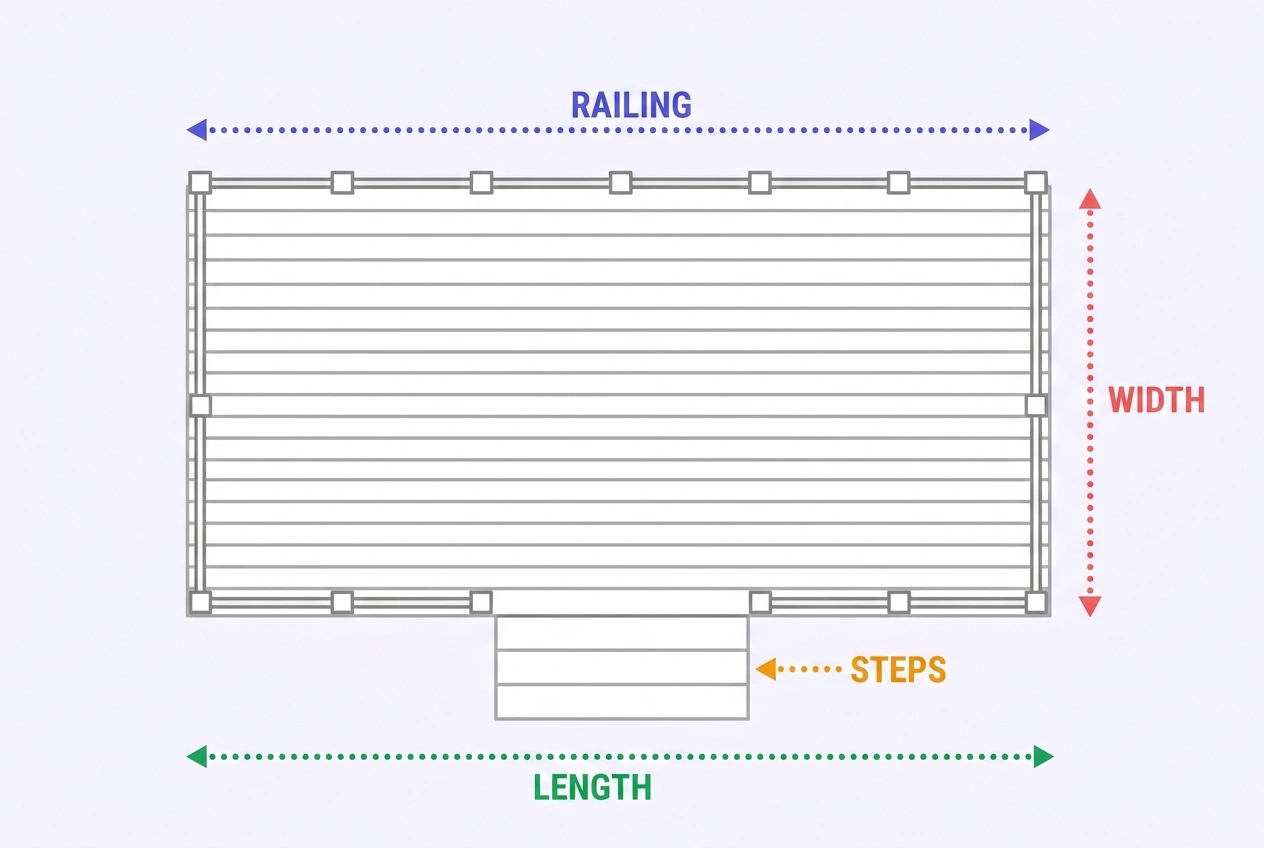 16 feet
12 feet
40 feet
3 steps
Results
Surface Breakdown
Stain Quantity
Calculation Assumptions
What You Get
- ✓Free — no sign-up, nothing to install
- ✓Live results as you type
- ✓Floor + railing + steps surface takeoff
- ✓Detailed railing: posts, rails & balusters on four sides
- ✓Wood-condition coverage rates (150–250 ft²/gal)
- ✓Stain-type factors, transparent through solid
- ✓Smart coat rules — new wood 1 coat, solid always 2
- ✓Second-coat bonus — not just double the stain
- ✓Custom coverage override from the can
- ✓Gallons + liters, quarts/pail buy hint
- ✓Price per gallon cost with currency selector
- ✓Export a PDF takeoff in one click
- ✓Shareable link that saves your inputs
- ✓Works on phone, tablet & desktop
ON THIS PAGE:
How the Stain Math Works
Every gallon of stain buys a fixed amount of coverage, and the whole estimate comes down to one division — but the number you divide by matters more than the area itself. The calculator builds your total stainable area from three parts (floor, railing, steps), then divides it by a coverage rate matched to your wood condition and stain type, coat by coat:
stain = area × (1/cov₁ + 1/cov₂ + … + 1/covₙ) × (1 + waste%)
The coverage rate for every coat after the first is boosted by 25%, because a penetrating stain's second coat soaks into already-saturated wood and spreads farther. That single adjustment is the difference between most calculators — which just multiply by the coat count — and reality: two coats on a 432 ft² deck take about 3.9 gallons, not 4.3.
When you enter a custom coverage rate from the can, the calculator treats it as the first-coat rate and still applies the second-coat bonus and your waste allowance on top. The result is rounded up to the nearest quart, and the buy hint expresses it in the cans you will actually find at the store — gallons, quarts, and a 5-gallon pail when the total passes four.
Coverage Rates by Wood & Stain
Coverage varies more for stain than for paint because wood porosity swings so widely. The two dropdowns above set the rate: your wood's condition sets the base, and the stain's opacity multiplies it:
| Wood Condition | Base Coverage | Why |
|---|---|---|
| Smooth / previously stained | 250 ft²/gal | Sealed wood resists absorption — a maintenance re-coat spreads far |
| Average weathered | 200 ft²/gal | The typical deck: dry, cleaned, some porosity |
| Rough, bare or grayed | 150 ft²/gal | Sawn faces, open grain, and UV-grayed fibers drink stain |
| New, under 1 year | 150 ft²/gal, 1 coat | Dense unweathered lumber takes one coat at most |
| Stain Type | Factor | Coats | Notes |
|---|---|---|---|
| Transparent | 1.0× | 1–2 | Shows full grain; least UV protection; re-coat yearly |
| Semi-transparent | 1.0× | 2 (wet-on-wet) | The deck standard — pigment with visible grain |
| Semi-solid | 1.15× | 2 | More hiding, some grain still visible |
| Solid (film-forming) | 1.45× | 2, always | Highest coverage per gallon (200–350 ft²); same rate every coat |
Two Wood-condition caveats the dropdowns cannot fully capture. Species shifts absorption — porous pine and cedar drink more than dense teak or ipe, all else equal. And a cedar or redwood deck receiving a solid stain or paint should be primed first with a stain-blocking primer: the species' natural extractives bleed through film-forming finishes as tannin stains, and no amount of extra topcoat fixes that.
Railing & Steps Math
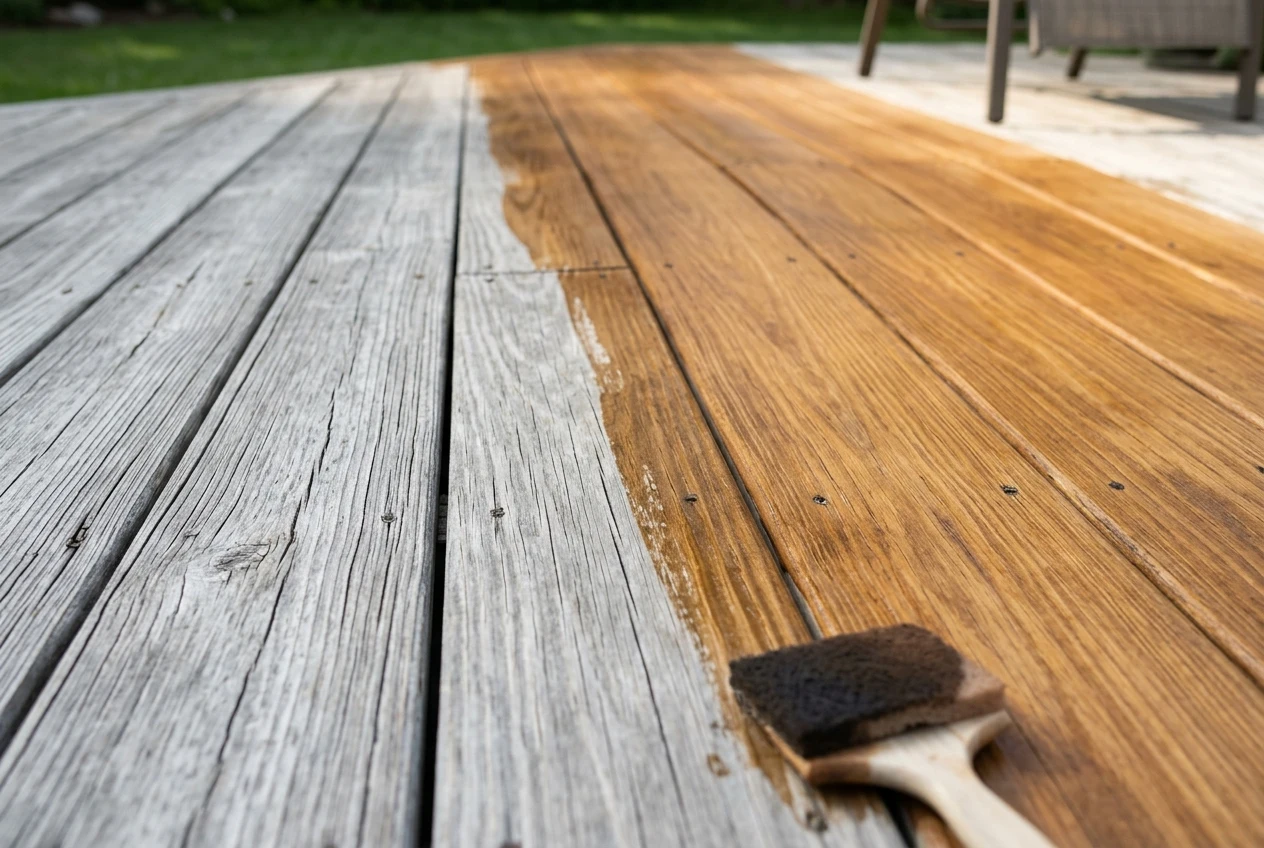
The deck floor is the easy part — railings and steps are where estimates fall short, because their vertical faces add more stainable square footage than people expect and balusters get coated on all four sides. The calculator offers two railing models:
Simple: railing area = length × height × 2 faces
Detailed: posts + rails + balusters, each face-counted
The detailed model builds the railing piece by piece. Posts (spaced 6 ft apart or less, per code rail-span limits) are counted on all four faces; the top and bottom rails on all four faces along their length; and balusters on all four faces at whatever density you run — three per foot is typical for 4×4 code spacing. A 40 ft railing at 3 ft high with 4″ posts, 2″ rails, and 1.5″ balusters at 3 per foot works out to roughly 81 ft² of posts and rails plus 160 ft² of balusters — about 241 ft² total, remarkably close to the simple model's 240 ft², which is why the simple estimate holds up for straight railings.
Steps are counted tread plus riser: each step contributes its width × (tread depth + riser height), and open risers simply contribute the tread. Stringer edges and skirt boards are small but real — if your stairs are open-sided, add their face area to the waste allowance rather than measuring each stringer.
If the deck has features neither field covers — built-in benches, planter boxes, a wraparound fascia — measure their faces once and add 10–15% to the waste allowance rather than skipping them. Running short mid-deck leaves lap marks where the stain dried, which no second coat hides.
Coat Rules & the Second-Coat Bonus
Coat count is not a free choice — it is set by the wood and the product, and the calculator enforces both rules automatically:
| Situation | Coats | Why |
|---|---|---|
| New wood under 1 year old | 1, forced | Dense unweathered lumber cannot absorb a second coat — it sits sticky on the surface |
| Solid film-forming stain | 2, forced | Opaque builds need full even film to hide grain and protect; coverage is the same both coats |
| Bare or stripped penetrating stain | 2, wet-on-wet | Second coat goes on 20–60 minutes after the first, while the first is still wet |
| Maintenance re-coat over sound finish | 1 | The existing finish limits absorption — a second coat wastes product |
| Extreme light-to-dark (or reverse) color change | Consider 3 | Pigment jump may need an extra coat to fully cover |
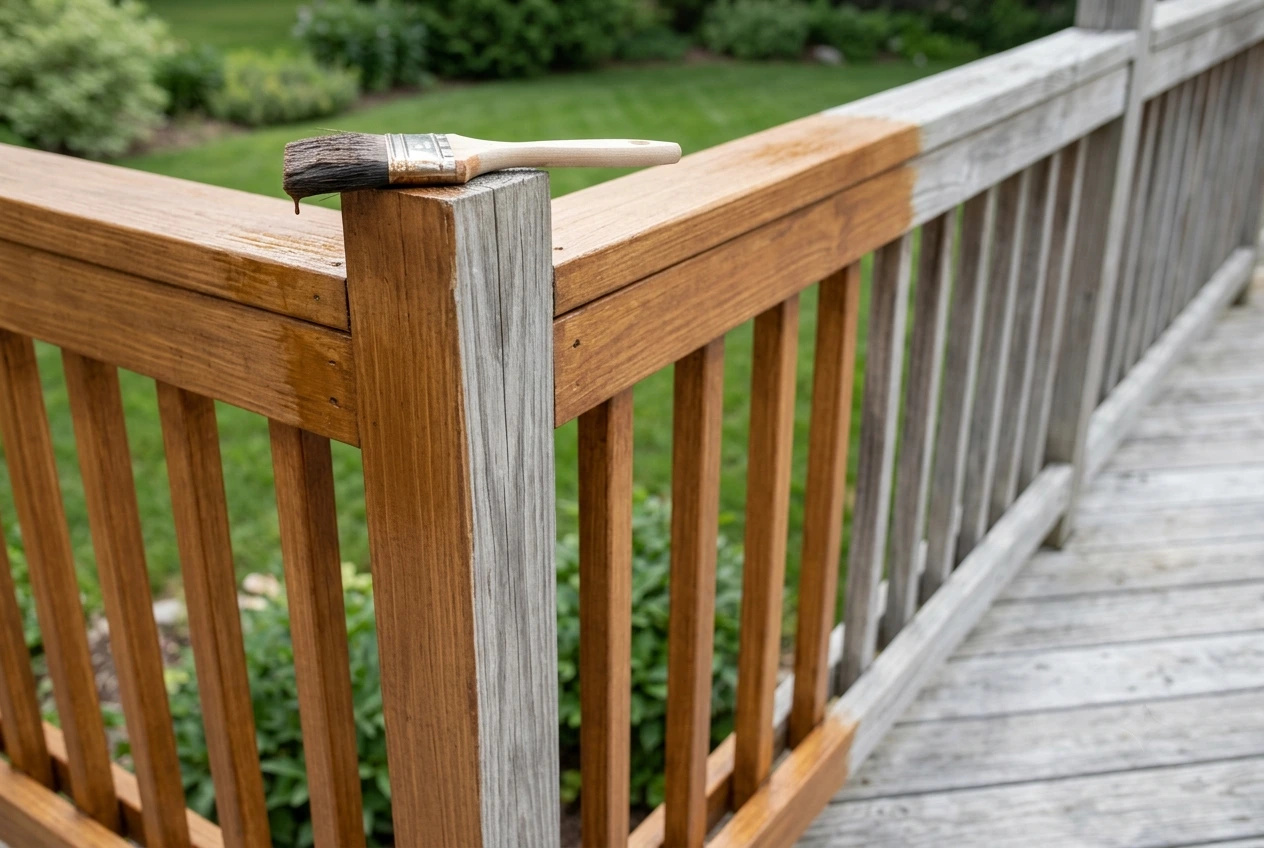
The second-coat bonus is the part almost every estimator misses. Penetrating stains soak into the first coat's saturated wood instead of the bare fibers, so the second coat spreads roughly 25% farther per gallon — manufacturers' published rates confirm it: first coat 150–200 ft², second coat 200–300 ft². Two coats therefore consume about 1.8× the single-coat quantity, not 2×. On a 500 ft² deck that is 5 gallons for two coats — exactly what the long-running stain retailers' own examples show. Solid stains are the exception: as film-formers they cover the same rate on every coat, so the calculator removes the bonus and enforces two coats when you pick one.
Worked Example
Take the calculator's defaults: a 16 × 12 ft deck (192 ft²) with a 40 ft railing at 3 ft high, no steps, average weathered wood, semi-transparent stain, two coats, 10% waste:
| Step | Calculation | Result |
|---|---|---|
| Floor area | 16 × 12 | 192 ft² |
| Railing area | 40 × 3 × 2 faces | 240 ft² |
| Total area | 192 + 240 | 432 ft² |
| First coat | 432 ÷ 200 ft²/gal | 2.16 gal |
| Second coat (bonus) | 432 ÷ (200 × 1.25) | 1.73 gal |
| Coats subtotal | 2.16 + 1.73 | 3.89 gal |
| With 10% waste | 3.89 × 1.10 | 4.28 gal (16.2 L) |
| Rounded to the quart | ceil(4.28 × 4) ÷ 4 | 4.5 gal |
| Buy hint | — | 4 × 1-gal + 2 quarts, or 1 × 5-gal pail |
| Cost at $45/gal | 4.5 × $45 | $202.50 |
The second-coat bonus saves a full quart here: two flat coats would compute 4.32 gallons before waste, but the second coat's extra spread pulls the real need to 3.89. The railing is the other headline — it adds more stainable area than the floor's width suggests, 240 ft² against the floor's 192, which is why decks run short on stain when railings are forgotten. Rerun the same deck as new wood and the calculator forces one coat: 192 + 240 = 432 ÷ 150 ft²/gal = 2.88, or 3.2 gallons with waste — less material, but a full season of weathering comes first.
Stain Cost & Cans
Stain pricing tracks opacity and quality more than brand. The table below reflects typical 2026 US retail for the material itself; the cost estimate above multiplies your rounded-up purchase by the price you enter:
| Product | Per Gallon | 5-Gal Pail | Notes |
|---|---|---|---|
| Clear sealer / toner | $22–$50 | $90–$180 | Least UV pigment; shortest re-coat cycle |
| Semi-transparent stain | $30–$60 | $120–$240 | The volume category for decks |
| Solid stain / deck paint | $35–$70 | $140–$280 | Lowest cost per ft² of coverage; primer may be needed on cedar/redwood |
| Premium restoration coatings | $60–$120 | $250–$450 | Thick-build products for failed decks |
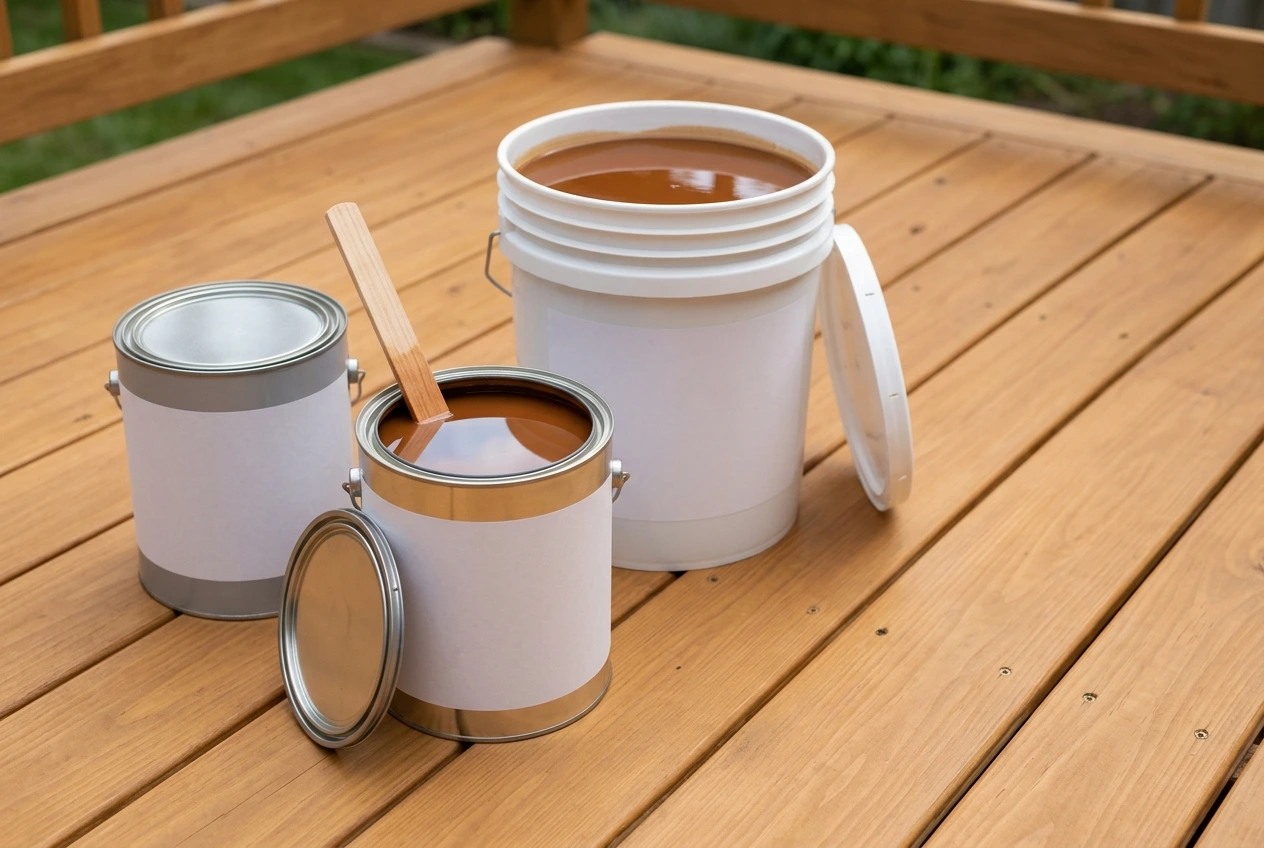
Three buying rules that save money and headaches. Buy the whole project from one batch — stain is tinted per run, and a second batch rarely matches perfectly across a deck. Step up to a 5-gallon pail once the estimate passes about 4 gallons: the per-gallon price drops and you keep one batch. And keep the leftovers — resealed penetrating stain lasts about a year opened, and a maintenance re-coat in two years needs far less than the original job.
If hiring out instead, installed deck staining runs $2–$6 per square foot of deck surface depending on prep — a light re-coat over a clean deck sits at the bottom of that range, a full strip-and-brightener job with two coats at the top. A 200 ft² deck lands around $500–$1,200 turnkey.
Frequently Asked Questions
A 12 × 16 deck is 192 square feet of floor. On average weathered wood at 200 ft² per gallon, one coat needs 1 gallon and two coats about 2 gallons before waste. Add a typical 40-foot railing (240 ft²) and two coats with 10% waste land near 4.5 gallons — four gallons plus two quarts.
Most deck stains cover 150 to 300 ft² per gallon per coat. Smooth, previously stained wood reaches 250–300; average weathered wood runs about 200; rough, bare, or heavily grayed wood drops to 150. Solid film-forming stains cover the most per gallon, 200–350, because the wood absorbs them less. The number printed on the can always wins.
No. The first coat fills the wood pores, so the second soaks in less and covers roughly 25% farther per gallon. Two coats of a penetrating stain work out to about 1.8× the single-coat amount. Solid film-forming stains are the exception — each coat covers at the same rate, so two coats really are double.
Estimate railing as length × height × 2 faces — a 40-foot run at 3 feet adds about 240 ft². Balusters are coated on all four sides: a standard 3-foot baluster 1.5 inches wide adds about 1.5 ft² each, at roughly three per foot. Railings commonly add more area than the deck's width suggests, which is why unstained railings are the top reason decks run short.
Yes, twice over. New smooth lumber is dense and absorbs less, and most penetrating-stain makers say to weather it 4–12 months first anyway. When stained, new wood takes one coat only — a second cannot soak in and sits sticky on the surface. On a mixed deck, only the older weathered boards get the second coat.
Round up to the nearest quart for small remainders, and step up to a 5-gallon pail once the total passes about 4 gallons — cheaper per gallon and one batch color. Stain is tinted per run, so buying everything at once avoids a visible color break mid-deck. Resealed penetrating stain keeps about a year for the next maintenance coat.
Material runs $20–$80 per gallon depending on opacity and quality — semi-transparent typically $30–$60, solid $35–$70. Installed, deck staining runs $2–$6 per square foot of surface, so a 200 ft² deck lands around $500–$1,200 turnkey. Prep intensity moves the price most: a strip-and-brightener job with two coats sits at the top of the range.
Not for penetrating stains. But for a solid stain or paint on cedar or redwood, prime first with a stain-blocking primer — those species carry extractives that bleed tannin discoloration through film-forming finishes, and the bleed shows up weeks after the job looks perfect.
References
- Restore-A-Deck (The Sealer Store), “Deck Stain Calculator & Coverage Guide” — semi-transparent 150–250 ft²/gal, solid 200–350 ft²/gal, second-coat spread, and 10–15% overage rule, restore-a-deck.com
- TWP Stain, “Deck Stain Calculator” — first/second coat coverage rates and new-wood single-coat rule, twpstain.com
- DeckStainHelp, “Deck Stain Coverage & Cost Guide” — 150–300 ft²/gal range and material pricing by opacity, deckstainhelp.com
- HomeGuide, “Cost to Stain a Deck (2026)” — $20–$50 per gallon and 5-gal pail pricing, homeguide.com
Disclaimer: The deck stain calculator results on this page are estimates for planning purposes only. Actual coverage varies with wood species, porosity, prep quality, application method, and product-specific labels. This tool does not verify finish compatibility or local code compliance — confirm coverage and application against your stain product's label and guidance before ordering.
Rebuilding boards before you stain? Size the decking first with the decking calculator, or get quotes from local painters near you.
Get Free Estimates