
Lumber Calculator
Turn any board size and quantity into board feet, whole pieces to order, linear feet and cost — nominal sizes built in, waste allowance and three price bases handled.
Enter Board Details
 8 feet
4 inch
2 inch
Board Feet: 5.33 BF
Results
Lumber Needed
Waste & Rounding
Cost Estimate
Assumptions
Quick Reference
Yard Notes
What You Get
- ✓Free — no sign-up, nothing to install
- ✓Live results as you type
- ✓Nominal presets 1×4 through 2×12, 4×4, 6×6, 5/4×6
- ✓Custom dimensions for rough-sawn and hardwood
- ✓Board feet per piece and total, nominal basis
- ✓Whole pieces to order — you cannot buy a partial board
- ✓Effective overage after whole-board rounding
- ✓Linear feet and cubic volume equivalents
- ✓Price per board foot, per piece or per linear foot
- ✓Cost in 10 currencies
- ✓Export a PDF order sheet in one click
- ✓Shareable link that saves your inputs
ON THIS PAGE:
How the Lumber Math Works
Every lumber estimate on this page is a four-step chain. First the board becomes a volume: board feet are thickness in inches times width in inches times length in feet, divided by 12. Second the quantity multiplies that per-piece figure into the net total. Third a waste allowance covers the cuts, defects and miscuts that every real project produces. Fourth the waste-adjusted footage is rounded up to whole boards, because no lumber yard sells a tenth of a board. The whole chain:
BF per piece = T × W × L ÷ 12
net BF = BF per piece × quantity
order BF = net BF × (1 + waste%)
pieces to order = ceil( order BF ÷ BF per piece )
The waste allowance exists because lumber is cut, not poured. A straight wall or a square deck loses around five to ten percent to trim cuts and the occasional warped board; diagonal layouts, openings for doors and windows, and the habit of culling knotty pieces at the yard push the honest number to fifteen or twenty percent. On framing lumber the loss is cheap insurance — a second trip to the yard for two studs costs more than the studs.
The rounding step is where estimates go quietly wrong, and it is why the results card shows the effective overage next to the piece count. Ten percent on a hundred boards is a smooth 110 — but ten percent on three boards is 3.3 boards, which becomes 4 whole pieces at the counter, and the real overage is 33%. Small orders round harder than big ones, and knowing that before you buy is the difference between a fair quote and a surprise.
Nominal vs Actual Lumber Sizes
The name on the ticket is not the size of the board. A "2×4" is rough-sawn at a true 2 by 4 inches, then dried and planed smooth — and by the time it reaches the rack it measures 1½ by 3½ inches. The lumber trade prices and tallies softwood on the nominal name under the American Softwood Lumber Standard, which is why a yard's board-foot tally on a 2×4 uses the full 2 and 4. The calculator follows that convention: the preset fills nominal dimensions, and board footage matches what the yard will charge. The table below is the map between the two:
| Nominal Size | Actual Thickness | Actual Width | Board Feet (8 ft) | Common Use |
|---|---|---|---|---|
| 1×4 | 3/4 in | 3½ in | 2.67 BF | Trim, furring, small projects |
| 1×6 | 3/4 in | 5½ in | 4.00 BF | Fence boards, shelving, siding |
| 1×8 | 3/4 in | 7¼ in | 5.33 BF | Ceiling and wall covering |
| 1×12 | 3/4 in | 11¼ in | 8.00 BF | Wide shelving, risers |
| 2×4 | 1½ in | 3½ in | 5.33 BF | Studs, general framing |
| 2×6 | 1½ in | 5½ in | 8.00 BF | Exterior walls, floor joists |
| 2×8 | 1½ in | 7¼ in | 10.67 BF | Floor joists, headers |
| 2×10 | 1½ in | 9¼ in | 13.33 BF | Long-span joists, ridge boards |
| 2×12 | 1½ in | 11¼ in | 16.00 BF | Stair stringers, beams |
| 5/4×6 | 1 in | 5½ in | 6.67 BF | Deck boards |
| 4×4 | 3½ in | 3½ in | 10.67 BF | Posts, fence corners |
| 6×6 | 5½ in | 5½ in | 24.00 BF | Heavy posts, retaining walls |
One exception matters: hardwood and rough-sawn lumber have no dressed standard to hide behind. When you buy walnut or oak at a specialty dealer, the tally still uses the nominal quarter thickness (see the FAQ on 4/4 and 8/4), but a genuinely irregular reclaimed or planed-down board should be entered measured — type the real thickness and width into the custom fields and the volume is correct for the physical wood. Metric readers: a dressed 2×4 is 38 × 89 mm, a 2×6 is 38 × 140 mm, and the thickness and width inputs accept millimeters directly.
Board Feet, Linear Feet & Pieces
Lumber is quoted in three different units depending on who is selling it, and they answer different questions. Board feet measure volume — 144 cubic inches, a board 12 inches wide, 12 inches long and 1 inch thick — and that is how hardwood dealers, sawmills and freight invoices count wood. Linear feet measure length only, which is how siding, fencing and decking boards are usually priced. Pieces are what you actually carry to the register at a big-box store, where a 2×4 stud has a sticker price and nothing else. The calculator reports all three because an order needs all three: board feet to check the tally, linear feet to compare per-foot quotes, pieces to place the order.
For quick mental math at the yard, the board feet in one linear foot of common sizes:
| Nominal Size | BF per Linear Foot | BF in an 8 ft Board | BF in a 12 ft Board |
|---|---|---|---|
| 1×4 | 0.33 | 2.67 | 4.00 |
| 1×6 | 0.50 | 4.00 | 6.00 |
| 1×8 | 0.67 | 5.33 | 8.00 |
| 1×12 | 1.00 | 8.00 | 12.00 |
| 2×4 | 0.67 | 5.33 | 8.00 |
| 2×6 | 1.00 | 8.00 | 12.00 |
| 2×8 | 1.33 | 10.67 | 16.00 |
| 2×10 | 1.67 | 13.33 | 20.00 |
| 2×12 | 2.00 | 16.00 | 24.00 |
| 4×4 | 1.33 | 10.67 | 16.00 |
| 6×6 | 3.00 | 24.00 | 36.00 |
The same board can carry three different prices for exactly the same wood — a 2×6×8 is 8 board feet, 8 linear feet and 1 piece, and a seller charging by any of the three is describing one board. Converting between bases is the only fair way to compare quotes, and it is the arithmetic the results card does for you: price per linear foot divided by (BF per linear foot) gives price per board foot, and per-piece divided by the board's BF gives the same.
Lumber Prices & Buying Guide
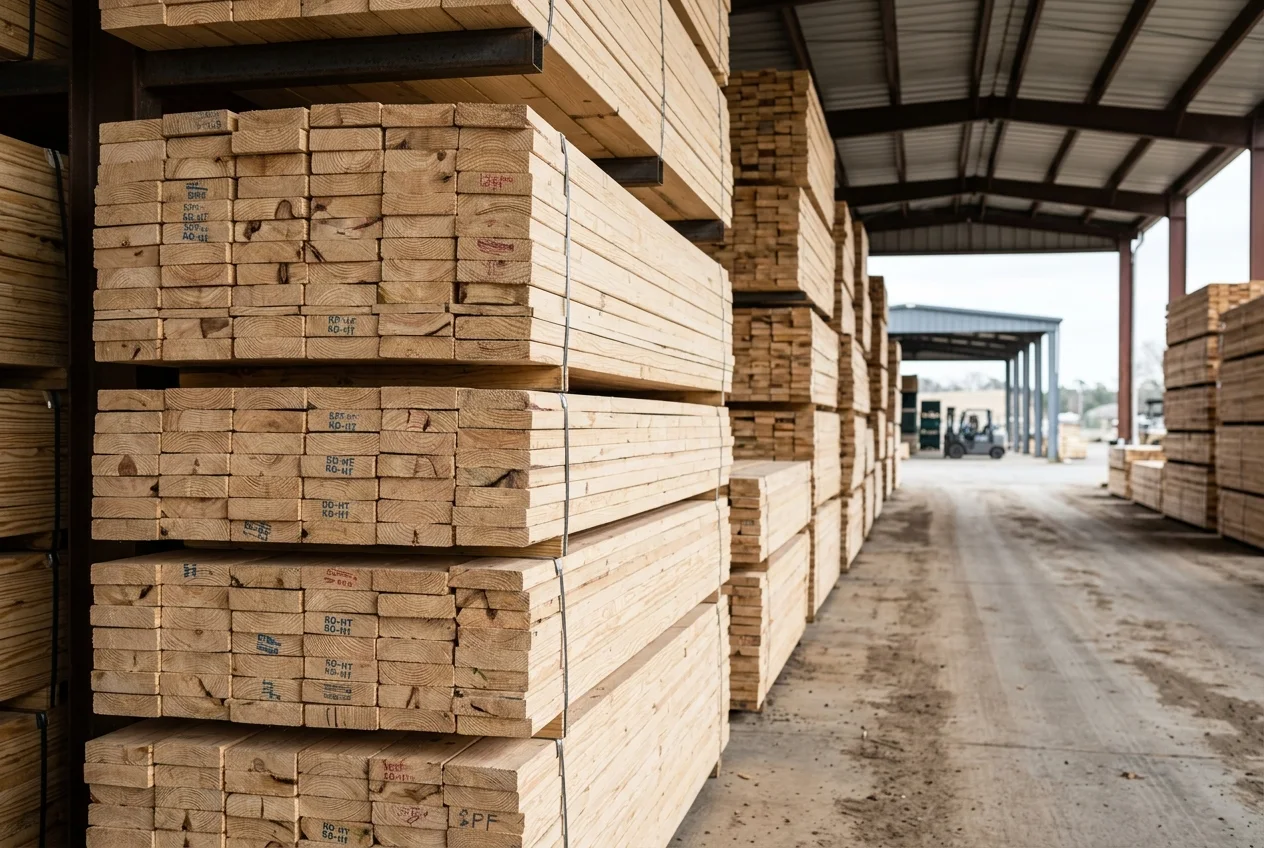
Lumber pricing moves with futures markets, so the only trustworthy number is your supplier's quote — but the ranges below frame what "normal" looks like when a quote lands. Framing lumber is sold per piece at big-box stores; hardwood and rough stock per board foot; siding and fencing per linear foot:
| Material | Sold By | Typical Price | Notes |
|---|---|---|---|
| 2×4 stud (SPF) | piece | $4–$7 | Pre-cut 92⅝ in studs at big-box stores |
| 2×6 stud | piece | $8–$14 | Deeper wall cavities for insulation |
| Pine / spruce (common) | board foot | $2–$5 | Softwood lumber, rough or S4S |
| Oak / maple | board foot | $4–$10 | Hardwood, priced by 4/4 thickness basis |
| Walnut / cherry | board foot | $8–$15+ | Premium hardwood, width upgrades extra |
| Cedar fencing / decking | linear foot | $2–$8 | By board profile and grade |
| Pressure-treated | piece or LF | $3–$15 | Ground-contact ratings cost more |
Three buying habits save money. First, buy standard lengths: 8, 10, 12, 14 and 16 foot stock is priced per the length ladder, and an off-length cut from a longer board can cost less than the short board itself — check both before ordering. Second, ask which dimension basis the tally uses when a yard quotes board footage; on standard softwood it should be nominal, and a quote on dressed sizes will look 30% cheaper for the same wood. Third, count the waste into the budget, not around it: the calculator's pieces-to-order line is what the register will ring, not the net footage.

Worked Example: Ten 2×4×8 Studs
Here is the page's own default order run end to end — these are the numbers you see on load:
- Board: 2×4 at 8 ft → BF per piece = 2 × 4 × 8 ÷ 12 = 5.33 BF.
- Quantity: 10 studs → net total 10 × 5.33 = 53.33 BF, which is 4.44 ft³ of wood.
- Waste allowance: 10% for trim cuts and culls → 53.33 × 1.10 = 58.67 BF to order.
- Pieces: 58.67 ÷ 5.33 = 11.0 exactly → 11 whole boards, 88 linear feet, 58.67 BF ordered.
- Effective overage: 10% requested, 10% actual — a clean case. The same order at 3 boards would round to 4 and show 33%.
- Cost per piece: at $5.20 per stud → 11 × $5.20 = $57.20.
- Cost per board foot: the same lumber at $0.98/BF → 58.67 × $0.98 ≈ $57.50 — the two price bases agree within rounding, as they should.
Change the length to 12 ft and the board becomes 8.0 BF; ten studs then need 88 BF with waste, which is exactly 11 boards again — the piece count survives because both the board and the order grew by the same factor. That is the quiet advantage of working in board feet: the waste-adjusted volume scales cleanly even when the stock length changes under you.
Common Lumber Estimating Mistakes
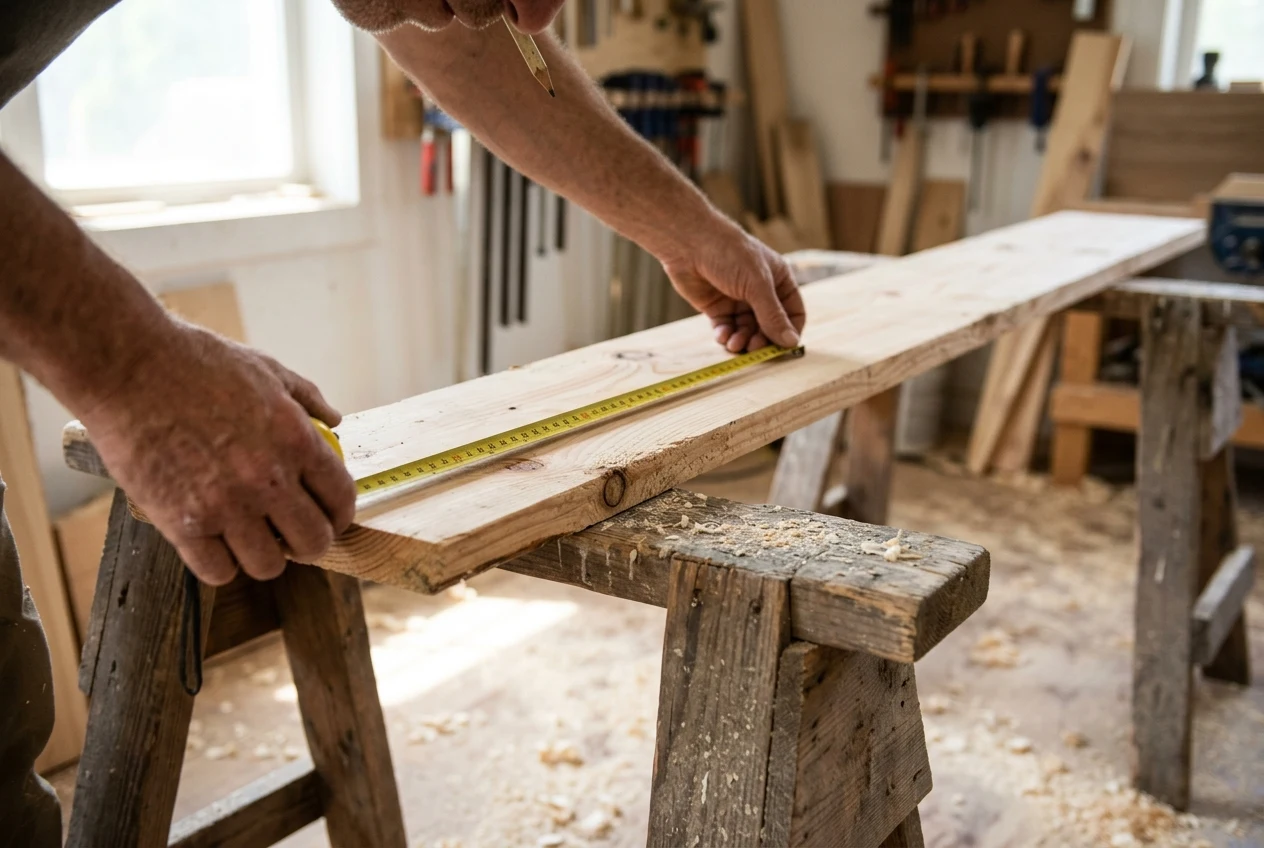
- Tallying on dressed dimensions. Computing a 2×4 as 1.5 × 3.5 produces 70% of the yard's board-foot number — your "short" quote is just the wrong basis. Board footage on standard softwood uses nominal sizes; the dressed board only matters when it has to fit a space.
- Skipping the waste allowance. Net footage is a fantasy number: every project cuts boards, and every cut turns the offcut into scrap unless another piece needs exactly that length. Five to ten percent for clean runs, up to twenty for diagonals and heavy culling.
- Forgetting boards come whole. A 3-board job with 10% waste needs 3.3 boards — and the register sells 4. The effective-overage line in the results exists so small orders cannot sneak a 33% premium past the budget.
- Comparing prices across bases. A $0.60 per-linear-foot board and a $1.20 per-board-foot board are not comparable until converted — and depending on the profile, either one can be the better deal. Convert everything to board feet before choosing a supplier.
- Buying random lengths for cut lists. Twelve feet of board cutting into three 45-inch shelf pieces wastes 21 inches per board; a 10-foot board cuts the same list with 15 inches left over. Sketch the cut list against stock lengths before ordering — the calculator prices any stock length you enter.
- Ignoring moisture. Pressure-treated lumber is sold wet and shrinks across the grain as it dries; green rough lumber moves even more. For coverage layouts (decking, siding) that shrinkage is the gap you leave between boards — the decking calculator's 1/8-inch default exists for exactly this reason.
Frequently Asked Questions
References
- NIST Voluntary Product Standard PS 20-25, American Softwood Lumber Standard — nominal dimensions and board-measure tally, nist.gov
- USDA Forest Products Laboratory, Wood Handbook — Wood as an Engineering Material, fpl.fs.usda.gov
- National Hardwood Lumber Association — Rules for the Measurement and Inspection of Hardwood & Cypress (board-foot tally rules), nhla.com
- American Wood Council — Structural Lumber Properties: dressed dimensions of standard nominal sizes, awc.org
Disclaimer: The lumber calculator results on this page are planning estimates. Board-foot tally conventions, dressed dimensions, grades and prices vary by supplier, species and market conditions — confirm the tally basis and current pricing with your lumber supplier before ordering, and check structural requirements with your local building department.
Lumber list priced and counted? Get quotes from local framing and carpentry pros near you.
Get Free Estimates