
ON THIS PAGE:
Board Footage at a Glance
A board foot is a volume of wood: 1 inch thick, 12 inches wide, 1 foot long — exactly 144 cubic inches, or one twelfth of a cubic foot. The working formula multiplies the three dimensions and divides by twelve: board feet = thickness (inches) × width (inches) × length (feet) ÷ 12. That single line answers most questions in the trade, but three details separate a number that matches the invoice from one that does not. First is the basis: lumberyards tally dimensional softwood on the nominal call size (a 2×4 counts as 2 × 4), while hardwood is tallied on nominal thickness with the width measured as sawn — using dressed, actual sizes on a yard's nominal takeoff overstates nothing and understates everything about what you will be charged. Second is the quarter system: hardwood thickness is quoted as 4/4, 5/4, 8/4 — 1 inch, 1.25 inches, 2 inches — and stock thinner than 1 inch still counts as 1 inch. Third is waste: plan on 10 percent for straight framing cuts, 15 to 20 percent for grain-matched furniture work, then round up to whole boards, because nobody sells you half a board. Wholesale pricing rides on MBF — one thousand board feet — at $850/MBF equals $0.85 per board foot, and one cubic foot holds exactly 12 board feet.
What a Board Foot Is — and Why Lumber Is Sold That Way
A board foot is a unit of volume, not of area or length. One board foot is the wood in a board 1 inch thick, 12 inches wide, and 12 inches long: 144 cubic inches, one twelfth of a cubic foot, about 0.00236 of a cubic meter. The trade writes it as BF or bd ft; older price lists call it FBM, foot board measure. Volume is the only honest way to price wood because boards are not uniform — in a random-width hardwood stack, one 8-inch-wide board carries twice the wood of a 4-inch board of the same length and thickness, and counting boards or measuring linear feet would price them the same. Board footage fixes that: it folds thickness, width, and length into one number so two pieces with the same face area but different thicknesses compare correctly.
Who Sells by the Board Foot
Hardwood dealers, sawmills, and specialty suppliers price oak, maple, walnut, cherry, and any random-width stock by the board foot — that is hardwood board feet in practice: you walk the stack, hand-pick boards, and the yard tallies each one into a running BF total that becomes the invoice. Dimensional softwood at home centers is usually quoted per piece or per linear foot, but those prices are derived from an underlying per-board-foot rate, so the same formula still governs the math behind the sticker. Wholesale and mill transactions quote per thousand board feet (MBF). Sheet goods such as plywood and OSB are the outlier: they are sold by the sheet and priced per thousand square feet — a unit the trade calls per mille — because their thickness is fixed and area is what varies.

The Unit and Its Names
The abbreviations you will meet on invoices and price lists all mean the same volume: BF and bd ft for one board foot, FBM for foot board measure, MBF for one thousand board feet, and MMBF for a million — the trade writes M for thousand, so 6 MBF is 6,000 board feet and a big mill shipment might be quoted in MMBF. Internationally the same wood is measured in cubic meters; the conversion factor is roughly 423.8 board feet per cubic meter, which matters when a supplier's quote arrives in metric and your takeoff is in BF.
The Board Foot Formula: How to Calculate Board Feet
Every board feet calculation on the internet reduces to one equation with two unit conventions. Pick the version that matches the units you measured in, keep the units straight through the division, and the answer is exact — board footage has no estimation built into it.
The Three Forms of the Formula
1. Length in feet (the practical form):
Board feet = thickness (in) × width (in) × length (ft) ÷ 12
Thickness and width stay in inches, length is in feet, and the division by 12 converts the inch-based product into feet-based volume. This is the form lumberyards, price lists, and calculators use by default.
2. Everything in inches:
Board feet = thickness (in) × width (in) × length (in) ÷ 144
When all three dimensions come off the same tape in inches, divide by 144 — the number of cubic inches in one board foot. This is the definition made arithmetic: raw volume in cubic inches, normalized to 144 cubic inches per unit.
3. Face area form:
Board feet = thickness (in) × face area (sq ft)
Convert the board's face to square feet first, then multiply by thickness in inches. A board that covers 6 square feet at 1 inch thick holds 6 board feet; the same face at 2 inches thick holds 12. This is the form that makes the definition visible — one board foot literally is one square foot of surface, one inch deep.
Quantity, and the Unit Trap
For identical boards, multiply the single-board result by the quantity: a 4/4 board 8 inches wide and 8 feet long is (1 × 8 × 8) ÷ 12 = 5.33 board feet, and five of them total 26.67. The classic arithmetic error is mixing conventions — feeding a length measured in inches into the ÷ 12 form without converting produces a figure twelve times too large, because the product is already in cubic inches and needs ÷ 144, not ÷ 12. Keep a unit discipline: thickness and width in inches, length in feet, divide by 12. If any dimension slips into the wrong unit, the answer is wrong by exactly the factor of the slip — 12, or 144, not "close enough."
Worked by Hand: Three Quick Checks
A 1×6, 8 feet long: (1 × 6 × 8) ÷ 12 = 4.00 board feet. A 2×6, 12 feet long: (2 × 6 × 12) ÷ 12 = 12.00 board feet. A 4/4 board 10 inches wide, 9 feet long: (1 × 10 × 9) ÷ 12 = 7.50 board feet. Note the last one — the honest arithmetic gives 7.50, but a dealer's tally may round differently under the surface-measure rules covered further down. The formula gives the measured volume; the yard's conventions decide the billed number.
Nominal vs Actual Lumber Dimensions
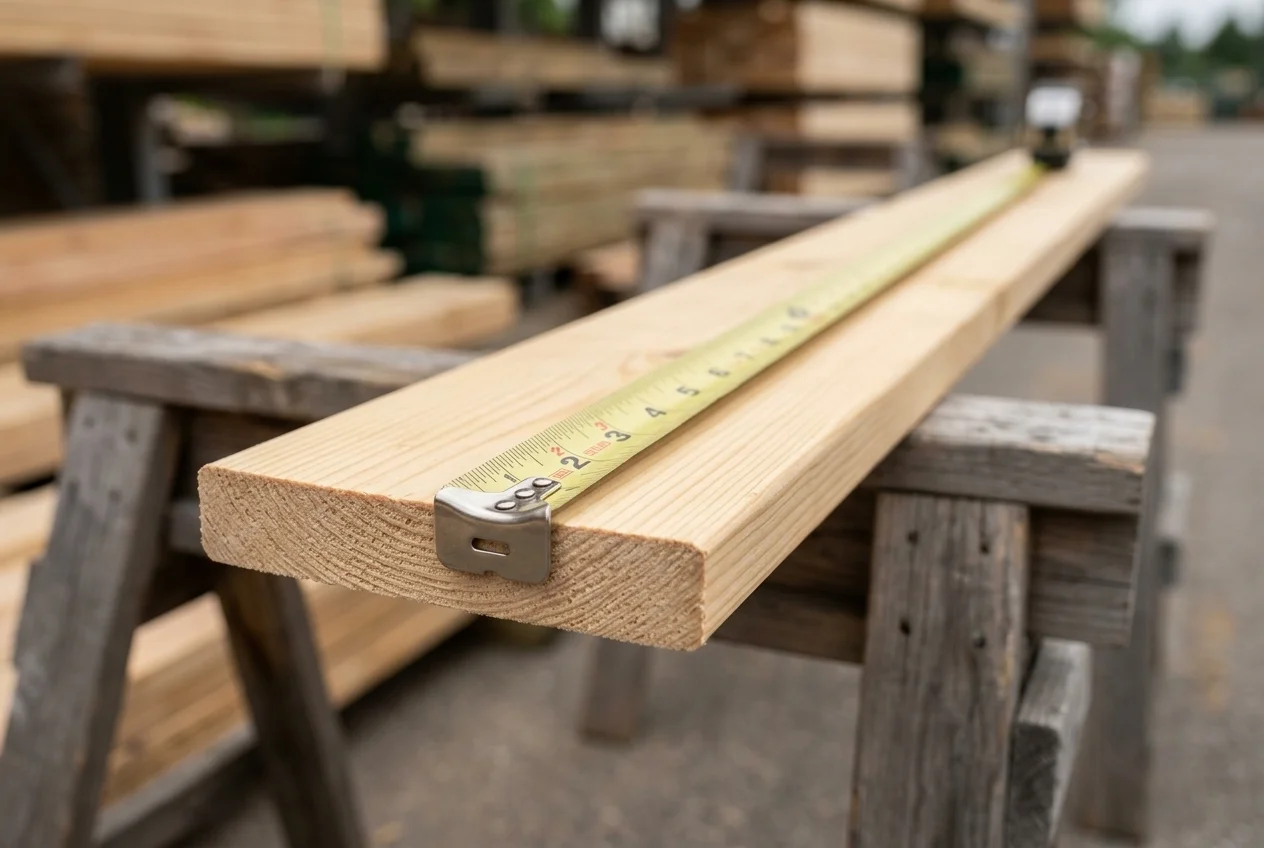
A 2×4 is not 2 inches by 4 inches. The name is a nominal dimension — the size the board carried when it left the saw green, before kiln drying and planing removed material from every face. What you can measure with a tape after that processing is the actual dimension: 1.5 × 3.5 inches for a 2×4, 1.5 × 5.5 for a 2×6, 0.75 × 5.5 for a 1×6. The pattern is systematic: nominal 1-inch stock dresses to ¾ inch, nominal 2-inch stock to 1½ inches, nominal 4-inch to 3½ inches; widths through 6 inches lose about ½ inch total, while 8-inch-and-wider boards lose about ¾ inch because larger cross-sections shrink more in drying. Length is the exception — the labeled length is what you get, so a 10-foot 2×4 measures a full 10 feet. National softwood standards set these dressed minimums, which is why the actual sizes are consistent yard to yard.
| Nominal Size | Actual (Dried, Surfaced) | BF at 8 ft — Nominal | BF at 8 ft — Actual |
|---|---|---|---|
| 1×4 | ¾″ × 3½″ | 2.67 | 1.75 |
| 1×6 | ¾″ × 5½″ | 4.00 | 2.75 |
| 1×8 | ¾″ × 7¼″ | 5.33 | 3.63 |
| 1×10 | ¾″ × 9¼″ | 6.67 | 4.63 |
| 1×12 | ¾″ × 11¼″ | 8.00 | 5.63 |
| 2×4 | 1½″ × 3½″ | 5.33 | 3.50 |
| 2×6 | 1½″ × 5½″ | 8.00 | 5.50 |
| 2×8 | 1½″ × 7¼″ | 10.67 | 7.25 |
| 2×10 | 1½″ × 9¼″ | 13.33 | 9.25 |
| 2×12 | 1½″ × 11¼″ | 16.00 | 11.25 |
| 4×4 | 3½″ × 3½″ | 10.67 | 8.17 |
| 4×6 | 3½″ × 5½″ | 16.00 | 12.83 |
| 6×6 | 5½″ × 5½″ | 24.00 | 20.17 |
The 52 Percent Question
The pivot example every lumber conversation runs on: an 8-foot 2×4 counts 5.33 board feet on nominal dimensions and 3.50 board feet on actual dimensions. Stated precisely: the nominal figure is about 52 percent higher than the actual one, and the actual figure is about 34 percent below the nominal one — the same gap measured from two directions. Which number is correct depends entirely on the transaction. For pricing framing lumber, use nominal: that is how the yard tallies it, and a takeoff built on 1.5 × 3.5 will come in a third short of the invoice. For true material volume — engineering checks, weight estimates, spec-sheet comparisons — use actual. For hardwood, use nominal thickness with the width measured as the board really is, which is a hybrid basis that catches first-timers out on both sides.
Which Basis Should You Use?
One rule settles it: use the basis your supplier bills on, and confirm which one that is. Dimensional softwood at retail is nominal. Hardwood is nominal thickness, measured width, measured length truncated to the whole foot. Custom or rough-sawn orders sometimes bill true measured volume — rare, but it happens, and the invoice will say which. The cost of guessing is symmetric: nominal arithmetic on an actual-basis invoice overstates by half, and actual arithmetic on a nominal-basis invoice understates by a third. When the takeoff feeds an engineering calculation or a structural check instead of a purchase, the actual dressed sizes are the ones codes and span tables reference — but that is a different question from the one the lumberyard is asking.
Hardwood Thickness in Quarters: 4/4 Through 16/4
Hardwood is not sold in nominal 1x and 2x names; its thickness is quoted in quarter-inch increments, spoken as "four-quarter," "eight-quarter," written 4/4 and 8/4. The figure is the rough-sawn nominal thickness — the minimum the board carried when green or air-dried — and it is the number every board feet calculation on hardwood uses, even after the board has been surfaced smooth.
| Thickness Designation | Nominal Inches | Surfaced (Approx.) | Commonly Cut Into |
|---|---|---|---|
| 4/4 (four-quarter) | 1″ | 13/16″ | Boards, paneling, drawer sides, general furniture parts |
| 5/4 (five-quarter) | 1.25″ | 1″ – 1 1/16″ | Decking, stair treads, tongue-and-groove flooring |
| 6/4 (six-quarter) | 1.5″ | 1 1/4″ – 1 5/16″ | Heavy treads, seat stock, thick panels |
| 8/4 (eight-quarter) | 2″ | 1 11/16″ – 1 3/4″ | Table legs, chair parts, thick slabs |
| 10/4 (ten-quarter) | 2.5″ | 2 1/8″ – 2 3/16″ | Turned stock, heavy legs, butcher block |
| 12/4 (twelve-quarter) | 3″ | 2 5/8″ – 2 3/4″ | Large turned legs, newel posts, thick timbers |
| 16/4 (sixteen-quarter) | 4″ | 3 5/8″ – 3 3/4″ | Big posts, beams, specialty millwork |
Two conventions complete the system. First, stock thinner than 1 inch counts as 1 inch for board footage: a ¾-inch surfaced board is tallied at its 4/4 nominal thickness, which is why a "1-inch" board you measure at 13/16 inch still bills as one inch. (Woodworkers who sell finished thin stock sometimes express sub-inch material in square feet instead — thickness is fixed, so area carries the pricing — but the yard tally stays on the quarter system.) Second, surfacing never changes the tally: an S2S or S4S 4/4 board planes to about 13/16 inch, yet it remains 4/4, one board foot per square foot of face, on the invoice. The nominal thickness is the contract; the measured thickness is a property.
Board Feet per Board: Size Charts and Quick Multipliers
Because most boards you meet are standard sizes, the board feet per board for any length is a lookup, not a calculation. Two tables cover the field: board feet carried per linear foot of each nominal size, and board feet per board across the common stock lengths. Both use nominal dimensions — the yard's basis.
Board Feet per Linear Foot (Nominal Sizes)
The per-foot figure is simply thickness × width ÷ 12 — the coefficient that converts linear feet to board feet for that size. Memorize the rows you buy often and you can price a stick without paper.
| Nominal Size | BF per Linear Foot | Typical Use |
|---|---|---|
| 1×4 | 0.33 | Trim, furring, fascia |
| 1×6 | 0.50 | Siding, shelf stock, tongue and groove |
| 1×8 | 0.67 | Shelving, casework, wide trim |
| 1×10 | 0.83 | Stair risers, wide trim |
| 1×12 | 1.00 | Casework, finish lumber, ceiling boards |
| 2×4 | 0.67 | Wall framing, studs |
| 2×6 | 1.00 | Exterior walls, rafters, deck boards |
| 2×8 | 1.33 | Floor joists, roof headers |
| 2×10 | 1.67 | Joists, stair stringers, beams |
| 2×12 | 2.00 | Heavy joists, beams, deck framing |
| 4×4 | 1.33 | Deck posts, fence posts |
| 4×6 | 2.00 | Beams, post-and-beam framing |
| 6×6 | 3.00 | Heavy timbers, landscape beams |
Memory anchors: a 2×6 carries exactly 1 board foot per foot, so any length of 2×6 equals its own length in board feet. Same for 1×12. A 4×6 carries 2 per foot, a 4×12 would carry 4, and a 2×4 carries two thirds of a foot per foot — 8 feet of 2×4 is 5.33.
Board Feet per Board by Length (Nominal Sizes)
| Size | 6 ft | 8 ft | 10 ft | 12 ft | 16 ft |
|---|---|---|---|---|---|
| 1×4 | 2.00 | 2.67 | 3.33 | 4.00 | 5.33 |
| 1×6 | 3.00 | 4.00 | 5.00 | 6.00 | 8.00 |
| 1×8 | 4.00 | 5.33 | 6.67 | 8.00 | 10.67 |
| 1×12 | 6.00 | 8.00 | 10.00 | 12.00 | 16.00 |
| 2×4 | 4.00 | 5.33 | 6.67 | 8.00 | 10.67 |
| 2×6 | 6.00 | 8.00 | 10.00 | 12.00 | 16.00 |
| 2×8 | 8.00 | 10.67 | 13.33 | 16.00 | 21.33 |
| 2×10 | 10.00 | 13.33 | 16.67 | 20.00 | 26.67 |
| 2×12 | 12.00 | 16.00 | 20.00 | 24.00 | 32.00 |
| 4×4 | 8.00 | 10.67 | 13.33 | 16.00 | 21.33 |
| 4×6 | 12.00 | 16.00 | 20.00 | 24.00 | 32.00 |
| 6×6 | 18.00 | 24.00 | 30.00 | 36.00 | 48.00 |
For random-width hardwood the chart does not exist — every board is its own size — so run the formula per board: 4/4 stock 6 inches wide holds 0.50 board feet per foot, 8 inches holds 0.67 per foot, 10 inches holds 0.83, 12 inches holds 1.00. Multiply by the board's actual length, and if you are tallying a stack the way a yard does, round each board by the surface-measure rules in the next section rather than keeping the raw fractions.
Lumber Pricing by Board Foot, MBF, and Money
Price per board foot is exactly what it sounds like: the cost of one board foot of wood volume. Total cost is a single multiply — total cost = total board feet × price per BF — and every pricing convention in the trade is a restatement of that line in different units. A hardwood invoice that reads 4/4 walnut, 6 inches wide, 9 feet long, 4.50 BF at $14.00/BF equals $63.00, because (1 × 6 × 9) ÷ 12 = 4.50 board feet and 4.50 × 14 = 63. Wholesale quotes arrive per thousand: $850/MBF is $0.85 per board foot — divide the thousand-rate by 1,000. Some mill quotes come per cubic meter; at roughly 423.8 board feet per cubic meter, a $/m³ rate converts by dividing by that factor. The board feet calculation itself never changes; only the label on the dollar does.
| Unit | Meaning | Conversion |
|---|---|---|
| BF (board foot) | 144 cubic inches of wood | 1 BF = 1/12 ft³ ≈ 0.00236 m³ |
| MBF | One thousand board feet | 1 MBF = 1,000 BF = 83.33 ft³ ≈ 2.36 m³ |
| MMBF | One million board feet (M = thousand) | 4 MMBF = 4,000,000 BF |
| Price per BF | Cost of one board foot | $850/MBF ÷ 1,000 = $0.85/BF |
| Cubic feet | Volume in ft³ | ft³ = BF ÷ 12 |
| Cubic meters | Metric volume | m³ = BF ÷ 423.8 (or BF × 0.00236) |
| Linear feet | Length only | LF = BF ÷ (thickness × width ÷ 12) |
What Lumber Costs per Board Foot
The ranges below are planning figures compiled from published dealer listings and construction cost surveys — directionally right for budgeting, not quotes. Framing lumber has traded in the mid-hundreds of dollars per thousand board feet in recent years, which pencils out to under a dollar per board foot for basic SPF studs, while domestic hardwoods run several dollars per board foot and figured or premium grades run higher still.
| Species / Grade | Typical Range per BF | Notes |
|---|---|---|
| SPF #2 (framing) | $0.50 – $0.90 | Studs and boards; sold per piece at retail, derived from BF rates |
| Pressure-treated | $0.90 – $1.60 | Check the use-category tag for ground contact |
| Cedar | $1.50 – $3.50 | Decking, trim, fencing |
| Douglas fir | $1.00 – $2.50 | Higher-strength framing |
| Red oak, 4/4 FAS | $3.50 – $8.00 | Most available domestic hardwood |
| White oak, 4/4 FAS | $5.00 – $13.00 | Premium over red oak |
| Hard maple, 4/4 FAS | $4.50 – $9.00 | Furniture, cutting boards, flooring |
| Cherry, 4/4 FAS | $5.00 – $14.00 | Cabinet and furniture stock |
| Black walnut, 4/4 FAS | $8.00 – $22.00 | Wide spread with figure and width |
Two adjustments move these numbers on real invoices. Thickness premium: 8/4 and 12/4 stock typically costs 20 to 50 percent more per board foot than 4/4 of the same species, because thicker logs are rarer and slower to dry. Grade: FAS (Firsts and Seconds) yields 83⅓ percent or more clear wood from boards at least 6 inches wide and 8 feet long; 1 Common yields 66⅔ percent, 2 Common 50 percent, 3 Common 33⅓ percent. Dropping from FAS to 1 Common commonly saves 20 to 30 percent per board foot when your parts are short enough to cut around the lower yield.

Reading the Price on the Invoice
Each line on a hardwood invoice carries species, thickness, width, length, board feet, price per BF, and a line total — the 4/4 walnut example above is a complete line. Softwood retail stickers show a piece price or a price per linear foot instead; that number is derived from the same board-foot math (a 2×4 at $0.50 per linear foot is $0.75 per board foot), so comparing a per-stick retail price against a per-BF yard quote requires converting one to the other with the per-linear-foot coefficients in the previous section. Watch the phrase "per foot" on any quote: in practice it means the linear foot — 10 feet of 2×4 at "$2.40 per foot" is $24; $2.40 spread over the 6.67 board feet those ten feet contain reads $16, two-thirds of the bill.
How Hardwood Dealers Tally Board Feet
The straight formula gives measured volume; hardwood dealers bill from a rounding convention called the surface measure, and knowing it explains why your arithmetic and the invoice disagree by a few tenths. Surface measure converts a board's face into square feet, rounds it to a whole number, then multiplies by nominal thickness:
SM = length (ft) × width (in) ÷ 12, rounded to the nearest whole number · Board feet = SM × thickness (in)
Work it once and the convention sticks. A 5/4 board 8 feet 3 inches long and 6½ inches wide: SM = (8 × 6.5) ÷ 12 = 4.33, which rounds to 4; 4 × 1.25 = 5 board feet. An 8/4 board 10 feet 9 inches long and 8¼ inches wide: SM = (10 × 8.25) ÷ 12 = 6.875, which rounds to 7; 7 × 2 = 14 board feet. Lengths truncate rather than round: the hardwood convention cuts the length down to the whole foot, so a board measuring 9 feet 10 inches tallies as 9 feet — the leftover 10 inches drop out before the surface measure is even computed. For a bundle of boards of the same thickness, yards accumulate the surface measure of every piece first and multiply the total once: a stack of 8/4 maple with 350 total SM is 350 × 2 = 700 board feet.
The Rounding Rules, Plainly
Hardwood (industry tally convention): length rounds down to the whole foot, width is measured as the board actually is, thickness is the nominal quarter figure, and the surface measure rounds to the nearest whole square foot — per piece or across an accumulated total — after which the board feet follow as surface measure × nominal thickness. Fractional inches of width stay in the multiplication; they disappear when the surface measure rounds.
Dimensional softwood: nominal thickness and nominal width throughout, length counted in whole feet, and the final figure carried to hundredths — an 8-foot 2×4 is 5.33, not 5 1/3. Because the inputs are nominal, the softwood figure is a trade tally, not the dressed volume of the wood in the board.
The practical consequence: if you compute a stack with exact measured dimensions and the yard computes it with truncation and rounding, your totals will differ — sometimes in your favor, usually not. For purchases, let the yard's stated basis govern and use your own number as the check; for material planning, the raw formula with a waste allowance on top is the right estimate.
Adding a Waste Allowance to a Board Foot Total
The formula tells you how much wood is in the cut list; the waste allowance tells you how much wood to ask for. Boards get ripped, defects get cut out, ends get trimmed, and grain-matched parts get selected out of boards that then hold less usable wood than the tally counted. The allowance is a percentage of the net board foot total, sized to the work:
| Work Type | Waste Allowance | Why |
|---|---|---|
| Straight framing cuts (studs, plates) | 5 – 10% | Few cuts per member; plates barely cut at all |
| Decking, trim, straight-lay flooring | 10 – 15% | End cuts and occasional rip cuts along runs |
| Hardwood furniture, grain-matched work | 15 – 20% | Defect avoidance, color and grain selection |
| Complex joinery, figured or defect-heavy stock | 20 – 30% | Offcuts cannot be reused; irregular boards |
Apply the percentage to the net board feet first, then round up — boards are indivisible, and a cut list totaling 24.8 board feet after waste is planned at 25. Rounding before the percentage, or applying waste to an already-rounded piece count, double-markups the same number. The full cross-material version of this logic — every material's percentage, the rounding sequence, and worked order examples — lives in the Construction Material Waste Factors reference; on lumber the only additional step is remembering that partial boards do not exist.
Board Feet vs Linear Feet vs Square Feet
Three units, three different questions. Board feet answer "how much wood is this?" — thickness, width, and length together, which is why it is the pricing unit. Linear feet answer "how long is it?" — a 2×4 and a 2×12 of the same length are identical in linear feet and completely different in board feet. Square feet answer "how much surface does it cover?" — the unit for flooring area, wall cladding, and sheet goods, and the unit that ignores thickness entirely.
Conversions run through the dimensions: linear feet = board feet ÷ (thickness × width ÷ 12), so 100 board feet of 1×6 equals 100 ÷ (6 ÷ 12) = 200 linear feet. Square feet = board feet ÷ thickness (in inches), so 100 board feet of 1-inch stock covers 100 square feet, while the same board feet at 2 inches thick covers only 50. That last one is the trap: an area figure with no thickness attached cannot convert to board feet at all — twelve square feet of 1-inch material is 12 board feet, and the identical twelve square feet at 2 inches thick is 24.
Where each unit appears: invoices per piece or per linear foot at retail; per-board-foot lines at hardwood yards; per-thousand quotes at wholesale; square feet everywhere a surface is being covered; and cubic feet or meters in engineering and shipping contexts. Confusing them at the quote stage is expensive in both directions — extending a per-linear-foot price with board feet instead of linear feet scales the bill by the cross-section factor (about a third short on a 2×4, doubled on a 2×12), and treating a per-board-foot rate as per-linear-foot scales it by the inverse.
Worked Examples: Five Board Feet Calculations
Five jobs covering every pattern on this page: a single hardwood board, a framing piece on both bases, a whole stack, a small cut list with waste and cost, and a dealer-style surface-measure tally. Follow the lines; the same arithmetic runs on any order you write.
Example 1 — Single Hardwood Board, Then a Small Order
A 4/4 board, 8 inches wide, 8 feet long: (1 × 8 × 8) ÷ 12 = 5.33 board feet. Three boards of the same size: (1 × 8 × 8) ÷ 12 × 3 = 16.00 board feet exactly — the rounded 5.33 × 3 would read 15.99. Priced at $6.50 per board foot: 16 × $6.50 = $104.00 before tax and delivery. This is the whole pricing chain in three lines: per-board volume, multiplied out, times the rate.
Example 2 — The Same 2×4×8 on Both Bases
Nominal: (2 × 4 × 8) ÷ 12 = 5.33 board feet. Actual: (1.5 × 3.5 × 8) ÷ 12 = 3.50 board feet. Twelve studs, yard basis: (2 × 4 × 8) ÷ 12 × 12 = 64.00 board feet exactly — the ÷ 12 and × 12 cancel. If you tallied those studs on actual dimensions you would record 42 board feet — a 34 percent shortfall against what the yard bills, and the single most common way a framing budget comes up short on paper before the first board is cut.
Example 3 — A Whole Stack by Outside Dimensions
A bundle of 8-foot boards stacked 3 feet high and 5 feet wide: convert the stack cross-section to inches — 36 inches high × 60 inches wide — then stack-height × stack-width × board length ÷ 12 = (36 × 60 × 8) ÷ 12 = 1,440 board feet. The same shortcut works on any uniform stack: measure the outside of the pile, keep the units consistent, divide by 12 when length is in feet and the cross-section is in inches. (Stickers and gaps between boards are wood's air, not wood — a measured stack counts sticker courses and gap share as volume unless you subtract them, which is why an outside-dimension estimate runs slightly high on surfaced lumber.)
Example 4 — A Cut List With Waste and Cost
A small table: top in 8/4, 10 inches wide, 6 feet long → (2 × 10 × 6) ÷ 12 = 10.00 BF. Four legs in 8/4, 4 inches square-ish face width, 3 feet long → (2 × 4 × 3) ÷ 12 = 2.00 BF each, 8.00 BF total. Two aprons in 1×4, 4 feet long → (1 × 4 × 4) ÷ 12 = 1.33 BF each, 2.67 BF total. Net cut list = 10 + 8 + 2.67 = 20.67 board feet. Furniture-grade waste at 20 percent: 20.67 × 1.20 = 24.80, round up to 25 board feet to have on the rack. At $9.00 per board foot: 25 × $9 = $225.00 of lumber. Three multiplies and one rounding turn a drawing into a number you can take to the yard.
Example 5 — The Dealer's Tally on One Board
The yard measures that 5/4 board at 8 feet 3 inches long, 6½ inches wide. Surface measure: (8 × 6.5) ÷ 12 = 4.33 → round to 4. Board feet: 4 × 1.25 = 5.00. Your raw formula on the same board: (1.25 × 6.5 × 8.25) ÷ 12 = 5.59 board feet — higher, because 8 feet 3 inches was truncated to 8 and the surface measure rounded down. Neither number is wrong; they answer slightly different questions. The dealer's 5.00 is the billed tally, and knowing the convention in advance means the invoice holds no surprises.
Common Board Foot Calculation Mistakes
Most bad tallies trace to a short, repeatable list of errors. Run it against your numbers before the purchase.
Mixing nominal and actual dimensions in one takeoff. Half the boards figured nominal, half actual, and the total is meaningless. Pick the supplier's basis for the whole order.
Using actual dimensions on a nominal-basis invoice. The 2×4×8 trap: 3.50 recorded where the yard bills 5.33. Your budget comes in a third short before any cutting starts.
The unit slip — inches where feet belong. Length in inches fed into the ÷ 12 form produces a number twelve times too large. All inches require ÷ 144; mixed units require ÷ 12. Check which form you are actually using.
Forgetting to multiply by quantity. One board's board feet is not the order's board feet. Per-piece math has to be extended by the count, every time.
Ignoring the waste allowance, or rounding before it. Net board feet first, percentage second, whole-board rounding last — in that order only. Rounding first stacks two markups on the same wood.
Reading "per foot" as per board foot. A quote at "$2.40 per foot" means the linear foot. Extending it with board feet instead scales the bill by the cross-section factor — about a third short on a 2×4, doubled on a 2×12 — never the straight feet you were quoted.
Applying log-scale numbers to lumber tallies. Board feet from a log rule estimate what a mill expects to saw from a round log; they are not interchangeable with board feet tallied off finished boards. Keep log math and lumber math in separate columns.
Rounding length up the way you wish it measured. Hardwood convention truncates: 9 feet 10 inches tallies as 9 feet. Rounding it to 10 inflates your expected invoice and gets corrected at delivery anyway.
Treating square feet as board feet. Any area figure without a thickness attached cannot convert — 100 square feet of 1-inch stock is 100 BF, of 2-inch stock 200 BF. State the thickness or state nothing.
Frequently Asked Questions
A board foot is a unit of wood volume equal to 144 cubic inches: a piece of lumber 1 inch thick, 12 inches wide, and 1 foot long. It is the standard unit the North American lumber trade uses to measure and price hardwood, native-sawn timber, and any stock sold in random widths. Square feet measure area and linear feet measure length; only board feet account for thickness, so two boards the same length can carry very different board footage depending on how wide and thick they are.
Multiply thickness in inches by width in inches by length in feet, then divide by 12: board feet = (thickness × width × length) ÷ 12. If the length is also in inches, divide by 144 instead — 144 cubic inches is one board foot. For identical boards, multiply the single-board result by the quantity. A board 1 inch thick, 6 inches wide, and 8 feet long is (1 × 6 × 8) ÷ 12 = 4 board feet, and five of them total 20 board feet.
Using nominal dimensions, an 8-foot 2x4 contains 5.33 board feet: (2 × 4 × 8) ÷ 12 = 5.33. Using its actual surfaced dimensions of 1.5 by 3.5 inches, the same board holds 3.50 board feet. Lumberyards tally and price dimensional softwood on the nominal call size, so 5.33 is the number you pay by — but confirm the basis on your invoice, because some suppliers bill true volume.
Use whichever basis your supplier bills from, and confirm it before you budget. Dimensional softwood at home centers and most yards is tallied on the nominal call size — a 2x4 counts as 2 × 4 even though it planes down to 1.5 × 3.5. Hardwood is tallied on nominal thickness (4/4 counts as 1 inch) with the width measured as the board actually is. Engineering work, structural checks, and true-material volume use actual dimensions. Mixing the two on one takeoff is the single largest source of board feet calculation error.
Board feet measure volume — thickness, width, and length together — while linear feet measure length only. Ten 8-foot boards are 80 linear feet no matter what size they are, but their board footage can range from a few board feet to dozens depending on thickness and width. Convert between them with linear feet = board feet ÷ (thickness × width ÷ 12): 100 board feet of 1×6 equals 200 linear feet. A price quoted per foot on a lumber invoice almost always means the linear foot, not the board foot.
4/4 (four-quarter) is hardwood thickness expressed in quarter-inch increments: 4/4 is 1 inch, 5/4 is 1.25 inches, 6/4 is 1.5 inches, 8/4 is 2 inches, 12/4 is 3 inches, and 16/4 is 4 inches. The figure is the rough-sawn nominal thickness, not the finished thickness — surfaced 4/4 stock planes to about 13/16 inch but still tallies as 1 inch. Board feet for hardwood are always figured on the nominal quarter thickness the dealer quotes.
One cubic foot contains 12 board feet, because a board foot is 144 cubic inches and a cubic foot is 1,728 cubic inches. MBF means one thousand board feet — the unit wholesale lumber, mill quotes, and market prices are stated in — so a price of $850 per thousand board feet is $0.85 per board foot. The trade also uses M for thousand and MMBF for million: 6 MBF is 6,000 board feet. To convert board feet to cubic feet, divide by 12.
Add 10 percent for straightforward framing cuts, 10 to 15 percent for decking, trim, and straight-lay flooring, 15 to 20 percent for hardwood furniture where grain and color have to match, and 20 to 30 percent for complex joinery, figured wood, or defect-heavy stock. Apply the percentage to the net board foot total first, then round up — boards are sold whole, so a cut list needing 24.8 board feet is planned at 25. The board foot math itself never changes; the waste allowance only changes the quantity you ask the yard for.
References
- University of Wisconsin Extension, What Is A Board Foot? (FEM-042), forestry.extension.wisc.edu — board-foot formula, nominal-versus-actual worked example, and stack-volume calculation method.
- National Hardwood Lumber Association, Official Rules of the National Hardwood Lumber Association, nhla.com — hardwood tally conventions: nominal quarter thickness, length truncation, and surface-measure rounding.
- NIST Voluntary Product Standard PS 20, American Softwood Lumber Standard, nist.gov — standard nominal sizes and the dressed actual dimensions softwood lumber is surfaced to.
- Oregon State University Extension, Measuring Timber Products Harvested from Your Woodland (EC 1127), extension.oregonstate.edu — board-foot and MBF definitions and board-foot log-rule background.
- Oklahoma State University Extension, Measuring Woodland Timber, extension.okstate.edu — Doyle, Scribner, and International log rules compared side by side, with each rule's accuracy limits on small and large logs.
- Purdue University Extension, Quality Control in Lumber Purchasing (FNR-130), extension.purdue.edu — worked surface-measure calculation (SM = length in feet × width in inches ÷ 12, rounded, multiplied by nominal thickness) and the FAS and Common grade-yield requirements behind the pricing section's grade discussion.
- Published dealer price surveys and construction cost data for 2026 lumber price ranges per board foot and per thousand board feet, and trade practice for thickness premiums on 8/4 and 12/4 hardwood stock.
Disclaimer: This guide compiles board footage measurement and pricing conventions for general educational use — the board foot formula, nominal vs actual lumber dimensions, quarter-thickness conventions, size charts, waste allowances, and worked examples typical of residential and small-shop lumber buying. It is not a supplier quote, an engineering standard, or a substitute for the tally basis printed on your invoice. Tally rules, rounding conventions, dressed dimensions, grades, and prices vary by supplier, species, region, and market conditions — confirm the billing basis and current pricing with your lumber supplier before budgeting a purchase, and verify structural sizes against your plans and local code requirements.