
ON THIS PAGE:
Lumber Sizes at a Glance
A lumber size is written as two numbers, thickness by width, and those numbers are nominal — the rough size the board was cut to at the mill. The board you buy is smaller. Drying shrinks the wood and planing smooths all four sides, and the standard subtracts a fixed amount from each dimension: 1/4 inch under 2 inches, 1/2 inch for nominal dimensions from 2 through 7 inches, and 3/4 inch at 8 inches and wider. That is why the most common board in construction, the 2x4, has an actual size of 1-1/2 by 3-1/2 inches, and a 2x10 is really 1-1/2 by 9-1/4. The three families of standard lumber sizes are the 1-by boards (finished 3/4 inch thick), the 2-by dimension lumber (finished 1-1/2 inches thick, the backbone of framing), and the heavier 4-by and 6-by timbers. Length is the one dimension that does not shrink — an 8-foot board is a true 96 inches. Grades run alongside size, not instead of it: softwood lumber grades measure strength and stiffness on a ladder from Select Structural down through No. 1, No. 2, and No. 3, with No. 2 the grade most framing lumber carries and the grade standard span tables assume. Every board carries a grade stamp that records the grade, the species, the moisture content, the mill, and the agency that supervised the grading. Read the stamp and the chart below together and both the size and the quality of any piece become plain.
Why a 2x4 Is Not 2 Inches by 4 Inches
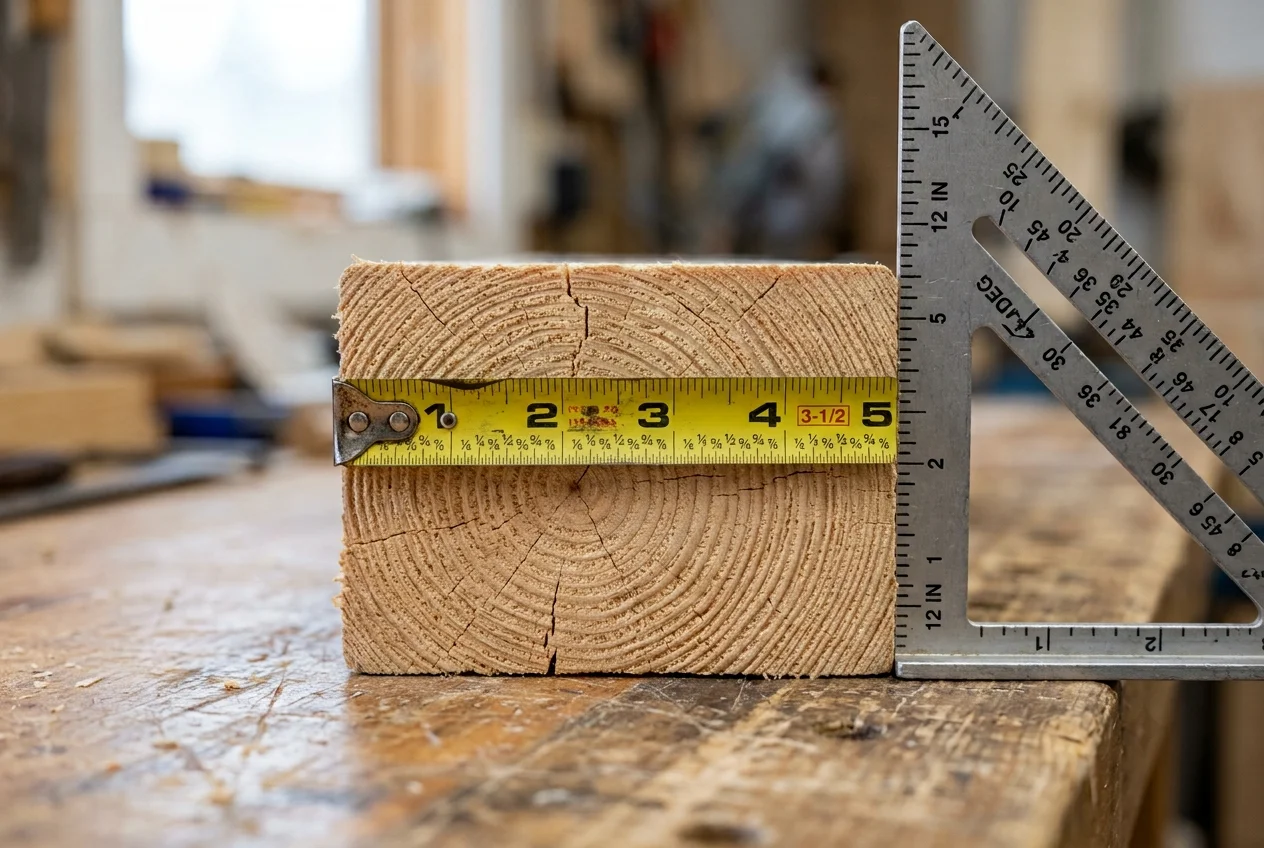
A board starts life as a rough-sawn rectangle cut from a log, and at that moment a 2x4 really is two inches by four inches. What happens next is what changes the number. The lumber is seasoned — dried in a kiln or in the air — and wood shrinks as it gives up moisture, mostly across the grain, so both the thickness and the width come down. Then the board is planed smooth on all four sides, and the planer removes a thin layer from every face, taking the surface down again. By the time the board is ready to sell, its finished — or dressed — size is smaller than its name in every direction except length. The name never changes, because the whole industry buys, sells, and designs by the nominal size; only the tape measure reveals the actual size.
This is not a rounding error or a trick. It is written into the American Softwood Lumber Standard, PS 20, published by the National Institute of Standards and Technology through the American Lumber Standard Committee. That standard sets the minimum dressed sizes a mill must meet to call a board a certain nominal size, and it is the document every nominal-versus-actual chart on the internet is quietly copying. Because the standard is a minimum, a mill may leave a board slightly thicker or wider than the table — but it may not go below, so the chart is the floor you can plan against.
The practical reason to care is that layout and fit depend on the actual number, while the budget and the plan call out the nominal one. Studs are spaced based on the actual 1-1/2-inch thickness of the material they are attached to. A wall framed with 2x4s, drywalled on both sides, ends up about 4-1/2 inches thick, not 4, because the lumber is 3-1/2 plus half-inch board on each face. A beam pocket cut for a nominal 6x6 needs 5-1/2 inches of clear space. Getting this wrong by half an inch at layout time is the difference between a wall that lands on the mark and one that grows a quarter inch per stud across the room.
Nominal vs Actual Lumber Dimensions Chart
This lumber dimensions chart covers the standard dimensional lumber sizes you will meet at any supplier: the 1-by boards, the 2-by framing stock, and the 4-by and 6-by structural members. The actual size column is the dressed size for dry lumber under PS 20; the millimeter column is the metric equivalent shown on most spec sheets; and the board feet per foot column is the nominal volume per running foot, the number a supplier uses when lumber is priced by the board foot instead of by the piece. Weights, where shown, are approximate for kiln-dried Douglas Fir at roughly 30 pounds per cubic foot and move up or down with the species. Measure the actual column when you lay out, cut, or fit; quote the nominal column when you talk to the yard.
| Nominal Size | Actual — Dry (in) | Actual (mm) | Board Feet / Foot |
|---|---|---|---|
| 1-by boards — finished 3/4 inch thick | |||
| 1 x 2 | 3/4 x 1-1/2 | 19 x 38 | 0.17 |
| 1 x 3 | 3/4 x 2-1/2 | 19 x 64 | 0.25 |
| 1 x 4 | 3/4 x 3-1/2 | 19 x 89 | 0.33 |
| 1 x 6 | 3/4 x 5-1/2 | 19 x 140 | 0.50 |
| 1 x 8 | 3/4 x 7-1/4 | 19 x 184 | 0.67 |
| 1 x 10 | 3/4 x 9-1/4 | 19 x 235 | 0.83 |
| 1 x 12 | 3/4 x 11-1/4 | 19 x 286 | 1.00 |
| 2-by dimension lumber — finished 1-1/2 inches thick | |||
| 2 x 2 | 1-1/2 x 1-1/2 | 38 x 38 | 0.33 |
| 2 x 3 | 1-1/2 x 2-1/2 | 38 x 64 | 0.50 |
| 2 x 4 | 1-1/2 x 3-1/2 | 38 x 89 | 0.67 |
| 2 x 6 | 1-1/2 x 5-1/2 | 38 x 140 | 1.00 |
| 2 x 8 | 1-1/2 x 7-1/4 | 38 x 184 | 1.33 |
| 2 x 10 | 1-1/2 x 9-1/4 | 38 x 235 | 1.67 |
| 2 x 12 | 1-1/2 x 11-1/4 | 38 x 286 | 2.00 |
| 4-by and 6-by structural lumber and timbers | |||
| 4 x 4 | 3-1/2 x 3-1/2 | 89 x 89 | 1.33 |
| 4 x 6 | 3-1/2 x 5-1/2 | 89 x 140 | 2.00 |
| 4 x 8 | 3-1/2 x 7-1/4 | 89 x 184 | 2.67 |
| 4 x 10 | 3-1/2 x 9-1/4 | 89 x 235 | 3.33 |
| 4 x 12 | 3-1/2 x 11-1/4 | 89 x 286 | 4.00 |
| 6 x 6 | 5-1/2 x 5-1/2 | 140 x 140 | 3.00 |
| 6 x 8 | 5-1/2 x 7-1/2 | 140 x 190 | 4.00 |
| 6 x 10 | 5-1/2 x 9-1/2 | 140 x 241 | 5.00 |
| 6 x 12 | 5-1/2 x 11-1/2 | 140 x 292 | 6.00 |
Actual sizes are minimum dressed dimensions for dry lumber per NIST PS 20-10. Board feet per foot is calculated from nominal dimensions, the industry convention for pricing. Metric values are rounded to the nearest millimeter.
Dry vs Green Dressed Sizes: The Column Most Charts Leave Out
Almost every nominal-versus-actual chart shows one column: the dry, or surfaced-dry, size. That is the size of lumber that has been seasoned to a moisture content of 19 percent or less before it was planed, and it is what you will find on most framing sold today. But the standard carries a second set of sizes for lumber dressed while still green — above 19 percent moisture — and green stock is dressed deliberately larger because it has not finished shrinking. A dry 2x4 is 1-1/2 by 3-1/2; a green 2x4 is about 1-9/16 by 3-9/16, a sixteenth larger in each direction. Once that green board dries in place it shrinks back toward the dry dimension, which is why a deck or a treated frame can measure slightly different six months after it was built.
| Nominal Dimension | Dry (Actual) | Green (Actual) | Amount Removed, Dry |
|---|---|---|---|
| Face widths | |||
| 2 in | 1-1/2 in | 1-9/16 in | 1/2 in |
| 4 in | 3-1/2 in | 3-9/16 in | 1/2 in |
| 6 in | 5-1/2 in | 5-5/8 in | 1/2 in |
| 8 in | 7-1/4 in | 7-1/2 in | 3/4 in |
| 10 in | 9-1/4 in | 9-1/2 in | 3/4 in |
| 12 in | 11-1/4 in | 11-1/2 in | 3/4 in |
| Thicknesses | |||
| 1/2 in | 7/16 in | 15/32 in | 1/16 in |
| 3/4 in | 5/8 in | 11/16 in | 1/8 in |
| 1 in | 3/4 in | 25/32 in | 1/4 in |
| 1-1/2 in | 1-1/4 in | 1-9/32 in | 1/4 in |
| 2 in | 1-1/2 in | 1-9/16 in | 1/2 in |
| 4 in | 3-1/2 in | 3-9/16 in | 1/2 in |
The green-versus-dry distinction matters most on treated lumber, where the wood is often sold still wet and will shrink as it seasons on the job. If a dimension has to hold — a beam pocket, a rail post, a door frame that has to stay square — buy dry or kiln-dried stock and let it acclimate before you cut, rather than trusting a green dimension to stay put.
Boards, Dimension Lumber, and Timbers: Three Different Subtraction Rules
The amount taken off a nominal dimension is not one number; it changes with the size of the member and, for the largest stock, with whether the board is dry or green. The standard sorts lumber into three groups — boards, dimension lumber, and timbers — and each behaves a little differently.
Boards are less than 2 inches nominal thick: the 1-by stock and its thinner cousins. They lose about 1/4 inch of thickness and 1/2 inch of width, but the smallest boards break even that rule — a nominal 3/8 board dresses to 5/16, losing only 1/16, and a 1/2 board loses 1/16 too. This is where the popular shorthand "subtract a quarter under 2 inches" begins to wobble.
Dimension lumber is 2 to 4 inches nominal thick: the 2-by framing stock. Thickness loses 1/2 inch (a 2 dresses to 1-1/2), and width loses 1/2 inch up to nominal 7, then 3/4 inch at 8 and up. That step at 8 inches is the one people get wrong, because it means a 2x8 is 7-1/4 wide, not 7-1/2.
Timbers are 5 inches nominal and larger, and they play by their own lines. Nominal 5- and 6-inch timbers lose 1/2 inch whether they are dry or green — a 6x6 is 5-1/2 square either way. Nominal 7 through 15 inch timbers lose 3/4 inch dry but only 1/2 inch green. And timbers 16 inches and larger lose a full inch dry but still only 1/2 inch green. Timbers are also frequently manufactured and sold without drying at all, so a post that measures wider than the chart expected may simply still be green.
| Lumber Group | Nominal Range | Amount Removed | Example |
|---|---|---|---|
| Boards (thin stock) | Under 1 in thick | 1/16 to 1/8 in | 3/8 dresses to 5/16 |
| Boards and 1-by | 1 to 1-1/2 in thick | 1/4 in thickness, 1/2 in width | 1x4 dresses to 3/4 x 3-1/2 |
| Dimension lumber | 2 to 4 in thick | 1/2 in to 7; 3/4 in at 8 and up | 2x8 dresses to 1-1/2 x 7-1/4 |
| Timbers | 5 to 6 in | 1/2 in, dry or green | 6x6 dresses to 5-1/2 x 5-1/2 |
| Timbers | 7 to 15 in | 3/4 in dry, 1/2 in green | 8x8 dry is 7-1/4, green is 7-1/2 |
| Timbers | 16 in and larger | 1 in dry, 1/2 in green | 16x16 dry is 15, green is 15-1/2 |
One bookkeeping note: board foot volume is always figured from the nominal dimensions, not the dressed ones, which is why a 2x4 eight feet long is sold as 5.33 board feet even though the actual amount of wood is a little less. That convention is covered in full in the Board Footage Basics guide.
Standard Lumber Lengths and the Length Exception
Length is the dimension that does not shrink. Wood moves across the grain as it dries, not along it, so an 8-foot board is a true 96 inches, and the standard only requires that actual length meet the nominal length and not run more than about 3 inches over. That makes length the easiest dimension to trust — and the one most often assumed correctly.
Standard lengths run in two-foot increments. Dimensional lumber is stocked from 6 feet to 24 feet: 6, 8, 10, 12, 14, 16, 18, 20, 22, and 24. Not every length is stocked in every size, and longer members and unusual sizes may be special order. For walls, mills also sell precut studs that are not a named length at all: an 8-foot wall stud is commonly 92-5/8 inches, and a 9-foot stud is 104-5/8, so the stud fits under the plates with the wall height coming out to a full 8 feet or 9 feet after the top and bottom plates are added.
| Dimension | Does It Shrink? | What to Use for Layout |
|---|---|---|
| Thickness | Yes | Actual (dressed) size |
| Width | Yes | Actual (dressed) size |
| Length | No | Nominal length is true (up to +3 in tolerance) |
| Precut stud | No | 92-5/8 (8-ft wall), 104-5/8 (9-ft wall) |
Softwood Lumber Grades: From Select Structural to No. 3
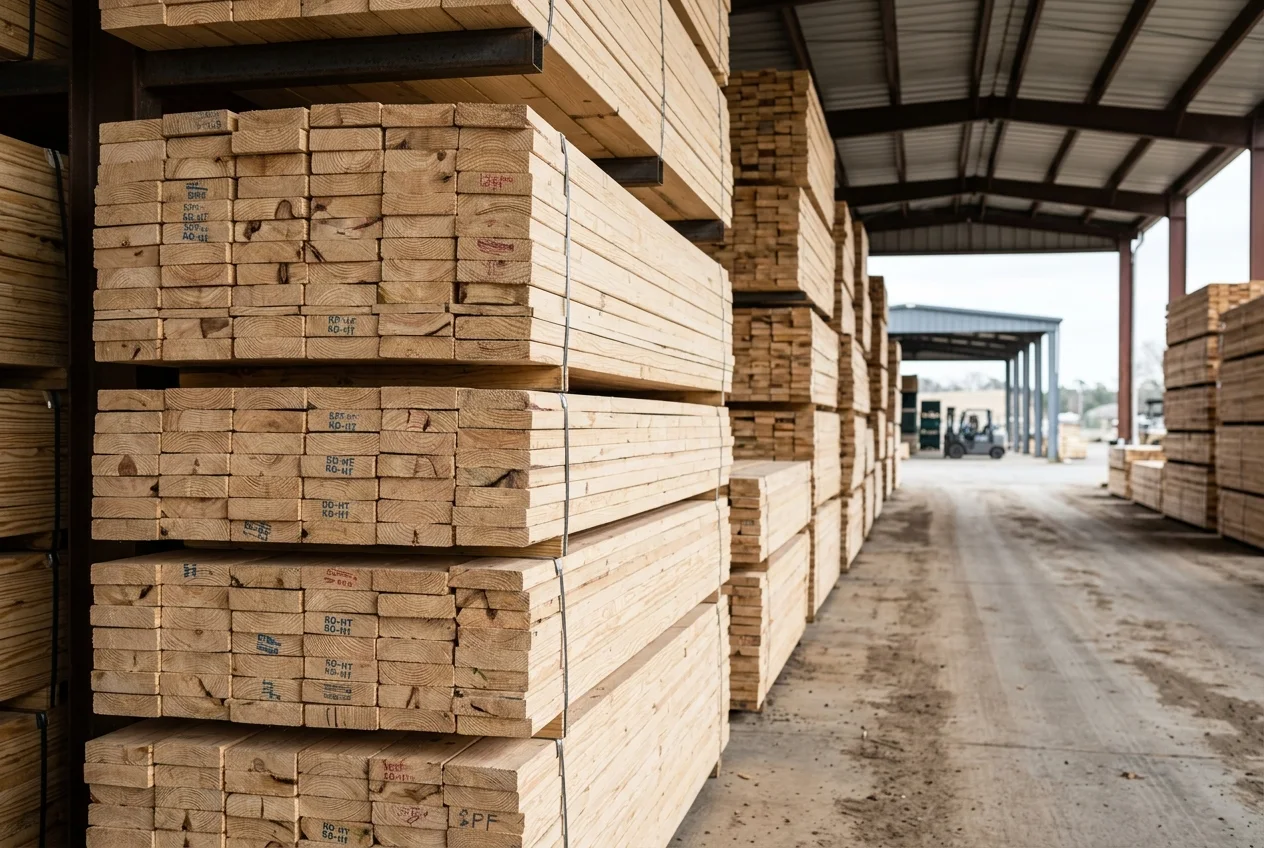
Size tells you how big a piece is; grade tells you how strong and how clean it is. For softwood structural lumber the grade is assigned by visual inspection or by machine, and it rates the piece against limits on knots, splits, wane, and slope of grain — the defects that weaken wood in bending. The structural grades climb from the top down as Select Structural, then No. 1, No. 2, and No. 3, and each step down allows more and larger defects and carries lower published design values. Framing lumber is also sorted by end use into Structural Light Framing for engineered members like trusses and rafters, Light Framing (Construction, Standard, and Utility) for plates, sills, cripples, and blocking, Stud for vertical load-bearing walls, and Structural Joists and Planks for the deeper members used as joists, rafters, and headers.
| Grade | Strength | Typical Use |
|---|---|---|
| Select Structural (SS) | Highest published design values; fewest, smallest knots | Long spans, exposed beams, heavy loads |
| No. 1 | High strength and stiffness; about 1,850 psi bending stress in a 2x4 (Southern Pine example) | Exposed structural work, pergola beams, cathedral rafters |
| No. 1 & Better | Mixed bundle of Select Structural and No. 1 | Where the top two grades are acceptable interchangeably |
| No. 2 | Moderate strength; about 1,050 psi bending stress in a 2x4 | The standard framing grade; assumed by most span tables |
| No. 3 | Lowest structural grade; about 600 psi bending stress in a 2x4 | Blocking, cripples, backing, light or non-critical use |
| Stud | Rated for axial compression | Vertical load-bearing wall studs, up to 10-foot walls |
The bending-stress (Fb) values shown are representative Southern Pine figures for a 2x4, used here to show how the grades separate; design values differ by species and by size and are always read from the published tables for the exact species and grade you are using. Two grades can only be compared within the same species — a Douglas fir 2x4 carries more than a hemlock-fir 2x4 of the same grade and size.
Not every board is graded by eye. Machine stress rated (MSR) and machine evaluated (MEL) lumber is tested piece by piece by machine, and those grades are printed as a combined bending-strength and stiffness code — 1650f-1.5E, 1800f-1.6E, 2100f-1.8E, 2400f-2.0E — where the number before the f is the assigned bending stress in psi and the number before the E is the stiffness in millions of psi. MSR lumber is used where a tighter, more uniform strength value lets an engineer design a lighter member.
How to Read a Lumber Grade Stamp
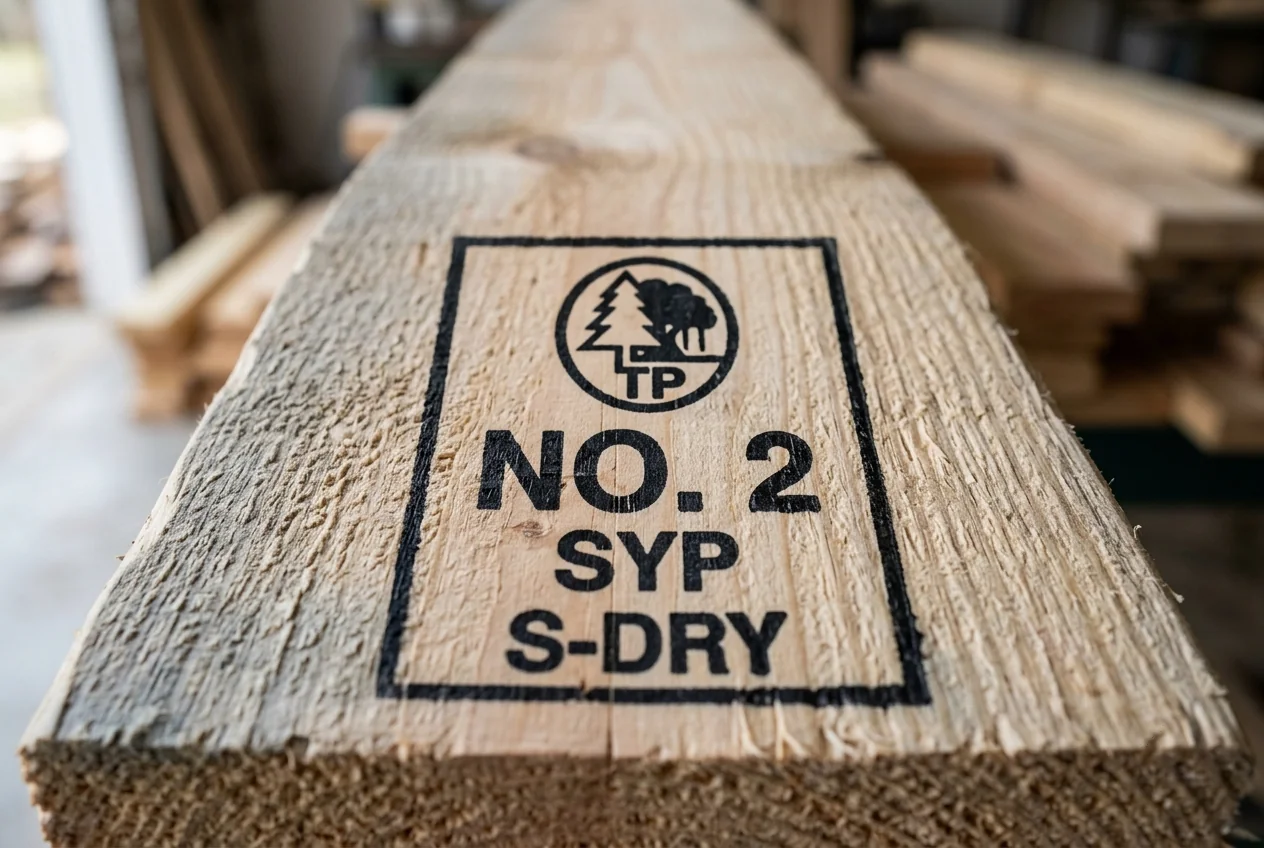
Every piece of structural softwood lumber carries an ink stamp — the grade mark — applied near the end of the board and sometimes repeated once along its length. The stamp is not decoration: it records that the piece was graded under an accredited agency's rules and it lets the board be traced back to the mill if something goes wrong. Under the American Softwood Lumber Standard every grade mark must show five things, and once you know what they are, a stamp that looked like random ink becomes a complete description of the board.
The Five Elements of a Grade Stamp
1. Certification mark. The symbol or name of the grading agency that supervised the mill. Six agencies write rules and inspect softwood lumber in the United States: the National Lumber Grades Authority (NLGA), the Northeastern Lumber Manufacturers Association (NeLMA), Redwood Inspection Services (RIS), the Southern Pine Inspection Bureau (SPIB), the Pacific Lumber Inspection Bureau (PLIB / WCLIB), and the Western Wood Products Association (WWPA).
2. Mill identification. The mill's assigned number or its name or brand, so the board can be traced to where it was produced.
3. Grade designation. The strength and appearance rating — Select Structural, No. 1, No. 2, No. 3, Stud, or an MSR code.
4. Species identification. The species or species combination, often as an abbreviation. The common ones are DF-L or D.FIR (Douglas fir or western larch), SYP (Southern yellow pine), HF or Hem-Fir (western hemlock and fir), and SPF (spruce, pine, and fir).
5. Moisture content at surfacing. How wet the board was when it was planed.
| Stamp Mark | Meaning | Moisture Content |
|---|---|---|
| S-GRN | Surfaced green (unseasoned) | Over 19% |
| S-DRY or KD | Surfaced dry / kiln dried | 19% maximum |
| KD15 or MC15 | Kiln dried to a lower target | 15% maximum |
| HT | Heat treated (pest control, common on exports) | Core to 56°C for 30 minutes |
A useful limit to remember: cross-cutting a graded board does not change its grade. A piece cut from a stamped board is assumed to keep the same grade and design values as the original, even though the offcut carries no stamp of its own. That is why a production shop tracks which bundle of lumber each component came from.
#1 vs #2 Lumber Grade: Which One Do You Actually Need?
No. 2 is the workhorse. It is the most widely produced grade, the most widely used grade in wood-frame construction, and the grade that ordinary span tables assume when they list allowable joist and rafter spans. For framing that will be covered by drywall or sheathing, and for members working within their published spans and loads, No. 2 is almost always the correct and the economical choice. The defects it allows look worse than they act: knots up to about 3-1/2 inches, a hole here and there, some wane on the corners. Within the engineering, the piece is sound.
No. 1 is the step up, and it buys you both strength and appearance. It permits fewer and smaller knots — no larger than about 2-3/4 inches — one hole every 3 feet instead of every 2, no splits wider than the board, and straighter grain. That combination raises the published design values above No. 2 and makes the board look clean, which is why No. 1 and Select Structural are specified for exposed structural work where people will see the wood: porch beams, pergola rafters, cathedral ceilings, stair stringers, and any member carrying a heavier-than-ordinary load.
| Feature | No. 1 Grade | No. 2 Grade |
|---|---|---|
| Maximum knot size | 2-3/4 in | 3-1/2 in |
| Holes allowed | One per 3 ft | One per 2 ft |
| Splits | None wider than the board | Up to 1-1/2 times the board width |
| Wane (bark edge) | Minimal | Allowed on corners |
| Appearance | Clean; good for exposed work | Rustic; fine under cover |
| Relative strength | Higher published values | Standard framing values |
| Relative cost | Higher | Lower |
The rule of thumb that keeps you out of trouble: you can always substitute a higher grade than a job calls for, but never a lower one. If a plan or a span table assumes No. 2 and the yard is out of it, No. 1 or Select Structural will do the same job with margin to spare. Going the other way — swapping a No. 3 into a spot specified for No. 2 — is exactly the error that fails inspection.
Hardwood Grades and the Quarter System
Hardwood is a different animal, and the first difference is how thickness is named. Hardwood thickness is measured in quarters of an inch, not in nominal inches: a 1-inch board is 4/4 (four-quarter), a 1-1/4 board is 5/4, a 1-1/2 board is 6/4, a 2-inch board is 8/4, a 3-inch board is 12/4, and a 4-inch board is 16/4. Hardwood is also sold random width and random length, and it is priced by the board foot of nominal volume rather than by the piece. On top of the quarter thickness, a hardwood board's finished size depends on how many faces were surfaced: S1S means surfaced one side, S2S means surfaced two sides, and each removes a little more material.
| Nominal (Quarters) | Rough | Surfaced 1 Side | Surfaced 2 Sides |
|---|---|---|---|
| 4/4 | 1 in | 7/8 in | 13/16 in |
| 5/4 | 1-1/4 in | 1-1/8 in | 1-1/16 in |
| 6/4 | 1-1/2 in | 1-3/8 in | 1-5/16 in |
| 8/4 | 2 in | 1-13/16 in | 1-3/4 in |
| 12/4 | 3 in | 2-13/16 in | 2-3/4 in |
| 16/4 | 4 in | 3-13/16 in | 3-3/4 in |
Hardwood grades are set by the National Hardwood Lumber Association and they measure something different from softwood structural grades: the percentage of clear, defect-free cuttings a board will yield once the defects are cut away. The top grade, FAS (First and Seconds), must yield at least 83 percent clear cuttings on the better face; FAS One Face applies that standard to one face only; and No. 1 Common must yield at least 66 percent. This system suits furniture and cabinet makers, who cut a board into smaller pieces and discard the defects. Appearance grades for softwood finish and trim use yet another scale — C Select and Better, D Select, No. 1 Common, and No. 2 Common — which rate how clean the face looks rather than how much clear wood it yields.
Worked Examples: Where the Quarter Inch Bites
Three short jobs show why the nominal-versus-actual difference is not trivia. In every one the plan speaks in nominal sizes and the tape measures the actual ones.
Example 1 — Filling a Run With 2x10s
A rim is framed with three 2x10 joists set edge to edge, and you want the finished width of the run. Nominal math says 3 × 10 = 30 inches. Actual math says each 2x10 is 9-1/4 wide, so the run is 3 × 9-1/4 = 27-3/4 inches — two and a quarter inches less than the nominal total. The gap between the rough number and the real one is exactly the kind of difference that shows up as a short rim or a trim piece cut one size too big.
Example 2 — How Thick Is a Framed Wall?
A standard interior wall is 2x4 studs with 1/2-inch drywall on each face. The studs are 3-1/2 inches deep, so the wall thickness is 3-1/2 + 1/2 + 1/2 = 4-1/2 inches, not 4. An exterior wall of 2x6 studs with 1/2-inch drywall inside and 1/2-inch sheathing outside measures 5-1/2 + 1/2 + 1/2 = 6-1/2 inches. That extra half inch, multiplied across a plan, sets the width of door jambs, the depth of window returns, and whether a cabinet box clears the wall it is scribed to.
Example 3 — Picking the Grade for a Beam
A 4x10 header will be left exposed in a finished room and carries an upper floor. By span and load it could be framed with No. 2, and a covered No. 2 member would be sound. Because the member is visible, though, the plan calls for No. 1 or Select Structural: the fewer and smaller knots read as clean wood, the higher design values add margin, and the appearance matches the exposed rafters beside it. Same size, same species, one grade step up — the difference is what the board is graded to do and how it will look doing it.
Frequently Asked Questions
The actual size of a 2x4 is 1-1/2 inches by 3-1/2 inches. The name 2x4 is a nominal size — the rough dimensions the board had when it was first sawn at the mill, before it was dried and planed smooth on all four sides. Kiln-drying shrinks the wood across the grain and planing removes a thin layer from each face, so a nominal 2x4 finishes at 1-1/2 x 3-1/2 inches, or 38 x 89 millimeters. A green 2x4, which has not finished drying, is dressed slightly larger at about 1-9/16 by 3-9/16 inches so it can shrink down toward the dry size.
Nominal lumber dimensions are the names the trade uses — 2x4, 2x10, 6x6 — and they do not reflect the size of the board you actually measure. Actual, or dressed, dimensions are the finished sizes after the wood has been dried and surfaced on all four sides. The standard reduces each nominal dimension by a set amount: 1/4 inch under 2 inches, 1/2 inch for nominal dimensions from 2 through 7 inches, and 3/4 inch at 8 inches and wider. That is why a 2x4 measures 1-1/2 by 3-1/2 and a 2x8 measures 1-1/2 by 7-1/4 — the wide dimensions step to a three-quarter reduction, not a half. Length is the exception: an 8-foot board is a true 96 inches.
Standard dimensional lumber sizes come in a few families. The 1-by boards — 1x2 through 1x12 — are surfaced to a finished 3/4-inch thickness and are used for trim, shelving, and non-structural work. The 2-by group — 2x2 through 2x12 — finishes at 1-1/2 inches thick and carries most wall framing, floor joists, and rafters. The 4-by and 6-by sizes — 4x4, 4x6, 4x8, 4x10, 4x12, 6x6, 6x8, 6x10, and 6x12 — are heavier members used for posts, beams, and columns. Standard lengths run in two-foot increments from 6 feet to 24 feet, though precut studs are common for 8-foot and 9-foot walls.
A lumber grade stamp carries five pieces of information. The certification mark identifies the grading agency that supervised the mill, such as SPIB, WWPA, NeLMA, RIS, PLIB, or NLGA. The mill identification is the manufacturer's number or brand. The grade designation is the strength and appearance rating, from Select Structural down through No. 1, No. 2, and No. 3. The species or species combination is shown as a name or abbreviation such as DF-L for Douglas fir, SYP for Southern yellow pine, HF for hem-fir, or SPF for spruce-pine-fir. The moisture content at surfacing is marked S-GRN for green, S-DRY or KD for 19 percent or less, KD15 or MC15 for 15 percent or less, and HT when the lumber is heat-treated.
No. 1 and No. 2 are the two structural grades most framing lumber carries, and the difference is how many defects the rules allow. No. 1 grade permits relatively few, small knots — no larger than about 2-3/4 inches — one hole every 3 feet, and no splits wider than the board, so it looks clean and carries the highest design values below Select Structural. No. 2 grade allows larger knots up to about 3-1/2 inches, one hole every 2 feet, some wane on the corners, and more grain deviation, but it remains structurally sound for ordinary framing. No. 2 is the most widely produced and most widely used grade, and building codes assume No. 2 for standard span tables. Choose No. 1 or Select Structural when the member is exposed, long, or heavily loaded.
Construction grade is a light-framing grade — one of the three grades, along with Standard and Utility, that make up the light-framing category used for wall plates, sills, cripples, and blocking, where the highest design values are not required. In everyday speech, though, people often use construction grade to mean the general-purpose structural lumber sold for framing, which is almost always No. 2 or No. 2 and better. The name overlaps with No. 1, which is sometimes printed as Construction grade on older stamps because it was recommended for general construction where high strength and good appearance are wanted. When a stamp or a plan just says construction grade, assume ordinary structural framing stock and check the actual grade designation on the board.
Softwood lumber grades measure strength and stiffness, not appearance, and the structural grades run from the top down as Select Structural, No. 1, No. 2, and No. 3. Select Structural gets the highest published design values and the fewest knots; No. 3 is the lowest structural grade and is used for light-load, non-critical work. Framing lumber is also sorted into use categories: Structural Light Framing for engineered applications, Light Framing (Construction, Standard, and Utility) for wall framing and blocking, Stud for vertical load-bearing walls, and Structural Joists and Planks for deeper members. Appearance and factory grades use a separate system, and hardwood grades from the National Hardwood Lumber Association are based on the percentage of clear cuttings a board yields, not on strength.
No. The nominal-versus-actual shrink applies to thickness and width only, because wood shrinks across the grain as it dries, not along its length. An 8-foot board is a true 8 feet, or 96 inches. Under the American Softwood Lumber Standard the actual length must be at least the nominal length and may run up to about 3 inches longer, but mills cut lengths to the named dimension. The one length that trips people up is the precut wall stud: an 8-foot wall stud is commonly sold at 92-5/8 inches so it fits under a top and bottom plate and a double top plate, and a 9-foot stud at 104-5/8 inches. Those studs are not short — they are cut to account for the plates.
References
- National Institute of Standards and Technology / American Lumber Standard Committee, Voluntary Product Standard PS 20-10: American Softwood Lumber Standard, nist.gov — nominal and minimum dressed lumber sizes by width and thickness (dry and green), the definitions of nominal size, dry (19 percent or less), and green lumber, and the required elements of a grade mark.
- American Wood Council, National Design Specification (NDS) for Wood Construction and 2018 NDS Supplement, awc.org — Table 1A nominal and minimum dressed sizes of sawn lumber and Table 1B section properties and weight per linear foot of standard dressed sizes.
- Southern Forest Products Association, Standard Sizing of Southern Pine Lumber, southernpine.com — dressed dimension lumber, boards, timbers, and radius-edge decking sizes with metric equivalents.
- Western Wood Products Association, Interpreting Grade Stamps, wwpa.org — the five elements of a grade stamp and the seasoning codes MC-15, KD-15, S-DRY, KD, and S-GRN.
- Structural Building Components Association, How to Read a U.S. Softwood Lumber Grade Stamp, sbcacomponents.com — accredited grading agencies, visual grade hierarchy, species abbreviations, and machine stress rated (MSR) grades.
- National Hardwood Lumber Association, Rules for the Measurement and Inspection of Hardwood and Cypress, nhla.com — the FAS, FAS One Face, and No. 1 Common hardwood grades and their minimum clear-cutting yields.
- USDA Forest Service, Forest Products Laboratory, Wood Handbook: Wood as an Engineering Material, fs.usda.gov — nominal versus manufactured versus actual lumber dimensions and the hardwood quarter system.
- International Code Council, International Residential Code (IRC), iccsafe.org — framing lumber grade requirements and the span-table assumptions that standardize on No. 2 grade.
Disclaimer: This guide compiles standard lumber sizes and grades for general educational reference — a nominal versus actual lumber dimensions chart, dry and green dressed sizes, the board, dimension-lumber, and timber subtraction rules, standard lengths, softwood and hardwood grades, and how to read a lumber grade stamp. It is not an engineering design, a span table, or a substitute for the published design values for the specific species, grade, and size you are using. Illustrated design-stress figures are representative and differ by species and size; always read the governing grading rules and span tables, confirm dimensions by measuring the material in hand, and consult a licensed engineer or your building department for structural, load-bearing, or code-regulated work.