
Enter Tile Project Details
Results update live as you type. Mixed units welcome.
 12 feet
10 feet
12 x 24 in
Results
Tile Quantity
Installation Materials
Cost Estimate
Calculation Assumptions
What You Get
- ✓Free — no sign-up, nothing to install
- ✓Live results as you type
- ✓Feet, inches, cm, meters & yards — mix any units
- ✓Export a PDF takeoff in one click
- ✓Shareable link that saves your inputs
- ✓Works on phone, tablet & desktop
- ✓Floor, wall & backsplash surfaces
- ✓Pattern waste for herringbone & more
- ✓Boxes or single tiles with price modes
ON THIS PAGE:
About Tile Estimating
Tile is ordered by the piece or the box, but installed by the square foot. That mismatch is why tile projects run short: a box of 12×24 porcelain usually covers about 15 square feet, so a 120 sq ft floor needs roughly 8 boxes on paper — and 9 or 10 once cuts, breakage, and lot matching are considered.
Three things drive a tile estimate: the area to cover, the coverage of each tile including its grout joint, and the waste allowance for your layout. Getting all three right turns a guess into an order list you can take to the supplier.
This calculator converts every input to a common unit for you — enter the room in feet and the tile in inches, or the wall in centimeters and the tile in millimeters — and reports tiles, boxes, grout, thinset, and cost in one pass.
How to Calculate Tile
Tile quantities come from a four-step calculation. Here is the method the calculator uses, and the manual math if you want to check it by hand:
- Step 1: Measure the area — Multiply length × width of each section, then add sections together. For backsplashes, measure in inches and divide by 144 for square feet.
- Step 2: Add the grout joint to the tile — Real coverage per tile is (tile width + joint) × (tile length + joint). A 12×24 tile with a 1/4-inch joint covers 12.25 × 24.25 = 297.06 square inches, or 2.063 sq ft.
- Step 3: Choose the pattern waste — Straight grids need about 10% waste. Diagonal and running bond (brick joint) layouts need 15%, and herringbone needs about 20% because every tile is cut twice. Pick your pattern in the calculator and the waste adjusts automatically.
- Step 4: Round up to boxes — Divide tiles by tiles-per-box, or divide the waste-adjusted area by the coverage per box, then round up. Partial boxes are not sold.
Formula Summary
Tile Coverage = (Tile Width + Joint) × (Tile Length + Joint) ÷ 144
Tiles Needed = ⌈(Area − Obstacles) × (1 + Waste%) ÷ Tile Coverage⌉
For L-shaped rooms, kitchens with islands, or walls with windows, don't do the subtraction in your head: enter each rectangle with Add Another Area, deduct windows and doors with the obstacle field, and the net area flows through every calculation — tiles, boxes, grout, thinset, and cost — automatically.
Common Tile Sizes: Coverage per 100 Sq Ft
Use this reference to sanity-check the calculator. Counts include no waste; add your waste allowance afterward.
| Tile Size | Metric | Coverage | Tiles per 100 sq ft |
|---|---|---|---|
| 4 × 4 in | 10 × 10 cm | 0.111 sq ft | 900 |
| 3 × 6 in (subway) | 7.5 × 15 cm | 0.125 sq ft | 800 |
| 6 × 6 in | 15 × 15 cm | 0.25 sq ft | 400 |
| 4 × 24 in (plank) | 10 × 61 cm | 0.667 sq ft | 150 |
| 12 × 12 in | 30 × 30 cm | 1.000 sq ft | 100 |
| 12 × 24 in | 30 × 61 cm | 2.000 sq ft | 50 |
| 18 × 18 in | 46 × 46 cm | 2.25 sq ft | 45 |
| 24 × 24 in | 61 × 61 cm | 4.000 sq ft | 25 |
Layout Patterns and How Much Waste They Add
The pattern you lay changes how much tile you must order, because more angles mean more cuts and more unusable offcuts. The calculator applies these waste presets automatically when you choose a pattern — the table shows why.
| Pattern | Recommended Waste | Why |
|---|---|---|
| Straight (grid) | 10% | Most cuts are reusable; perimeter cuts only |
| Diagonal (45°) | 15% | Every perimeter tile is cut at an angle; offcuts rarely reusable |
| Running bond / brick joint | 15% | Offset rows produce half-tiles that often can't be reused |
| Herringbone | 20% | Every tile is cut twice at 45°; highest breakage rate |
Rooms with many corners, jogs, columns, or frequent obstacles can add another 5% on top of any pattern. When in doubt between two numbers, order the higher one from a single production lot — most stores accept returns of unopened boxes.
Grout & Thinset: How Much to Buy
Tile is only part of the order. Two more materials matter, and both depend on tile size.
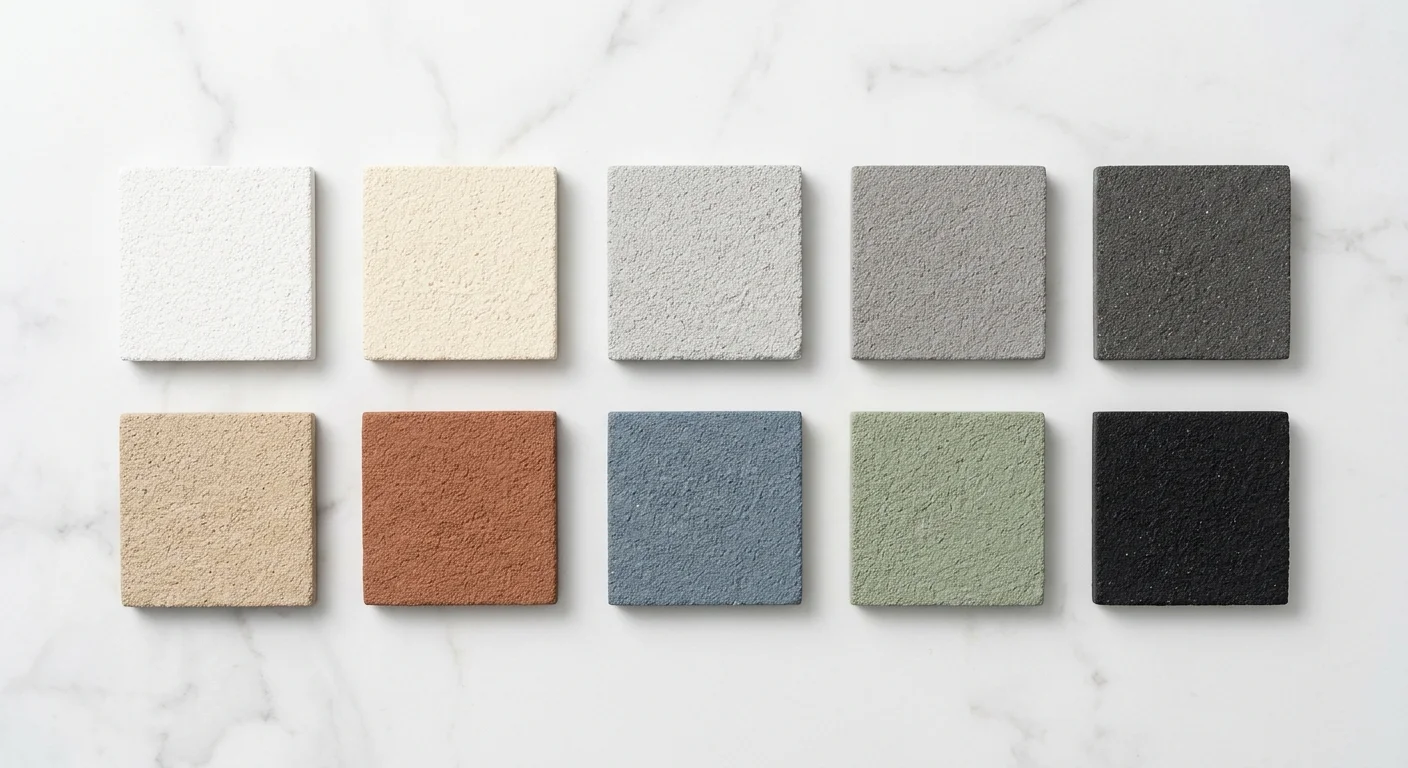
Grout
Grout fills the joints between tiles. The narrower the joint and the larger the tile, the less grout you need — big-format tiles on a tight grid use very little, while mosaics use several times more per square foot.
| Tile Size | Joint | Grout per 100 sq ft |
|---|---|---|
| 12 × 24 in | 1/4 in | 6 – 7 lb |
| 12 × 12 in | 1/4 in | 9 – 10 lb |
| 6 × 6 in | 1/8 in | 12 – 15 lb |
| Subway 3 × 6 in | 1/8 in | 18 – 22 lb |
| Mosaic 1 × 1 in | 1/16 in | 40 – 50 lb |
Thinset
Thinset mortar coverage depends on trowel size, not tile size. A 50-pound bag covers roughly 75–85 sq ft with a 1/4-inch notch trowel, 60–70 sq ft with a 1/4 × 3/8-inch notch, and 40–50 sq ft with a 1/2-inch notch used for large-format tiles. The calculator assumes a mid-range 60 sq ft per 50 lb bag. Despite the shared name, thinset is not the mortar that bonds brick and block — that material, sold as Type N/S/M bags or site-mixed cement and sand, is covered by the Mortar Calculator.
Installation Tips That Affect Quantity
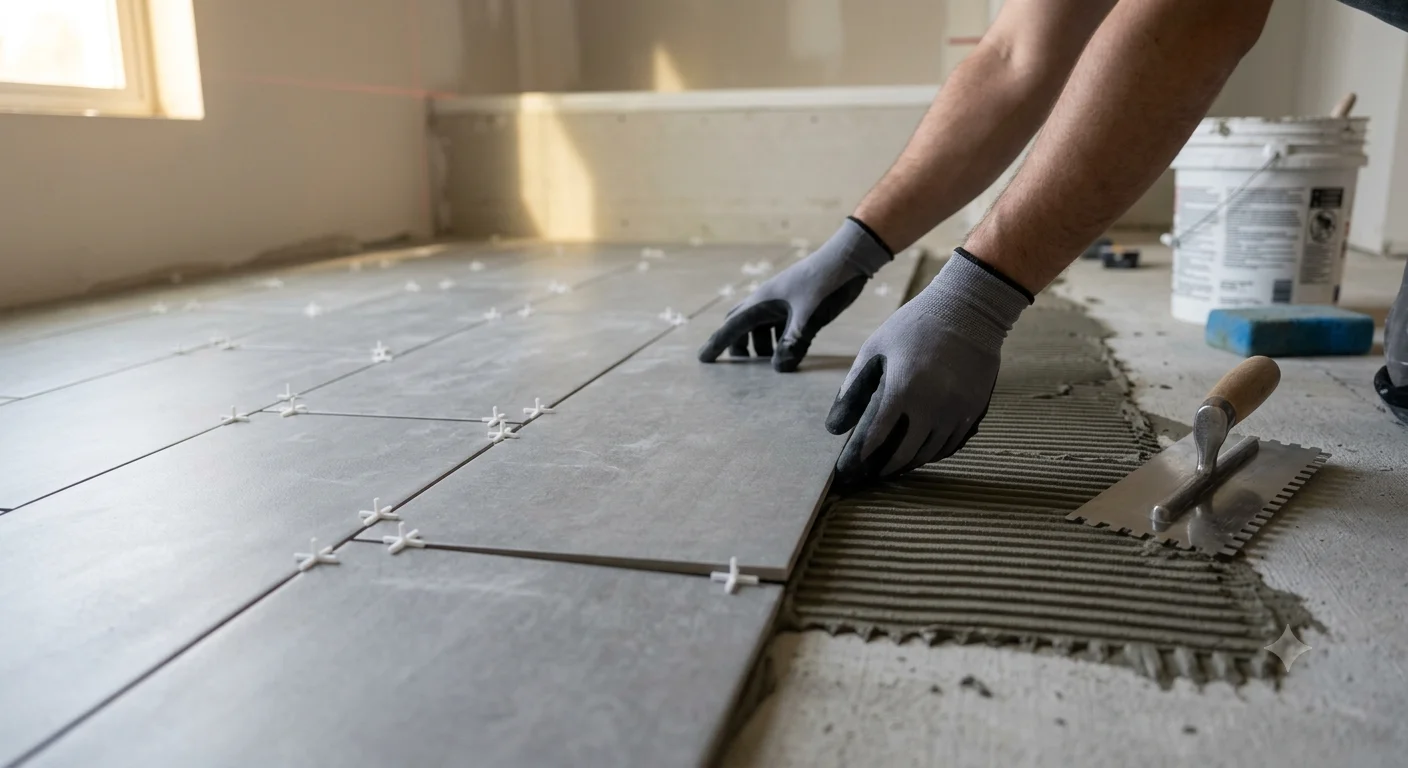
- Order from one lot — Tile color varies between production runs. Buy every box for the job at once, plus spares, so shade variation stays consistent.
- Layout before you buy — Dry-fit a row across the floor and a column up the wall. If the last tile would be a sliver, shifting the starting point by half a tile changes your cut count and your waste.
- Diagonal and herringbone cost more — Angled layouts push cuts up dramatically. Move from 10% waste to 15–20% and expect to return unopened boxes only if the store allows it.
- Keep 1/16 to 1/8 inch joints for rectified tile — Precisely cut rectified tile can be set nearly flush. Non-rectified ceramic needs 3/16 to 1/4 inch to hide size variation.
- Buy spares for the future — Cracked tile years from now will not match a new production lot. One extra box in the attic is the cheapest insurance in tiling.
Worked Example
Estimate a 12 ft × 10 ft floor with 12×24 inch tile, 1/4-inch joints, 10% waste, boxes covering 15 sq ft at $45 each. These are the calculator's defaults.
| Step | Calculation | Result |
|---|---|---|
| Area to tile | 12 × 10 | 120 sq ft |
| Tile coverage (joint added) | (12.25 × 24.25) ÷ 144 | 2.063 sq ft |
| Tiles before waste | 120 ÷ 2.063 | 58.2 |
| With 10% waste | 58.2 × 1.10 | 64.0 → 64 tiles |
| Boxes (15 sq ft each) | (120 × 1.10) ÷ 15 + 10% buffer | 9 boxes → 10 boxes |
| Tile cost | 10 × $45 | $450 |
| Grout (6.5 lb / 100 sq ft) | 120 × 0.065 | 7.8 lb → 1 bag |
| Thinset (60 sq ft / 50 lb) | 120 ÷ 60 | 2 bags |
Frequently Asked Questions
Multiply the room length by width to get the area, divide by the area of one tile (tile width × length ÷ 144 if measured in inches), then add a waste allowance of 10% for straight layouts or 15-20% for diagonal or patterned layouts. Round up to whole tiles.
Add 10% for straight-set layouts in simple rectangular rooms, 15% for diagonal, herringbone, or running bond layouts, and 15-20% for rooms with many corners, jogs, or obstacles. Tile that is cut cannot usually be reused, so extra material is essential.
A 12x12 inch tile covers exactly one square foot, so 100 square feet needs 100 tiles before waste. With a 10% waste allowance you should order 110 tiles, or 8 boxes if the tiles come 15 to a box.
Grout depends on tile size and joint width. Large 12x24 tiles with 1/8 inch joints need about 0.7 pounds per 10 square feet, while small mosaics can need 3-5 times more. As a rule of thumb, one 25-pound bag covers roughly 200-300 square feet of standard floor tile.
Use a 1/4 inch square-notch trowel for wall and mosaic tiles, a 1/4 × 3/8 inch trowel for floor tiles up to 12 inches, and a 1/2 inch notch for tiles over 16 inches. Larger tiles need deeper notches so the thinset fully contacts the tile back.
Multiply tile width by tile length in inches, then divide by 144 to get square feet per tile. For example, a 4×12 subway tile is 48 square inches, which is 0.333 square feet per tile.
Boxes often cover slightly less than listed because of size variation between tiles, so the calculator adds a 10% box-rounding buffer on top of your waste allowance. Always order all boxes from the same production lot to keep color consistent.
Measure the wall length from end to end, then measure the height from countertop to cabinets. Multiply for area, then subtract window or outlet areas if they are large. The tile calculator handles mixed units, so you can enter 30 feet length and 18 inches height directly.
Straight grid layouts need about 10% waste. Diagonal layouts and running bond (brick joint) layouts need about 15% because of the extra cuts, and herringbone needs about 20%. The calculator sets the recommended waste automatically when you pick a pattern, and you can override it at any time.
Split the room into rectangles, calculate each one, and add the areas together. Enter the largest rectangle in the main form, then use the Add Another Area button for each remaining rectangle — the calculator totals them, deducts any obstacles, and rounds up boxes for the whole project at once.
References
- Tile Council of North America (TCNA), TCNA Handbook for Ceramic, Glass, and Stone Tile Installation — grout joint and substrate requirements, tcnahandbook.com
- ANSI A108 / A118 standards, Installation of Ceramic Tile — thinset and grout application standards, tileusa.com/standards
- National Tile Contractors Association, Tile installation best practices and waste guidance, tileusa.com
- Manufacturer published coverage data for grout and thinset bag yields (averaged across major brands)
Disclaimer: The tile calculator results on this page are estimates for planning purposes only. Actual quantities vary with tile size variation, layout complexity, substrate condition, and installer technique. Always consult a professional installer and verify quantities with your tile supplier before purchasing materials.
Need a tile installer for your project?
Get Free Estimates