
Enter Paver Project Details
Results update live as you type. Mixed units welcome.
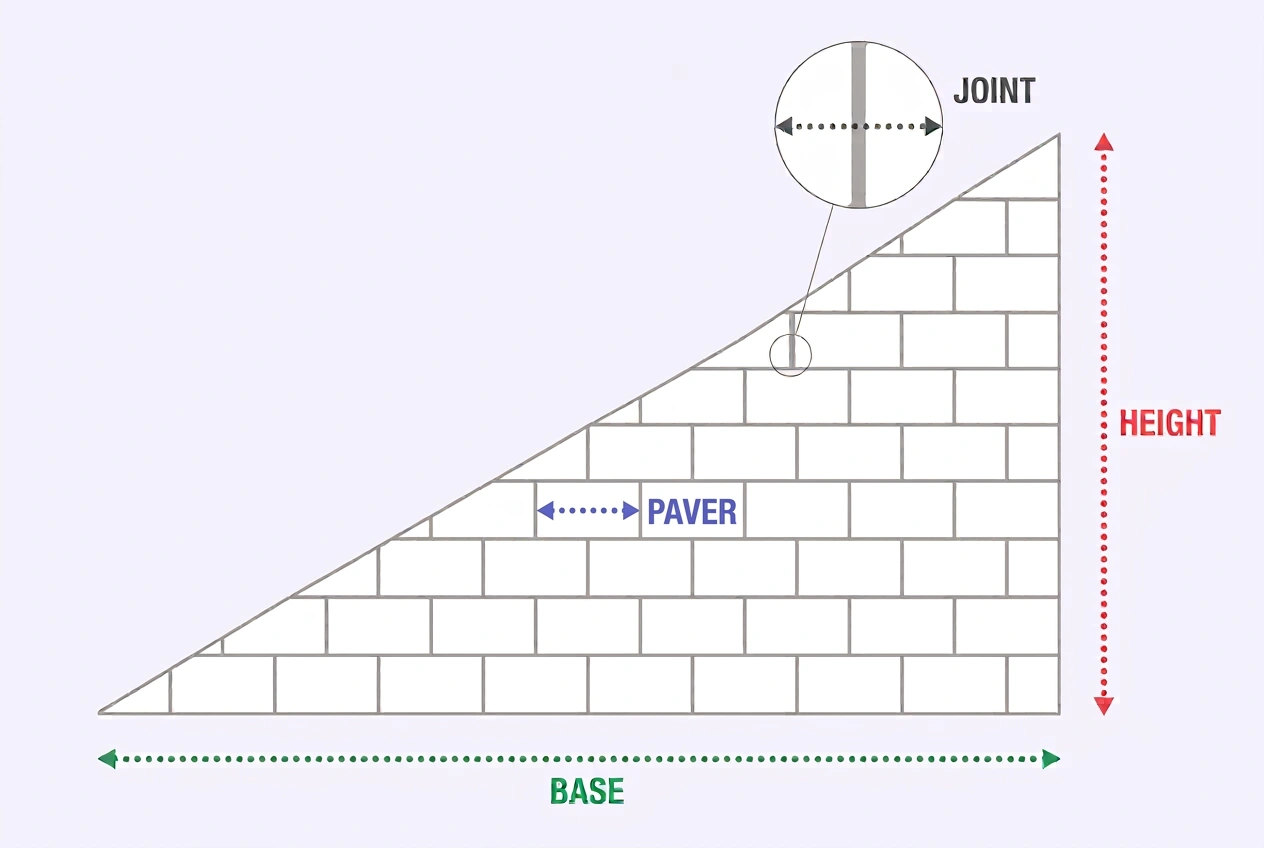
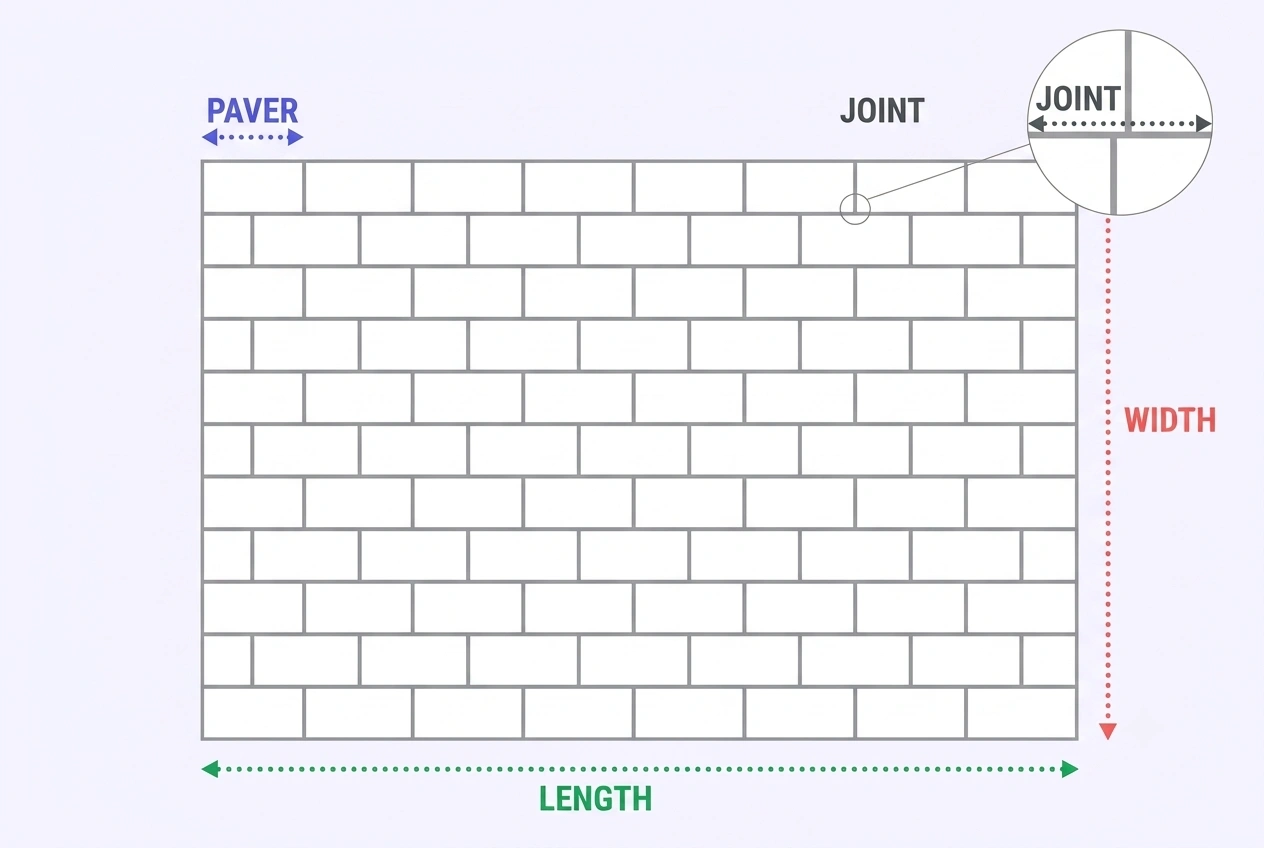 16 feet
12 feet
8 × 4 inches
1/4 inch

Results
Paver Breakdown
Base & Bedding
Edge Restraint
Calculation Assumptions
What You Get
- ✓Free — no sign-up, nothing to install
- ✓Live results as you type
- ✓Paver count with joint spacing included
- ✓Rectangle, circle & triangle areas
- ✓Multi-area support for split or stepped projects
- ✓7 paver presets + any custom size
- ✓Pattern-based waste presets, adjustable
- ✓Gravel base in yd³ & tons with compaction factor
- ✓Bedding sand + polymeric joint sand bags
- ✓Edge restraint lineal feet + spike count
- ✓Cost per paver, ft² or pallet + installed, with currency
- ✓Soldier or row border course takeoff
- ✓Export a PDF takeoff in one click
- ✓Shareable link that saves your inputs
- ✓Works on phone, tablet & desktop
ON THIS PAGE:
How the Paver Count Works
Most paver estimators divide the project's square footage by the face area of one paver and stop there. That shortcut ignores the joint. Every paver in the field occupies its own face area plus its share of the joint on all four sides, so the installed footprint is larger than the paver itself: a 4×8″ brick set at a 1/4″ joint consumes 4.25 × 8.25″ per piece — 35.06 in² instead of 32 — and coverage drops from 4.50 to 4.11 pavers per square foot. Ignoring the joint therefore over-orders by the joint's share of the footprint — about 9% on this brick — which on a 192 ft² patio is 81 pavers you never lay.
This calculator works from the effective footprint:
coverage per ft² = 144 / ((paver length + joint) × (paver width + joint))
base pavers = ceil( project area × coverage per ft² )
Waste is then applied on top of the base count, not inside it. Waste exists to cover edge cuts, broken pieces, and future repairs — the pattern you choose sets how much, and the laying-pattern selector handles it automatically. The results panel always shows the base count and the waste count separately, so you can see exactly what the extra pavers are for:
pavers to buy = ceil( base pavers × (1 + waste%) )
Circular and triangular projects use their exact geometric areas, and the edge-restraint output reports the perimeter you will need to lock the field in place. If the project is two or three identical shapes — stepped patios, split-level courtyards — enter the count of identical areas and every quantity multiplies in one step.
Laying Patterns & Waste
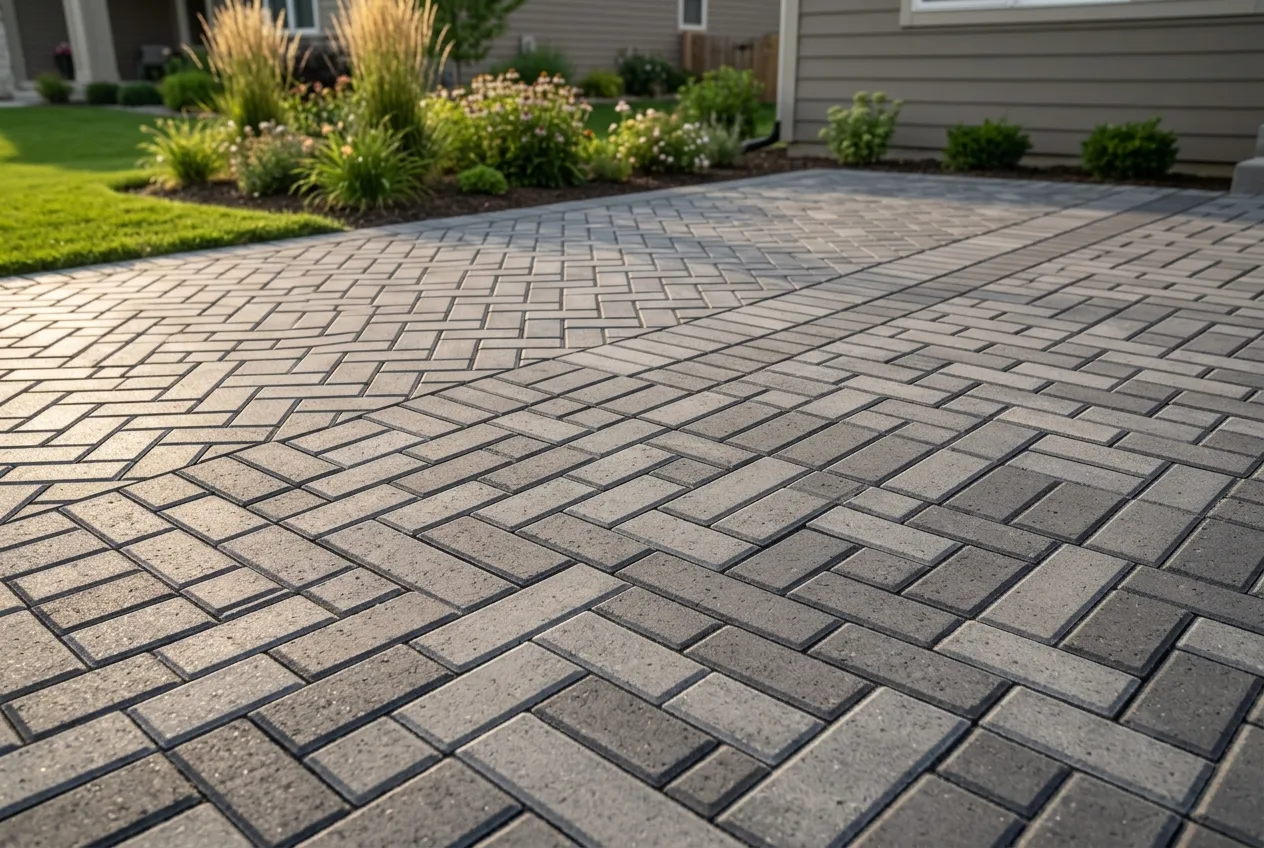
Waste is not a flat percentage you guess — it comes from cutting pavers at the edges, and the laying pattern decides how many cuts you make. Running bond rarely cuts more than the perimeter; herringbone cuts every board at the boundary; curved layouts cut nearly every piece. The waste presets below are the planning numbers the calculator uses:
| Pattern | Waste Preset | What Drives the Cuts |
|---|---|---|
| Stack bond | 5% | Grid-aligned rows; cuts only at the perimeter |
| Running bond | 8% | Each row offset half a paver; perimeter cuts plus a few starters |
| Basketweave | 10% | Pairs of alternating pavers; more cut intersections at edges |
| Herringbone (90° / 45°) | 12% | Every field paver is angled; all four edges cut on the bias |
| Diagonal layouts | 15% | 45° field meets every edge on an angle — no square cuts |
| Curved or irregular | 18% | Radial borders and freeform edges cut nearly every perimeter paver |
Two pattern notes worth knowing before you order. A 45-degree herringbone wastes more than a 90-degree one on a rectangular patio, because the pattern meets every straight edge on an angle instead of squaring up on two sides. And multi-piece patterns — three-piece random layouts sold as sets — should be ordered by pattern repeats: compute the area of one full repeat, divide the project area by it, and round up to whole sets, since manufacturers sell them bundled.
Whatever the pattern, order everything from a single manufacturing batch. Concrete pavers vary slightly in shade between runs, and an extra pallet bought two years later will not match the field. Store the spare pavers flat and dry — they are your future repairs.
The Paver Base System
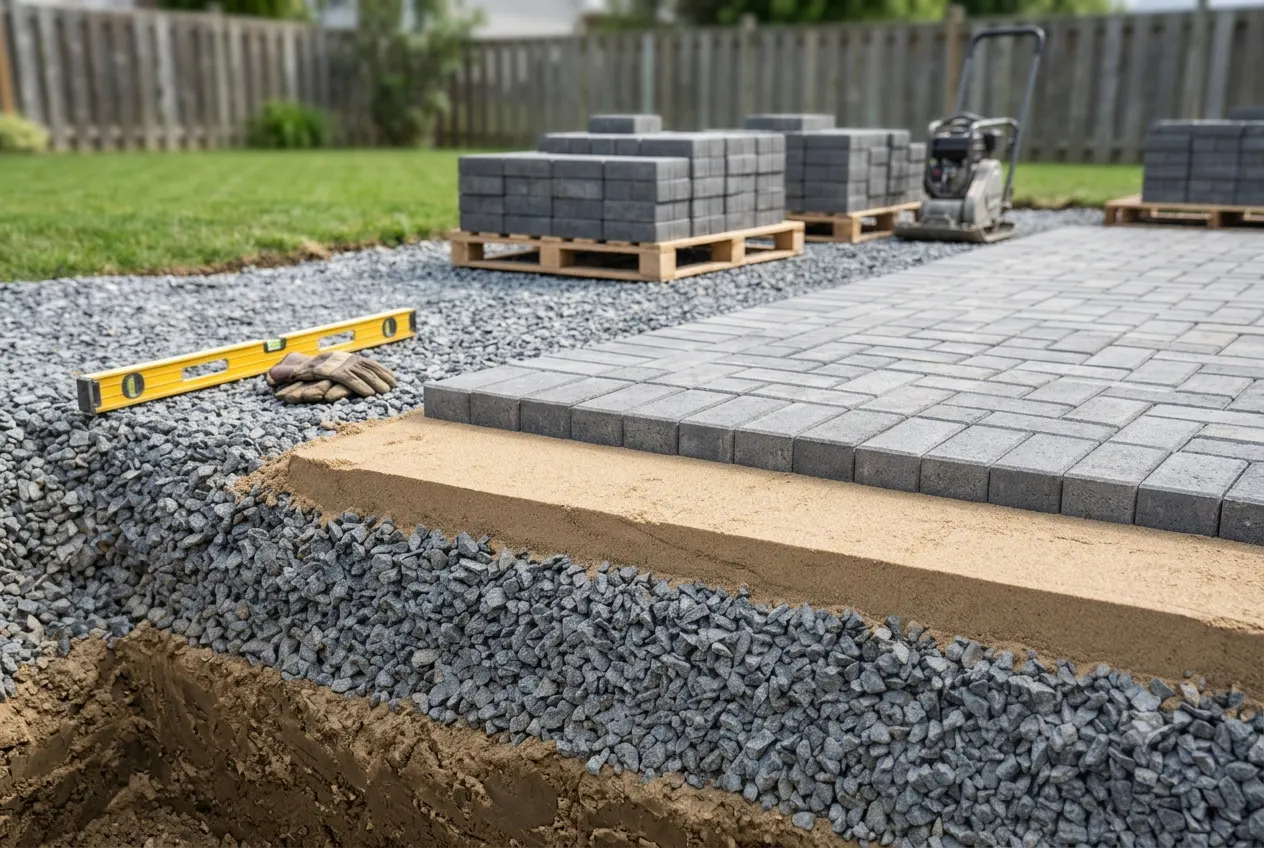
A paver surface is a four-layer system, and the layers below the pavers decide whether it lasts decades or fails in five years. From the bottom up: compacted crushed gravel for structure and drainage, a 1-inch screeded bed of washed concrete sand for leveling, the pavers themselves, and polymeric sand swept and compacted into the joints to lock the field together. The calculator sizes all four layers from your project area:
| Layer | Standard Spec | Why It Matters |
|---|---|---|
| Compacted gravel base | 4″ patios & walkways · 6–8″+ driveways | Spreads load and drains water; the #1 cause of paver failure is a thin or uncompacted base |
| Bedding sand | Exactly 1″ screeded, ASTM C33 washed concrete sand | Levels the pavers; thicker beds settle. Stone dust and play sand hold water and fail |
| Pavers | 2.36″ (60 mm) concrete standard; 80 mm for vehicles | Thicker pavers resist vehicle loads without cracking |
| Polymeric joint sand | Swept into joints, compacted, activated with water | Locks pavers together, blocks weeds and ants, prevents sand washout |
The base numbers in the results already account for compaction: gravel shrinks roughly 20% when compacted, so the loose order volume is 1.2× the compacted depth you specify, with the weight in tons for bulk delivery. Excavate a little deeper than the base on soft or clay soils, and consider a geotextile fabric between the native soil and the gravel — it stops the two from mixing, which is a common cause of undulating patios.
Slope every layer about 1/8 inch per foot away from the house so water sheds off the surface instead of pooling in the joints. And do not skip the edge restraint: plastic or aluminum edging spiked into the base every 12 inches is what keeps the perimeter pavers from spreading under load. Driveways use a poured concrete bond beam instead.
Common Paver Sizes
Pavers are sold by face dimensions, and the piece count climbs fast as the paver shrinks — a 4×8″ brick takes more than four times the pieces of a 12×12″ stone over the same area. The table below lists the common stock sizes, their metric equivalents, and roughly how many of each cover 100 ft² before any joint or waste is added:
| Paver Size | Metric | Face Area | Per 100 ft² | Typical Use |
|---|---|---|---|---|
| 4″ × 8″ | 10 × 20 cm | 0.22 ft² | 450 | The classic Holland-style brick — driveways, walkways, herringbone |
| 6″ × 6″ | 15 × 15 cm | 0.25 ft² | 400 | Patios, accents and border courses |
| 6″ × 9″ | 15 × 23 cm | 0.38 ft² | 267 | Walkways and patio fields |
| 8″ × 8″ | 20 × 20 cm | 0.44 ft² | 225 | Patio workhorse, fast to lay |
| 12″ × 12″ | 30 × 30 cm | 1.00 ft² | 100 | Large patios and courtyards — one per square foot |
| 14″ × 14″ | 36 × 36 cm | 1.36 ft² | 74 | Oversized slab look, premium installs |
| 12″ × 18″ | 30 × 46 cm | 1.50 ft² | 67 | Large-format planks, contemporary layouts |
Thickness is separate from face size: most concrete pavers run 60 mm (2.36″), which is fine for patios and walkways, while vehicle surfaces want 80 mm. Natural stone runs thinner, roughly 3/4″ to 1 1/4″, and large-format porcelain slabs are nominally 3/4″. Confirm the actual face dimension on the product spec sheet — a “6×9” from one mill may measure 5.5″ × 8.5″ actual, and the count follows the actual number, which is exactly what the custom-size fields above are for.
Worked Example
Take the calculator's defaults: a 12 × 16 foot patio (192 ft²) laid with 4×8″ pavers at a 1/4″ joint, running bond at 8% waste, a 4″ gravel base with 1″ bedding sand:
| Step | Calculation | Result |
|---|---|---|
| Effective paver footprint | (8 + 0.25) × (4 + 0.25) = 35.06 in² | 0.2435 ft² |
| Coverage per ft² | 1 / 0.2435 | 4.11 pavers |
| Base pavers | 192 × 4.11 = 788.6 | 789 pavers |
| Pavers to buy (+8%) | 789 × 1.08 = 852.1 | 853 pavers |
| Pallets | 853 × 0.2435 ft² = 208 ft² / 100 | 3 pallets |
| Gravel (compacted) | 192 × 4/12 ÷ 27 | 2.37 yd³ |
| Gravel (loose order, +20%) | 2.37 × 1.2 | 2.84 yd³ (≈3.8 tons) |
| Bedding sand | 192 × 1/12 ÷ 27 | 0.59 yd³ |
| Polymeric sand | 192 / 75 ft² per bag | 3 bags |
| Edge restraint | 2 × (16 + 12) | 56 lf + 56 spikes |
| Paver cost ($0.85 ea) | 853 × 0.85 | $725.05 |
The joint is the difference-maker in this table. Ignoring it, the same patio computes 864 base pavers and an order of about 934 after waste — 81 pavers (9%) more than the 853 you actually need, because the naive method pretends the joints take up no field area. For comparison, switching to 12×12″ stones at the same 1/4″ joint drops the order to about 151 pavers — same area, fewer pieces, faster lay day.
Paver Patio Cost
Paver pricing has two parts: the material you order from the count above, and the installation labor, which is quoted per square foot of finished surface. Standard concrete pavers run roughly $10–$20 per square foot installed for patios, $14–$24 for driveways, and $20–$40 for premium clay brick or natural stone. Those figures bundle excavation, gravel base, bedding sand, edging, pavers, and labor — but site conditions move them: removing an old concrete slab, poor access for the skid steer, or major drainage work can add $5–$15 per square foot.
| Paver Type | Material per Paver | Installed per ft² | Notes |
|---|---|---|---|
| Concrete (Holland-style 4×8) | $0.50–$1.20 | $10–$20 | The volume product — most colors, always in stock |
| Premium concrete / slab | $2–$8 | $15–$30 | Larger formats, textured faces, longer lead times |
| Clay brick pavers | $0.80–$2.50 | $18–$35 | Color never fades; harder to cut |
| Natural stone (bluestone, travertine) | $5–$25 | $25–$40+ | Variable thickness adds leveling labor |
DIY cuts the labor line but not the tool line: a plate compactor runs $75–$150 per day to rent, plus a wet saw for cuts, and the excavation is real work — a 12×16 patio at 8″ of excavation moves about 4.5 cubic yards of soil. Estimate both paths with the cost inputs above: price per paver for materials, installed cost per square foot for the turnkey figure. If a pro bid comes in far below the material-only math, ask which layer got thin — the base is the easiest place for an installer to hide a discount.

Frequently Asked Questions
A 12 × 12 foot patio is 144 square feet. With a 1/4 inch joint, each 4×8 paver occupies a 4.25 × 8.25 inch footprint, about 0.243 ft², so the field takes 592 base pavers and the order lands at 640 with 8% waste. An estimator that ignores the joint computes 648 base pavers and sells you about 700 — roughly 9% more than the field actually takes, because it never accounts for the space the joints consume.
Area × depth ÷ 27 gives compacted cubic yards — a 192 ft² patio at 4 inches needs 2.37 yd³. Order about 20% more loose, because gravel compacts down: 2.84 yd³ loose, roughly 3.8 tons. Patios and walkways use 4–6 inches; driveways need 6–8 inches or more, and clay or freeze-thaw soils push higher still.
Exactly 1 inch, screeded over the compacted gravel — never thicker. Bedding sand levels the pavers; it is not a fill layer, and deep sand beds settle under load and create low spots. Use washed concrete sand meeting ASTM C33; stone dust, mason sand, and play sand hold water and fail. A 100 ft² patio needs about 0.31 yd³.
Yes. Without a rigid edge the perimeter pavers creep outward and the field loosens within a season or two. Plastic or aluminum paver edging spiked into the base every 12 inches is standard on patios and walkways; driveways and commercial work get a poured concrete bond beam. A 12 × 16 patio needs 56 lineal feet of edging and about 56 spikes.
Waste tracks the cutting your pattern makes: about 5% for stack bond, 8% for running bond, 10% for basketweave, 12% for herringbone, 15% for diagonal layouts, and up to 18% for curved edges. The calculator applies the preset for the pattern you pick. Order everything from one batch and keep the spares — future repairs need color-matched pieces.
The field uses the same pavers per square foot either way. The difference is at the edges: a 45-degree herringbone meets every straight boundary on an angle, so nearly every perimeter paver is a compound cut, while a 90-degree pattern squares up on two sides of a rectangle. Plan for the higher waste on 45 degrees and expect the lay to take longer.
No. Pavers need compacted crushed gravel under the bedding sand. On bare soil they settle unevenly with the first wet season; on sand alone they pump and shift underfoot. The gravel base drains water and spreads load — it is the single biggest difference between a paver installation that lasts decades and one that fails within five years.
Roughly $10–$20 per square foot installed for standard concrete paver patios, $14–$24 for driveways, and $20–$40+ for clay brick or natural stone — including excavation, base, sand, edging, pavers, and labor. A 12 × 16 patio with 4×8 concrete pavers lands around $2,300–$3,900 turnkey. Use the installed-cost input in the advanced options to price your own area.
References
- Interlocking Concrete Pavement Institute (now NCMA), “Tech Spec: Interlocking Concrete Pavements” — base thickness, bedding sand, and edge restraint standards, ncma.org
- Belgard, “Paver Installation Guide” — 4–6″ compacted aggregate base and 1″ bedding sand specs, belgard.com
- ASTM International, “ASTM C33 — Standard Specification for Concrete Aggregates” — washed concrete sand gradation for bedding layers, astm.org
- Concrete Masonry & Hardscape Association (CMHA), “Segmental Retaining Wall & Paver Construction Details” — edge restraint and compaction practice, masonryandhardscapes.org
Disclaimer: The paver calculator results on this page are estimates for planning purposes only. Actual quantities vary with paver milling tolerances, laying pattern, edge cuts, subgrade conditions, and manufacturer specs. This tool does not verify structural base design, drainage, or local code compliance — confirm base depths and installation practice against your paver manufacturer's installation guide and your local building department before ordering materials or building.
Ordering pavers but also pouring a footing or edging? Get the concrete right with the concrete calculator, or get quotes from hardscape contractors near you.
Get Free Estimates