
Enter Project Details
Results update live as you type. Mixed units welcome.
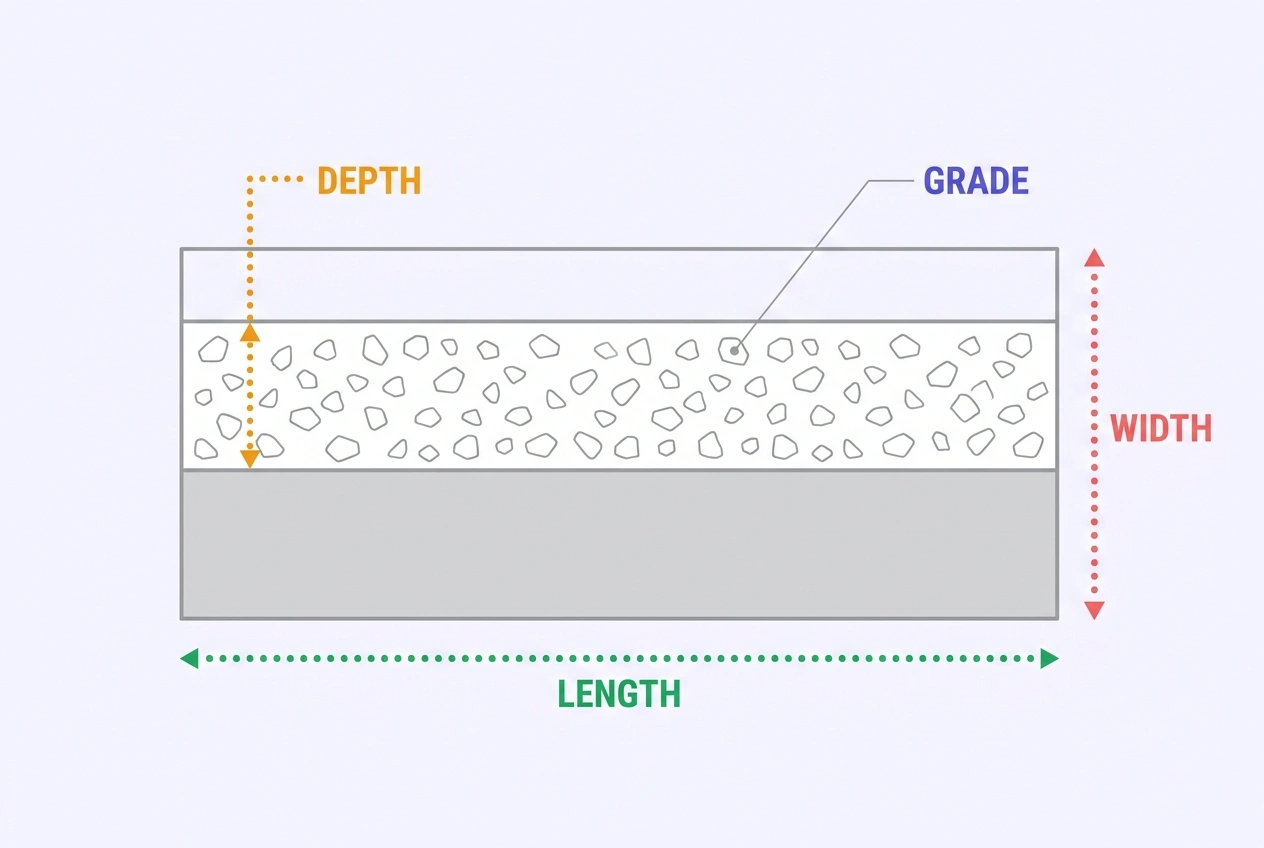 20 feet
10 feet
Total Area: 200 sq feet
6 inches
#57 stone


Results
Volume
Weight
Coverage & Waste
Calculation Assumptions
What You Get
- ✓Free — no sign-up, nothing to install
- ✓Live results as you type
- ✓Tons and cubic yards from area × depth
- ✓Grade dropdown with real per-grade densities
- ✓Volume-only input mode for known quantities
- ✓Rectangle, circle, triangle & custom areas
- ✓Known-volume input mode — skip the geometry
- ✓Depth presets by project type
- ✓Waste allowance for compaction & spillage
- ✓Coverage per ton at your depth
- ✓Bag count with bag-size selector (0.33–2 ft³) & bulk advice
- ✓Truck-load sizing for ordering
- ✓Cost per ton or per yd³ + delivery fee
- ✓Export a PDF takeoff in one click
- ✓Shareable link that saves your inputs
- ✓Works on phone, tablet & desktop
ON THIS PAGE:
How the Stone Math Works
Crushed stone is planned by volume but sold by weight, and the whole estimate is three short steps: area times depth gives volume, a waste allowance converts that to an order, and the grade's density converts the order to tons. The calculator runs it like this:
volume (yd³) = area (ft²) × depth (ft) ÷ 27
order (yd³) = volume × (1 + waste%)
tons = order × density (t/yd³)
Two details carry most of the accuracy. First, the waste allowance is not optional padding: compacted dense-graded base loses 15–20% of its loose delivered volume as it locks down, and even spread-as-delivered stone loses 5–10% to spillage, uneven subgrade, and edges that are not square. Second, the density is a material property that varies by grade — the same volume of traprock outweighs river rock by nearly 20%, which on a 10-ton order is almost 2 tons of stone you did not budget for.
The depth you enter should be the finished, compacted depth. If you specify a compacted depth and use a loose delivery density, the waste allowance is what reconciles the two states — which is why compacted base work belongs at 15–20% and loose decorative fill at 10%.
Volume-only estimating. If a supplier has already quoted you a quantity — or an old takeoff says 4 yards — switch the Custom Area card to Volume and enter it in yd³, ft³, or m³. The calculator skips geometry and depth entirely and runs the same waste → tons → cost chain on your number, so the grade dropdown, waste allowance, bag count, truck loads, and cost modes all still apply.
Stone Grades, Sizes & Densities
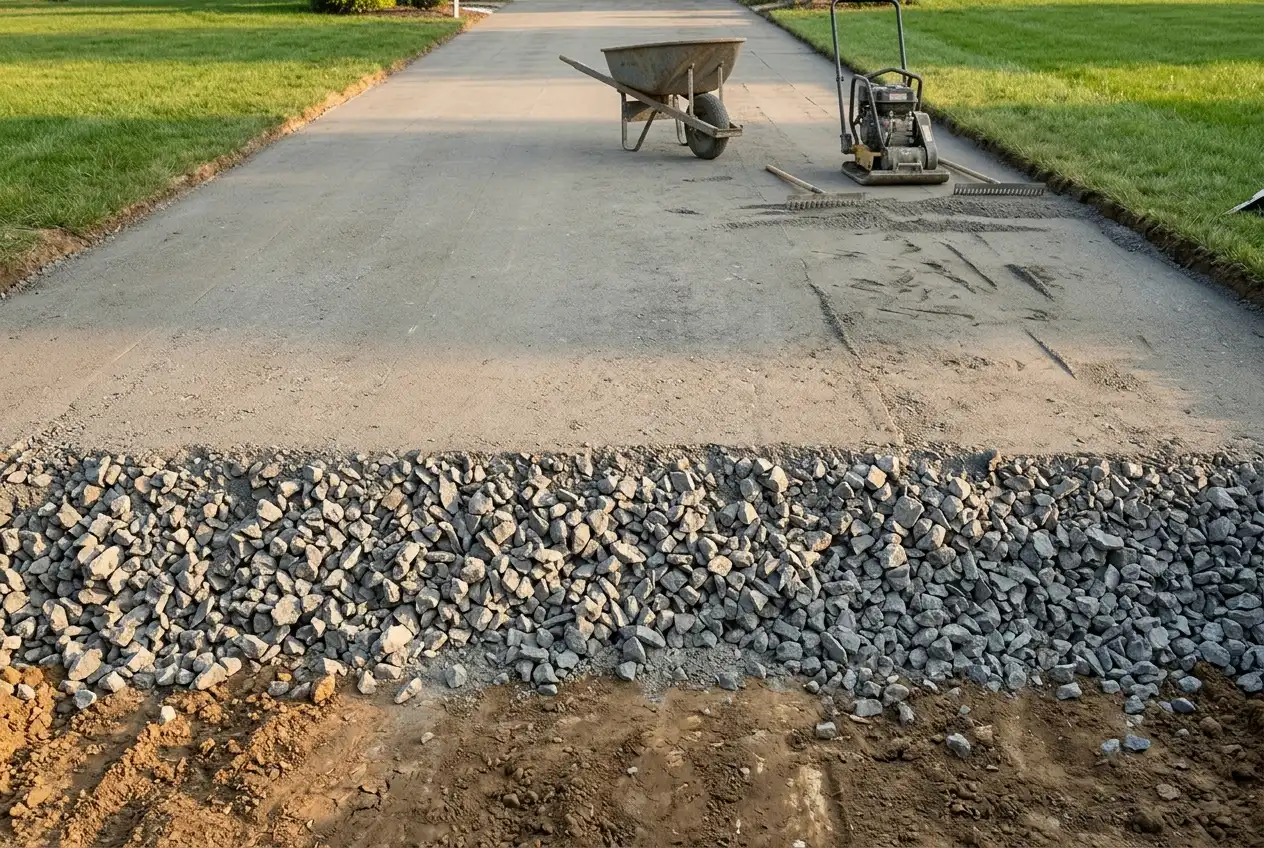
The grade numbers — #57, #67, #411 — are published gradations from ASTM D448, not marketing names. The number tells you the size band; whether the stone compacts or drains is decided by whether the fines were screened out. Both properties are in the table below:
| Grade | Nominal Size | Fines? | Density (t/yd³) | Typical Use |
|---|---|---|---|---|
| #57 | 3/4″ | No (washed) | 1.45 | Driveway surface, drainage, pipe bedding, under slabs |
| #67 | 3/4″ (tighter) | No (washed) | 1.45 | Slab base, road course — denser surface than #57 |
| Crusher run | 3/4″ minus | Yes | 1.50 | Compacted driveway and road base |
| #411 | #57 + screenings | Yes | 1.50 | Paver and patio base |
| #1 / #2 | 2–4″ | No | 1.40 | Heavy sub-base, erosion control, fill |
| #8 | 3/8″ | No | 1.40 | Finishing layer, asphalt/ concrete aggregate |
| Stone dust | < 1/4″ | All fines | 1.40 | Leveling, screenings — drains poorly |
| Recycled concrete | 1–2″ minus | Yes | 1.40 | Economy base, parking areas |
| Pea gravel | 3/8″ rounded | No | 1.35 | Paths, play areas — will not compact |
| River rock | 1–3″ rounded | No | 1.30 | Decorative beds, dry creek beds |
| Rip rap | 4–12″ | No | 1.60 | Erosion control, culvert & ditch lining |
| Cobblestone | 4–8″ rounded | No | 1.40 | Decorative beds, stream banks, borders |
| Lava rock | 3/4–2″ porous | No | 0.78 | Xeriscape, fire pits, lightweight decorative fill |
Densities are typical loose delivery values for US short tons; moisture adds 10–15%, and each quarry's gradation differs slightly. For orders above roughly 10 tons, ask the supplier for the bulk density of the exact product — a two-minute phone call that can swing the delivered weight by half a truck.

Coverage, Bags & Truck Loads
Coverage is the fastest sanity check on any stone order. One cubic yard covers 324 square feet divided by the depth in inches — 108 ft² at 3″, 81 ft² at 4″, 54 ft² at 6″. Divide by the density to get coverage per ton:
| Depth | ft² per yd³ | ft² per ton (#57) | Typical job at that depth |
|---|---|---|---|
| 2″ | 162 | 112 | Decorative beds, borders, top-ups |
| 3″ | 108 | 74 | Walkways, light-traffic paths |
| 4″ | 81 | 56 | Patio and shed pads, resurfacing |
| 6″ | 54 | 37 | Driveway base layers |
| 8″ | 40.5 | 28 | New drives over soft soil (per lift) |
For small jobs, stone comes bagged — most commonly 0.5 ft³ (54 bags per yard), but 40 lb gravel bags hold closer to 0.45 ft³ (60 per yard) and 40 lb sand bags just 0.33 ft³ (81 per yard). Pick the size matching your bag in the form and the count self-corrects; the bulk crossover near one yard still holds at any bag size.
For bulk orders, deliveries arrive by the truckload: a standard single-axle dump carries 10–14 tons, a tandem 14–18, and a semi end-dump 20–25. The results card sizes your order in 20-ton semi loads — and because most yards sell in half-ton increments with a delivery fee per load, one clean full load usually beats two partials on price.

Open-Graded vs Dense-Graded: The Distinction That Decides Your Order
Choosing stone by size alone is the most common ordering mistake in this category. What actually determines whether a layer carries load or drains water is not the stone's diameter — it is whether the mix contains fines, the dust-sized particles that fill the gaps between the stone.
Dense-graded material (crusher run, #411, 2A) runs continuously from coarse stone down to dust. Under a plate compactor the fines migrate into the voids, the air is driven out, and the layer locks into a solid, load-bearing platform — exactly what you want beneath a driveway, patio, or paver field. Open-graded stone (#57, #67) is washed to a narrow size range with the fines removed. Roughly 36–42% of its volume stays as open voids even after rolling: the angular faces interlock, but the layer never closes up. That open structure is precisely why it excels in French drains, under slabs, and in permeable bases — and why vehicles sink into it when it is misused as a driveway base.
Grade names also change at the state line. The same dense-graded base is sold as crusher run in the Southeast, #411 in the Ohio Valley, 2A modified in Pennsylvania, ABC stone in the Carolinas, road base in the West, and DGA in Northeast spec language. When comparing quotes across regions, match the gradation sheet rather than the name — and never assume two products both labeled ¾ inch are interchangeable, because one may be washed and the other dense-graded. The word that decides it is minus: “¾ minus” means everything down to dust and compacts; “¾ clean” or “¾ washed” means fines screened out and drains.
Worked Example
Take the calculator's defaults: a 20 × 10 ft driveway section, 6 inches deep, #57 limestone at 1.45 t/yd³, 10% waste:
| Step | Calculation | Result |
|---|---|---|
| Area | 20 × 10 | 200 ft² |
| Depth in feet | 6 ÷ 12 | 0.5 ft |
| Volume | 200 × 0.5 ÷ 27 | 3.70 yd³ |
| With 10% waste | 3.70 × 1.10 | 4.07 yd³ (110 ft³) |
| Weight | 4.07 × 1.45 t/yd³ | 5.9 tons |
| Coverage check | 200 ft² ÷ 5.91 t | 33.9 ft² per ton |
| Bag equivalent | 110 ft³ ÷ 0.5 | 220 bags — bulk wins |
| Truck loads | 5.9 ÷ 20 | 1 load (minimum) |
| Cost at $35/ton | 5.91 × $35 | $206.76 |
The sanity check runs in the other direction: at 6″, a yard covers 54 ft², so 200 ft² needs 3.7 yards before waste — matching the volume math exactly. Note what the waste allowance is doing here: 6″ is a compacted driveway layer, so 10% is the floor, and a soft subgrade or irregular edges would justify 15%.
Cost & Ordering
Crushed stone pricing tracks the grade and the haul. Typical 2026 US ranges for the material itself:
| Material | Per Ton | Per yd³ | Notes |
|---|---|---|---|
| Recycled concrete | $12–$25 | $18–$38 | Cheapest base; check local availability |
| Crusher run / road base | $20–$40 | $25–$60 | Compacted driveway and road base |
| #57 / #67 clean stone | $25–$50 | $35–$75 | Drainage, slabs, driveway surface |
| Pea gravel / river rock | $30–$75 | $40–$100 | Decorative; priced closer to landscape yards |
Delivery adds $50–$150 per load in most markets, many yards set a 1-ton or 1-yard minimum, and orders above roughly 20 tons often qualify for contractor pricing of 10–20%. Proximity to the quarry moves the price more than anything else — rural stone country can run half the delivered price of a metro job two states away. Always compare quotes in the same unit: at 1.45 t/yd³, $35/ton and about $51/yd³ are the same money.
Two ordering rules prevent the expensive mistakes. Order everything from one quarry batch — color and gradation drift between runs, and a mismatched top-up shows on any finished surface. And confirm whether the quote is by loose yard or by ton before the truck is scheduled; suppliers price by weight but customers plan by volume, and the density conversion in this calculator is exactly the bridge between the two.
Frequently Asked Questions
A 20 × 10 foot area at 6 inches deep is 100 cubic feet, or 3.70 cubic yards. Adding a 10% waste allowance brings the order to about 4.07 cubic yards, which weighs roughly 5.9 tons at #57 limestone's 1.45 tons per cubic yard — call it 6 tons when ordering, and 15–20% waste if it will be plate-compacted.
Between about 1.3 and 1.55 US short tons depending on grade: clean #57 limestone runs about 1.45 t/yd³, granite-based crushed stone about 1.50, dense crusher run about 1.50, and light rounded materials like river rock closer to 1.30. Wet stone runs 10–15% heavier than dry.
At 1.45 t/yd³, one ton covers about 112 ft² at 2 inches deep, 56 ft² at 4 inches, and 37 ft² at 6 inches. The general rule: a cubic yard covers 324 ÷ depth-in-inches square feet, then divide by the density for tons.
Not as the structural base on its own. #57 is washed, open-graded stone — 36–42% of its volume stays as open voids, so it never compacts dense and wheels sink into it. Use dense-graded crusher run, #411, or 2A for the base, and keep #57 for the surface course or drainage.
Crusher run is dense-graded — everything from the top size down to dust — so fines fill the voids and the layer compacts into a solid base. #57 is single-size washed stone that drains freely but will not compact. A common driveway build-up uses both: compacted crusher run for the base, #57 for the surface.
10% for loose, spread-as-delivered material; 15–20% when the stone will be mechanically compacted, because dense-graded base loses roughly that much loose volume as it locks down. Irregular edges and soft subgrade push the number higher still.
Beds and borders 2–3″, walkways 2–3″, patio and shed pads 4–6″ compacted, driveways 4–6″ per layer — a new drive over soft soil can total 8–12″ built in compacted 2–4″ lifts. Compacting in lifts, never one deep pass, is what makes the base carry load.
One cubic yard is about 54 of the common 0.5 ft³ bags, so past roughly a yard bulk delivery almost always wins — stone that costs $80 bulk can run $400+ bagged. Bags make sense only for small beds, top-ups, and spot repairs under about half a yard.
References
- ASTM D448, “Standard Classification for Sizes of Aggregate for Road and Bridge Construction” — source of the #57, #67, #8 size designations, astm.org
- ASTM D2940, “Standard Specification for Graded Aggregate Material for Bases or Subbases” — dense-graded base gradation bands, astm.org
- U.S. Geological Survey, “Crushed Stone Statistics and Information” — production and material data, usgs.gov
- Federal Highway Administration, “Pavements and Pavement Design” — aggregate base layers, compaction, and subgrade preparation guidance, fhwa.dot.gov
Disclaimer: The crushed stone calculator results on this page are planning estimates only. Actual delivered weight varies with quarry, gradation, and moisture (±10% is common), and correct base depth depends on soil, drainage, and loading. Confirm density, gradation, and price with your supplier before ordering, and follow the governing specification where one applies.
Building a patio or shed on top of the stone? Size the surface with the paver calculator, or get quotes from local gravel suppliers near you.
Get Free Estimates