
Enter Project Details
Results update live as you type. Mixed units welcome.
 50 feet
20 feet
4 inches
Screened topsoil


Results
Volume
Weight
Bags
Delivery & Coverage
What You Get
- ✓Free — no sign-up, nothing to install
- ✓Live results as you type
- ✓Delivered loose vs in-place volume, side by side
- ✓Cubic yards, tons and metric tonnes from real densities
- ✓Rectangle, circle, triangle, custom & known-volume modes
- ✓Application depth presets, topdressing to raised beds
- ✓Waste allowance plus separate compaction allowance
- ✓Bag counts in four sizes & the bulk crossover flagged
- ✓Truck loads, coverage per yard & total area covered
- ✓Cost per yard, ton or bag + delivery fee, ten currencies
- ✓PDF takeoff export & shareable link that saves inputs
- ✓Works on phone, tablet & desktop
ON THIS PAGE:
How the Topsoil Math Works
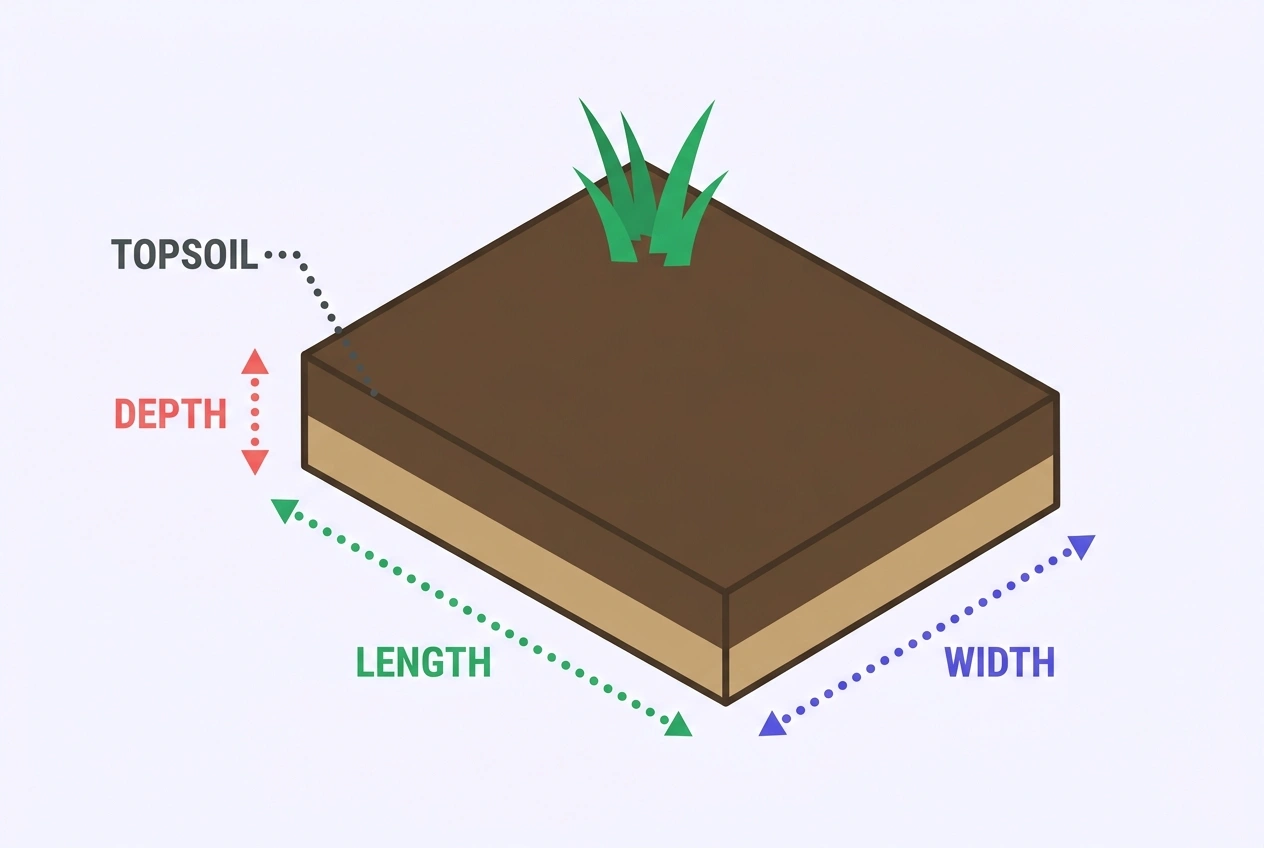
A topsoil calculator answers one geometry question: how much space does the soil layer occupy? Multiply the area you want to cover by the depth you want it, and the volume falls out. Everything after that — waste, weight, bags, trucks, cost — is conversion, not guesswork:
This topsoil calculator then adds two independent allowances. The waste allowance (10% by default) covers settling after the first watering, spillage, and uneven subgrade — screened topsoil loses real volume as it settles into place. The compaction allowance is separate and optional: deep fills placed and tamped in lifts need extra loose material to hit a finished height, which is why delivered-loose yards run higher than finished yards on structural jobs. For a 4-inch new lawn you leave compaction at zero.
Weight uses the density of the material you select. Screened topsoil runs about 75 pounds per cubic foot dry — 2,025 pounds, or 1.01 tons per cubic yard — while a wet week can push the same yard past 1.35 tons. One density drives both the tonnage and the cost in this calculator, so the numbers on your ticket and your invoice agree.
Prefer metric? The same chain works in meters — area in square meters times depth in meters gives cubic meters, and one cubic meter is 1.31 cubic yards. The unit dropdowns handle the conversion either way.
How Much Topsoil Do I Need?
The honest answer: it depends on depth, and depth depends on the job. A light topdressing over an established lawn needs half an inch; a new lawn from seed needs at least 4 inches of quality topsoil for roots to take; a raised bed filled 12 inches deep is really just a box to fill. The calculator's Application dropdown encodes those proven depths so you start from the right number instead of a guess.
Two quick anchors: one cubic yard of topsoil covers about 324 square feet at 1 inch deep, or 81 square feet at 4 inches. So a 1,000 square foot new lawn at 4 inches takes about 12.35 cubic yards finished — order 13.58 loose with the 10% waste allowance, roughly 13.75 tons of screened topsoil. The same 1,000 square feet as a half-inch topdressing takes just 1.54 cubic yards.
For irregular yards, split the area into rectangles, compute each, and enter the total in Custom Area mode — the depth, waste, weight, bag, truck and cost math all run on whatever area you give it.
How Deep Should Topsoil Be?
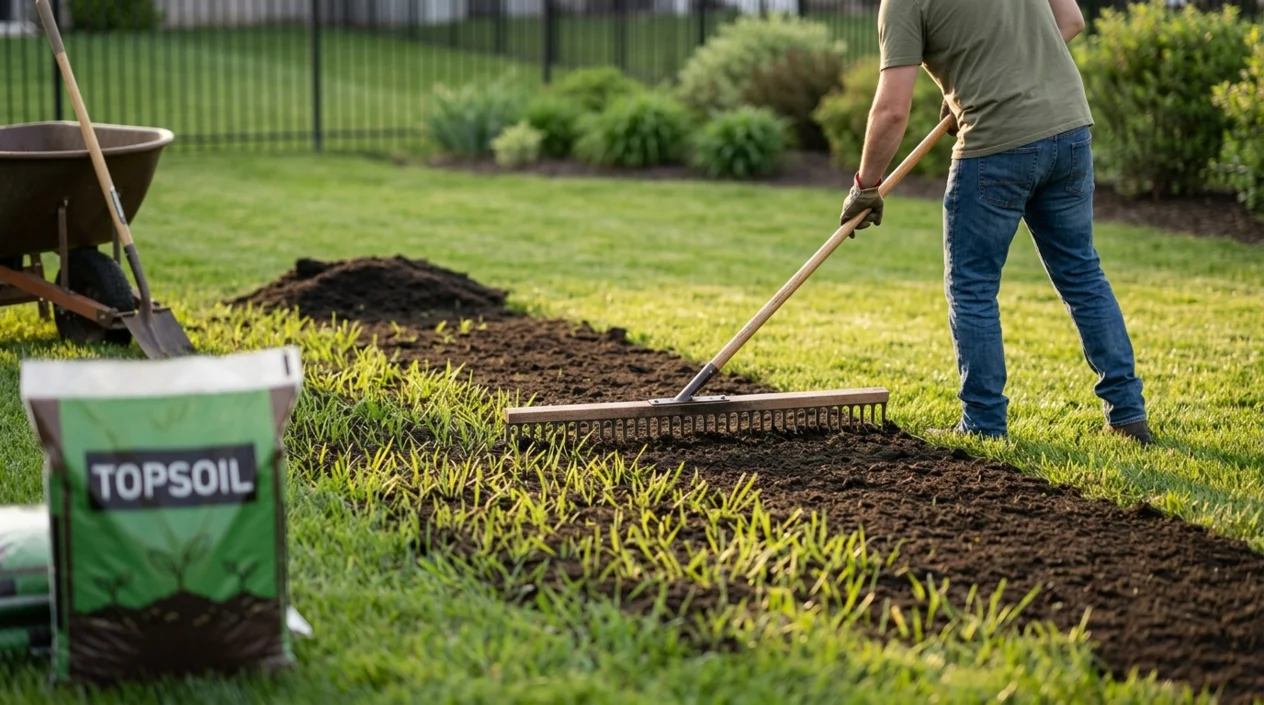
Depth drives the whole order: the same 500 square feet takes 0.77 cubic yards as a 2-inch repair but 6.17 cubic yards as a 4-inch new-lawn base. Match the depth to what you're growing:
| Application | Recommended Depth | Coverage per yd³ | Notes |
|---|---|---|---|
| Lawn topdressing | 1/2 – 1 inch | 324–648 ft² | Screened only; rake into existing grass |
| Overseeding | 1 – 2 inches | 162–324 ft² | Thin layer; seed needs light and contact |
| New lawn from seed | 4 – 6 inches | 54–81 ft² | 4 in minimum for root development |
| Under sod | 2 – 4 inches | 81–162 ft² | Grade and firm before laying |
| Flower beds | 6 – 8 inches | 40–54 ft² | Blend with compost for best results |
| Vegetable gardens | 8 – 12 inches | 27–40 ft² | Deep soil for root crops |
| Raised beds | 8 – 12 inches | 27–40 ft² | Use the bed's inside dimensions |
| Tree & shrub backfill | Hole depth + 6 in | — | Mix with native soil, don't bury the flare |
One rule saves the most money: use cheap fill dirt to build bulk grade below the root zone, and spend on quality screened topsoil only for the top 4 to 6 inches where the plants actually live.
Bags vs Bulk Topsoil
Bagged topsoil typically costs 3 to 5 times more per cubic yard than a bulk delivery once packaging and retail markup are counted — but bags are sealed, dry, easy to stage, and make sense below roughly a quarter to half a cubic yard. The results card shows both at once so the crossover is visible for your exact quantity:
| Amount Needed | Best Purchase | Typical Package |
|---|---|---|
| Under 0.25 yd³ | Bagged | 10–15 bags of 40 lb (0.75 ft³) |
| 0.25 – 1 yd³ | Bags or small delivery | 14–36 bags, or a single trailer load |
| 1 – 5 yd³ | Bulk delivery | One dump truck |
| 5+ yd³ | Bulk delivery | One large or multiple loads |
Two practical notes: one cubic yard is 27 cubic feet — about 36 bags of 0.75 ft³, 27 bags of 1 ft³, 18 bags of 1.5 ft³, or 13.5 (so 14) bags of 2 ft³ — and pallet quantities (typically 30–45 bags) sometimes price close to bulk, so price both when a supplier is nearby. And one sealed spare bag from the same batch is worth keeping for patching; soil color varies between batches just like mortar.

Topsoil vs Garden Soil vs Compost vs Fill Dirt
Suppliers use overlapping names, and buying the wrong one is the most common ordering mistake. The volume math in this calculator is identical for all four — only the density and the price change:
| Material | What It Is | Typical Density | Best For |
|---|---|---|---|
| Screened topsoil | Natural upper soil, sifted to remove rocks and clumps | ≈ 1.01 t/yd³ dry | Lawns, general beds, anything visible |
| Topsoil + compost blend | Topsoil enriched with 25–40% compost | ≈ 0.88 t/yd³ | Vegetable gardens, flower beds, new lawns |
| Unscreened / fill-grade topsoil | Raw topsoil, may contain stones and clods | ≈ 0.95 t/yd³ | Deep fills, grading, under screened caps |
| Fill dirt (subsoil) | No organic matter; compacts hard | ≈ 1.25 t/yd³ | Building grade only — never for planting |
Good topsoil should be dark, crumbly, and smell earthy — not sour. Ask whether it's screened, whether it contains compost, and what the source was; "topsoil" sold off a construction site is sometimes just filtered fill.
Topsoil Coverage Quick Reference
Finished volumes and weights at 75 lb/ft³ screened topsoil — add your waste allowance on top when ordering:
| Area | 1″ deep | 4″ deep | 6″ deep | 12″ deep |
|---|---|---|---|---|
| 100 ft² | 0.31 yd³ (0.31 t) | 1.23 yd³ (1.25 t) | 1.85 yd³ (1.87 t) | 3.70 yd³ (3.75 t) |
| 250 ft² | 0.77 yd³ (0.78 t) | 3.09 yd³ (3.13 t) | 4.63 yd³ (4.69 t) | 9.26 yd³ (9.38 t) |
| 500 ft² | 1.54 yd³ (1.56 t) | 6.17 yd³ (6.25 t) | 9.26 yd³ (9.38 t) | 18.52 yd³ (18.75 t) |
| 1,000 ft² | 3.09 yd³ (3.13 t) | 12.35 yd³ (12.50 t) | 18.52 yd³ (18.75 t) | 37.04 yd³ (37.50 t) |
The tonnage column uses the same 75 lb/ft³ density as the calculator's Screened topsoil option, so the rows and the tool agree — one yard of screened topsoil is about 1.01 tons, and 1,000 square feet at 4 inches is 12.35 yards or 12.50 tons finished.
Topsoil for Raised Beds
A raised bed is just a box to fill: measure the inside length and width, set the depth to the bed's height, and the calculator does the rest. A standard 8 × 4 ft bed filled 12 inches deep takes 32 cubic feet — about 1.2 cubic yards, or roughly 22 bags of 1.5 cubic feet. Round up, because fresh soil settles an inch or two in the first season.
Don't fill a deep bed with straight topsoil. A reliable recipe is 60% topsoil, 30% compost, 10% perlite or coarse sand for drainage — work out the total volume here, then split it by those percentages. Root crops like carrots want at least 10 inches of loose soil; for very deep beds, filling the bottom with logs or branches (hugelkultur) or cheap fill saves money where nothing roots anyway.
Most vegetables are happy in 8 to 12 inches of soil, which is why the Application preset jumps straight to 12 inches — you can always top up next season.
Weight, Trucks & Hauling
Weight decides transport. Dry screened topsoil runs about 75 lb per cubic foot — one cubic yard is 2,025 lb, just over a ton. Moisture is the swing factor: the same yard can weigh 2,700 lb or more after rain, which is why suppliers that sell by weight re-price in wet weeks and why the calculator offers a wet-or-compacted density option at 1.35 t/yd³.
For self-hauling: a half-ton pickup (F-150, Silverado 1500) safely carries about half a cubic yard of topsoil — 1,000 to 1,500 lb depending on moisture. Three-quarter and one-ton trucks handle ¾ to 1 yard. Past one yard, delivery is cheaper than the trips, the suspension, and your back.
For deliveries: standard dump trucks run 10 to 16 cubic yards by volume, and a 12-yard truckload covers about 1,200 square feet at 4 inches deep. Bulk delivery fees typically run $50–$150 per load regardless of distance nearby — one bigger load beats two small ones on fee alone.

Worked Example
Take the calculator's defaults: a 50 × 20 ft new lawn from seed, 4 inches of screened topsoil at 1.0125 t/yd³, 10% waste allowance, priced at $25 per cubic yard:
| Step | Calculation | Result |
|---|---|---|
| Area | 50 × 20 | 1,000 ft² |
| Depth in feet | 4 ÷ 12 | 0.333 ft |
| In-place (finished) volume | 1,000 × 0.333 ÷ 27 | 12.35 yd³ |
| With 10% waste | 12.35 × 1.10 | 13.58 yd³ loose (367 ft³) |
| Weight | 13.58 × 1.0125 t/yd³ | 13.75 tons (27,500 lb) |
| Truck loads | 13.58 ÷ 10 yd³ truck | 2 loads |
| Bag equivalent | 367 ÷ 0.75 | 489 bags — bulk wins |
| Coverage check | 324 ÷ 4 in | 81 ft² per loose yard |
| Cost at $25/yd³ | 13.580 × $25 | $339.51 |
The reverse check: one loose yard covers 81 ft² at 4 inches, and 1,000 ÷ 81 = 12.3 yards finished — matching the volume math, with the waste allowance visible as the extra coverage (about 1,100 ft² protected at the ordered quantity). The 10% allowance is what turns 12.35 into the 13.58 you actually order; without it, the lawn settles closer to 3.6 inches than 4 after its first rain. Switch the preset to Topdressing and the same lawn needs 1.54 yd³ finished — under $40 of material — which is why depth is the first question any supplier will ask you.
Common Topsoil Estimating Mistakes
- Forgetting that soil settles. Fresh topsoil loses volume as it settles and rains in — the 10% waste allowance exists for exactly this. Ordering the finished volume flat leaves a 4-inch lawn about half an inch low after the first season.
- Burying existing grass. More than about 2 inches of new topsoil over living turf smothers it. Build deep grade changes in staged layers across seasons, or kill and strip the sod first.
- Planting in fill dirt. Fill dirt has no organic matter and compacts hard. Use it to build bulk grade, then cap with 4 to 6 inches of screened topsoil as a separate line item.
- Ignoring moisture in the weight. A yard of wet topsoil can weigh a third more than dry — fatal to payload math if you're hauling yourself, and the reason per-ton quotes jump in rainy weeks.
- Measuring outside a raised bed. Walls eat interior volume. Measure inside dimensions and round the depth up for settling, or the first season leaves your bed looking half-filled.
- Buying bags for a big job. Past roughly one cubic yard, bags cost 3 to 5 times more per yard and multiply the labor. The results card shows both so the crossover can't sneak up on you.
Frequently Asked Questions
References
- USDA Natural Resources Conservation Service, “Web Soil Survey” — native soil types, textures, and properties by location, websoilsurvey.nrcs.usda.gov
- USDA NRCS, “Soil Health — Soil Texture & Composition” — bulk density ranges for mineral soils, nrcs.usda.gov
- University Extension turf guidance (e.g. Penn State Extension, “Lawn Establishment”) — recommended topsoil depths for seeding and sodding, extension.psu.edu
- Mulch & Soil Council, product certification standards — bagged topsoil volume and labeling conventions, mulchandsoilcouncil.org
Disclaimer: The topsoil calculator results on this page are planning estimates only. Delivered volume and weight swing with moisture and handling — a rain-soaked load can weigh 30% more than the same yards on a dry day — and screened topsoil settles after its first watering or rainfall, so ordered yards always run above finished yards. Confirm screening, density, and price with your supplier before ordering.
Lawn bed sized and ready to green up? Size the fill dirt that builds the grade underneath, or get quotes from local topsoil suppliers near you.
Get Free Estimates