
Enter Sand Dimensions
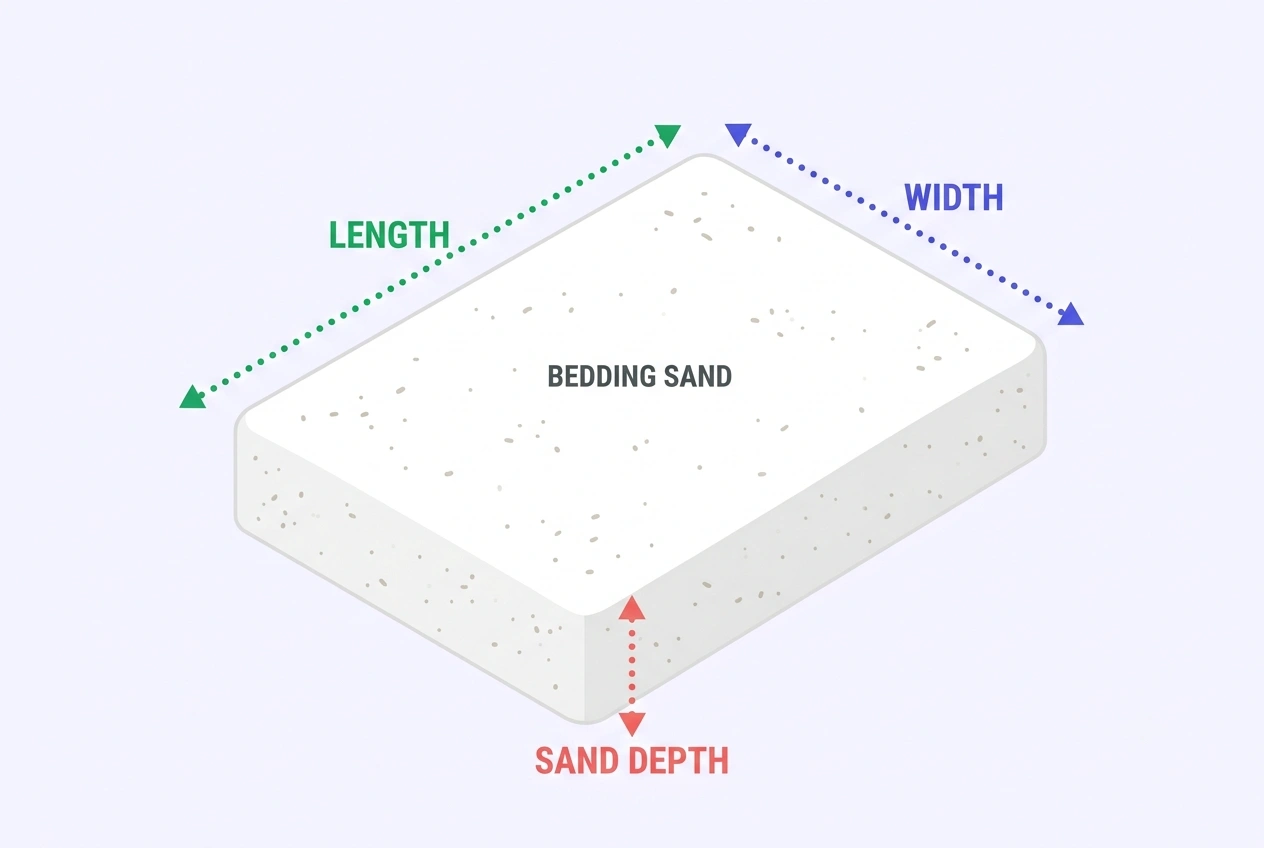
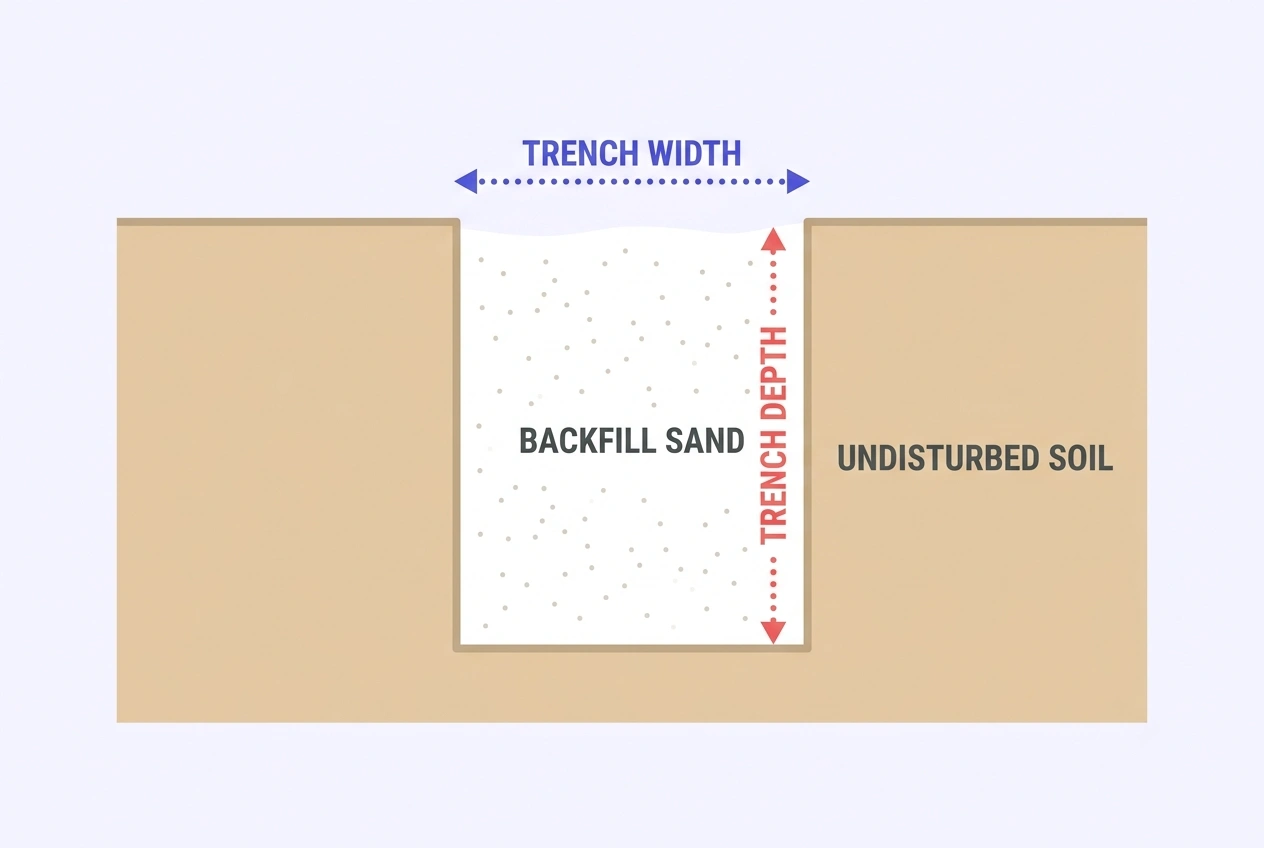
Choose a shape, set the sand depth and moisture state, and optionally enter a price. Results update live as you type.
Results
Volume
Weight
Bags Needed
Coverage
Cost Estimate
Calculation Assumptions
What You Get
- ✓Free — no sign-up, nothing to install
- ✓Live results as you type
- ✓Feet, inches, cm, meters & yards — mix any units
- ✓Dry, damp & wet sand density states
- ✓Export a PDF takeoff in one click
- ✓Shareable link that saves your inputs
- ✓Works on phone, tablet & desktop
- ✓Rectangle, circle & known-area shapes
- ✓Tons, cubic yards & 50 lb bags output
- ✓Five common construction sand types
ON THIS PAGE:
What Is a Sand Calculator
A sand calculator estimates how much construction sand you need for a project based on the area dimensions, the depth of the sand layer, and the sand's moisture state. It converts your measurements into cubic yards, US tons, 50 lb bags, and an estimated cost — so you can order the right amount from a bulk supplier or grab the right number of bags.
Getting sand quantities right is trickier than most materials because sand is sold two ways — by volume (cubic yard) or by weight (ton) — and its weight changes with moisture. The same pile of sand can weigh 2,700 lb per cubic yard dry or over 3,200 lb per cubic yard when saturated. That is a 20% swing on identical volume, which is why our calculator asks whether your sand is dry, damp, or wet before converting volume to weight.
Our calculator covers the main construction uses: paver bedding, patio and pool bases, lawn leveling, trench backfill, and general fill. Choose rectangle, circle, or known-area input, pick from five common sand types, and enter an optional price per ton for cost estimation.
How to Calculate Sand Needed
Calculating sand follows the same volume-first approach as gravel — with one sand-specific step: choosing the right density for the sand's moisture state. Follow these steps:
- Step 1: Measure the area
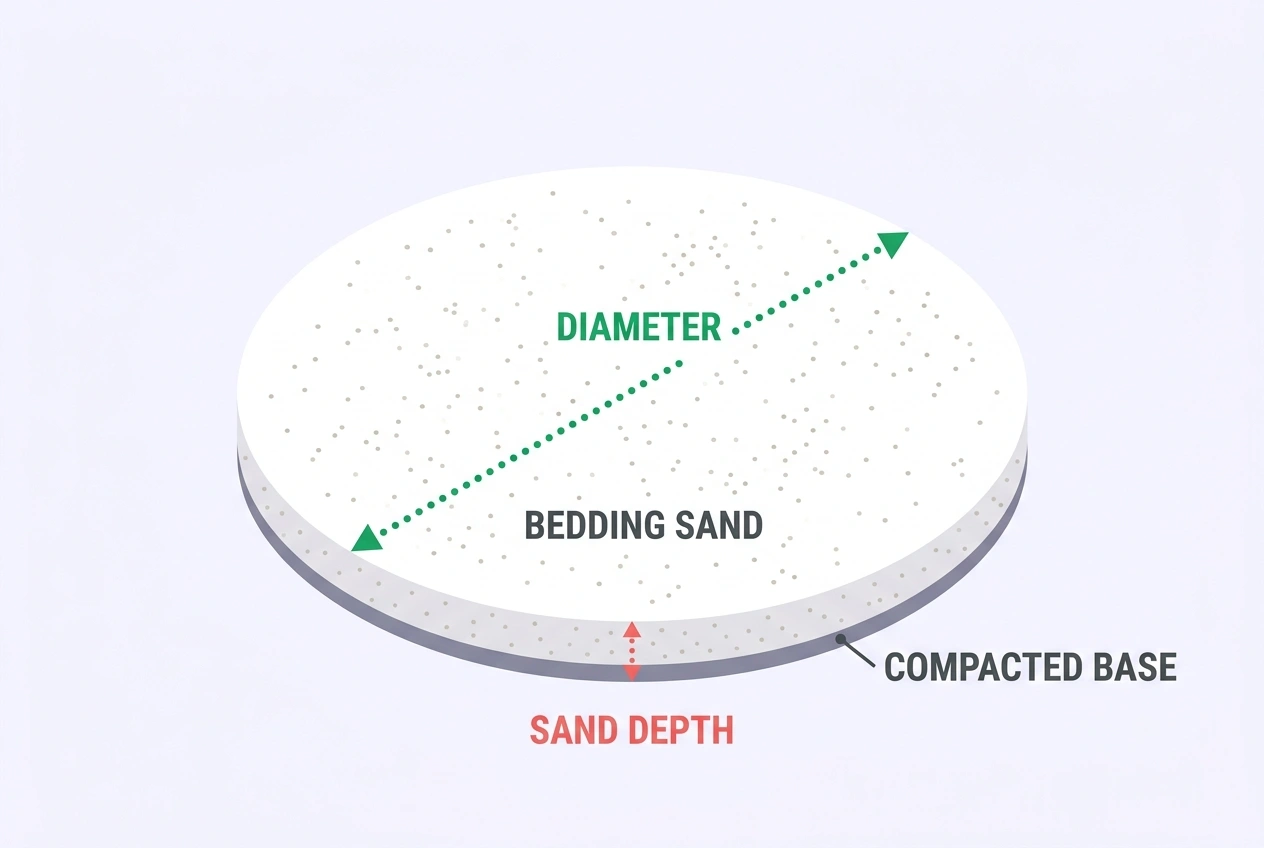
Measure the length and width of the area in feet. For a round pool base, measure the diameter. If you already know the area from a plan, switch to the Known Area shape and enter square feet, square yards, square meters, or acres directly.
- Step 2: Choose the depth
Pick the sand depth from the application: exactly 1 inch for paver bedding, 2 to 4 inches for patio or pool bases, 0.25 to 0.5 inch for lawn topdressing, and 6 to 12 inches for trench backfill. Convert inches to feet by dividing by 12.
- Step 3: Calculate volume in cubic feet
Multiply length × width × depth (all in feet). For a 20 ft × 10 ft patio base at 2 inches deep: 20 × 10 × 0.167 = 33.3 cubic feet. For a circular base: π × radius² × depth.
- Step 4: Convert to cubic yards and tons
Divide cubic feet by 27 to get cubic yards. Then multiply by the density in tons per cubic yard: 1.35 for dry sand, 1.5 for damp sand, 1.62 for wet sand. Example: 33.3 cu ft ÷ 27 = 1.23 cu yd × 1.5 = 1.85 US tons.
- Step 5: Add waste and compaction
Add 10% for waste, uneven subgrade, and moisture loss: 1.23 × 1.10 = 1.36 cubic yards to order. For sand that will be mechanically compacted (trench backfill, pool base), add a 15–20% compaction allowance in the dedicated field. Bedding sand screeded loose over a firm base needs 0% compaction.
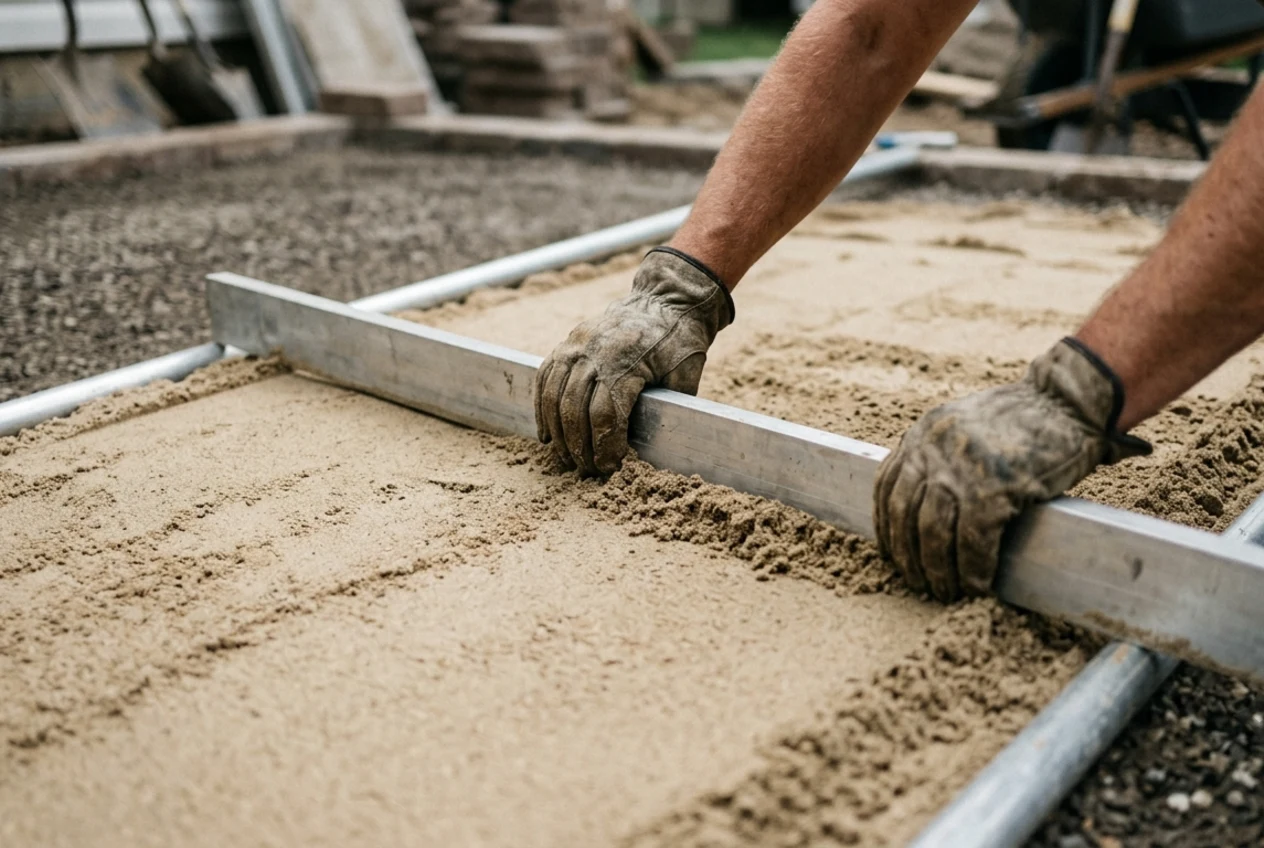
Sand Depth & Application Guide
Sand layers are thin by design — except in trenches and pools. The table below lists the depths pros use and what goes wrong when you deviate.
Typical construction sand depths by application.
| Application | Sand Depth | Sq Ft per Cu Yd | Notes |
|---|---|---|---|
| Paver bedding layer | exactly 1 inch | 324 | Screeded over compacted gravel; thicker beds let pavers shift |
| Patio / walkway base (sand-only) | 2 inches | 162 | Firm, well-drained subgrade only |
| Above-ground pool base | 2 to 3 inches | 108–162 | Mason or play sand protects the liner |
| Lawn topdressing / leveling | 0.25 to 0.5 inch | 650–1,300 | Worked into grass; washed fine sand |
| Trench backfill over pipe | 6 to 12 inches | 27–54 | Compacted in lifts around the pipe |
| General fill & regrading | varies | — | Fill sand is cheapest; add compaction allowance |
The one-inch rule: paver bedding sand must stay at 1 inch. A thicker sand bed feels easier to screed but is the classic cause of pavers that shift, settle, and pool water. Build thickness with compacted gravel below (4 to 6 inches), not with more sand. Total excavation for a paver patio is therefore 5 to 7 inches: 4–6 inches of gravel plus 1 inch of bedding sand.
Construction Sand Types & Densities
Sand types differ mainly in grain size and cleanliness — and those differences decide where each one belongs. Weight-wise they are close, but moisture changes the weight of all of them. Our calculator uses these densities, and Custom Density overrides them.
| Sand Type | Grain | Dry (lb/ft³) | Damp (lb/ft³) | Wet (lb/ft³) | Tons per Cu Yd (damp) | Best Use |
|---|---|---|---|---|---|---|
| Mason Sand (ASTM C144) | Fine, rounded | 100 | 111 | 120 | 1.50 | Paver bedding, mortar, pool liners |
| Concrete Sand (ASTM C33) | Coarse, angular | 102 | 113 | 122 | 1.53 | Concrete mixes, bases, drainage |
| Play Sand | Fine, washed | 98 | 109 | 118 | 1.47 | Pool bases, leveling, sandbox-grade fines |
| Fill Sand | Mixed, unwashed | 95 | 105 | 115 | 1.42 | Backfill, trenches, regrading |
| Silica / Filter Sand | Uniform #20 | 100 | 111 | 120 | 1.50 | Pool filters, specialty industrial uses |
Moisture is the swing factor. Dry sand runs about 100 lb per cubic foot, damp sand about 111, and saturated sand up to 120 — a 20% weight difference on the same pile. Bulk sand is almost always delivered damp, which is why 1.5 US tons per cubic yard is the safest planning number. Confirm with your supplier which moisture state a weight-based quote assumes.
Moisture-state conversions for planning:
| Equivalent | Dry (100 lb/ft³) | Damp (111 lb/ft³) | Wet (120 lb/ft³) |
|---|---|---|---|
| 1 cubic yard weighs | 2,700 lb · 1.35 t | 2,997 lb · 1.50 t | 3,240 lb · 1.62 t |
| 1 cubic meter weighs | 1,600 kg | 1,777 kg | 1,922 kg |
| 1 US ton equals | 0.74 cu yd | 0.67 cu yd | 0.62 cu yd |
| 1 metric tonne equals | 0.66 m³ | 0.60 m³ | 0.55 m³ |
Sand Cost per Yard & Ton
Sand prices vary by type, region, and whether you buy bulk or bagged. Bulk delivery is far cheaper per unit — bagged sand typically costs 4 to 6 times more per ton than a bulk load.
| Sand Type | Bulk (per Cu Yd) | Bulk (per Ton) | Bagged (per 50 lb) |
|---|---|---|---|
| Fill Sand | $15 – $30 | $10 – $25 | $3 – $5 |
| Mason Sand | $25 – $45 | $20 – $40 | $4 – $7 |
| Concrete Sand | $25 – $50 | $25 – $45 | $4 – $8 |
| Play / White Sand | $35 – $55 | $30 – $55 | $5 – $10 |
| Silica / Filter Sand | $40 – $70 | $35 – $60 | $8 – $15 |
Delivery costs: Most suppliers charge $50 to $100 for delivery within a short radius, with per-mile fees beyond that. Minimum loads of 1 to 3 cubic yards are common for delivery. For small jobs under about half a cubic yard (roughly 27 bags of 50 lb), bagged sand from a home improvement store is usually more practical despite the higher per-unit price.
Sand Cost for Common Projects
Estimated costs for typical projects using mason sand at $35 per ton delivered:
| Project | Size | Depth | Sand Needed | Estimated Cost |
|---|---|---|---|---|
| Paver bedding (10 ft × 10 ft) | 100 sq ft | 1 inch | 0.34 cu yd · 0.51 t | $15 – $25 |
| Patio sand base (12 ft × 14 ft) | 168 sq ft | 2 inches | 1.38 cu yd · 2.07 t | $65 – $95 |
| Pool base, 15 ft round | 177 sq ft | 2 inches | 1.45 cu yd · 2.18 t | $70 – $105 |
| Trench backfill (50 ft × 1.5 ft) | 75 sq ft | 8 inches | 2.47 cu yd · 3.71 t | $120 – $170 |
| Lawn leveling (30 ft × 30 ft) | 900 sq ft | 0.5 inch | 1.85 cu yd · 2.78 t | $90 – $135 |
* Estimates use damp-sand density (111 lb/ft³) with 10% waste included. Actual prices vary by region, supplier, and season; delivery is often billed separately.
Worked Example
Let us calculate sand for a 20 ft × 10 ft patio base at 2 inches deep using mason sand, delivered damp:
Step 1: Convert depth to feet
Step 2: Calculate volume in cubic feet
Step 3: Convert to cubic yards
Step 4: Convert to weight (damp sand)
(Using damp mason sand density of 111 lb/ft³ = 1.5 tons/cu yd)
Step 5: Add 10% waste
Step 6: Calculate cost
For this project you would order about 2 tons of mason sand (roughly 1.4 cubic yards, or 55 bags of 50 lb) at an estimated cost of $60 to $90. If the supplier quotes by volume instead of weight, ask for 1.4 cubic yards — same pile, different units. And if the sand-only base will be compacted rather than screeded over firm gravel, add 15–20% compaction allowance on top.
Tips for Ordering Sand
- Confirm the moisture state behind any weight quote
Wet sand weighs up to 20% more than dry sand. If a supplier quotes 3 tons assuming wet sand and you compute your needs from dry weight, you receive about 15% less volume than expected. Ask whether the quote assumes dry, damp, or wet sand — or order by the cubic yard to sidestep the ambiguity.
- Order bulk above half a cubic yard
Bagged sand at $4 to $10 per 50 lb bag works out to roughly $160 to $270 per cubic yard, while bulk mason sand averages $25 to $45 per cubic yard delivered. Around 27 bags equals one cubic yard, so bagged is only practical below that line.
- Keep paver bedding at one inch
More sand under pavers is not safer — it is the classic cause of shifting, uneven patios. Screed 1 inch of dry-ish mason or concrete sand over compacted gravel, lay the pavers, then sweep joint sand into the seams.
- Use mason or play sand under pool liners
Coarse concrete sand can puncture or print through vinyl liners. A 2 to 3 inch layer of fine mason or play sand, dampened and screeded, creates the smooth cushioned base a liner needs.
- Compact backfill in lifts
Trench and structural backfill should be compacted in 6-inch lifts with a plate compactor, adding 15–20% compaction allowance to your quantity. Dumping a trench full of loose sand in one go can settle inches over the first winter.
- Match the sand to the job
Fill sand is cheapest for burying, concrete sand drains and locks for bases, mason sand is fine and smooth for bedding and mortar. Using play sand for a paver bed (too fine, holds water) or concrete sand for a pool liner (too sharp) are the two swaps to avoid.
- Beware hidden fines in cheap sand
Very cheap "sand" is often crushed rock dust with high fines content. It compacts hard like rock, not like sand, and drains poorly — a poor bedding choice even when the price is tempting. Washed sands (C33, C144) cost a little more and behave predictably.

Frequently Asked Questions
References
- ASTM International, "Standard Specification for Concrete Aggregates (C33)" and "Standard Specification for Aggregate for Masonry Mortar (C144)," astm.org
- Interlocking Concrete Pavement Institute, "ICPI Tech Spec 2 — Construction of Interlocking Concrete Pavements," icpi.org
- National Stone, Sand & Gravel Association, "Sand & Gravel Resources," nssga.org
- United States Geological Survey, "Sand and Gravel (Construction) — Mineral Commodity Summaries," usgs.gov
Disclaimer: The sand calculator results on this page are estimates for planning purposes only. Actual quantities may vary based on site conditions, moisture content, compaction, and local material density. Always consult a qualified contractor and verify quantities and moisture assumptions with your material supplier before ordering. Sand prices shown are national averages and will vary by region and supplier.
Need Sand Delivered?
Get free delivery quotes from bulk sand and aggregate suppliers near you.
Get Free Quotes