
Enter Project Details
Results update live as you type. Mixed units welcome.
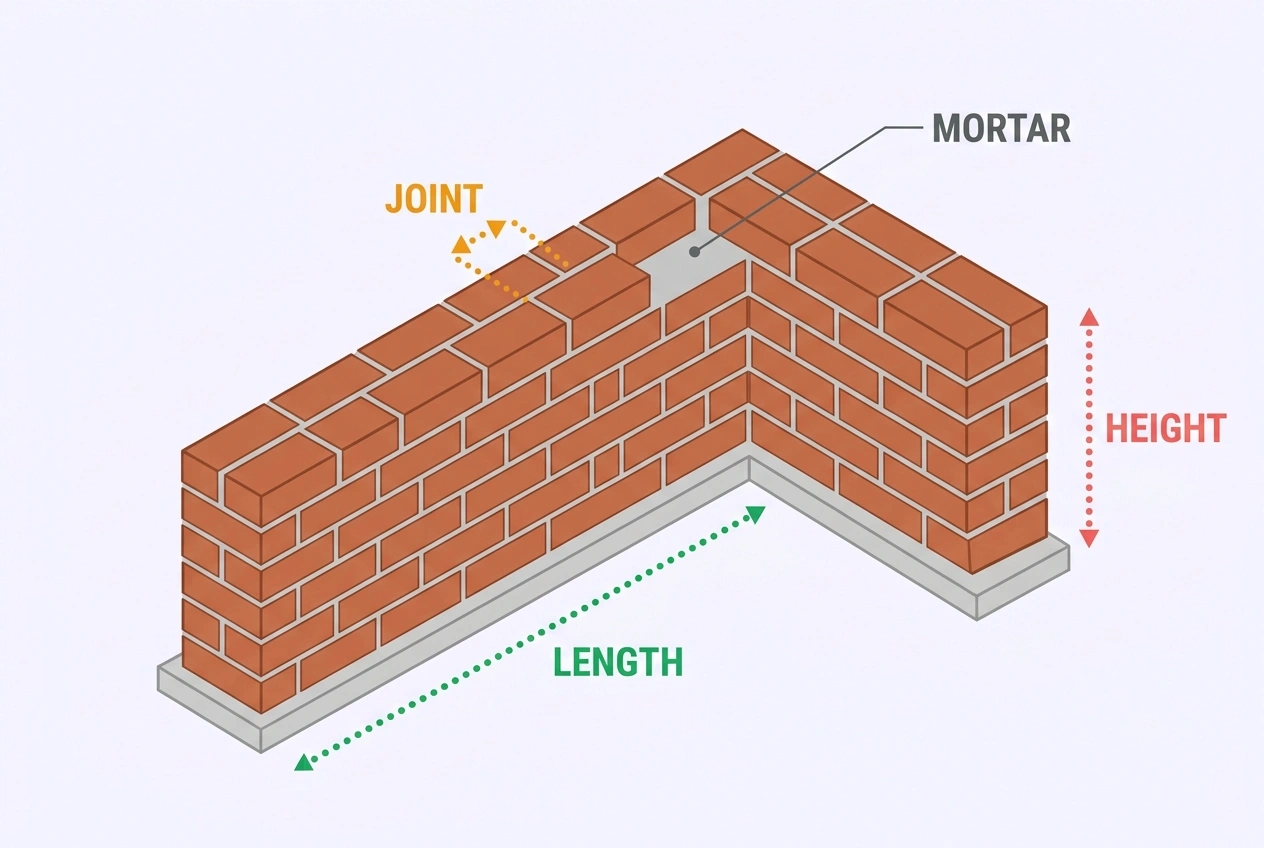 20 feet
8 feet
3/8 inch joint
Modular brick
Results
Wall & Joint Volume
Pre-Mixed Bags
Bag Yield Reference
Batching Notes
Calculation Assumptions
What You Get
- ✓Free — no sign-up, nothing to install
- ✓Live results as you type
- ✓Three modes: wall area, unit count, known volume
- ✓Joint-volume math with per-unit coverage presets
- ✓80 lb, 60 lb & 40 lb bag counts at once
- ✓Custom bag yield from the manufacturer label
- ✓Site-mix mode: cement, sand, lime & water
- ✓Ratios 1:3 to 1:6 plus 1:1:6 gauged mortar
- ✓ASTM C270 types O, N, S, M with psi guidance
- ✓Openings deduction for doors and windows
- ✓Waste allowance with per-unit guidance
- ✓Material cost estimate with currency selector
- ✓Export a PDF takeoff in one click
- ✓Shareable link that saves your inputs
- ✓Works on phone, tablet & desktop
ON THIS PAGE:
How the Mortar Math Works
Mortar fills the joints between masonry units — not the wall itself — and every good estimate starts there. The biggest estimating error in masonry is treating mortar as if it filled the whole wall volume, which over-orders by a factor of 4 to 10. The calculator offers three routes to the same answer:
joint volume (ft³) = net area (ft²) × coverage% × joint (in) ÷ 12
order volume = joint volume × (1 + waste%)
bags = ⌈ order volume ÷ bag yield ⌉
The coverage percentage is the fraction of the wall face occupied by mortar rather than by brick, block, or stone. A standard running-bond brick wall is about 17% mortar; a CMU block wall only about 6% because the units are so much larger; rubble stone with wide irregular joints can reach 30 to 35%. Multiply that share of the wall area by the joint thickness and you have the true mortar volume.
When you already know the unit count — from a takeoff or our Brick Calculator — the yield route is faster: divide the buffered unit count by the units one bag lays. The bag label is the authority here, because manufacturer yields range from roughly 30 to 45 modular bricks per 80 lb bag depending on the mix design. The volume route exists for the third case: a spec or a supplier quote that states mortar in cubic feet or meters directly.
How Much Mortar Do I Need?
For the two questions masons ask most, here are the direct answers. Per 1,000 modular bricks: about 29 bags of 80 lb pre-mixed mortar before waste — order 32 with a 10% allowance. Per 100 standard 8×8×16 blocks: about 9 bags of 80 lb — order 10 with the allowance. In volume terms, a 100-square-foot brick wall at a 3/8-inch joint consumes roughly 0.53 cubic feet of mortar net, and a 100-square-foot block wall about 0.19 cubic feet.
Three variables move those constants more than anything else. Joint size: going from 3/8 inch to 1/2 inch adds about a third to mortar consumption, and doubling the joint doubles it. Unit size: bigger units mean fewer joints — a utility brick wall uses roughly half the mortar of a modular wall of the same area. Unit type: stone veneer consumes 20 to 40% more mortar than brickwork because irregular units demand thicker, fuller joints. The calculator bakes all three into the coverage preset and the joint field.
One more number worth knowing: bag yield. An 80 lb bag of pre-blended mortar yields about 0.60 cubic feet of mixed mortar and lays roughly 35 modular bricks or 12 CMU blocks; a 60 lb bag yields about 0.45 cubic feet; a 40 lb bag about 0.30. If your bag's label states a different coverage, enter it as the custom yield — the label beats any table.
Mortar Types O, N, S, M (and K)
ASTM C270 classifies mortar into types by compressive strength, and picking the wrong type is as costly as picking the wrong quantity. Stronger is not better: mortar that is harder than the brick forces movement into the units, and the brick faces spall instead of the joint. The joint is supposed to be the sacrificial, repairable element:
| Type | Strength | Cement : Lime : Sand | Best For |
|---|---|---|---|
| Type M | 2,500 psi | 3 : 1 : 12 | Below grade, foundations, retaining walls, drive paving |
| Type S | 1,800 psi | 2 : 1 : 9 | Exterior walls, patios, below-grade residential — the default |
| Type N | 750 psi | 1 : 1 : 6 | Above-grade exterior, veneers, chimneys, interior walls |
| Type O | 350 psi | 1 : 2 : 9 | Interior non-load-bearing, historic repair — not for wet exposure |
| Type K | 75 psi | 1 : 3 : 10+ | Historic preservation of soft, pre-1900 masonry only |
For most homeowner projects the choice narrows to two: Type S for anything that touches the ground or takes weather head-on, and Type N for everything above grade, where flexibility and workability matter more than raw strength. In site-mixed terms, Type N corresponds roughly to a 1:1:6 gauged mix and Type S to about 2:1:9 — which is why the mix-ratio selector in the calculator's site-mix mode maps directly onto the ASTM types.
Bag Yield Reference
Midpoint yields for pre-blended mortar — always verify against the coverage printed on the bag you are buying, then enter it as the custom yield if it differs:
| Units | 80 lb Bag | 60 lb Bag | 40 lb Bag |
|---|---|---|---|
| Modular brick | ≈ 35 | ≈ 26 | ≈ 17 |
| Queen brick | ≈ 30 | ≈ 22 | ≈ 15 |
| King brick | ≈ 24 | ≈ 18 | ≈ 12 |
| Utility brick | ≈ 19 | ≈ 14 | ≈ 9 |
| CMU 8×8×16 | ≈ 12 | ≈ 9 | ≈ 6 |
| Stone veneer (flats) | ≈ 14 | ≈ 10 | ≈ 7 |
The volume behind those numbers: an 80 lb bag yields about 0.60 ft³ of mixed mortar, a 60 lb bag about 0.45 ft³, and a 40 lb bag about 0.30 ft³. Yields shift with site practice, sand moisture, and how generously the crew applies joints — regions with fine local sand regularly report higher coverage, which is one more reason the bag label wins over any table.
Pre-Mixed Bags vs Site Mix
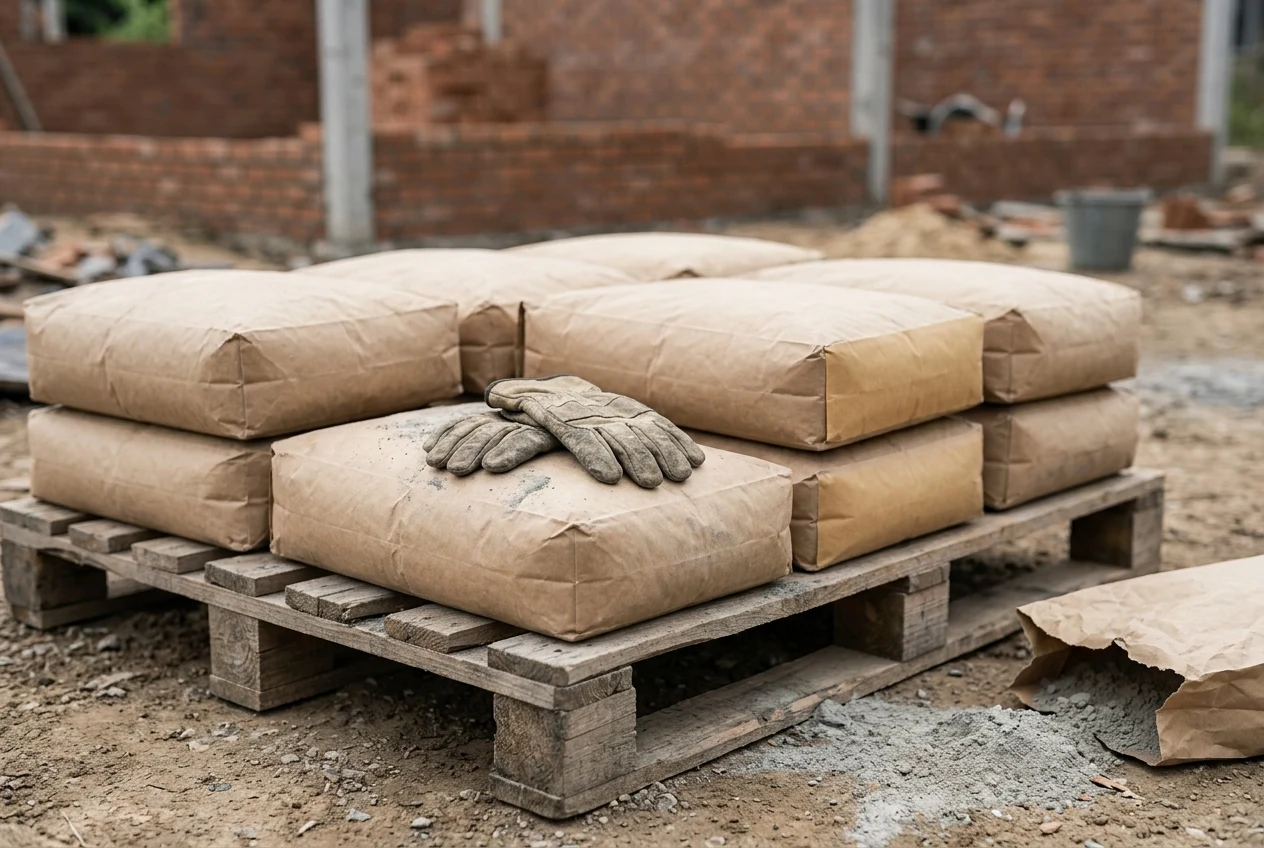
Pre-blended bags cost more per cubic foot but eliminate proportioning errors entirely — sand is pre-graded, cement is pre-dosed, and every batch is identical. Site mixing with bulk sand and bagged cement runs meaningfully cheaper per volume and makes sense once the job is big enough to need more than a pallet of bags:
| Approach | What You Buy | Yield | Best For |
|---|---|---|---|
| Pre-mixed bags | 80/60/40 lb bags of Type N or S blend | 0.30–0.60 ft³ per bag | Small jobs, DIY, patching, color-critical work |
| Site mix | 94 lb cement bags + bulk sand (+ optional lime) | Split by ratio | Walls over roughly a pallet of bags, bulk economics |
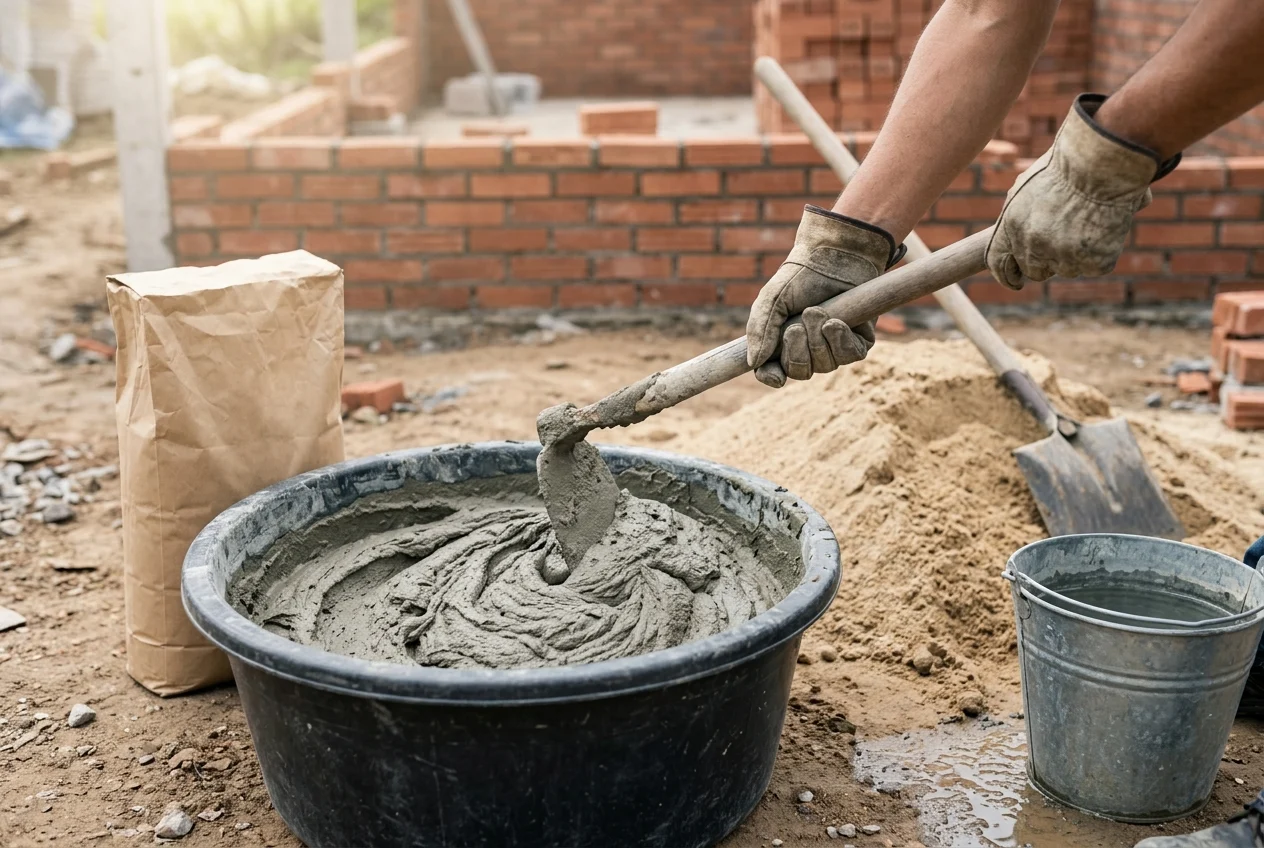
The calculator's site-mix mode splits your order volume by ratio. 1:5 (cement:sand) is the everyday general-purpose brickwork mix. 1:4 suits structural and exposed work; 1:6 is the economical mix for partitions and blockwork; 1:3 is strong but brittle — chimneys and below-DPC work, not soft brick. 1:1:6 gauged adds hydrated lime for workability and flexibility, the traditional choice for soft brick and heritage walls. Cement figures assume 94 lb bags (roughly one cubic foot each); sand is reported in both cubic feet and cubic yards so you can order a delivery, and water is estimated at a 0.5 water-cement ratio — add it gradually; the mix should hold its shape like peanut butter, not pour like slurry.
Repointing & Tuck-Pointing
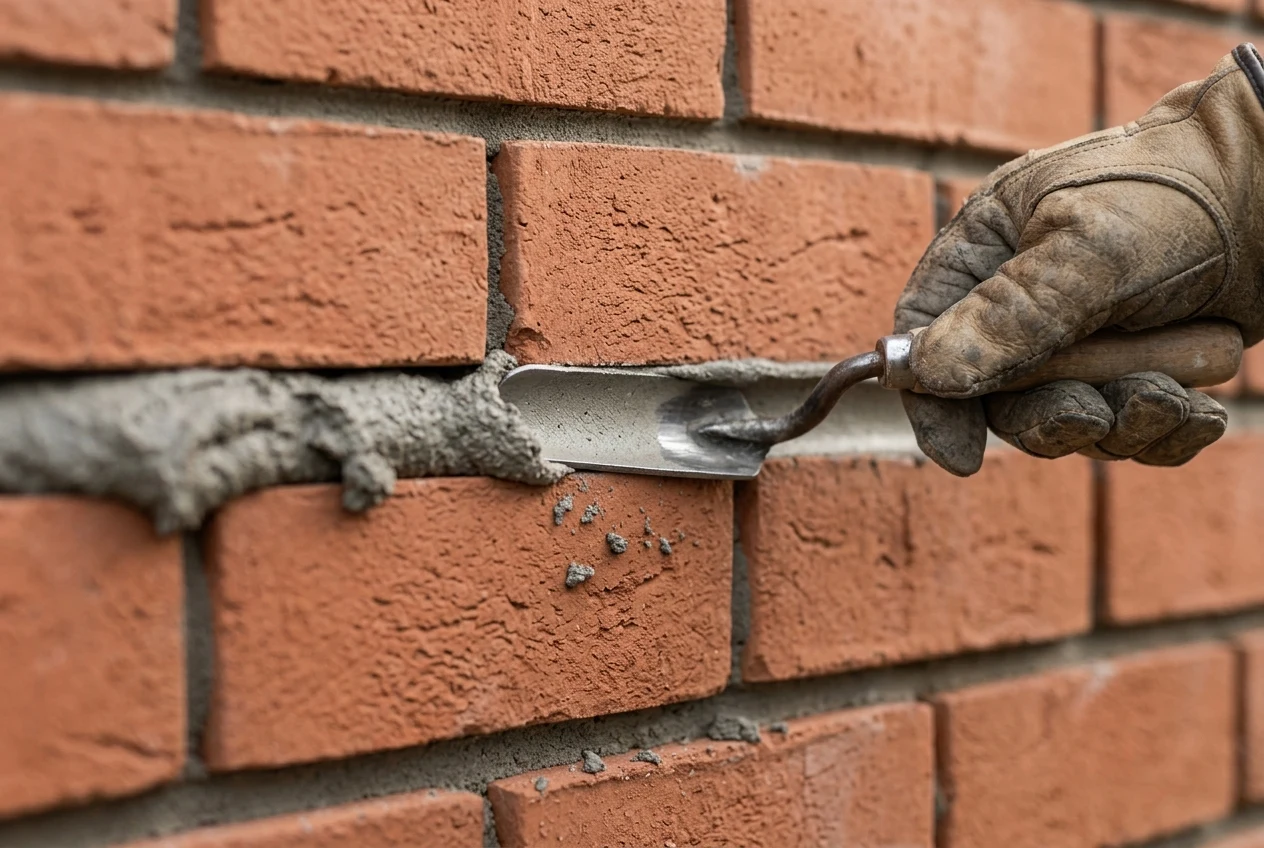
Repointing fills only the outer depth of joints that have been raked out — typically 3/4 to 1 inch deep — not the full joint behind, so the mortar needed is a fraction of a new-wall estimate: roughly 0.25 to 0.35 cubic feet per 100 square feet of brickwork. A practical route: run this calculator with your wall area, joint size, and unit type, then cut the resulting volume by 50 to 70% before ordering.
Mix selection matters more in repointing than in new work. Modern hard brick tolerates 1:3 or 1:4 cement-sand; Victorian and softer stocks want a 1:1:6 gauged mix; pre-1900 lime-pointed walls need natural hydraulic lime, not Portland cement at all — mixing NHL with OPC causes rapid strength loss and cracking. And because mortar color varies between production batches, buy one sealed spare bag from the same lot for future patching; matching a repair to old mortar after the original batch is gone is notoriously difficult.
Common Mortar Estimating Mistakes
- Calculating wall volume instead of joint volume. Mortar fills the joints, not the wall. Treating the whole wall as mortar over-orders by 4 to 10 times — the coverage-percent method in this calculator exists precisely to prevent it.
- Using brick coverage on a block wall. Brick runs about 17% joints; CMU about 6%. Applying the brick figure to a block wall triples the order.
- Ignoring openings. Doors and windows take no mortar. A heavily fenestrated facade can over-order 15 to 30% if the gross area is used.
- Re-tempering stiffened mortar. Adding water to mortar that has begun to set is prohibited by ASTM C270 — it destroys bond strength. Mix batches sized to the 2-hour pot life instead.
- Mixing past the temperature limits. Below 40°F mortar may never cure properly; above 95°F it stiffens faster than a crew can place it. Plan batch sizes around the weather, not just the wall.
- Buying to the exact bag count. Batch color varies. Add the waste allowance, then keep one sealed spare bag from the same lot for repairs.
Worked Example
Let us size the mortar for a 20-foot × 8-foot modular brick veneer wall with a 3/8-inch joint and a 10% waste allowance — the calculator's own defaults.
Step 1: Net wall area
With openings, subtract each in full: a 3 ft × 7 ft door removes 21 sq ft, leaving 139 sq ft net — and every later step drops by the same 13 percent.
Step 2: Joint volume
Step 3: Add the waste allowance
Step 4: Convert to bags
Step 5: Or mix on site (1:5)
Step 6: Cost (at $14 per 80 lb bag)
Frequently Asked Questions
References
- ASTM C270, “Standard Specification for Mortar for Unit Masonry” — mortar types O, N, S, M, proportion and property specifications, astm.org
- Portland Cement Association, mortar materials and mix proportion guidance, cement.org
- Bag yield ranges reflect figures commonly published by mortar manufacturers (pre-blended Type N and S mixes, 80/60/40 lb bags); individual products vary by brand and mix design, so verify against the coverage printed on the bag being purchased.
- Joint-coverage percentages (brick ≈17%, CMU ≈6%, stone 25–35%) are computed from nominal unit and joint dimensions in running bond and match trade estimating practice; site conditions and bond pattern shift the true figure.
Disclaimer: The mortar calculator results on this page are estimates for planning purposes only. Actual mortar consumption varies with joint tooling, unit absorption, bond pattern, site practice, and manufacturer mix designs (±15% is common). Verify quantities against the yield printed on the product you buy and consult a qualified mason for structural work.
Walls sized and mortar ordered? Count the bricks or blocks that go with it — and get quotes from local masonry suppliers near you.
Get Free Estimates