
Enter Wall & Brick Details
Results update live as you type. Mixed units welcome.
 20 feet
8 feet
7.625 inch
2.25 inch
0.375 inch
Results
Wall Area
Brick Count
Mortar
Cost Estimate
Calculation Assumptions
What You Get
- ✓Free — no sign-up, nothing to install
- ✓Live results as you type
- ✓Feet, inches, cm, meters & yards — mix any units
- ✓Export a PDF takeoff in one click
- ✓Shareable link that saves your inputs
- ✓Works on phone, tablet & desktop
- ✓9 brick size presets plus fully custom dimensions
- ✓Door & window openings deducted automatically
- ✓Mortar bags or cement + sand site mix, with cost
ON THIS PAGE:
About Brick Walls
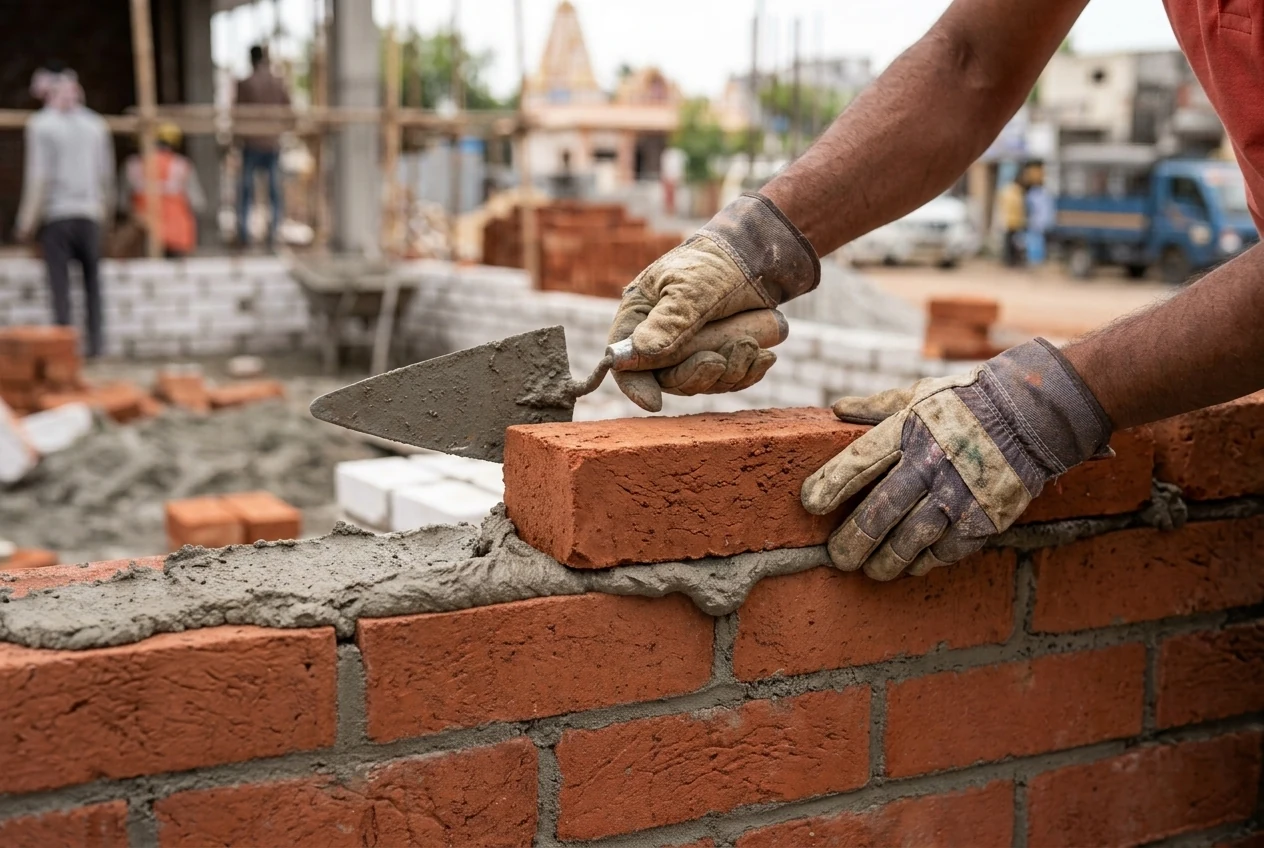
Brick remains one of the oldest and most durable wall materials in construction. Clay or shale bricks are kiln-fired, laid in courses, and bonded with mortar joints that both hold the wall together and define how many bricks a given area consumes. Unlike concrete block, brick is sized by its face — the length-by-height rectangle you see on the wall — and the depth only decides how thick the wall is, not how many pieces the face needs.
That face coverage is what makes brick estimating simple in principle: divide the wall area by the area one brick covers, including its share of the mortar joint on all four sides. A standard modular brick measures 7⅝ by 2¼ inches; add a ⅜-inch joint to each dimension and the covered area becomes 8 by 2⅝ inches, or 21 square inches. One hundred forty-four square inches per square foot divided by 21 gives 6.86 bricks per square foot — the famous "seven bricks per square foot" rule masons quote from memory.
Real estimates also account for the openings you will brick around (or not brick at all), the wall's wythe count, and the waste that breakage and cutting always produce. Bricks arrive by the pallet and sell by the piece or by the thousand, so a one-percent improvement in the count is real money on a house-sized job. The calculator handles the geometry and the packaging so you order the right pallet count the first time.
How the Brick Calculation Works
The calculator converts your wall and brick dimensions into a count, a mortar order, and a cost. Here is the sequence:
- Compute the net wall area — Wall length × height gives the gross area in square feet. Door and window openings are subtracted in full. For very small openings like vents, you can leave the count at zero and let the waste allowance absorb the cuts.
- Find the coverage of one brick — The mortar joint is added to the brick's length and height, and the two sums are multiplied: (length + joint) × (height + joint). This is the wall rectangle one brick occupies, joint included, because every brick shares its joint with the next brick in the course and the course above.
- Count the bricks — Net wall area × 144 (square inches per square foot) ÷ covered area gives the single-wythe count. Multiply by 2 for a double-wythe wall. The waste allowance is applied on top and the result rounds up to a whole brick.
- Estimate mortar — In pre-mixed mode, an 80-pound bag lays roughly 30 to 36 standard bricks with a ⅜-inch joint, so the calculator divides the order by 35 and rounds up. In site-mix mode, the mortar volume equals the wall volume minus the volume of all bricks, converted from wet to dry volume with the 1.52 factor, then split between cement and sand by your mix ratio.
- Price the project — Brick cost uses your price per brick or per 1,000 bricks. Mortar, cement, sand, and optional labor are added for the total. Switch the currency selector and every label and result converts with it.
The math runs entirely in your browser as you type — nothing is uploaded, and the shareable link in the Share panel carries your result to a colleague or client.
How Many Bricks Do I Need?
For most walls the answer comes down to one division. Measure the wall, subtract the openings, and divide by what one brick covers:
Worked the other direction, a standard modular brick with a ⅜-inch joint covers 21 square inches, so one square foot takes 6.86 bricks and one square meter takes about 73. A 10 ft × 8 ft veneer wall with no openings therefore needs 80 × 6.86 = 549 bricks, and once a 10 percent waste allowance is added you order 604. Enter the same wall into the brick wall calculator above and it returns the same number — plus the mortar and cost that a plain brick-and-mortar calculation tends to forget.
Three things move that count the most: larger brick faces cut the count (king-size drops it to about 4.8 per square foot), thicker mortar joints also cut it (each brick consumes a wider slice of wall), and a double-wythe wall simply doubles it. The presets, joint field, and wythe selector in the calculator handle all three.
Brick Sizes & Coverage
Brick names describe face proportions, and each size changes the count. These are the sizes the calculator's presets use, with coverage computed at a ⅜-inch mortar joint from the listed face dimensions:

| Brick Style | Size (D × H × L, inches) | Size (mm) | Weight | Bricks per Ft² | Bricks per M² |
|---|---|---|---|---|---|
| Modular | 3⅝ × 2¼ × 7⅝ | 92 × 57 × 194 | 4.2 lb | 7 | 73 |
| Queen | 3⅛ × 2¾ × 7⅝ | 79 × 70 × 194 | 4.1 lb | 6 | 62 |
| Closure | 3⅝ × 3⅝ × 7⅝ | 92 × 92 × 194 | 6.8 lb | 4.5 | 48 |
| Standard | 3⅝ × 2¼ × 8 | 92 × 57 × 203 | 4.5 lb | 6.5 | 70 |
| Jumbo Standard | 3⅝ × 2¾ × 8 | 92 × 70 × 203 | 5.9 lb | 6 | 59 |
| King | 2¾ × 2⅝ × 9⅝ | 79 × 70 × 244 | 5.6 lb | 4.8 | 52 |
| Roman | 3⅝ × 1⅝ × 11⅝ | 92 × 41 × 295 | 4.7 lb | 6 | 64 |
| Norman | 3⅝ × 2¼ × 11⅝ | 92 × 57 × 295 | 6.4 lb | 4.5 | 49 |
| Utility | 3⅝ × 3⅝ × 11⅝ | 92 × 92 × 295 | 10.2 lb | 3 | 32 |
Modular sizes dominate North American construction because they course cleanly with concrete block: three courses of modular brick match the height of one 8-inch CMU course. Queen brick trades a slightly taller face for a thinner depth, cutting both weight and count. King and Norman brick stretch the face, which is why they need fewer pieces per square foot. Read the per-square-meter column the same way: modular lands near 73 bricks per m², utility near 32 — handy for plans drawn in metric. If your brick does not match a preset, choose Custom and enter the tape-measured dimensions — never the nominal brochure size — for an honest count.
Mortar Guide
Mortar is a mixture of cement, sand, and often lime, and it typically makes up 15 to 20 percent of a brick wall's volume once every joint is accounted for. There are two ways to buy it:
| Method | What You Buy | Coverage | Best For |
|---|---|---|---|
| Pre-mixed bags | 80 lb bags of Type N or S mortar mix | ≈ 30–36 bricks per bag at a ⅜-inch joint | Small jobs, DIY, patching |
| Site mix | Cement bags + loose sand, mixed on site | Split by ratio — 1:4 is the general-purpose default | Large walls, bulk economics |
Mortar strength is set by the cement-to-sand ratio. A 1:3 mix is strong and stiff, suited to below-grade and load-bearing work. A 1:4 mix is the everyday general-purpose wall mix. Softer 1:5 and 1:6 mixes flex with soft brick and are common on interior partitions. If lime is part of your specification, a classic Type N blend is roughly one part cement, one part lime, and six parts sand by volume.
The site-mix path also needs the wet-to-dry conversion: mortar occupies less volume once water is added, so the dry ingredients you actually shovel must be about 1.52 times the wet volume the joints occupy. The calculator applies that factor automatically and divides the dry volume between cement and sand according to your ratio, then converts cement volume to 94-pound bags (one bag is roughly one cubic foot). If you would rather have the bags, cement, and sand worked out for you, the Mortar Calculator applies these same yields and ratios to any brick or block count.
Single vs Double Wythe Walls
A wythe is one vertical layer of brick. A single-wythe wall — the standard brick veneer over a wood or steel frame — is one layer deep, typically 3⅝ inches thick, and its brick count is simply the net face area times the bricks per square foot. A double-wythe wall (called "one-brick thick") stacks two layers bonded together, roughly 7⅝ inches thick, and is the traditional solid load-bearing wall. Brick thickness — the depth dimension — therefore controls the wall's structure and cost per course, but it never changes the face count: a 4-inch-deep brick and a 3⅝-inch-deep brick with the same face need the same number of pieces.

The count scales exactly with the wythes: a double wall of the same face dimensions needs twice the bricks. Mortar rises a little more than twice as fast, because a double wall adds a collar joint between the wythes on top of the bed and head joints. The calculator multiplies both the brick count and the mortar volume by the wythe count when you select double.
For most modern residential projects the answer is single-wythe veneer: it is faster to build, cheaper in material, and the structural work is done by the frame behind it. Double-wythe construction appears in historic restoration, garden and boundary walls, and buildings where the brick itself carries the load. Local codes govern which you can use in structural applications.
Brick Cost Benchmarks
Brick is sold by the piece, but quoted per thousand. These 2026 ranges cover material only — mortar, labor, and scaffolding are separate:
| Brick Grade | Per Brick | Per 1,000 | Typical Use |
|---|---|---|---|
| Common / red builder | $0.35 – $0.70 | $350 – $700 | Hidden walls, foundations, behind stone or siding |
| Standard face brick | $0.50 – $1.20 | $500 – $1,200 | Exterior veneer, visible walls |
| Premium / engineering / glazed | $1.20 – $2.50+ | $1,200 – $2,500+ | Accent work, high-exposure facades, restoration |
Installed veneer work typically lands between $9 and $22 per square foot of wall depending on region, wall height, and scaffolding needs, with premium masonry running higher. Regional supply and freight move brick prices more than most materials — a pallet's weight makes distance expensive — so treat these as planning ranges and confirm with a local supplier quote before ordering. The Brick Industry Association publishes state-average brick pricing that is useful for cross-checking a quote.
Worked Example
Let us estimate brick for a 20-foot × 8-foot veneer wall using modular brick, a ⅜-inch mortar joint, single wythe, and a 10 percent waste allowance.
Step 1: Net wall area
With openings, subtract each one in full: a 3 ft × 7 ft door removes 21 sq ft, leaving 139 sq ft net — and the count in every later step drops by the same 13 percent.
Step 2: Coverage of one brick
Step 3: Bricks per square foot
Step 4: Net brick count
Step 5: Add 10% waste
Step 6: Mortar
Step 7: Cost
Frequently Asked Questions
References
- Coverage figures on this page are computed from the face-coverage formula stated in the How It Works section — (brick length + joint) × (brick height + joint) — using the assumptions displayed with each result (brick preset, mortar joint thickness, wythe count, waste allowance) rather than quoted from manufacturer literature.
- Brick Industry Association (BIA), Technical Notes on Brick Construction and brick square-foot pricing resources, gobrick.com
- Manufacturer brick sizing and coverage data, Glen-Gery brick size guide, glengery.com
- Pre-mixed mortar bag coverage (an 80 lb bag lays roughly 30–36 modular bricks) reflects figures commonly published on mortar manufacturer packaging; individual products vary by brand and type, so check the coverage printed on the bag you buy when precision matters.
Disclaimer: The brick calculator results on this page are estimates for planning purposes only. Actual quantities vary with brick size tolerance, mortar joint variation, bond pattern, breakage, site conditions, and manufacturer specifications. Verify counts against your supplier's figures and consult a qualified mason for structural work.
Need a mason for your brick project?
Get Free Estimates