
Enter Bed & Depth Details
Results update live as you type. Mixed units welcome.
 20 feet
10 feet
3 inches


Results
Bed Area
Mulch Volume
Bags & Weight
Cost Estimate
Calculation Assumptions
What You Get
- ✓Free — no sign-up, nothing to install
- ✓Live results as you type
- ✓Feet, inches, cm, meters & yards — mix any units
- ✓Export a PDF takeoff in one click
- ✓Shareable link that saves your inputs
- ✓Works on phone, tablet & desktop
- ✓Rectangle, circle, tree ring, or known-area beds
- ✓Refresh mode credits the mulch already down
- ✓1.5, 2, 3 or custom bag sizes with bag-vs-bulk cost
ON THIS PAGE:
About Mulch Beds
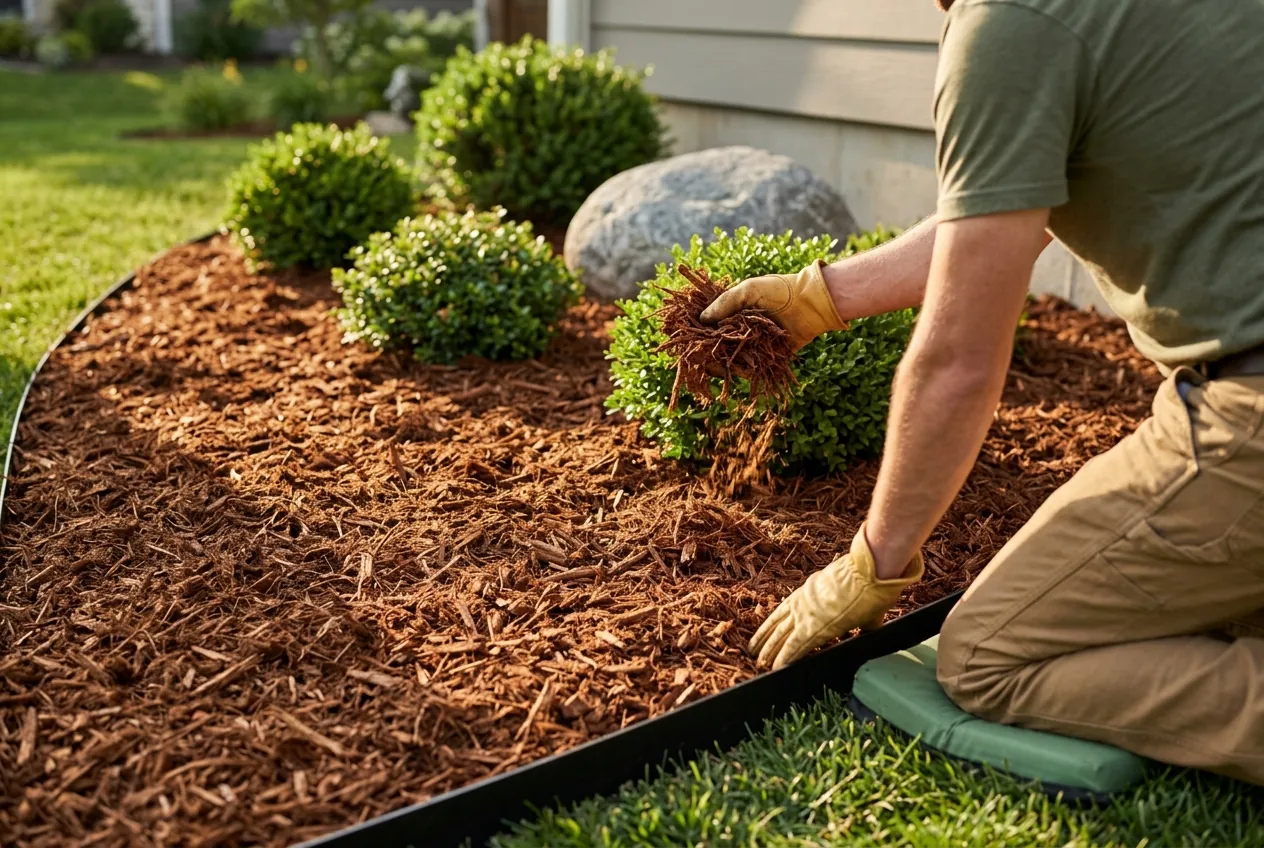
Mulch is a layer of material spread over bare soil — most often shredded or chipped wood, bark, or sometimes rubber and stone — and it does four jobs at once. It shades the soil so moisture evaporates more slowly, blocks sunlight from reaching weed seeds, cushions soil temperature swings between hot afternoons and cold nights, and gives a bed its finished look. A bed that is properly mulched needs less watering, weeding, and erosion repair than the same bed left bare.
What makes mulch awkward to buy is that it is sold two completely different ways: bulk mulch comes by the cubic yard from landscape suppliers, while bagged mulch comes in 1.5, 2, or 3 cubic-foot bags from garden centers and hardware stores. One cubic yard is 27 cubic feet — about 13.5 of the standard 2-cubic-foot bags — so the same bed can be "2 yards" or "28 bags" depending on where you buy. Getting the two to agree is the whole math problem this calculator solves.
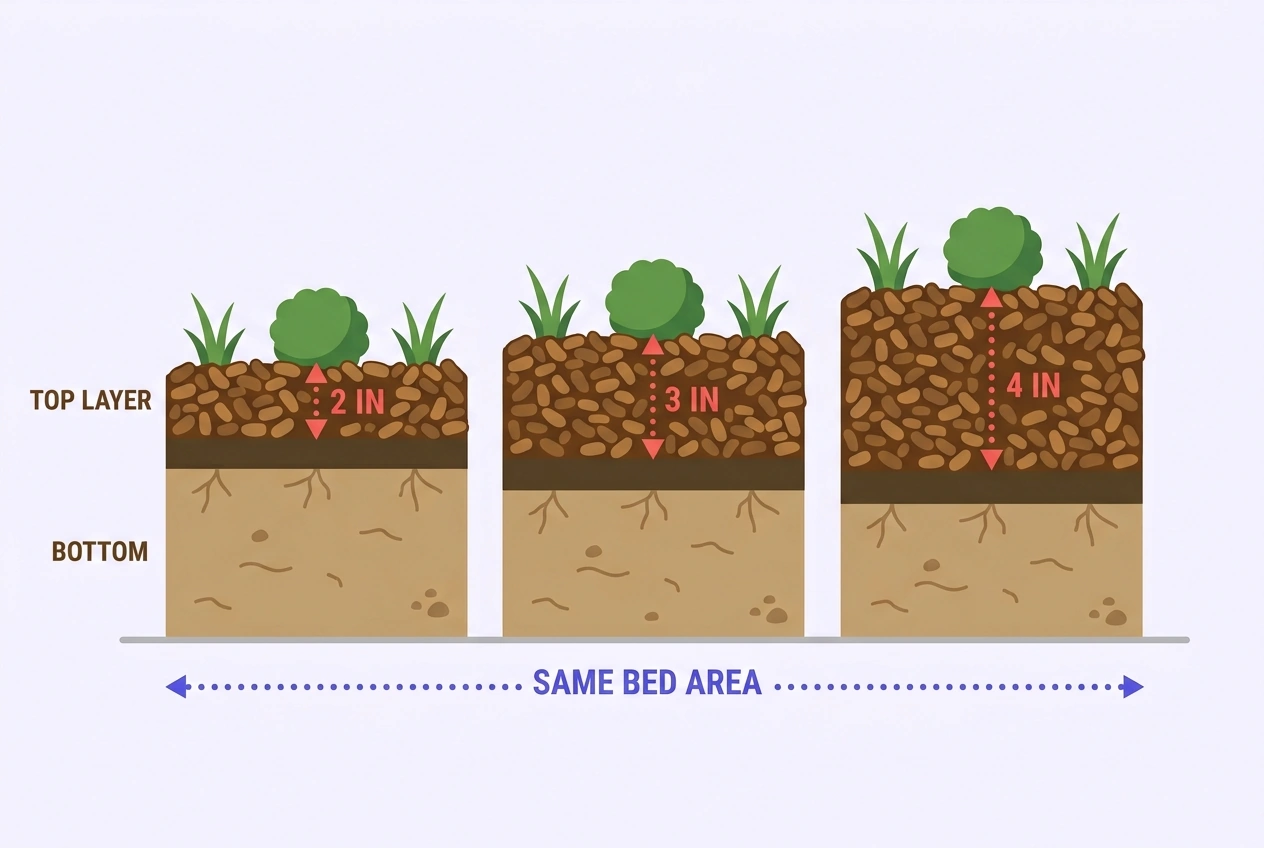
Depth is the other half of the equation. The depth you choose changes the quantity in direct proportion: a 4-inch layer needs exactly twice as much mulch as a 2-inch layer over the same bed. Too thin and weeds push through; too thick and water struggles to reach the roots. That is why the depth guide below is worth two minutes of your time before you order.
How the Mulch Calculation Works
The calculator finds the bed's area in square feet, multiplies it by the depth you still need to fill, adds waste, and converts the result into whatever way you are buying. Here is the sequence using the page's own defaults:
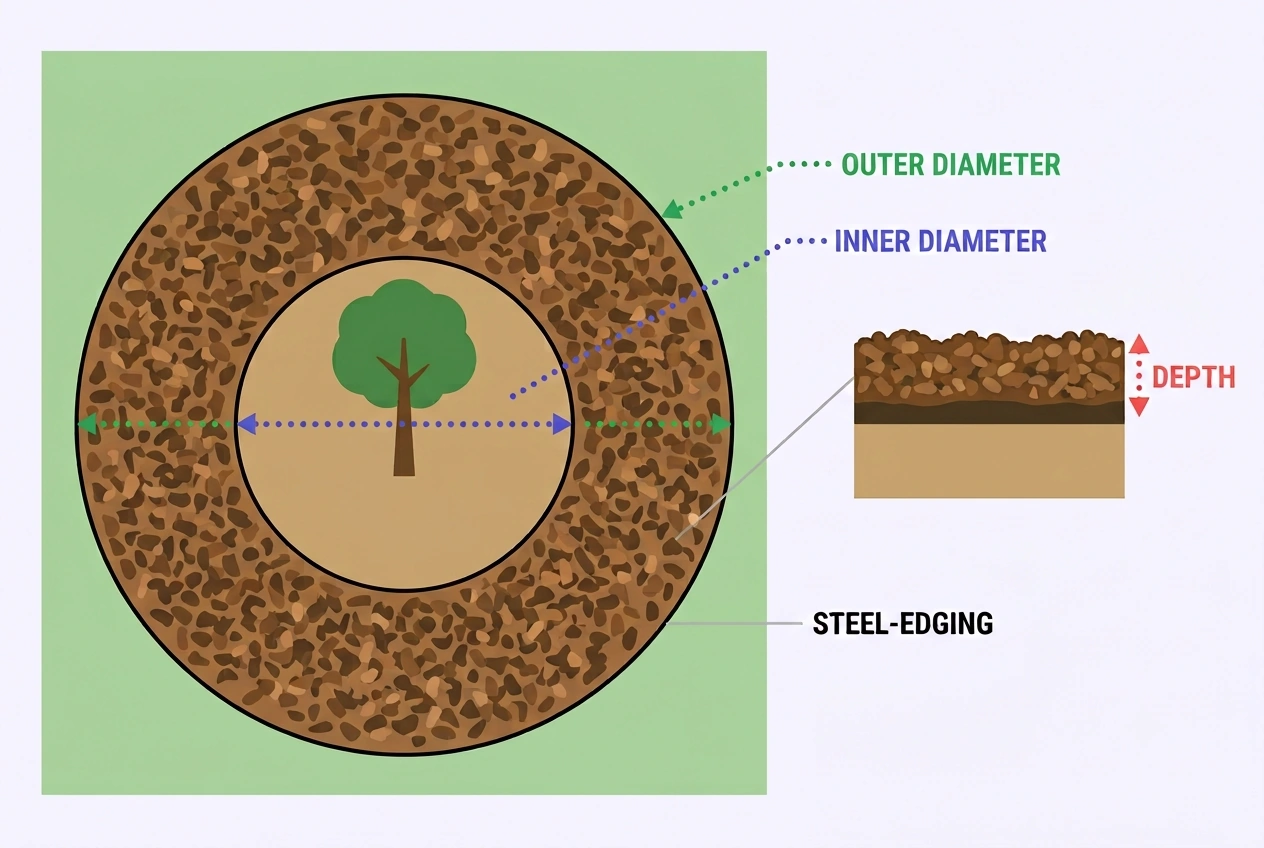
- Compute the bed area — For the default 20 ft × 10 ft rectangle: 20 × 10 = 200 sq ft. Circle beds use π × (diameter ÷ 2)², tree rings subtract the inner trunk circle, and the known-area option takes your square footage directly.
- Find the additional depth — The default bed is new, so the full 3-inch target is still to fill: 3 ÷ 12 = 0.25 ft. On a refresh job the existing mulch depth is subtracted from the target first — 1 inch down on a 3-inch target means you only buy the remaining 2 inches.
- Multiply area by depth — 200 sq ft × 0.25 ft = 50 cubic feet of net volume.
- Add the waste allowance — 50 × 1.10 = 55 cubic feet to order. Waste covers uneven beds, spillage, settling, and the mulch that stays in the wheelbarrow.
- Convert to cubic yards — 55 ÷ 27 = 2.04 cubic yards. This is the number bulk suppliers quote.
- Convert to bags — 55 ÷ 2 (the standard bag) = 27.5, rounded up to 28 bags. Bags always round up because a part-bag does not exist.
- Weight and cost — 55 ft³ × ≈10 lb/ft³ ≈ 550 lb, and 28 bags × $4.00 = $112.00 bagged. Enter a bulk price and the comparison row shows which way of buying wins for this quantity.
Mulch Depth Guide by Application
| Application | Recommended Depth | Notes |
|---|---|---|
| New beds & around trees | 2–4 in | 2 in is fine for fine mulches; coarse bark sits better at 3–4 in |
| Refreshing an existing bed | 1–2 in | Measure the old layer first — it counts toward the target |
| Tree rings | 2–3 in | Keep 3–6 in clear of the trunk; never pile against bark |
| Vegetable gardens | 1–2 in | Use clean, weed-free material; thin layers warm faster in spring |
| Paths & walkways | 3–4 in | Chunky mulch stays put underfoot |
| Slopes | 3–4 in | Fibrous or shredded material resists washing out in rain |
Two limits matter as much as the targets. Below about 2 inches, weeds and soil evaporation come back quickly. Above about 4 inches, a dense layer can shed light rain and restrict oxygen to the roots — extension services recommend bark never exceed roughly 3 inches and wood chips 4 inches for established woody plants.
Mulch Coverage Tables
One cubic yard is 27 cubic feet, so the deeper you spread it, the less area it covers. These are the numbers suppliers quote:
Coverage of One Cubic Yard
| Depth | Coverage per Cubic Yard |
|---|---|
| 1 inch | 324 sq ft |
| 2 inches | 162 sq ft |
| 3 inches | 108 sq ft |
| 4 inches | 81 sq ft |
| 5 inches | 64 sq ft |
Bags per Cubic Yard
| Bag Size | Exact per Yard | Buy (rounded up) |
|---|---|---|
| 1.5 cu ft | 18 bags | 18 |
| 2 cu ft | 13.5 bags | 14 |
| 3 cu ft | 9 bags | 9 |
What One Bag Covers
| Bag Size | at 2 in deep | at 3 in deep |
|---|---|---|
| 1.5 cu ft | ≈ 9 sq ft | ≈ 6 sq ft |
| 2 cu ft | ≈ 12 sq ft | ≈ 8 sq ft |
| 3 cu ft | ≈ 18 sq ft | ≈ 12 sq ft |
Quick mental math: one 2-cubic-foot bag covers about 12 square feet at 2 inches or 8 square feet at 3 inches. Count your bags backward from bed size and you will land within a bag of the calculator's answer.
Mulch Types Compared
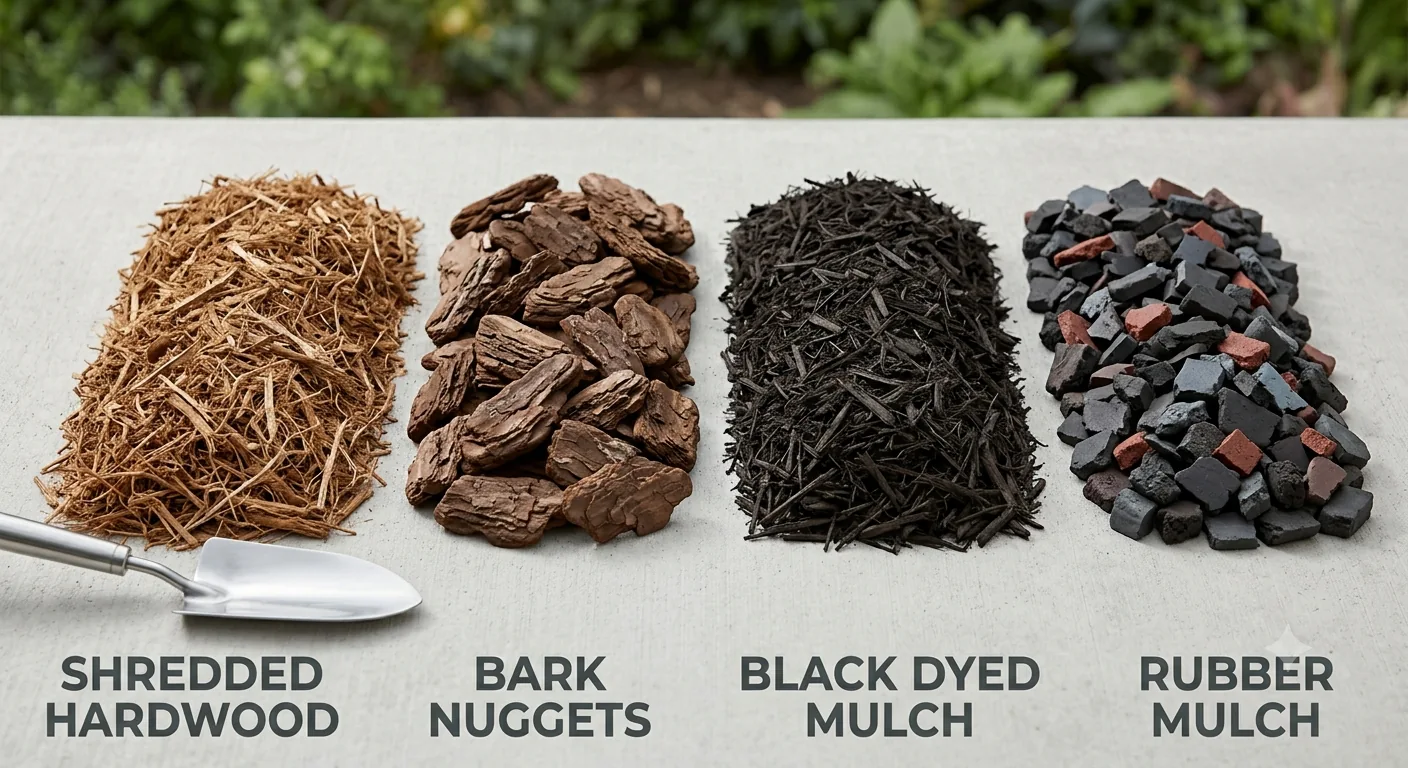
The volume math does not change with material — a cubic yard of cedar occupies the same bed as a cubic yard of rubber. What changes is the depth you should choose, how long it lasts, and what it does for the soil:
| Type | Best For | Typical Depth | Longevity | Notes |
|---|---|---|---|---|
| Shredded hardwood | Beds, trees, paths | 2–3 in | 1 season | Stays in place well; can tie up nitrogen if mixed into soil |
| Bark nuggets | Decorative beds | 2–3 in | 1–2 seasons | Slow to break down; can float away in heavy rain |
| Cedar / cypress chips | Bedding around foundations | 2–3 in | 1–2 seasons | Naturally aromatic; heavier and slower to decay |
| Dyed (black/red/brown) | Curb appeal beds | 2–3 in | 1 season | Color fades yearly; verify dye source for vegetable beds |
| Straw / pine needles | Vegetable beds, berries | 2–3 in | Months | Light and cheap; straw may carry weed seeds |
| Compost | Soil feeding | 1–2 in | Months | Feeds as it breaks down; top with mulch to suppress weeds |
| Rubber mulch | Play areas, paths | 2–3 in | Many years | Does not feed soil or decompose; check playground guidance for depth |
| Stone / gravel | Xeriscapes, hot dry spots | 2–3 in | Permanent | Heats soil; never adds organic matter — see our gravel calculator |
Mulch Cost Benchmarks
| Buying Format | Typical Price (2026) | Per Cubic Yard Equivalent |
|---|---|---|
| Bulk, picked up | $25–75 per yd³ | — |
| Bulk, delivered | $30–135 per yd³ incl. delivery | — |
| Bagged (2 cu ft) | $3.25–8 per bag | ≈ $44–112 per yd³ |
| Premium bagged (cedar, dyed, rubber) | $5–12 per 2 cu ft bag | ≈ $67–162 per yd³ |
| Installed (labor + material) | — | ≈ $0.70–1.40 per sq ft |
The spread is wide because region, species, and dye all move the price. The useful constant: bulk is typically 7–35% cheaper per yard than bags on large orders, and many suppliers include delivery above roughly 5 yards. Under about 2 cubic yards, bags usually win once you factor delivery minimums — but the only answer that matters is your local price, which is why the calculator compares whatever numbers you enter.
Bagged vs Bulk: Which to Buy
Buy bags when: the job is under about 2 cubic yards (roughly 28 bags or less), you have no way to receive a dump truck, you want several different materials, or the bed is far from where a truck can reach. Bags store cleanly, transport in a car or SUV, and let you spread the work across weekends.
Buy bulk when: the order is 2 cubic yards or more, delivery access is fine, and you will spread it within days. Bulk is fresher, cheaper per yard, and skips the pile of plastic — a 5-yard delivery replaces about 68 bags of hauling. The trade-offs are the delivery fee, a big pile that wants to be spread promptly, and needing a wheelbarrow.
The crossover point differs by supplier, which is exactly why the calculator's cost section takes both prices plus the delivery fee and tells you which one wins for your quantity rather than assuming a national average.
Frequently Asked Questions
One cubic yard is 27 cubic feet, so it equals exactly 13.5 two-cubic-foot bags, 9 three-cubic-foot bags, or 18 one-and-a-half-cubic-foot bags. Because you cannot buy half a bag, round up: 14 of the 2 cu ft bags per yard, 9 of the 3 cu ft bags, or 18 of the 1.5 cu ft bags. Our calculator rounds the whole order up to whole bags automatically.
At 2 inches deep, one cubic yard covers about 162 square feet. At 3 inches it covers about 108 square feet, and at 4 inches about 81 square feet. The rule of thumb most suppliers quote — one yard covers a 10 by 10 foot area — assumes a full 3 inch layer with a little margin.
New beds and around trees do best at 2 to 4 inches, refreshing an existing bed needs only 1 to 2 inches on top, and paths or slopes benefit from 3 to 4 inches of chunky material that resists washing out. Finer mulches sit at the shallow end and coarse bark at the deep end. More is not better: beyond about 4 inches mulch can shed water and suffocate roots, and it should never touch a tree trunk — keep it 3 to 6 inches clear.
Bulk mulch typically runs 30 to 135 dollars per cubic yard delivered locally, while bagged mulch works out to roughly 44 to 112 dollars per cubic yard equivalent at the common 3.25 to 8 dollar price for a 2 cubic foot bag. Bags usually win under about 2 cubic yards or when you have no delivery access; bulk wins on bigger jobs, often saving 7 to 35 percent. Enter both prices in the calculator and it compares the two for your exact quantity.
Between roughly 400 and 800 pounds depending on material and moisture — a soggy hardwood load is about twice as heavy as a dry one. A standard 2 cubic foot bag weighs around 20 pounds dry. Our calculator estimates about 10 pounds per cubic foot of ordered mulch, so you can plan vehicle loads and wheelbarrow trips.
Measure the outer diameter of the mulched circle and the inner diameter you want to leave open around the trunk. The calculator subtracts the inner circle so you do not buy mulch for the trunk area. Keep the layer 2 to 3 inches deep and pull it 3 to 6 inches away from the bark — piling mulch against the trunk (volcano mulching) rots the bark and invites pests and disease.
Only for rough volume planning. Playground surfacing is a fall-protection system, not a landscape layer: the required depth depends on the equipment fall height and the surfacing product, and the U.S. Consumer Product Safety Commission publishes specific guidance for it. Follow the surfacing manufacturer's specification rather than a general landscape depth for any play area.
References
- Coverage figures on this page are computed from the volume formula stated in the How It Works section — bed area × additional depth — using the assumptions displayed with each result (bed shape, desired and existing depth, waste allowance, bag size) rather than quoted from supplier tables.
- Iowa State University Extension, How to Determine the Amount of Mulch Needed for a Garden Bed (area × depth method, bag conversions), hortnews.extension.iastate.edu
- Oregon State University Extension, Mulching Woody Ornamentals with Organic Materials (bark ≤ 3 in, wood chips ≤ 4 in guidance), extension.oregonstate.edu
- University of Maryland Extension, Mulching Trees and Shrubs (trunk clearance guidance), extension.umd.edu
- U.S. Consumer Product Safety Commission, Public Playground Safety Checklist (playground surfacing depth is a fall-height specification, not a landscape depth), cpsc.gov
- Price ranges reflect typical 2026 U.S. retail and supplier figures aggregated from published industry sources; local pricing varies by region, species, and dye, so verify with your supplier before ordering.
Disclaimer: The mulch calculator results on this page are estimates for planning purposes only. Actual quantities vary with bed shape, settling, moisture content, application technique, and supplier rounding. Verify volumes against your supplier's figures and follow local extension guidance for plant health.
Need a landscaper for your mulch project?
Get Free Estimates