
Sod Calculator
Turn any lawn area into pallets, rolls and slabs of sod at once — with waste allowance, whole-pallet rounding, sod weight and cost handled.
Enter Project Details
 40 feet
25 feet
Total Area: 1,000 sq ft


Results
Sod Needed
Weight & Handling
Cost Estimate
Assumptions
What You Get
- ✓Free — no sign-up, nothing to install
- ✓Live results as you type
- ✓Rectangle, circle, triangle and custom area inputs
- ✓Rolls, slabs and pallets calculated at once
- ✓Editable pallet coverage, 400–600 sq ft
- ✓Whole-pallet rounding with remainder as rolls or slabs
- ✓Sod weight for pickup and delivery planning
- ✓Price per pallet, per sq ft, or both
- ✓Delivery fee and installation lines, optional
- ✓Cost in 10 currencies
- ✓Export a PDF order sheet in one click
- ✓Shareable link that saves your inputs
How the Sod Math Works
Every sod estimate is a two-step conversion. First the lawn becomes an area: length × width for a rectangle, π × (diameter ÷ 2)² for a circle, base × height ÷ 2 for a triangle, or the measured total for a custom shape. Second, the area — after a waste allowance — is divided into the coverage of the unit you actually buy: a pallet of roughly 450 square feet, a 10-square-foot hand roll, or a 2.67-square-foot slab. The whole chain:
ordered area = lawn area × (1 + waste%)
pallets = ceil( ordered area ÷ pallet coverage )
remainder = ordered area − full pallets × coverage
The waste allowance exists because sod is cut, not poured. Every edge along a bed, a walkway or a tree ring turns into a scrap piece you cannot reuse, and a straight rectangular lawn still loses a slab or two to staggering the joints. Five percent covers a clean rectangle; ten percent is the safe default; fifteen percent is for yards full of curves, islands and obstacles. Sod is a living crop — if you run short, a second delivery days later will not match the first, so the allowance is cheaper than the gap.
The remainder line is the money-saver. Farms sell whole pallets, so a 1,100-square-foot order is two full pallets plus 200 square feet — but 200 square feet of extra pallet costs far more than 20 individual rolls bought loose from the same delivery. The calculator splits the order the way a sod farm actually fills it: full pallets first, remainder as rolls or slabs.
Rolls, Slabs & Pallets
Sod is harvested by machine into rectangles that are either stacked flat (slabs) or rolled up (rolls), then stacked on pallets. Sizes vary by farm and harvester, but the conventions below cover most of the market — and the calculator's advanced fields let you match any supplier who cuts differently:
| Unit | Typical Size | Coverage | Where You Meet It |
|---|---|---|---|
| Slab | 16 × 24 in | 2.67 sq ft | Standard stacked piece, most US farms |
| Slab (wide) | 24 × 24 in | 4 sq ft | Some Southern St. Augustine and Zoysia harvests |
| Hand roll | 2 × 5 ft | 10 sq ft | The common roll; ~45 per 450 sq ft pallet |
| Big roll | 3–4 ft × 100–150 ft | 300–450 sq ft | Golf, sports fields, large open lawns, machine-laid |
| Pallet | 4 ft × 4 ft stack | 400–600 sq ft | 450 sq ft is the standard quoted average |
Two conventions hide inside the pallet number. Coverage is set by the farm's harvester and region — 450 and 500 sq ft pallets are both common in the US, some Southern growers ship 400, and a few ship up to 600 — so the honest move is to ask your supplier for their number and set it in the calculator. Piece count is just coverage divided by piece size: a 450-square-foot pallet is 169 slabs or exactly 45 rolls. Metric buyers work in square meters: one standard hand roll is about 0.93 m², and a 450 sq ft pallet covers about 42 m².
Pallet Weight & Logistics
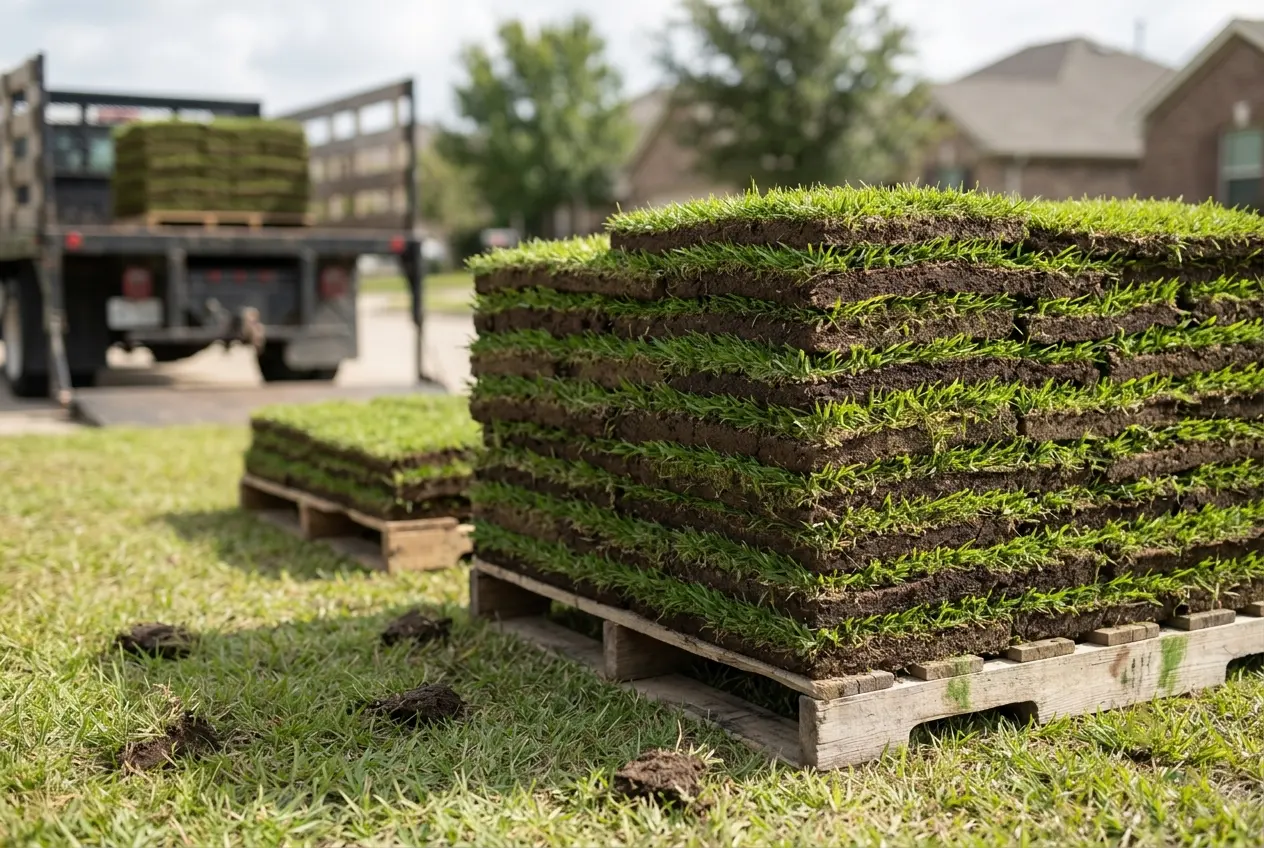
Sod is soil, roots and water, and water is heavy. A pallet runs roughly 1,500 to 3,000 pounds depending on moisture — about 1,000 pounds per 500 square feet of dry cool-season sod, around 20 pounds per hand roll, and up to twice that when cut wet in summer. The weight matters twice: for pickup, where a full pallet needs a half-ton truck or a 3,000-pound-rated trailer and will not legally ride in an SUV; and for delivery, where the truck needs access and the pallets need a spot to land.
Practical numbers the calculator prints for you: total sod weight (pallet coverage times pallet count plus the remainder, at the weight you set), and the pallet count with its combined weight so you can check a truck or trailer rating before you drive to the farm. Ask the farm to load with a forklift — they need an opening at least 8 feet wide to carry a pallet into a yard — and plan to unstack by hand, slab by slab, from wherever the pallet lands. Sod waits for no one: it should be laid the day it arrives, so the delivery date is a laying date.
Cost & Buying Guide
Sod pricing runs on two axes: grass type and unit. Per square foot, materials land between $0.30 and $0.90 across the common lawn grasses; per pallet, a 450-square-foot unit costs roughly $130 to $400; and the same lawn can swing hundreds of dollars on grass choice alone:
| Grass Type | Season | Material $/sq ft | Best Use |
|---|---|---|---|
| Centipede | Warm | $0.30–0.55 | Low-maintenance Southern lawns |
| Bermuda | Warm | $0.30–0.85 | Full sun, high traffic, quick repair |
| Kentucky Bluegrass | Cool | $0.30–0.80 | Northern full-sun lawns |
| Tall Fescue | Cool | $0.35–0.75 | North, handles some shade and drought |
| St. Augustine | Warm | $0.35–0.80 | Coastal South, partial shade |
| Zoysia | Warm | $0.40–0.90 | Dense, drought-tolerant, premium feel |
Beyond the pallet: delivery adds $50 to $150 per load, and professional installation — grade, lay, roll, water in — adds another $0.50 to $1.00 per square foot, which on a 1,000-square-foot lawn is more than the sod itself. Warm-season grasses (Bermuda, Zoysia, St. Augustine, Centipede) plant in late spring and summer in the South; cool-season grasses (Bluegrass, Fescue) prefer early fall and spring in the North. Whatever the type, buy from a farm or supplier that cuts to order — sod sitting on a pallet is a living crop wilting in the sun, not inventory.
Worked Example: 40 × 25 ft Backyard
Here is the page's own default lawn run end to end — these are the numbers you see on load:
- Lawn: 40 ft × 25 ft rectangle = 1,000 sq ft (92.9 m²).
- Waste allowance: 10% for the curved bed along the fence → 1,000 × 1.10 = 1,100 sq ft ordered.
- Pallets: 1,100 ÷ 450 = 2.44 → 3 whole pallets cover 1,350 sq ft.
- Remainder: ordering exactly: 2 pallets (900 sq ft) + 200 sq ft left = 20 rolls or 75 slabs bought loose.
- Weight: 3 pallets × 1,500 lb = 4,500 lb (2,041 kg) — one half-ton truck with a pallet-rated trailer, or delivery.
- Cost at $275 per pallet: 3 × $275 = $825; the same order priced per square foot at $0.75 is $825 — the two price bases agree here, but check both at your supplier.
- With delivery $100 + install $0.75/sq ft: $825 + $100 + $825 = $1,750 installed.
Switch the pallet coverage to 500 sq ft and the same lawn is 2.2 pallets — still 3 whole, but the remainder drops to 100 sq ft, 10 rolls. That sensitivity is why the advanced coverage input exists: a supplier shipping 500-square-foot pallets quietly saves you 10 rolls on this lawn.
Ground Prep & Laying Order
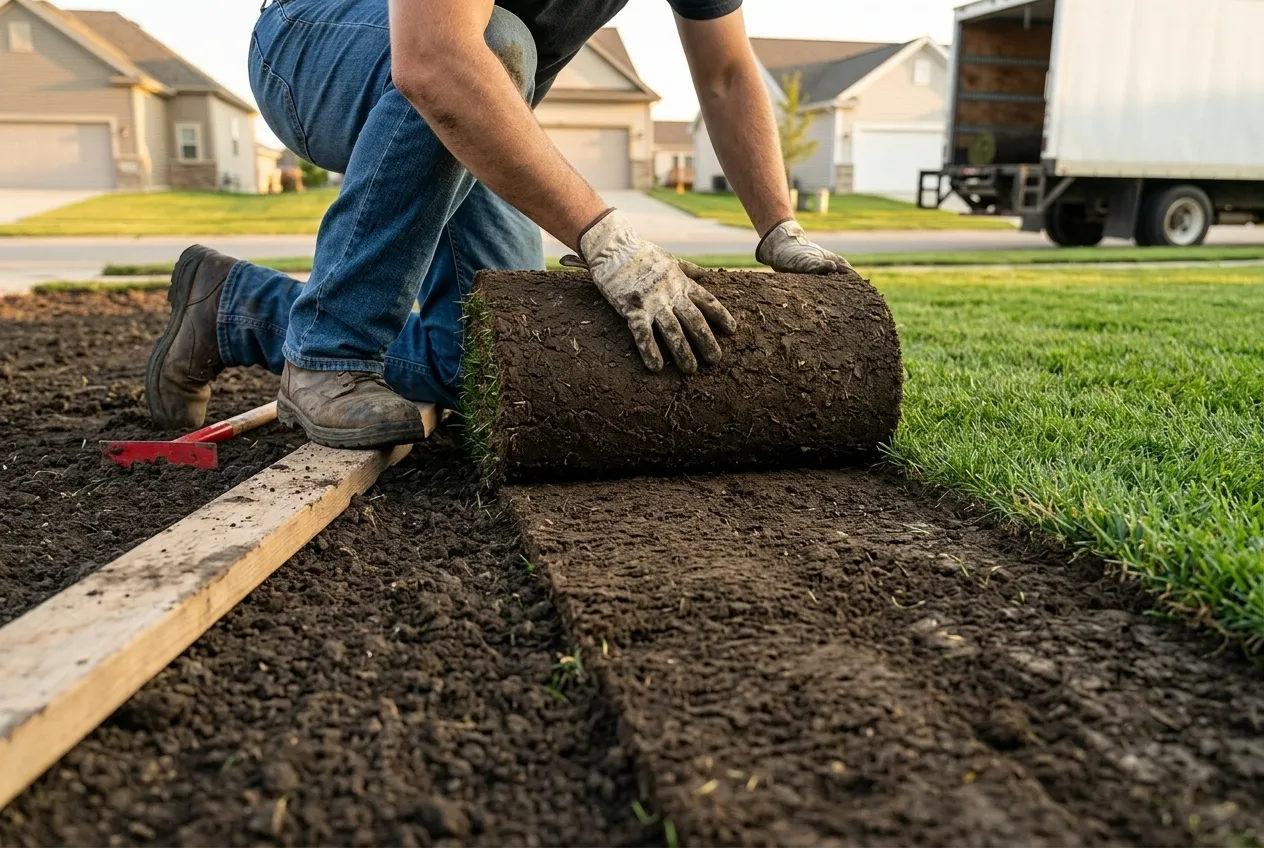
Sod fails on preparation more often than on grass quality. The sequence that works: kill and strip the old lawn or till it in; loosen the sub-base; spread 2 to 4 inches of screened topsoil (4 to 6 over a poor base) and grade it firm; set the finished grade about 1 inch below walks and drives so the sod lands flush; then lay the same morning the sod arrives.
Lay the first row along a straight edge — a driveway is ideal — and stagger every following row like brick joints so no two seams line up. Butt pieces edge to edge without stretching or overlapping, cut curves with a sharp knife, and roll the whole lawn to press roots into soil contact. Water within 30 minutes of the first pallet hitting the ground: about an inch of water a day for the first two weeks, tapering as roots knit. For the soil layer under it, the topsoil calculator handles the cubic yards; sod itself is sold by area, which is why this calculator speaks in pallets.
Common Sod Estimating Mistakes

- Ordering by the piece instead of the pallet. Farms sell whole pallets; a "240 pieces" order pays more per square foot and usually means a second trip. Compute area first, then round up to full pallets — or split the remainder into loose rolls the way the calculator does.
- Skipping the waste allowance. A clean rectangle loses ~5% to stagger and edge cuts; a yard of curves and tree rings loses 10–15%. Every cut is scrap, and running short means a second delivery fee plus grass that does not match.
- Assuming every pallet is 450 sq ft. Coverage varies 400–600 by farm and region. Two pallets short on a 600-square-foot pallet is a bigger error than the waste allowance itself — set the supplier's real number in advanced options.
- Ignoring pallet weight. 1,500–3,000 lb per pallet at pickup: an overloaded SUV or a half-rated trailer turns a lawn project into a roadside emergency. Check the rating before you drive.
- Letting sod sit on the pallet. A living crop yellows and rots within a day or two stacked, fastest in heat. Delivery morning is laying morning — schedule the ground prep before the truck, not after.
- Measuring slopes from a map. A tape or wheel follows the ground and already includes the hill; a satellite or plan measurement sees the hill flat and underestimates. Steep banks at 3:1 or steeper also need the rolls laid across the slope and pegged.
Frequently Asked Questions
References
- Turfgrass Producers International — sod harvest formats, pallet conventions and handling guidance, turfgrasssod.org
- University of California IPM — establishing a lawn from sod: preparation, laying and first-week irrigation, ipm.ucanr.edu
- Colorado State University Extension — lawn establishment, sod vs seed and rolling practice, extension.colostate.edu
- North Carolina State Extension — Turfiles: warm- and cool-season lawn grasses for the transition zone, turffiles.ncsu.edu
- Rutgers Cooperative Extension — Residential sod installation and care, njaes.rutgers.edu
Disclaimer: The sod calculator results on this page are planning estimates. Pallet coverage, piece sizes, weight and price vary by farm, region, grass type and season — confirm coverage and current pricing with your sod supplier before ordering, and lay sod the day it is delivered.
Lawn sized and pallets counted? Get quotes from local landscaping and sod installation pros near you.
Get Free Estimates