
Enter Post Hole Details
Results update live as you type. Mixed units welcome.
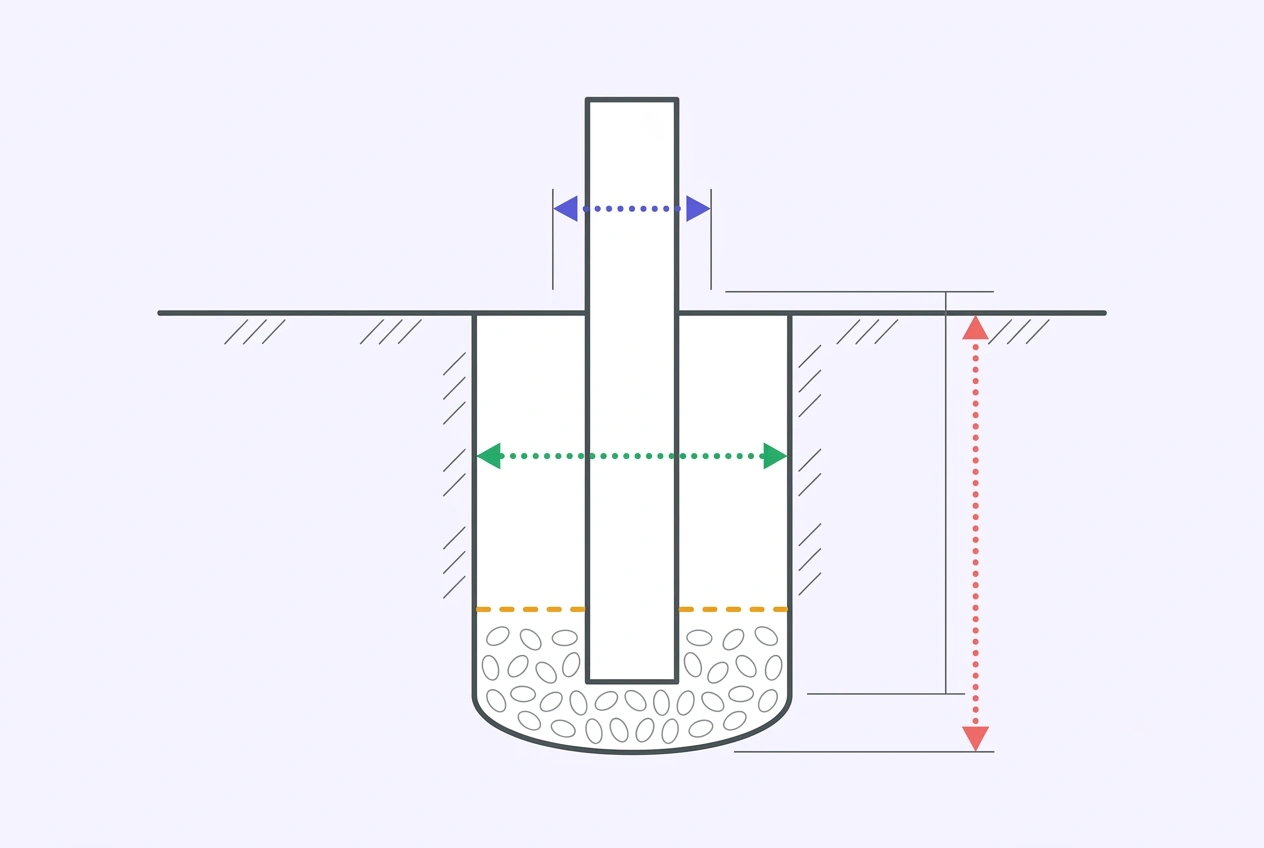 12 inches
36 inches
4 x 4 inch
Results
Per-Hole Breakdown
Total Project
Calculation Assumptions
What You Get
- ✓Free — no sign-up, nothing to install
- ✓Live results as you type
- ✓Feet, inches, cm, meters & yards — mix any units
- ✓Post presets: 4×4, 6×6 & steel pipe
- ✓Gravel base and sonotube options
- ✓Export a PDF takeoff in one click
- ✓Shareable link that saves your inputs
- ✓Works on phone, tablet & desktop
- ✓Per-hole and total project breakdown
- ✓40/50/60/80 lb & metric kg bag counts
- ✓Fence length → hole count helper
ON THIS PAGE:
About Post Hole Concrete
When you set a fence post, deck post, or mailbox post into the ground, concrete holds it in place. The concrete fills the annular space between the post and the walls of the hole, creating a rigid anchor that resists wind loads, lateral pressure, and the natural movement of soil over time. Without concrete, posts rely on compacted backfill alone, which loosens with rain and freeze-thaw cycles, eventually letting the post lean.
The amount of concrete you need depends on three things: the diameter of the hole, the depth of the hole, and the size of the post sitting inside it. The calculator computes the full cylindrical volume of the hole, then subtracts the volume occupied by the post. What remains is the concrete required to fill the gap. This displacement matters more than most people realize. A 6×6 post inside a 16-inch hole removes roughly twice as much concrete volume as a 4×4 post in the same hole, because the post occupies a much larger share of the cylinder.
Concrete for post holes is sold in pre-mixed bags — typically 40, 60, or 80 pounds — that you mix with water on site. One bag of 80 lb concrete mix yields about 0.6 cubic feet of wet concrete. The calculator tells you exactly how many bags to buy at each weight, so you can choose based on what the store carries and how heavy you want to carry.
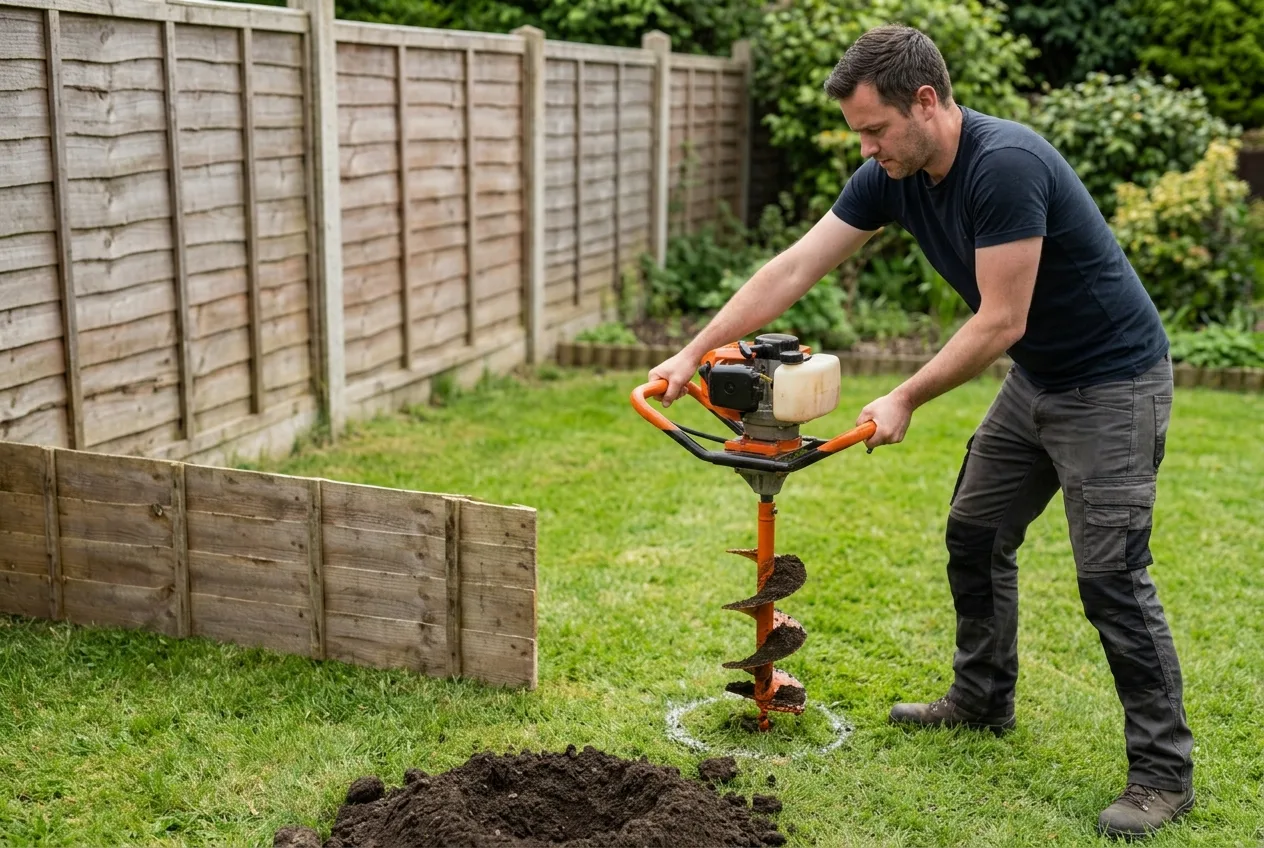
A two-man auger drills a clean 12-inch hole in minutes — the diameter the calculator's 3× post-width rule targets.
Two optional features affect the calculation. A gravel base at the bottom of the hole improves drainage and keeps the post from sitting in pooled water, but it reduces the depth available for concrete. A sonotube (cardboard form) can extend above grade to create a clean concrete pier, changing the effective hole diameter for the above-ground portion. Both are handled in the advanced options.
Hole Sizing Rules
Building codes and practical experience agree on two fundamental rules for post hole dimensions:
- Hole diameter = 3× post width. A 4×4 post (actual 3.5 inches) needs a hole roughly 10 to 12 inches in diameter. A 6×6 post (actual 5.5 inches) needs 16 to 18 inches. The three-times rule gives you enough room to pour concrete around the post, insert a temporary brace, and plumb the post before the concrete sets. Going much larger wastes concrete; going smaller makes it nearly impossible to fill the gap evenly.
- Hole depth ≥ 1/3 of post length. A 6-foot fence post should be buried at least 24 inches, and 30 to 36 inches is better. The deeper portion of the post acts as a lever arm against wind and lateral loads. The International Residential Code (IRC R403.1) requires footing depth of at least 12 inches below the undisturbed ground surface, and most jurisdictions add frost-line requirements on top of that.
For decks and structures that carry vertical loads, the footing must extend below the frost line to prevent seasonal heave from lifting the structure. The frost line varies from about 12 inches along the Gulf Coast to over 60 inches in northern Minnesota and Alaska. Always check your local building department for the required frost depth in your area.
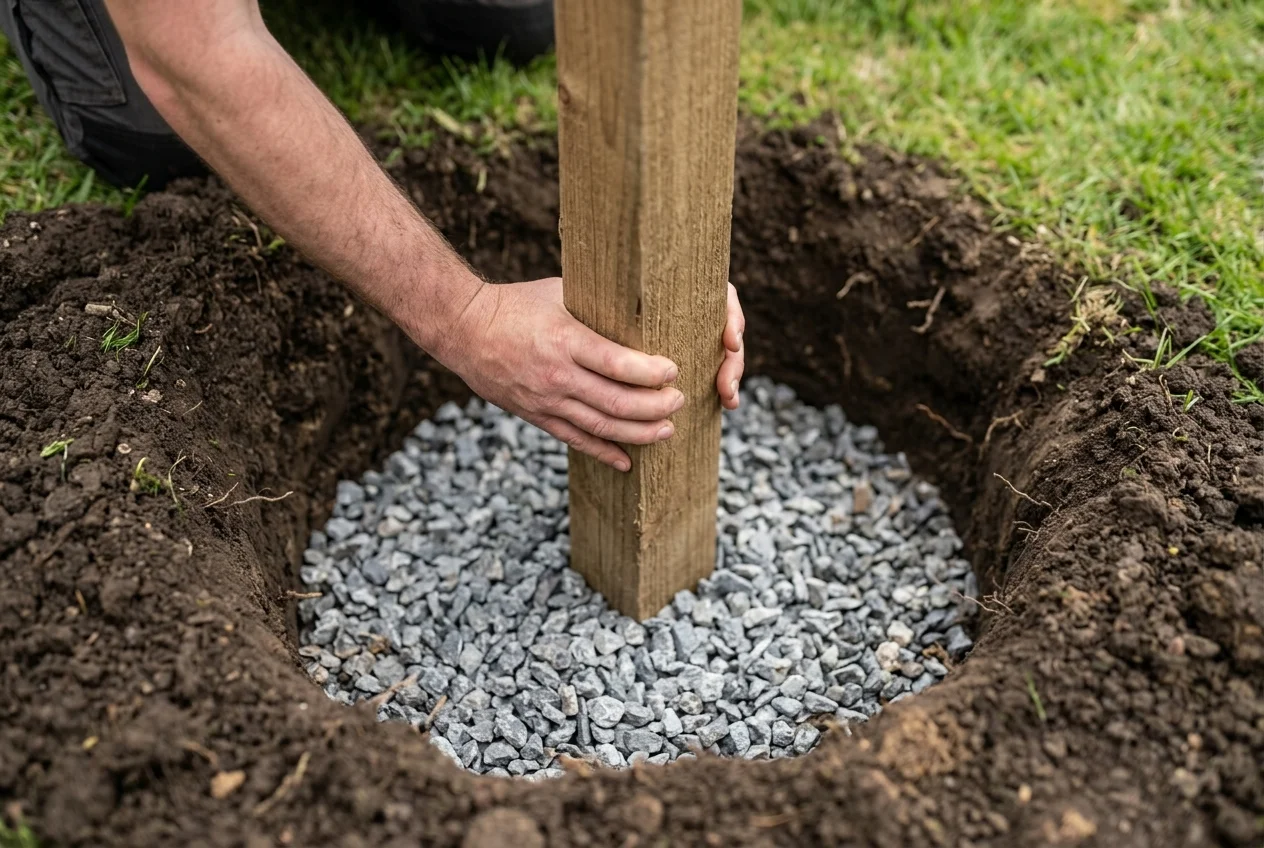
A 4–6 inch gravel base under the post improves drainage — the calculator subtracts it from the concrete depth.
The calculator defaults to a 12-inch diameter hole and 36-inch depth, which is the most common configuration for residential fence posts in moderate climates. Adjust these values to match your post size, soil conditions, and local code requirements.
Frost Depth by Region (United States)
The frost depth is the maximum depth at which groundwater in soil is expected to freeze. Footings must extend below this depth to prevent frost heave, which can crack concrete, warp fences, and lift deck posts out of alignment. The values below are general guidelines — always verify with your local building department.
| Region / Climate Zone | Typical Frost Depth | Example Cities |
|---|---|---|
| Southern (Gulf Coast) | 12 inches | Houston, Miami, New Orleans |
| Lower South | 12–18 inches | Atlanta, Dallas, Charlotte |
| Mid-Atlantic | 24–36 inches | Washington DC, Philadelphia, Richmond |
| Central Plains | 36–42 inches | Kansas City, Omaha, St. Louis |
| Great Lakes | 36–48 inches | Chicago, Detroit, Cleveland |
| Northern (Upper Midwest) | 48–60 inches | Minneapolis, Milwaukee, Burlington |
| Mountain West | 36–60 inches | Denver, Salt Lake City, Boise |
| Pacific Northwest | 12–24 inches | Seattle, Portland, Eugene |
| Alaska | 42–80+ inches | Anchorage, Fairbanks, Juneau |
These ranges reflect variation within each region. Coastal areas tend to have shallower frost lines than inland locations at the same latitude. Elevation also matters: mountain towns at 5,000 feet may freeze deeper than nearby valleys. When in doubt, dig to the maximum value for your zone or call the local building inspector.
Worked Example
Use the calculator's default values: a 4x4 post (3.5 inches actual), 12-inch diameter hole, 36 inches deep, 10 holes, 10% waste.
| Step | Calculation | Result |
|---|---|---|
| Hole volume (cylinder) | π × (6 in)² × 36 in = 4,071.5 in³ | 2.356 ft³ |
| Post displacement (square) | 3.5 in × 3.5 in × 36 in = 441 in³ | 0.255 ft³ |
| Net concrete per hole | 4,071.5 - 441 = 3,630.5 in³ | 2.101 ft³ |
| With 10% waste | 2.101 × 1.10 | 2.311 ft³ |
| Total for 10 holes | 2.311 × 10 | 23.11 ft³ |
| Cubic yards | 23.11 / 27 | 0.856 yd³ |
| Bags (80 lb at 0.6 ft³/bag) | 23.11 / 0.6 | 38.5 -> 39 bags |
| Bags (60 lb at 0.45 ft³/bag) | 23.11 / 0.45 | 51.4 -> 52 bags |
| Bags (40 lb at 0.3 ft³/bag) | 23.11 / 0.3 | 77.0 -> 78 bags |
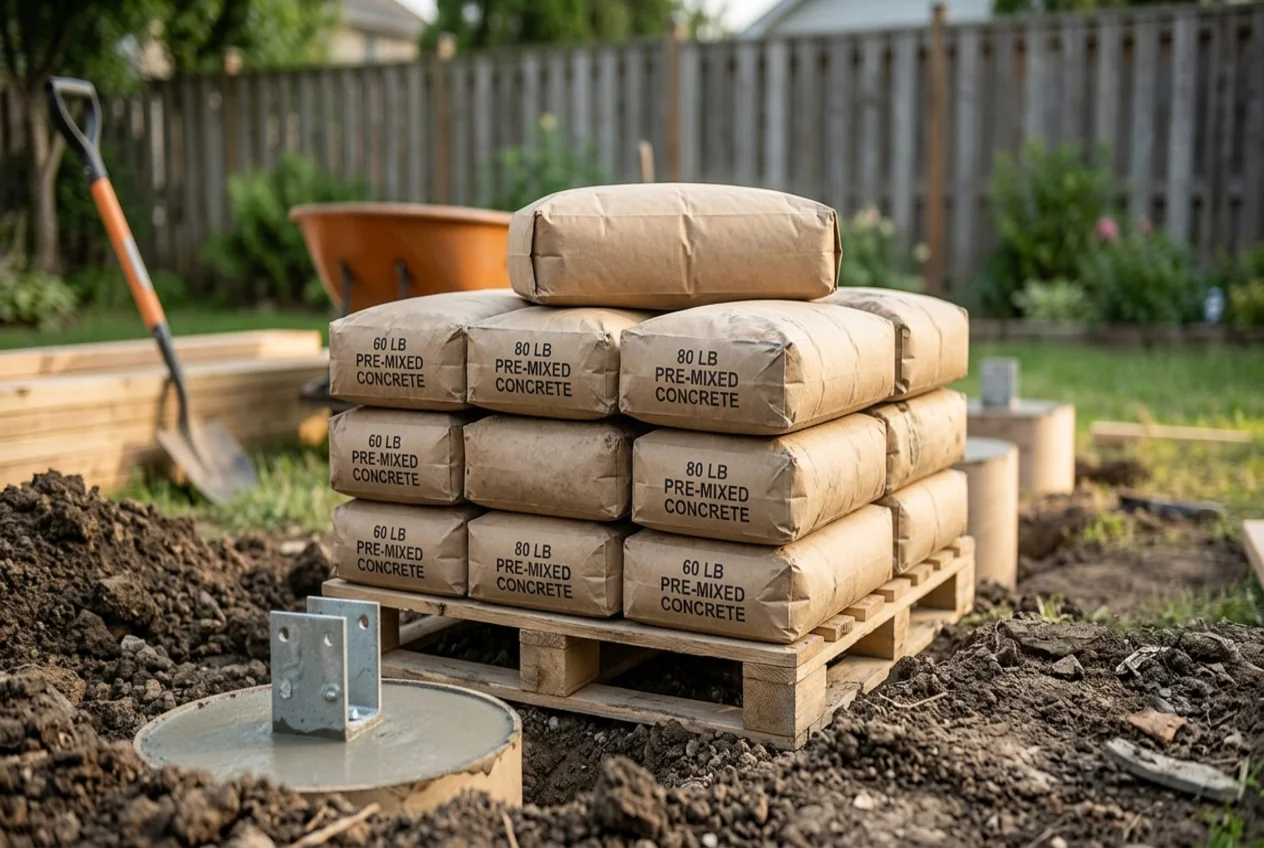
Pre-mixed bags in 40, 60, and 80 lb sizes — the calculator reports the count for each so you can buy whichever the store carries.
The post displacement subtracted from each hole is relatively small, but across 10 holes it adds up to roughly 2.5 cubic feet — nearly one full 80 lb bag. Ignoring displacement wastes money on bags you do not need. The calculator does this subtraction automatically.
Frequently Asked Questions
A post hole should be at least one-third the total length of the buried portion of the post, and at least 36 inches deep in frost-free regions. In cold climates, the hole must extend below the local frost line — often 42 to 48 inches or more — to prevent frost heave from pushing the post out of the ground. For a standard 6-foot fence post, plan on 36 to 40 inches of depth. For a 4-foot deck railing post, 24 inches is usually adequate.
The standard rule is that the hole diameter should be three times the width of the post. A 4x4 post (actual 3.5 inches) needs a hole about 10 to 12 inches in diameter. A 6x6 post (actual 5.5 inches) needs a 16 to 18 inch hole. The extra space lets you pack concrete tightly around the post and gives room to plumb and brace it while the concrete sets.
For a typical 12-inch diameter, 36-inch deep hole with a 4x4 post, you need about 2.1 cubic feet of net concrete — roughly four 80 lb bags or five 60 lb bags. A 6x6 post in a 16-inch hole at the same depth needs about 3.6 cubic feet — roughly six 80 lb bags or eight 60 lb bags. The calculator gives you the exact number based on your specific inputs.
Yes — a 4 to 6 inch layer of crushed gravel at the bottom of the hole improves drainage and prevents the post from sitting in pooled water, which accelerates rot and rust. Gravel also gives the concrete a stable base to sit on. For fence posts in clay or wet soil, gravel is strongly recommended. In dry, well-draining soil, it is still good practice but less critical.
Not always. For fence posts, sonotubes (cardboard forms) are optional — they keep the hole from collapsing in loose or sandy soil and create a clean concrete cylinder above grade. For deck footings that extend above the surface, sonotubes are usually required by code to form a neat pier. In firm clay or compacted soil the hole walls hold their shape without a tube, and concrete can be poured directly.
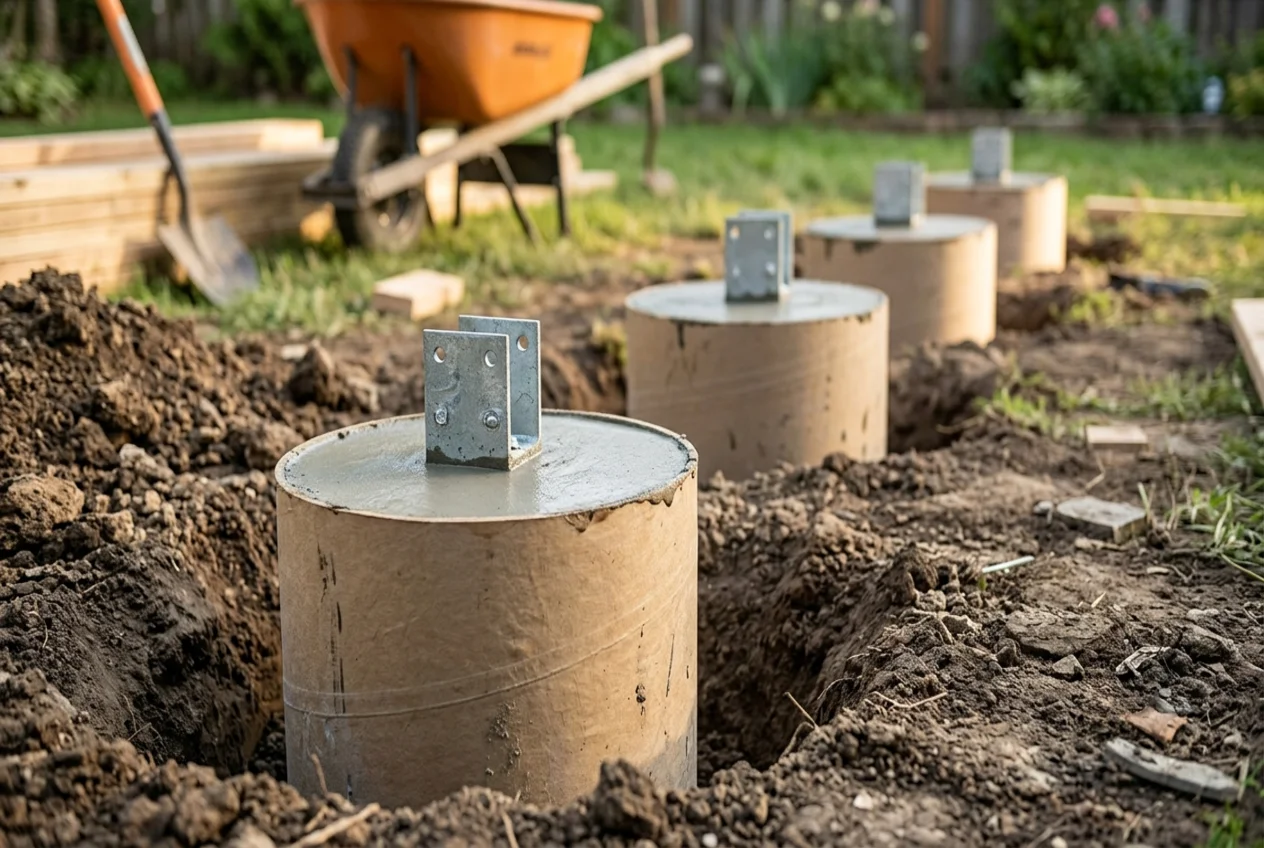
Sonotube forms create a clean pier above grade — the calculator swaps the hole diameter for the tube's outer diameter when enabled.
With standard 8-foot post spacing (center to center), a 100-foot fence needs about 14 posts, including the end and corner posts. Mark the line at 8-foot intervals, set the end posts first, then fill in the intermediate posts. For gate openings, leave a wider gap and add a post on each side of the gate for framing.
Fast-set concrete reaches initial set in 20 to 40 minutes instead of the 24 to 48 hours that regular concrete needs, so you can backfill and brace the same day. Fast-set costs more per bag and generates more heat during curing. It is ideal for fence posts where you want to work quickly and do not need maximum long-term strength. For structural deck footings that carry significant loads, regular concrete or a bag mix rated for structural use is the better choice.
Dry pouring (pouring the dry mix into the hole and adding water on top) is a common shortcut for fence posts. It works for non-structural applications where the post is held in place by the concrete. The downside is that dry-set concrete may not hydrate evenly, especially in deep holes or when water is not worked in thoroughly. For the strongest hold, mix the concrete before pouring. If you dry-pour, add water in stages and rod the mix to remove air pockets.
References
- International Code Council, "International Residential Code (IRC) — R403.1.6 Foundation Footings," iccsafe.org
- American Concrete Institute, "ACI 318 Building Code for Structural Concrete," concrete.org
- QUIKRETE, "Concrete Calculator — Fast-Setting Concrete Mix for Setting Posts," quikrete.com — bag yield reference (0.60 ft³ per 80 lb, 0.45 ft³ per 60 lb, 0.37 ft³ per 50 lb, 0.30 ft³ per 40 lb); actual yield varies by manufacturer and water ratio.
- USDA and state building department sources — frost depth data are approximate regional ranges; always verify with your local building authority.
Disclaimer: The post hole calculator results on this page are estimates for planning purposes only. Actual concrete quantities vary with hole tolerances, soil collapse, mixing water added, post taper, and product specifications. Always verify against your local building code requirements for frost depth and footing dimensions, and consult a qualified contractor for structural applications.
Need a contractor for your fencing project?
Get Free Estimates