
Enter Gravel Dimensions
Choose a shape, fill in the dimensions, and optionally enter a price. Results update live as you type.
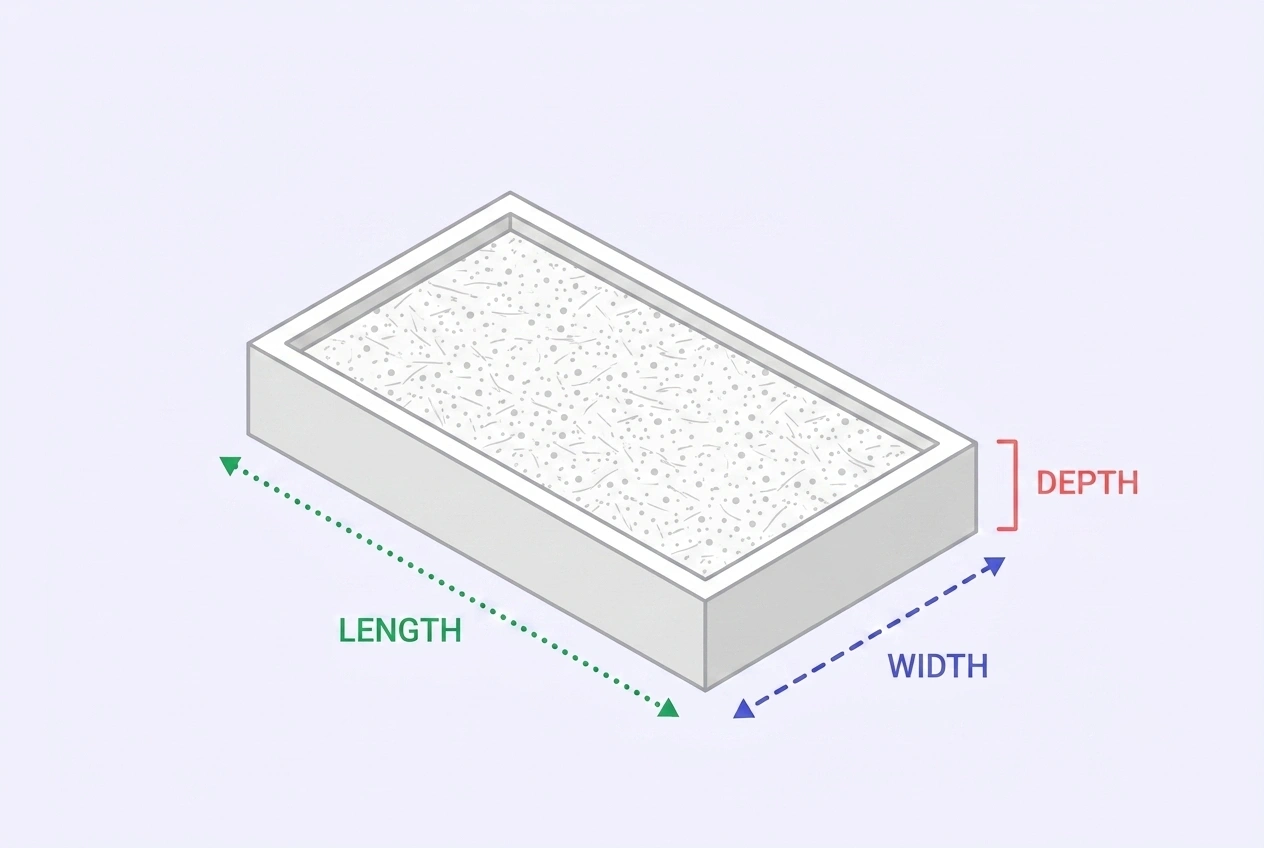
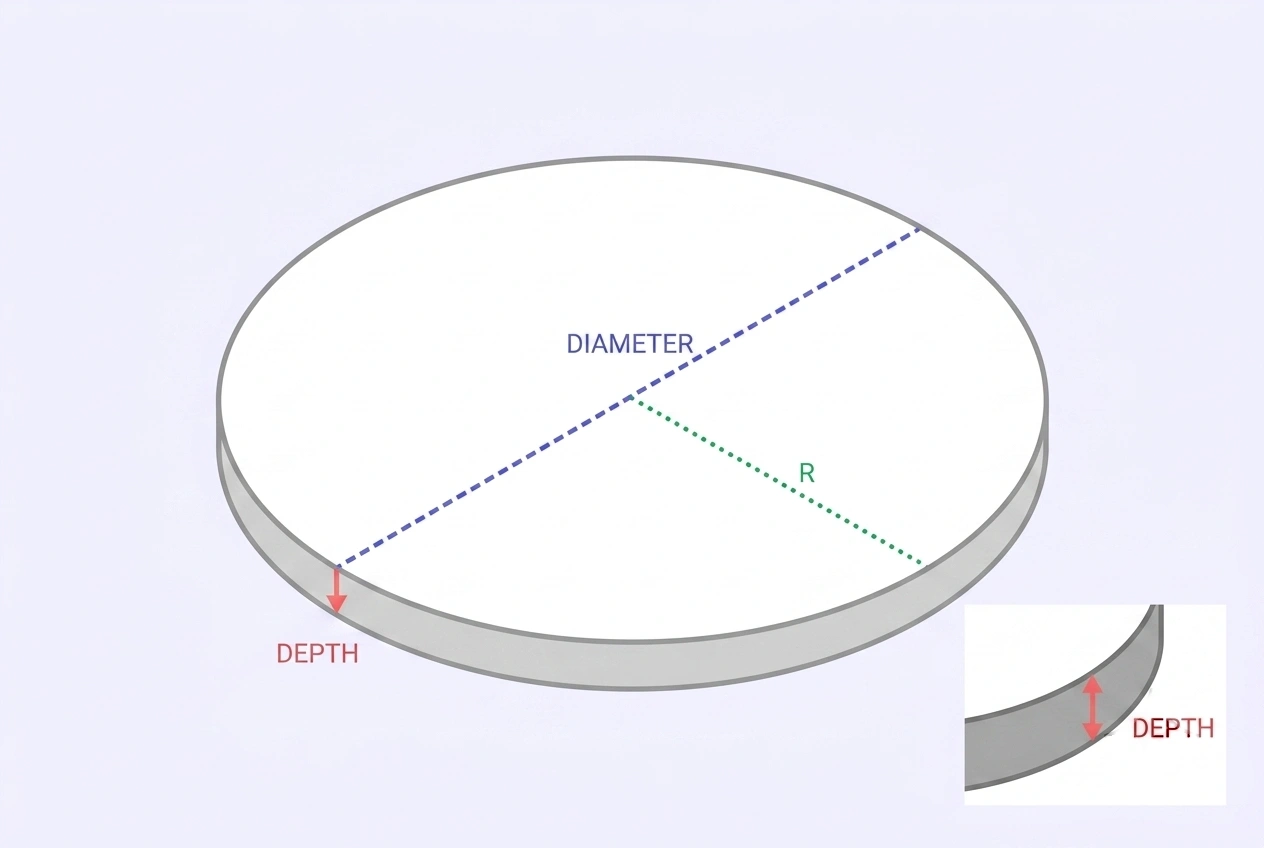


Results
Volume
Weight
Bags Needed
Cost Estimate
Calculation Assumptions
What You Get
- ✓Free — no sign-up, nothing to install
- ✓Live results as you type
- ✓Feet, inches, cm, meters & yards — mix any units
- ✓Export a PDF takeoff in one click
- ✓Shareable link that saves your inputs
- ✓Works on phone, tablet & desktop
- ✓Rectangle, circle & triangle shapes
- ✓Tons, cubic yards & cubic meters output
- ✓Common gravel materials with densities
ON THIS PAGE:
What Is a Gravel Calculator
A gravel calculator estimates how much gravel or crushed stone you need for a project based on the area dimensions and desired depth. It converts your measurements into cubic yards, US tons, bags, and an estimated cost — so you can order the right amount from a bulk supplier or know how many bags to buy.
Gravel is sold by the cubic yard for bulk delivery (the most economical option for driveways and large areas) and by the bag (50 lb, 70 lb) at home improvement stores for smaller projects. Getting the amount right matters because gravel settles and compacts over time — ordering too little means coming back for more, while too much is wasted money.
Our calculator supports four area shapes — rectangle, circle, driveway/path, and direct volume entry — and six common material types with built-in density values. Enter an optional price per cubic yard for cost estimation.
How to Calculate Gravel Needed
Calculating gravel is straightforward once you know the volume formula for your area shape. Follow these steps:
- Step 1: Measure the area
Measure the length and width of the area in feet. For a circular garden bed, measure the diameter. For a driveway, measure the length and the average width.
- Step 2: Choose your depth
Pick the gravel depth based on use. Decorative landscaping typically uses 2 to 3 inches. Walkways and patios use 3 to 4 inches. Driveways need 4 to 6 inches minimum, and heavy-use driveways may need 6 to 8 inches. Convert inches to feet by dividing by 12.
- Step 3: Calculate volume in cubic feet
Multiply length × width × depth (all in feet). For a 20 ft × 10 ft driveway at 6 inches deep: 20 × 10 × 0.5 = 100 cubic feet. For a circular area: π × radius² × depth.
- Step 4: Convert to cubic yards and tons
Divide cubic feet by 27 to get cubic yards (1 cubic yard = 27 cubic feet). Then multiply by 1.4 — the average US tons per cubic yard for most gravel — to estimate tons. Example: 100 cu ft ÷ 27 = 3.7 cubic yards. 3.7 × 1.4 = 5.2 tons.
- Step 5: Add 10% for waste
Gravel compacts and settles after installation. Add 10% to 15% extra to your total. For the driveway example: 3.7 × 1.10 = 4.1 cubic yards to order. For irregular shapes or sloping ground, use 15%. Driveway bases that will be mechanically compacted in lifts should add a separate 15–20% compaction allowance on top — the calculator has a dedicated field for it.
Gravel Depth & Coverage Guide
How deep you lay gravel depends on what the area will be used for. The table below shows recommended depths and approximate coverage per cubic yard at each depth.

Most common residential gravel depths, shown actual size.
| Application | Recommended Depth | Coverage per Cu Yd (approx.) |
|---|---|---|
| Decorative landscaping, flower beds | 2 inches | 162 sq ft |
| Garden paths, walkways | 3 inches | 108 sq ft |
| Patios, pavers base | 4 inches | 81 sq ft |
| Driveway surface (light use) | 4 inches | 81 sq ft |
| Driveway base (crushed stone) | 6 inches | 54 sq ft |
| Heavy-duty driveway | 8 inches | 40.5 sq ft |
| French drain / drainage | 12 inches | 27 sq ft |
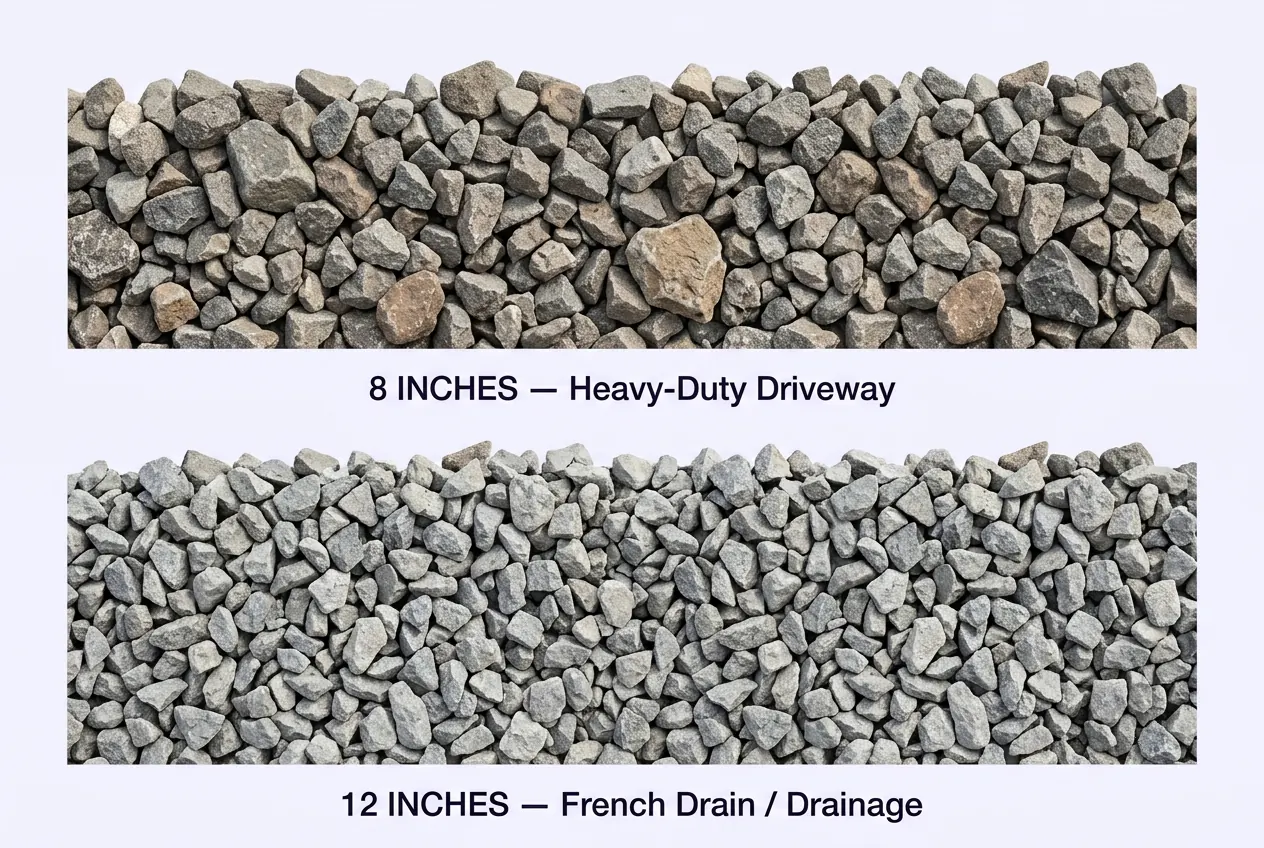
Heavier-duty and drainage applications need deeper gravel.
Note: Coverage values assume standard gravel density (~105 lb/ft³). Rounded materials like pea gravel and river rock cover slightly more area per cubic yard because they pack less densely. Coverage also decreases as stone size increases — larger crushed stone leaves more air gaps.
Gravel Material Types & Densities
Different gravel materials have different weights. Our calculator uses these standard densities, and you can override with a custom density if needed.
| Material | Type | Density (lb/ft³) | US Tons per Cu Yd | Best Use |
|---|---|---|---|---|
| Crushed Stone | Angular, quarried | 105 | 1.40 | Driveways, bases, general construction |
| 3/4" Crushed Stone | Angular, quarried | 110 | 1.47 | Driveway base, drainage |
| Pea Gravel | Rounded, natural | 95 | 1.27 | Decorative, paths, drainage layer |
| River Rock | Rounded, natural | 100 | 1.35 | Decorative landscaping, water features |
| Drainage Rock / Aggregate | Washed, angular | 110 | 1.47 | French drains, drainage projects |
| Shell / Coarse Aggregate | Crushed shell | 90 | 1.20 | Coastal driveways, decorative |
| Lava Rock | Lightweight, volcanic | 60 | 0.80 | Decorative landscaping, light weight |
| Recycled Concrete | Crushed concrete | 115 | 1.53 | Driveway base, eco-friendly option |
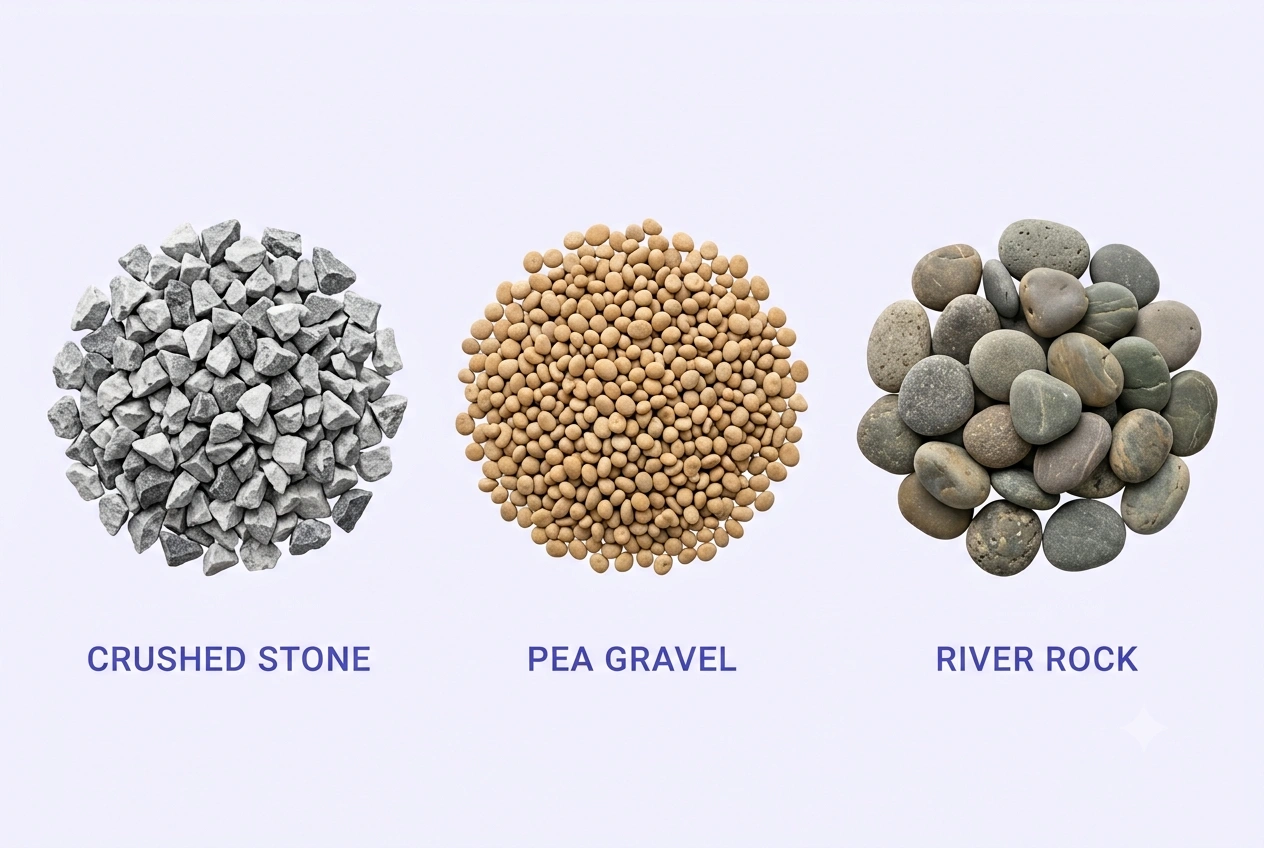
The three most common gravel types — crushed stone, pea gravel, and river rock.
Angular crushed stone is the preferred choice for driveways because the angular edges lock together and create a stable, compacted surface. Rounded materials like pea gravel and river rock shift under weight and are better suited for decorative use or drainage applications.
Gravel Cost per Yard & Ton
Gravel prices vary by material type, region, and whether you buy bulk (cubic yard) or bagged. Bulk delivery is almost always cheaper per unit than bags for projects over about 1 cubic yard.
| Material | Bulk (per Cubic Yard) | Bulk (per Ton) | Bagged (per 50 lb bag) |
|---|---|---|---|
| Crushed Stone (generic) | $30 – $50 | $40 – $70 | $3 – $5 |
| 3/4" Crushed Gravel | $35 – $55 | $45 – $75 | $4 – $6 |
| Pea Gravel | $40 – $60 | $50 – $85 | $4 – $7 |
| River Rock (1-3") | $50 – $75 | $65 – $100 | $5 – $8 |
| Drainage Rock | $30 – $50 | $40 – $65 | $3 – $5 |
| Shell / Coarse Aggregate | $35 – $60 | $45 – $80 | $4 – $6 |
| Recycled Concrete | $25 – $45 | $35 – $60 | $3 – $5 |
| Lava Rock | $45 – $80 | $60 – $110 | $5 – $9 |
Delivery costs: Most suppliers charge $50 to $100 for delivery within 10 miles, with additional per-mile fees beyond that. Minimum order quantities often apply — typically 1 to 3 cubic yards for delivery. For very small projects (under 1 cubic yard), bagged gravel from a home improvement store may be more practical despite higher per-unit cost.
Gravel Cost for Common Projects
Here are estimated gravel costs for typical residential projects, based on average US prices for crushed stone at $40 per cubic yard delivered:
| Project | Size | Depth | Volume Needed | Estimated Cost |
|---|---|---|---|---|
| Garden path (4 ft × 50 ft) | 200 sq ft | 3 inches | 1.85 cu yd | $74 – $130 |
| Small patio base (10 ft × 10 ft) | 100 sq ft | 4 inches | 1.23 cu yd | $49 – $86 |
| Medium driveway (20 ft × 50 ft) | 1,000 sq ft | 6 inches | 18.52 cu yd | $741 – $1,296 |
| Large driveway (20 ft × 100 ft) | 2,000 sq ft | 6 inches | 37.04 cu yd | $1,482 – $2,593 |
| French drain (100 ft, 1 ft × 1 ft) | 100 sq ft | 12 inches | 3.70 cu yd | $148 – $259 |
| Decorative bed (30 ft × 10 ft) | 300 sq ft | 2 inches | 1.85 cu yd | $74 – $130 |
* Estimates are based on average US bulk prices as of 2026. Actual prices vary widely by region, material, and supplier. Delivery charges usually apply separately.
Worked Example
Let us calculate gravel for a 20 ft × 10 ft garden path at 3 inches deep using crushed stone:
Step 1: Convert depth to feet
Step 2: Calculate volume in cubic feet
Step 3: Convert to cubic yards
Step 4: Calculate weight in tons
(Using crushed stone density of 105 lb/ft³ = 1.4 tons/cu yd)
Step 5: Add 10% waste
Step 6: Calculate cost
For this project, you would order about 2 cubic yards of crushed stone (approximately 2.6 tons) at an estimated cost of $80 to $100 including a typical delivery fee. If buying in 50 lb bags instead, you would need about 100 bags — clearly not practical, which is why bulk delivery is the standard for any project over about 1 cubic yard.
Tips for Ordering Gravel
- Order bulk for projects over 1 cubic yard
Bulk delivery by the cubic yard is significantly cheaper than bags. A 50 lb bag of gravel at $4 each works out to about $216 per cubic yard, while bulk crushed stone averages $30 to $50 per cubic yard delivered.
- Use angular crushed stone for driveways
Crushed stone with angular edges interlocks and compacts into a stable surface. Rounded materials like pea gravel shift under vehicle weight and create ruts. For a driveway, use 3/4" crushed stone or larger for the base layer.
- Layer larger stone first
A two-layer approach works well: 4 inches of larger crushed stone (1 to 2 inch) as the base, topped with 2 inches of smaller pea gravel or 3/8" crushed stone for the surface. The base layer provides stability and drainage.
- Compact the base
Use a plate compactor or hand tamper on the base layer before adding the surface layer. Compaction reduces settling and creates a firmer surface. Add gravel in 2-inch lifts and compact each layer.
- Use landscape fabric for weed control
Lay down woven landscape fabric before adding gravel in decorative beds and paths. This suppresses weeds while still allowing water to drain through. Avoid non-woven fabric for driveways — it can tear under vehicle weight.
- Remember delivery minimums
Most gravel suppliers have a minimum order of 1 to 3 cubic yards for delivery. If your project is smaller, check whether bagged gravel or a "mini-load" option is available. Some suppliers offer 1/2 cubic yard deliveries.
- Check local material availability
Crushed stone, pea gravel, and river rock are widely available. Specialty materials like lava rock or shell aggregate may only be available in certain regions and can cost more due to transportation distance.
- Plan for drainage on driveways
A gravel driveway needs a crowned center (slightly higher in the middle) so water runs off to the sides. Without proper drainage, water will pool and wash out the gravel over time. Install gravel trenches or French drains at the edges if water is an issue.
Frequently Asked Questions
References
- Federal Highway Administration, "Flexible Pavement Construction," fhwa.dot.gov
- National Stone, Sand & Gravel Association, "Gravel Roads Construction & Maintenance Guide," nssga.org
- American Association of State Highway and Transportation Officials, "AASHTO Guide for Design of Pavement Structures," transportation.org
- Oregon State University Extension Service, "Gravel Roads: Maintenance and Design Manual," extension.oregonstate.edu
Disclaimer: The gravel calculator results on this page are estimates for planning purposes only. Actual material quantities may vary based on site conditions, compaction, local material density, and drainage requirements. Always consult a qualified contractor and verify quantities with your material supplier before ordering. Gravel prices shown are national averages and will vary by region and supplier.
Need Gravel Delivered?
Get free delivery quotes from bulk material suppliers near you.
Get Free Quotes