
ON THIS PAGE:
Gravel Types and Sizes at a Glance
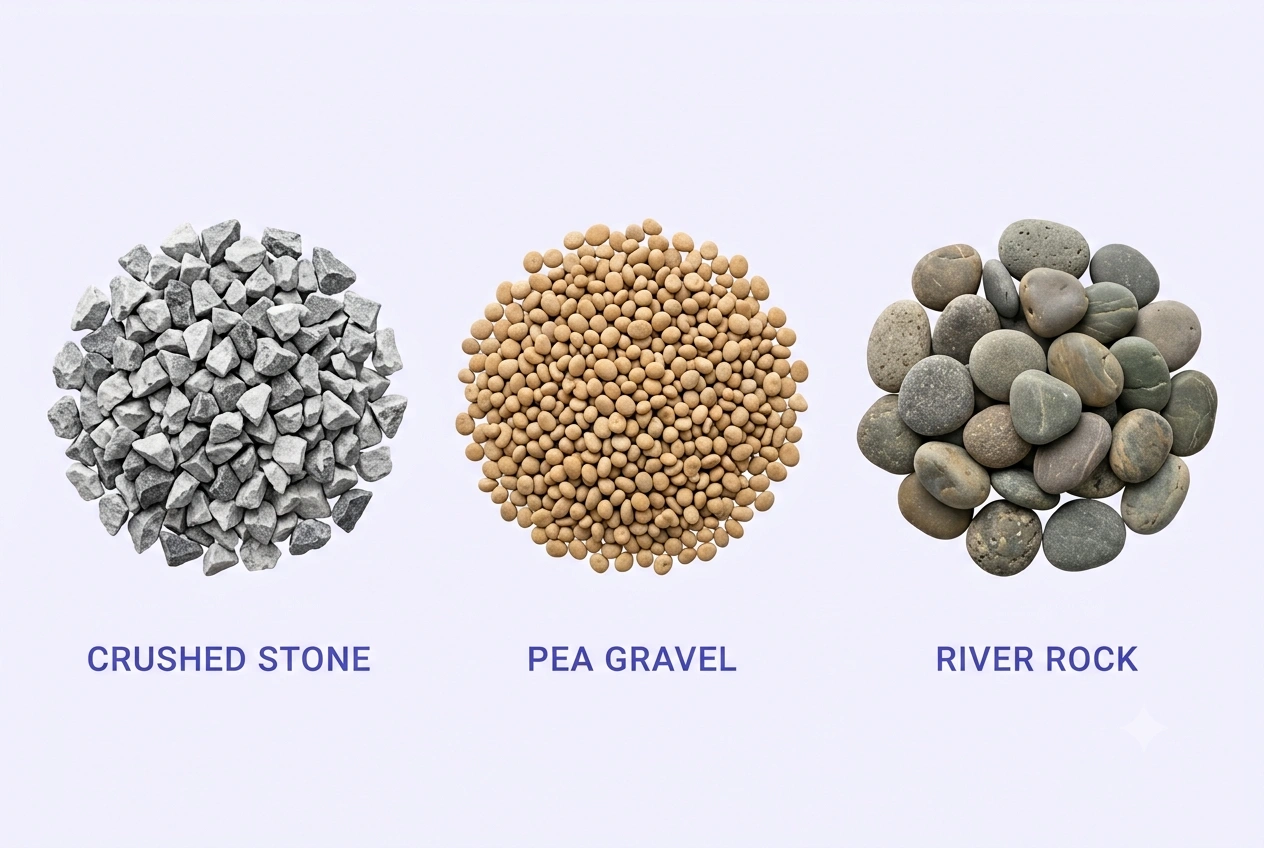
The right gravel depends on three questions: must the surface carry weight, must water pass through it, and must it look finished. Angular crushed stone locks together under compaction and is the default for driveways, parking pads, and structural bases. Rounded pea gravel and river rock stay loose, feel better barefoot, and belong on paths, play areas, and decorative beds — never as a driveway surface on their own. Washed clean stone (#57, #3, #8) drains; dense-graded stone with fines (crusher run, #411, #10 screenings) compacts. Size numbers follow ASTM D448: smaller number means larger stone, and two-digit numbers like #57 and #89 are graded blends. Most residential depths run 2 to 3 inches for decorative cover, 4 to 6 inches for a driveway surface, and 8 to 12 inches total for a three-layer driveway on soft ground. Volume is length × width × depth ÷ 27 cubic yards; multiply by about 1.3 to 1.5 tons per cubic yard for weight, then add 10 to 15 percent for compaction on bases. Those three filters — load, drainage, and appearance — are how every gravel types and sizes choice on this page is made.
What Gravel Actually Is
Gravel is a loose mixture of rock fragments, and the word covers two materials that behave very differently on a jobsite. Natural gravel forms by weathering and erosion — water rounds the edges over time, which is why pea gravel and river rock feel smooth in the hand. Crushed stone is produced mechanically: larger rock is broken in a crusher and screened to a size band, leaving angular faces that interlock when compacted. Both get sold by the ton or the cubic yard, both get called "gravel" at the landscape yard, and only one of them holds a driveway.
Classification systems sort the material by particle size rather than by origin. In the United States the working standard is ASTM D448, Standard Classification for Sizes of Aggregate for Road and Bridge Construction, adopted for highway work as AASHTO M 43. Those two documents are why a Department of Transportation spec sheet and a local quarry price list mean the same thing when they say "#57 stone." Geology definitions run slightly wider: ISO 14688 puts gravel in the 2 to 63 millimeter band and splits it into fine, medium, and coarse gravel; the Unified Soil Classification System uses roughly 4.75 to 76.2 millimeters; AASHTO soil classification uses 2 to 75 millimeters for gravel particles. For buying and building, the ASTM size numbers are the language that matters — and they are the backbone of every gravel types and sizes decision on this page.
Gravel and crushed stone show up in almost every exterior project. Concrete aggregate is the largest single use — nearly half of U.S. gravel production goes into concrete — but on a residential lot the same material builds driveway surfaces and bases, French drains and dry wells, paver bedding and joint fill, walkways, playgrounds, decorative beds, and mulch replacement in dry climates. Choosing among gravel types and sizes is mostly a performance decision: how much load the layer must carry, whether water must move through it freely, and how the finished surface should look and feel underfoot. The sections below turn that decision into a gravel size guide you can take to the yard.
Gravel Sizes Chart: ASTM D448 and AASHTO M 43
The table below is the residential end of the gravel sizes chart — every size number a landscape supplier or quarry stocks for homeowners and light commercial work, with the nominal particle range in inches and millimeters and the jobs each size is built for. Each range runs from the sieve nearly all particles pass down to the sieve nearly all are retained on. Common sieve landmarks: No. 4 is 4.75 millimeters, No. 8 is 2.36 millimeters, and No. 16 is 1.18 millimeters. Commercial names that are not ASTM numbers — pea gravel, river rock, crusher run — are included at the end because that is what the ticket will say at most yards. Used together with the type profiles below, this chart is the reference half of the gravel types and sizes decision.
| Size / Name | Particle Range | Typical Uses |
|---|---|---|
| #1 | 1.5–3.5 in (37.5–90 mm) | Culvert bedding, stabilizing very soft ground, erosion control. Too large to shovel or rake — machine-placed only. |
| #2 | 1.5–2.5 in (37.5–63 mm) | Construction entrances, muddy site pads, railroad ballast, first lift over mud. |
| #3 | 1–2 in (25–50 mm) | Drainage beds, dry wells, septic laterals, first lift of a driveway base. |
| #4 | 1.5–0.75 in (37.5–19 mm) | Driveway sub-base, septic drain fields, dry wells. |
| #357 | 2 in–No. 4 (50–4.75 mm) | Thick base lifts, pipe backfill, subgrade stabilization. Graded blend spanning #3 through #7. |
| #5 | 0.5–1 in (12.5–25 mm) | Road base topping, filter stone around structures, coarse concrete aggregate. |
| #57 | 1 in–No. 4 (25–4.75 mm) | Driveway topping, French drains, concrete aggregate, pipe bedding. The most-ordered size in North America; most particles about ¾ inch. |
| #67 | ¾ in–No. 4 (19–4.75 mm) | Concrete mixes, pipe bedding, slightly tighter finish than #57, asphalt and walkway work. |
| #8 | ⅜ in–No. 8 (9.5–2.36 mm) | Walkway topping over a base, pipe bedding, chip seal, asphalt mixes. Angular counterpart to pea gravel. |
| #89 | ⅜ in–No. 16 (9.5–1.18 mm) | Paver joint filling, permeable paving reservoirs, decorative topping. |
| #10 | No. 4 to dust (< 4.75 mm) | Screenings: paver leveling beds, path binder, fill under slabs. Also sold as stone dust or manufactured sand. Compacts hard; does not drain. |
| Crusher run | ¾ or 1.5 in "minus" — stone down to dust | Compactable base for driveways, patios, and sheds. Regional names: CR-6, 21A/21B, DGA, road base, ABC. |
| Pea gravel | ¼–⅝ in (6–16 mm), rounded | Walkways, playgrounds, dog runs, mulch alternative. A commercial name, not an ASTM size number. |
| River rock | 1–3 in (25–75 mm), rounded | Dry creek beds, borders, decorative ground cover. Screened natural stone; larger cobbles sold separately. |
Three rows on that chart carry most residential orders. #57 is the default clean stone: big enough to leave drainage voids, small enough to shovel, rake, and drive on — the specified aggregate in most ready-mix concrete and the standard fill around French-drain pipe. #8 is the fine clean stone for walkways and pipe bedding where a tighter surface matters. Crusher run (and its aliases) is the base material: it does nothing decorative and everything structural, compacting to a near-solid layer because the fines fill the voids between the larger pieces. If a project has layers, crusher run or an equivalent dense-graded blend is almost always the bottom one.

How the Size Numbers Work
The gravel size guide's most counterintuitive rule is that the scale runs backwards. Under ASTM D448, the smaller the number, the larger the stone: #1 is fist-sized rock up to about 3.5 inches; #10 is dust that passes the No. 4 sieve. Contractors learn the phrase early because it prevents the classic phone-order mistake of asking for "number ten gravel" and receiving a truckload of screenings.
Single-digit designations are close to one particle band. Two-digit designations are graded blends named by the sizes they span: #57 covers the #5-to-#7 range (1 inch down to No. 4), #67 covers #6 and #7 (¾ inch down to No. 4), #89 covers #8 and #9 (⅜ inch down to No. 16), and #357 runs all the way from #3 down to #7. The blend-versus-single-size distinction matters more than the exact inches. Blends and anything carrying fines — crusher run, #10, unwashed bank run — pack tight and make structural layers. Clean single-size stone — #57, #8, #3 — keeps open voids and makes drainage layers. Pick the family first (clean or dense-graded), then the size.
ASTM D448 and AASHTO M 43 use the same size numbers and gradation bands. D448 is the general classification; M 43 adopts it for road and bridge construction, which is why a DOT specification and a landscape yard both understand "#57" identically. Pea gravel is the exception that proves the rule: it is a commercial name for rounded natural stone screened to roughly ¼ to ⅝ inch. Its nearest ASTM cousin by particle size is #8, but #8 is crushed and angular — the two are not interchangeable in drainage or paving specs even when a tape measure shows similar diameters.
Clean vs Dense-Graded, Angular vs Rounded
Two distinctions decide almost every gravel types and sizes choice, and both are independent of the number on the ticket. Once the size chart is in hand, these two filters — clean versus dense-graded, angular versus rounded — narrow the list faster than memorizing another sieve range.
Clean (open-graded) vs dense-graded. Every numbered ASTM class is clean — screened to a narrow band with fines washed or sieved out — so it drains but never locks fully solid. Dense-graded products such as crusher run, quarry process, 21A, and #411 deliberately keep a continuum of sizes from coarse rock down to mineral dust. Compact those with a plate compactor and the fines migrate into the voids, producing a dense, nearly impermeable mass. Clean stone belongs where water must pass: French drains, retaining-wall backfill, septic dry wells, foundation drainage. Dense-graded stone belongs where the layer must carry load: driveway bases, concrete and asphalt sub-base, paver foundations, shed and equipment pads. Putting crusher run in a drain trench seals the layer; putting clean #57 under a driveway without a locked base is how surface stone migrates into ruts within a season.
Angular vs rounded. Crushed stone has jagged faces that interlock under compaction — the reason driveways and parking areas use #57, #411, or crusher run. Natural gravel is rounded by water: pea gravel and river rock feel comfortable underfoot and look attractive in beds and paths, but the same roundness means they roll under a car's weight and migrate off edges. That is the core of the pea gravel vs crushed stone debate. Pea gravel for walkways, play areas, and decorative cover; crushed stone for anything with wheels on it. When a homeowner wants the look of pea gravel on a drive, the workable answer is a firmly edged, compacted crushed-stone base with a thin pea-gravel top layer — and a maintenance plan to top off what migrates.
Size interacts with both distinctions. Smaller clean stone (#8, #89) packs into a smoother walking surface; larger clean stone (#3, #57) drains better because the voids are bigger. Dense-graded mixes with more fines compact harder but drain worse. Washed stone removes the fines that would otherwise plug a drain; unwashed stone keeps them, which is exactly what a base wants and exactly what a French drain must not have.
Types of Gravel and Their Uses
Below are the gravel types most residential suppliers stock — the commercial half of the gravel types and sizes picture — each with the size range you will see on the ticket, the depth that works, and the honest pros and cons. Depths assume a finished layer on a properly prepared base; cost figures are typical U.S. bulk ranges and vary by region and haul distance — treat them as orientation, not quotes.
Pea Gravel
Pea gravel is small, smooth, naturally rounded stone, usually screened to about ¼ to ⅝ inch (6 to 16 mm) — roughly the size of garden peas, which is where the name comes from. Colors run tan, brown, white, gray, and mixed earth tones depending on the quarry. It is one of the most popular landscaping gravels because it is affordable, comfortable barefoot, and drains freely.
Best uses: garden paths and walkways; playgrounds and play areas; dog runs; drainage beds and around downspouts where water must leave quickly; mulch alternative in low-water landscapes; under and around decks.
Typical depth: 2 to 3 inches for paths and play areas; 3 to 4 inches for drainage; about 9 inches compressed (≈12 inches placed) for playground fall cushioning.
Approximate cost: $30 to $60 per ton; $15 to $75 per cubic yard bulk; $4 to $8 per 50 lb bag retail.
Pros: comfortable underfoot, easy to spread, excellent drainage, widely available in many colors.
Cons: shifts and scatters without rigid edging; not suitable for driveways (round stones do not lock under vehicle weight); can track into the house and lawn; furniture sinks into it.
Crushed Stone (#57, #411, #21A, and Related Grades)
Crushed stone is angular rock broken mechanically from limestone, granite, or other hard parent stone. The jagged edges lock together when compacted, which makes crushed stone the go-to choice for driveways, parking areas, road base, and any surface that must support weight without shifting. Common residential grades: #57 (1 inch to No. 4, most particles about ¾ inch) as the all-purpose surface and drainage stone; #411 and #21A (crusher-run blends of crushed stone plus stone dust) as compactable base and finish; #3 and #4 as coarse first lifts; #8 as a finer clean stone for walkways and bedding.
Best uses: driveways (surface and base); parking pads and equipment pads; French drains and drainage ditches (use washed #57); concrete and asphalt sub-base; paver bases under sand bedding; shed and slab foundations.
Typical depth: 4 to 6 inches for driveway surface; 6 to 8 inches for a compacted base layer; 8 to 12 inches total in a three-layer driveway system.
Approximate cost: $20 to $50 per ton for common grades; crusher run often $15 to $35 per ton; $25 to $60 per cubic yard typical for #57.
Pros: compacts and interlocks, strong load-bearing capacity, excellent drainage in clean grades, cost-effective for large areas.
Cons: sharp edges are uncomfortable barefoot; less decorative than pea gravel or river rock; dusty grades (crusher run) track until compacted.

River Rock and Creek Rock
River rock is smooth, naturally rounded stone shaped by water, typically 1 to 3 inches for bed and border work and 3 to 6 inches or larger for dry creek beds and heavy drainage features. It costs more than pea gravel or crushed stone because collection and sorting are labor-intensive, and rare colors command a premium.
Best uses: decorative garden beds and borders; dry creek beds and stormwater channels; around downspouts and low spots; water features and pond edges; mulch replacement that will not decompose.
Typical depth: 2 to 3 inches for decorative cover; 4 to 6 inches (or a full trench) for dry creek beds and drainage channels.
Approximate cost: $45 to $100 per ton for common 1–3 inch stone; $80 to $150+ per ton for larger decorative sizes; $50 to $160 per cubic yard bulk.
Pros: attractive natural appearance, low maintenance, excellent open drainage, durable mulch alternative in dry climates.
Cons: heavier and harder to move; more expensive; not practical for driveways or high-traffic paths; larger stones feel unstable underfoot.
Decomposed Granite (DG)
Decomposed granite is granite that has weathered into a mix of fine particles and small chips, somewhere between coarse sand and fine gravel, with a warm gold-to-reddish-brown cast. Compact it and it forms a firm, natural-looking surface popular for Southwest-style landscaping and xeriscaping. Stabilized DG includes a resin binder that hardens further and resists erosion on higher-traffic paths.
Best uses: garden paths and patios; xeriscape and drought-tolerant beds; outdoor entertaining areas; flagstone joints; dog-friendly yards (gentler on paws than crushed stone).
Typical depth: 3 to 4 inches compacted, usually placed in 2-inch lifts and compacted with a plate compactor.
Approximate cost: $30 to $70 per ton; $40 to $80 per cubic yard; stabilized DG costs more but holds together better.
Pros: compacts firm, natural look, permeable, suppresses weeds when installed over fabric, works well in hot dry climates.
Cons: can wash away in heavy rain if unstabilized or unedged; tracks indoors; needs periodic recompaction and top-offs; not ideal in wet climates without stabilizer.
Marble Chips
White marble chips are a premium decorative aggregate, usually ⅜ to 1 inch, valued for the bright contrast they create against green plantings and dark mulch. They cost several times more than basic crushed stone and bring one botanical caveat: marble is alkaline and slowly raises soil pH, which can harm acid-loving plants such as azaleas, blueberries, and rhododendrons if used as ground cover in their beds.
Best uses: formal gardens; around pools; Mediterranean-style landscapes; accent borders and entry beds.
Typical depth: 2 to 3 inches over fabric.
Approximate cost: $60 to $150+ per ton; $80 to $160 per cubic yard.
Bank Run Gravel and Pit Run
Bank run (also pit run or river run) is unprocessed gravel taken straight from a deposit, typically a mix of stones, sand, and clay with little or no washing. It is cheap, compacts well because of the natural fines, and is fine for fill and rough base work where appearance does not matter. It is a poor choice for drainage layers and for any finished surface.
Best uses: rough fill; road and driveway base where a local product is specified; leveling undisturbed ground under non-critical slabs.
Typical depth: as engineered, usually in compacted lifts of 4 to 8 inches.
Approximate cost: among the least expensive bulk gravels; often $10 to $25 per ton depending on region.
| Type | Typical Size | Shape | Best Use | Approx. Depth | Approx. Cost / Ton |
|---|---|---|---|---|---|
| Pea gravel | ¼–⅝ in | Rounded | Paths, play areas, drainage beds | 2–3 in | $30–$60 |
| Crushed stone #57 | 1 in–No. 4 | Angular | Driveways, French drains, concrete aggregate | 4–6 in surface | $25–$55 |
| Crusher run / #411 | ¾ in to dust | Angular + fines | Compactable driveway and patio base | 4–6 in compacted | $15–$40 |
| River rock | 1–3 in | Rounded | Dry creek beds, decorative borders | 2–3 in; 4–6 in drainage | $45–$100 |
| Decomposed granite | Fines + ¼ in chips | Angular fines | Paths, patios, xeriscaping | 3–4 in compacted | $30–$70 |
| Marble chips | ⅜–1 in | Angular | Formal gardens, pool surrounds | 2–3 in | $60–$150 |
| Bank run | Mixed + sand/clay | Mixed | Fill, rough base | As engineered | $10–$25 |
Washed vs Unwashed Gravel
Washed gravel has been screened and rinsed to remove clay, sand, and dust. What remains is clean stone with open voids between particles — better drainage, a cleaner appearance, and a higher price because of the extra processing. Unwashed gravel keeps those fines. They fill voids, lock the mass together under compaction, and make the material behave more like a weak concrete once rolled.
That single property routes the material to opposite ends of a project. Use washed clean stone for French drains, dry creek beds, retaining-wall drainage backfill, septic dry wells, and any decorative surface where dust would spoil the look. Use unwashed or dense-graded stone for driveway bases, road base, paver foundations, fill under slabs, and muddy construction entrances. Never reverse the assignment: unwashed stone in a drain clogs the fabric and traps water; washed clean stone under a drive migrates and ruts because nothing locks it in place.
At the yard, the shortcut is to ask whether the product has fines. "Clean" or "washed" on the ticket means open drainage. "Minus," "dense-graded," "crusher run," "21A," or "road base" means fines are present and the material is meant to compact. Ordering by the number alone is not enough — #57 can arrive washed for drains or dirty from a scalpping circuit — so state the job when you call: "Four inches of compacted base for a driveway" or "Washed #57 for a French drain trench."
Matching Size to the Job
The matrix below covers the decisions most residential projects face — the practical end of matching gravel types and sizes to the work. It assumes a properly prepared subgrade — stripped of topsoil, graded, and compacted — because no gravel size fixes soft or dirty ground underneath.
| Job | Best Size | Why It Works |
|---|---|---|
| French drain | #57, washed | Open voids move water; no fines to clog the fabric around the pipe. |
| Driveway base | Crusher run (or #3 first lift) | Fines lock under compaction into a near-solid structural layer. |
| Driveway surface | #57 | Big enough to stay put under tires, small enough to drive and rake. |
| Paver joints and bedding | #89 joints, #10 bedding | Fine chip sweeps into joints; screenings screed flat under the pavers. |
| Walkway or patio surface | Pea gravel or #8 | Comfortable underfoot; contain with edging so the surface stays put. |
| Muddy site entrance | #2 or #3 | Large stone bridges soft ground and sheds mud better than small aggregate. |
| Dry well / high-flow bed | #3, washed | Larger clean stone maximizes void space for rapid water evacuation. |
| Decorative bed cover | Pea gravel, river rock, or DG | Appearance first; 2 to 3 inches over geotextile to suppress weeds. |
When two sizes both work, buy the one your nearest quarry stocks deepest. It will cost less per ton, arrive faster, and be easier to match on a top-up later — the maintenance reality of every gravel surface.
Gravel Depth by Application
Gravel depth is where projects succeed or fail more often than type selection. Too thin and the underlying soil shows through within a season, weeds push up, and vehicle traffic digs ruts. Too thick and every extra inch is more tons than the budget needed. The table below is the working range for residential work — the depth half of the gravel types and sizes question — and the notes under it cover the layer systems that sit behind the surface numbers.
| Application | Recommended Depth | Notes |
|---|---|---|
| Decorative mulch replacement | 2–3 in | Over 4 oz non-woven geotextile fabric. |
| Walkways and garden paths | 2–3 in surface; 3–4 in total | Compact a 3-inch #57 or crusher-run base under 2 inches of pea gravel or DG for longevity. |
| Patio base (under pavers) | 4–6 in compacted | Dense-graded crusher run or #411, compacted in lifts; then bedding sand and pavers. |
| Gravel patio surface | 2–3 in over base | Excavate 4–6 inches total; slope ¼ in per foot away from structures. |
| Driveway surface | 4–6 in | Over a compacted base; soft clay sites want the full three-layer 8–12 inch build. |
| Driveway total (three-layer) | 8–12 in | Base #3/#4 at 4–6 in; mid #57 at 3–4 in; top crusher run or #411 at 2–3 in. |
| French drain fill | Fill trench | Washed #57 around and above the pipe; leave ~2 in below grade for soil and sod. |
| Foundation drainage | 6–12 in | Around footings and drain tile; washed clean stone only. |
| Under concrete slab | 4–6 in compacted | Angular crushed stone, not rounded pea gravel; 8 in on clay or filled ground. |
| Playground fall zone | ≈9 in compressed (≈12 in placed) | Pea gravel or approved loose fill; CPSC guidance for fall heights to 5 ft. |
Two rules of thumb cover the edges of the table. Decorative cover that will never see a compactor rarely needs more than 3 inches. Structural layers that will see traffic or support a building are built as compacted lifts — usually 4 to 6 inches of dense-graded stone, sometimes with geotextile between soft subgrade and the first lift — because a single thick dump of loose stone never achieves uniform density.
Gravel Coverage: Formula and Worked Examples
How much gravel do I need is a volume problem before it is a weight problem. Start with three field measurements: length in feet, width in feet, and depth in inches. Convert depth to feet, find the volume in cubic feet, divide by 27 for cubic yards, then multiply by the material density if your supplier sells by the ton.
Core formulas:
depth (ft) = depth (in) ÷ 12
cubic feet = length (ft) × width (ft) × depth (ft)
cubic yards = cubic feet ÷ 27
tons = cubic yards × density (tons per cubic yard)
with waste and compaction: cubic yards × 1.10 (10%) to × 1.15 (15%)
Most crushed gravel and drain rock weigh about 1.35 to 1.5 tons per cubic yard (2,700 to 3,000 pounds). Pea gravel and river rock run a little lighter, closer to 1.2 to 1.4; dense crushed limestone can run heavier. A single "1.4 tons per cubic yard" factor is a reasonable default for quick checks, but confirm density with the supplier when the ticket matters.
Worked Example A — Garden Path
A 30-foot by 3-foot path at 2.5 inches of pea gravel.
Volume = 30 × 3 × (2.5 ÷ 12) = 18.75 cubic feet.
Cubic yards = 18.75 ÷ 27 = 0.69 yards.
Tons at 1.35 = 0.69 × 1.35 ≈ 0.93 tons (about one ton).
Decorative path, minimal compaction: no large waste factor needed. At $40 to $55 per ton of pea gravel plus a small delivery, this is a weekend project measured in bags or a single short-load dump.
Worked Example B — Driveway Surface and Base
A 40-foot by 12-foot parking pad: 6 inches of compacted crusher-run base plus 2 inches of #57 surface.
Base volume = 40 × 12 × 0.5 = 240 cubic feet = 8.89 cubic yards. With 10 percent compaction allowance ≈ 9.8 yards of crusher run.
Surface volume = 40 × 12 × (2 ÷ 12) = 80 cubic feet = 2.96 cubic yards of #57.
Tons (crusher run at 1.45; #57 at 1.40): base ≈ 14.2 tons; surface ≈ 4.1 tons.
Total roughly 18 tons of stone for a 480-square-foot pad built the way a driveway should be built. A calculator that accepts both layers saves the second pass.
Worked Example C — French Drain Trench
A 50-linear-foot trench, 12 inches wide, with the pipe at the bottom and washed #57 filled to 2 inches below grade (assume 10 inches of stone around and above a 4-inch pipe in a 12-inch-wide trench).
Volume ≈ 50 ft × 1 ft × (10 ÷ 12) ft ≈ 41.7 cubic feet ≈ 1.55 cubic yards.
Tons at 1.40 ≈ 2.2 tons of washed #57, plus fabric liner and perforated pipe. Round up: short loads and spillage are guaranteed on trench work.
| Depth | Approx. Sq Ft per Ton | Common Use |
|---|---|---|
| 2 inches | 114–130 | Decorative cover, thin top-up |
| 3 inches | 80–108 | Paths, garden beds, patios |
| 4 inches | 57–75 | High-traffic paths, driveway top layer |
| 6 inches | 40–54 | Driveway base layer, drainage fill |
For any set of dimensions, the Gravel Calculator returns cubic yards and tons for the gravel type you select; the Crushed Stone Calculator does the same for #57, crusher run, and related grades; and the Cubic Yards Calculator handles the pure volume step when density is not yet known.
Gravel for Driveways and Drainage
Gravel for driveways is a layered system, not a single product — the structural branch of the gravel types and sizes menu, and the one where skipping layers costs the most. The three-layer build is what separates a drive that lasts twenty years from one that turns to moon dust and ruts after one wet winter. Bottom layer: large 2 to 4 inch stone (#3 or #4) at 4 to 6 inches, providing drainage and bridging soft soil. Middle layer: #57 at 3 to 4 inches, filling the gaps and starting the surface. Top layer: crusher run or #411 at 2 to 3 inches, compacting into a smooth driving crust. Total depth lands at 8 to 12 inches of excavation and fill. Skipping the base to save money is the classic error — surface stone pushed into raw soil is what creates deep ruts in the first year.
Maintenance is the trade for the low first cost. Rake out ruts after heavy rain, top off displaced stone every one to two years, and regrade with a box blade or driveway drag when the crown disappears. In snow country, set plow blades an inch or two above the surface so the cutting edge does not scoop the top course. Edging — steel, aluminum, composite, or a shallow concrete curb — keeps the surface from walking into the lawn; without it, every loose gravel type eventually does.
Gravel for drainage is almost always washed clean stone, because the void space is the product — the drainage branch of the gravel types and sizes decision, and the one where using the wrong family fails fastest. French drains, foundation drains, dry wells, and curtain drains around a structure want washed #57 for standard trenches and washed #3 for high-flow beds and dry wells where maximum void volume matters. Line the trench with geotextile before placing stone so soil fines cannot migrate upward and plug the layer; overlap fabric seams by about 6 inches. Do not use crusher run, #10, bank run, or pea gravel in a drain trench — fines and round stones migrate into the voids, and the drain stops draining. For surface water features, dry creek beds built with 3 to 5 inch river rock move stormwater while looking intentional; the same fabric-and-clean-stone rules apply underneath.
Gravel for landscaping mostly optimizes appearance and foot comfort over load. Pea gravel and decomposed granite dominate paths and play areas; river rock dominates beds, borders, and dry creeks; marble chips dominate formal accents. Keep decorative cover at 2 to 3 inches over non-woven fabric, edge every loose type rigidly, and remember that any surface carrying furniture or wheelchairs prefers compacted crushed stone or stabilized DG over free-draining rounded gravel. When the job is purely visual, the landscaping branch of the gravel types and sizes menu is the one that matters — when a path will see a wheelbarrow or a stroller, fold the structural options back in.
Bags, Bulk, and Ordering by the Number
Small retail bags — usually 0.5 cubic feet at home centers — cost several times more per cubic yard than bulk delivery from a stone yard. A cubic yard is 27 cubic feet, or 54 half-cubic-foot bags, so the break-even against a delivery fee comes quickly, typically well under one cubic yard. Bags still make sense for a narrow path patch, a single planting bed, or a site the dump truck cannot reach. For anything measured in multiple yards, bulk by the ton is the economic answer, and the per-ton price usually drops as the load grows.
When you call the yard, name the job and the number together. "Two tons of washed #57 for a French drain" gets a comparable quote from every supplier; "some driveway gravel" gets whatever each yard decides that means. Regional aliases for the same dense-graded base product — CR-6, 21A, 21B, DGA, road base, ABC, road bond — all describe a compactable blend with fines; #411 is the common Midwest and Mid-Atlantic label. If two yards both stock "#57 limestone," ask whether it is washed and whether the ticket is clean or dirty; the number alone does not always tell you.
Budget for the costs that sit outside the per-ton price. Delivery is a flat trip fee that dominates small loads; tighter access (narrow gates, overhead wires, soft ground) may force a smaller truck and a higher per-ton haul. Geotextile fabric under decorative beds and between soft subgrade and base lifts is inexpensive insurance. Edging, excavation, and — if you hire it out — spreading and compaction are line items of their own. Running the volume math first with a coverage calculator keeps the material figure honest before any of those extras land on the final bill.
Frequently Asked Questions
The main commercial gravel types are pea gravel (smooth rounded 1/4 to 5/8 inch stone for paths and play areas), crushed stone (angular mechanically broken rock, most often #57 or #411, for driveways and bases), river rock (smooth 1 to 3 inch stone for decorative beds and dry creek beds), decomposed granite (compacting fines-and-chip mix for patios and xeriscaping), marble chips (premium decorative white stone), and bank run gravel (unprocessed pit-run mix for fill). The right choice depends on whether the surface must carry weight, drain water, or look finished — angular crushed stone locks together under load, while rounded pea gravel and river rock migrate and stay decorative.
In the United States, gravel and crushed stone are sold by ASTM D448 size numbers (adopted for road work as AASHTO M 43). The numbering runs backwards from intuition: #1 is the largest standard class at about 1.5 to 3.5 inches, and #10 is dust passing the No. 4 sieve. Single-digit numbers are close to one particle size; two-digit designations are graded blends named by the sizes they span — #57 covers the #5-to-#7 band (1 inch down to No. 4, mostly about 3/4 inch), #67 is 3/4 inch down to No. 4, and #89 is 3/8 inch down to No. 16. Pea gravel and river rock are commercial names, not ASTM size numbers.
A durable gravel driveway uses two or three layers rather than one thick blanket of a single stone. Build a compacted dense-graded base — crusher run, #411, or a #3 first lift — four to six inches thick so the fines lock under a plate compactor, then top with two to three inches of #57 stone as the running surface. #57 is graded from 1 inch down to the No. 4 sieve (25 to 4.75 mm), large enough to stay put under tires and small enough to drive on. Do not use rounded pea gravel as a driveway surface: the stones roll under vehicle weight, rut, and migrate off the edges.
Gravel depth depends on the job. Decorative beds and mulch replacement: 2 to 3 inches over geotextile fabric. Walkways and garden paths: 2 to 3 inches of surface gravel over a 3 to 4 inch compacted base, or 3 to 4 inches total if the path is low traffic. Patio base under pavers: 4 to 6 inches of compacted crushed stone. Residential driveway: 4 to 6 inches of surface gravel, or 8 to 12 inches total when built as a three-layer system on soft ground. French drains and dry wells: fill the trench with washed #57 stone, typically 12 inches around and above the pipe. Playground pea gravel: about 9 inches compressed, which means roughly 12 inches placed, per CPSC fall-height guidance.
Calculate volume first, then convert to weight if your supplier sells by the ton. Multiply length in feet by width in feet by depth in feet, then divide by 27 to get cubic yards. A 20 by 30 foot patio at 3 inches deep is 20 × 30 × 0.25 = 150 cubic feet, or 150 ÷ 27 = 5.56 cubic yards. Most gravel weighs about 1.3 to 1.5 tons per cubic yard, so 5.56 yards of crushed stone is roughly 7.8 tons at 1.4 tons per yard. Add 10 to 15 percent for compaction and spillage on bases and driveways; decorative beds that will not be compacted need little or none. The Gravel Calculator runs this math for any dimensions and gravel type.
Pea gravel is naturally rounded, smooth stone screened to roughly 1/4 to 5/8 inch — comfortable underfoot and good for paths, play areas, and decorative beds, but it does not interlock, so it shifts under vehicle traffic and needs rigid edging. Crushed stone is mechanically broken rock with angular faces that lock together when compacted, which is why driveways, parking pads, and structural base layers use crushed stone such as #57 or crusher run. Pea gravel drains well and feels better barefoot; crushed stone carries load. For a patio you will set furniture on, crushed stone (3/4 inch minus) packs firm; pea gravel only belongs where the surface is purely decorative or lightly walked.
Coverage depends on depth and density. A rough rule for 1.4 ton-per-cubic-yard gravel: one ton covers about 120 to 130 square feet at 2 inches deep, 80 to 100 square feet at 3 inches, and 60 to 75 square feet at 4 inches. At 2 inches, one ton of general gravel is close to 114 to 122 square feet when computed from a 1.4 tons-per-cubic-yard density. Coverage roughly halves each time you double the depth. Lighter pea gravel (about 1.3 tons per cubic yard) covers slightly more area per ton than denser crushed limestone (1.4 to 1.5).
Washed gravel has been screened and rinsed to remove fines, so it keeps open voids, drains freely, and looks cleaner — the right choice for French drains, dry creek beds, and decorative surfaces. Unwashed gravel still carries sand, clay, or dust; those fines fill voids, lock under compaction, and make the material ideal for driveway bases, road base, and fill. Never put unwashed or dense-graded stone in a drainage trench: the fines seal the layer and trap water. Rule of thumb: clean washed stone where water must pass, dense-graded unwashed stone where the layer must carry load.
ASTM D448 is the standard classification for sizes of aggregate used in road and bridge construction; AASHTO M 43 adopts the same size numbers for highway work, so a DOT spec and a landscape yard mean the same thing by '#57'. Each size number is defined by a pair of sieves: nearly all of the stone must pass the upper sieve and be retained on the lower one. Common residential sizes are #3 (1 to 2 inches) for drainage beds and first lifts, #57 (1 inch to No. 4) for driveway topping and French drains, #8 (3/8 inch to No. 8) for walkways and pipe bedding, #89 (3/8 inch to No. 16) for paver joints, and #10 (No. 4 to dust) for screenings and leveling beds. Crusher run is a dense-graded blend with fines — not an ASTM number — used for compactable bases.
References
- ASTM International, D448 Standard Classification for Sizes of Aggregate for Road and Bridge Construction, astm.org — the size-number system behind every #1–#10 designation in this guide.
- AASHTO, M 43 Sizes of Aggregate for Road and Bridge Construction, transportation.org — highway adoption of the same size numbers and gradation bands as ASTM D448.
- National Stone, Sand & Gravel Association (NSSGA), The Aggregates Handbook, 2nd ed. — industry reference for aggregate production, gradation, and end uses.
- U.S. Geological Survey, mineral commodity summaries for crushed stone and construction sand and gravel — production and pricing context for bulk aggregate.
- Pennsylvania State University, Aggregate Technician Certification Program — bulk density and unit weight methods (AASHTO T19) used in coverage and tonnage estimates.
- U.S. Consumer Product Safety Commission, Public Playground Safety Handbook — loose-fill depth guidance for playground fall zones.
Disclaimer: This guide summarizes gravel types, ASTM D448 size numbers, typical depths, and coverage rules of thumb for general educational purposes. It is not a specification for a specific site, a geotechnical recommendation, or a supplier quote. Densities, gradations, and prices vary by quarry, region, and moisture content; confirm quantities and product names with your supplier before placing a material delivery. Local codes, HOA rules, and stormwater regulations may impose additional requirements on driveways, drainage structures, and permeable surfaces.