
Enter Project Dimensions
Pick a mode and shape, enter your measurements, and choose the material for weight and bag counts. Results update live as you type.


Results
Volume
Weight & Bags
Cost Estimate
Calculation Assumptions
What You Get
- ✓Free — no sign-up, nothing to install
- ✓Live results as you type
- ✓Dimensions or known-area input modes
- ✓Depth in inches by default, 5 units available
- ✓Material weight in pounds and tons
- ✓Bag counts by bag size
- ✓Order rounding — full yards for suppliers
- ✓Price per yard, ton, or bag → total cost
- ✓Export a PDF takeoff in one click
- ✓Shareable link that saves your inputs
ON THIS PAGE:
What Is a Cubic Yard
A cubic yard is a unit of volume: a cube measuring one yard (3 feet) on every side, holding 27 cubic feet of material. It is the standard ordering unit for bulk construction and landscape material — mulch, topsoil, gravel, sand, and ready-mix concrete are all sold by the yard, because a delivery truck dumps volume, not bags.
The cube is bigger than most people picture: 3 feet by 3 feet by 3 feet is roughly the size of a full-size kitchen refrigerator, or two standard washing machines side by side. Spread thin, that single yard covers 100 square feet — a 10 × 10 patio — at 3 inches deep. Spread at 1 inch, it stretches to 324 square feet.
Calculating cubic yards is area times depth, converted: square feet × depth in feet gives cubic feet, and cubic feet ÷ 27 gives cubic yards. The depth is almost always specified in inches, which is where most manual math goes wrong. This calculator handles the conversions, adds a waste allowance for settling and spillage, and converts the volume into the two numbers that actually matter when ordering — weight in tons for delivery, and bag counts if you are loading by hand.
How to Calculate Cubic Yards
The formula is cubic yards = length × width × depth ÷ 27, with every measurement in feet. Work through it once by hand so the calculator's output never feels like a black box:
- Step 1: Measure the area
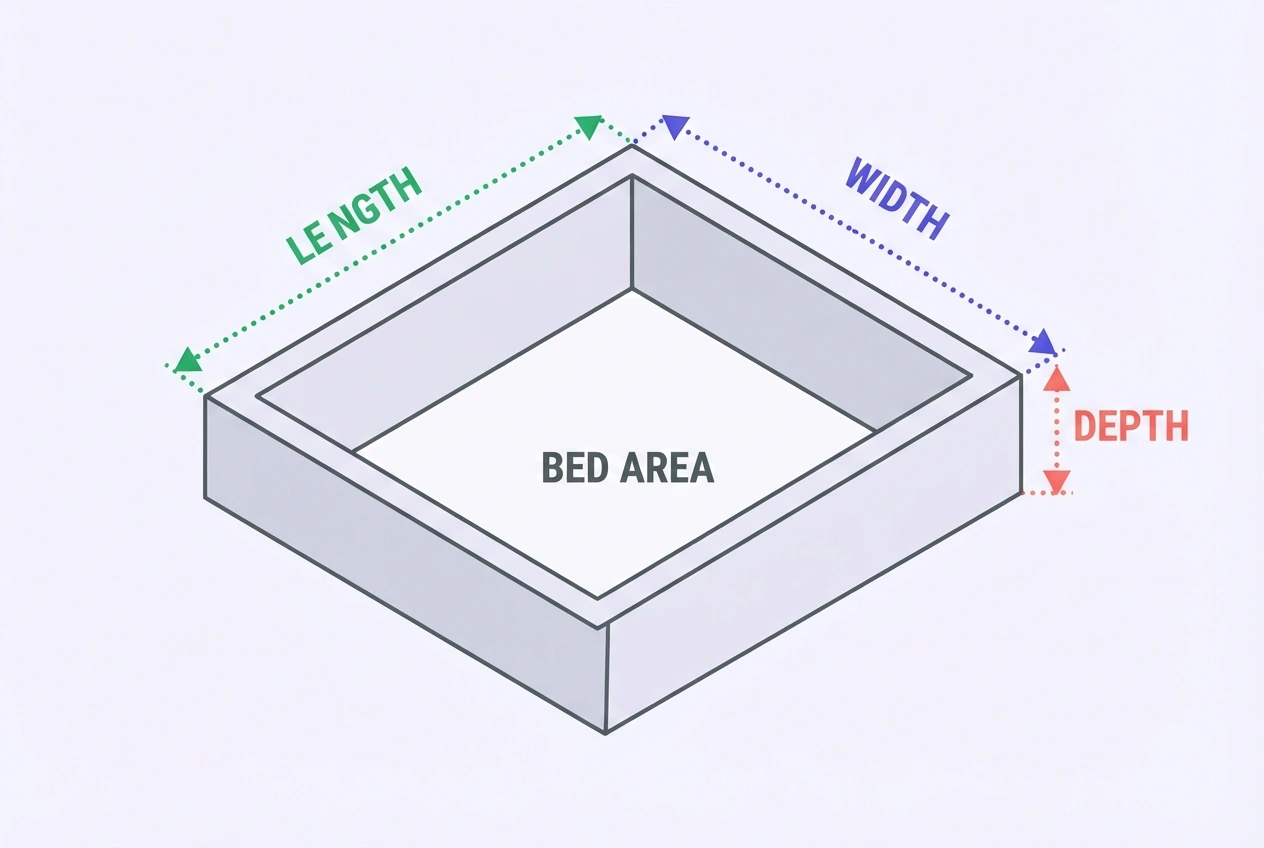
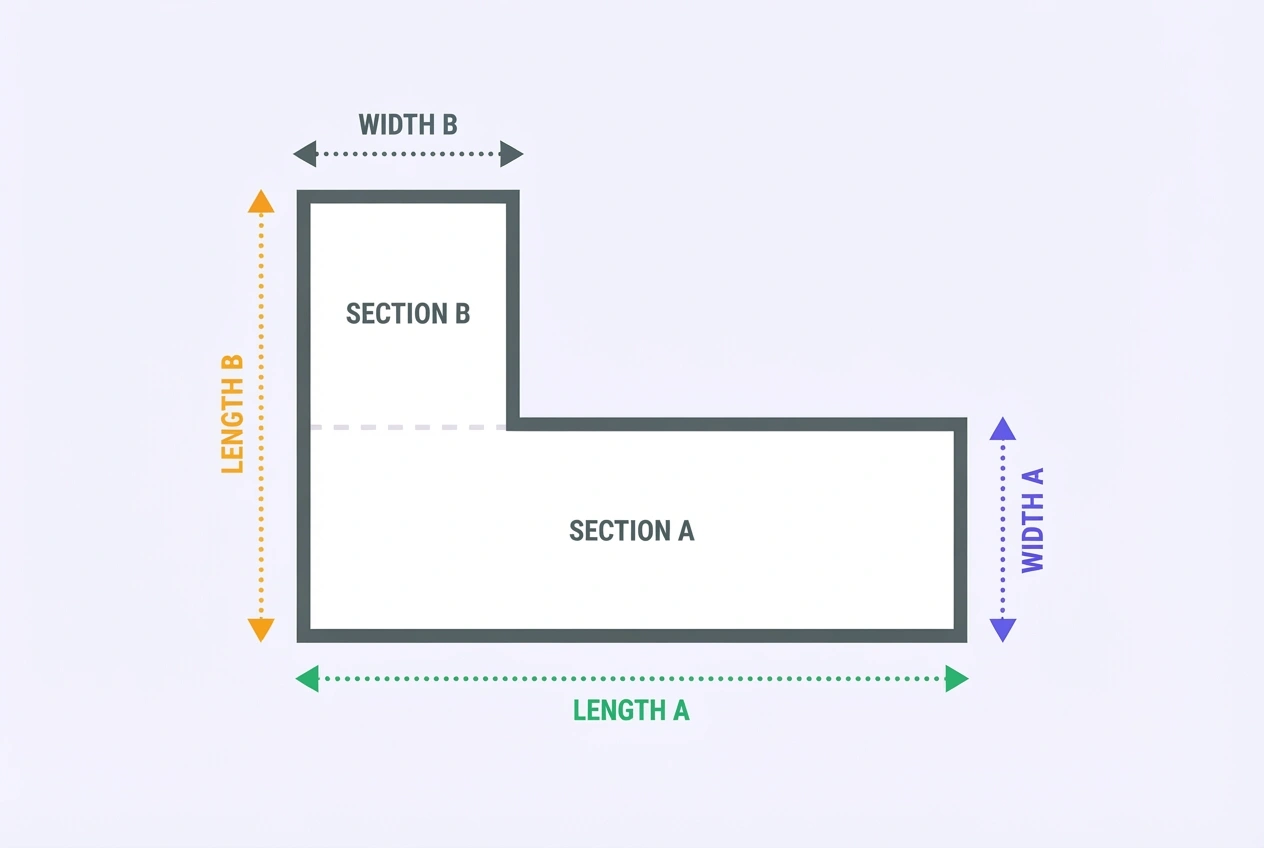
Measure length and width of the bed, slab, or pad in feet and multiply for square feet. For L-shaped or irregular areas, split them into rectangles, compute each, and add the areas. If a plan already gives you the area, switch the calculator to Known Area mode and enter it directly in square feet, square yards, or square meters.
- Step 2: Decide the depth in inches
Depth is specified by project type: 2–3 inches for mulch beds, 4–6 inches compacted for a gravel base, 4 inches for a concrete slab, a quarter to half inch for lawn topdressing. When in doubt, check the material spec or local code — structural fills have requirements.
- Step 3: Convert depth to feet
Divide the inches by 12. Six inches becomes 0.5 feet, three inches becomes 0.25. This single conversion is where most manual errors happen — multiplying area by raw inches inflates the result by a factor of twelve.
- Step 4: Multiply for cubic feet
Area × depth in feet = cubic feet. For a 20 ft × 12 ft bed at 6 inches: 240 × 0.5 = 120 cubic feet.
- Step 5: Convert to cubic yards
Divide cubic feet by 27: 120 ÷ 27 = 4.44 cubic yards. That is the exact geometric volume of the space.
- Step 6: Add waste and round up
Multiply by 1.05–1.15 depending on the material — gravel compacts, mulch settles, concrete spills at the chute. Then round up to the next half or full yard, because suppliers rarely sell fractions: 4.44 × 1.10 = 4.9 → order 5 yards.
Coverage per Cubic Yard
The fastest way to sanity-check any yardage figure: one cubic yard covers 324 square feet at one inch deep, and coverage shrinks in direct proportion as depth rises. Work backwards from the table to estimate what an order will actually cover:
| Depth | Area Covered by 1 Cubic Yard | Rule of Thumb |
|---|---|---|
| 1 inch | 324 sq ft | Topdressing passes |
| 2 inches | 162 sq ft | Light refresh mulch |
| 3 inches | 108 sq ft | Standard mulch bed |
| 4 inches | 81 sq ft | Weed-suppressing mulch, sand bed |
| 5 inches | 64.8 sq ft | Deep gravel path |
| 6 inches | 54 sq ft | Gravel base, new beds |
| 8 inches | 40.5 sq ft | Playground fall zone |
| 12 inches | 27 sq ft | Deep fill, raised beds |
The formula behind the table: coverage (sq ft) = 324 ÷ depth (inches), because one cubic yard is 324 one-inch-thick square-foot slices. Inverse check: yards needed = (area in sq ft × depth in inches) ÷ 324. Both give the same answer as the full L×W×D÷27 calculation.
Recommended Depths by Project
Volume math only matters if the depth is right. Typical ranges for the projects this calculator gets used for — structural work always follows the project spec or local code, not a table:
| Project | Depth | Notes |
|---|---|---|
| Mulch beds | 2–3 in | Keep mulch off stems and trunks |
| Tree rings | 2–3 in | Leave a mulch-free collar around the trunk |
| Mulch pathways | 3–4 in | Edging holds the material in place |
| Playground mulch | 8–12 in | Follow fall-height safety guidelines |
| Gravel paths | 3–4 in | Compact in lifts for a firm surface |
| Gravel base under pavers | 4–6 in | Depends on soil and expected load |
| Gravel driveway | 4–6 in | Two lifts of 2–3 in, compacted separately |
| Concrete slab | 4 in | 5.5 in with interior thicker sections per plan |
| Lawn topdressing | 0.25–0.5 in | Thin layers only — deeper smothers grass |
| Raised bed fill | 10–18 in | Blend topsoil with compost for planting |
Material Weights & Tons
Suppliers quote bulk material by the yard but trucks, weight limits, and some price sheets work in tons — and the same volume weighs wildly different amounts depending on the material. The calculator's weight row uses these densities:
| Material | Weight per Cubic Yard | Tons per Yard | Notes |
|---|---|---|---|
| Mulch (bark, shredded) | 400–800 lb | 0.2–0.4 | Dry is lightest; wet mulch nearly doubles |
| Topsoil | 1,800–2,200 lb | 0.9–1.1 | Moisture is the big variable |
| Gravel / crushed stone | 2,300–2,900 lb | 1.15–1.45 | Denser with fines; loose vs compacted differs |
| Sand (dry) | 2,600–3,000 lb | 1.3–1.5 | Wet sand runs up to ~3,400 lb |
| Concrete (mixed) | 3,600–4,050 lb | 1.8–2.0 | Ready-mix is batched, not weighed, per yard |
Converting in your head: multiply yards by the pounds-per-yard figure, divide by 2,000 for tons. Five yards of gravel at 2,600 lb is 13,000 lb — 6.5 tons — which is why gravel arrives by the truckload, not the trunk-load.
Compaction and swelling: loose gravel or stone loses roughly 15–25% of its depth once compacted, which is why bases are ordered after adding the waste allowance rather than before. Excavated soil does the opposite — it swells about 20% when dug, so a hole that yields 5 yards in the ground hauled closer to 6 yards away.

Bags vs Bulk Delivery
Bagged material makes sense for small jobs and tight access; bulk delivery wins on everything past a yard. The crossover point is mostly labor and price per unit:
| Bag Size | Bags per Cubic Yard | Typical Use |
|---|---|---|
| 0.5 cu ft | 54 | Small garden soil bags |
| 0.75 cu ft | 36 | Standard 40 lb topsoil bag |
| 1.0 cu ft | 27 | Premium soil, compost |
| 1.5 cu ft | 18 | Large soil / mulch blend |
| 2.0 cu ft | 13.5 | Standard mulch bag |
| 3.0 cu ft | 9 | Large mulch bag, light material |
When bags win: under a cubic yard total, jobs without vehicle access to the bed area, phased weekend projects with no storage pile, and materials you want kept dry. When bulk wins: anything over a yard — bagged mulch commonly runs 2–3× the per-yard price of a delivered pile, and every bag is a trip from pallet to bed. Note the half-bag realities in the table: a 13.5-bag figure means 14 bags, and the calculator's bag count always rounds up.
Truck Capacity & Delivery
Hauling your own material is cheaper until the volume — or the weight — exceeds the truck. Volume is what fills the bed; weight is what the suspension actually cares about, and for dense material weight caps out first.
Full-size pickup, 6.5 ft bed: about 2 cubic yards loaded level, up to 3 heaped for light mulch. But a half-ton truck is rated for roughly 1,500–2,000 lb of payload — one cubic yard of gravel at 2,600 lb already exceeds it. Two yards of gravel is 5,200 lb: trailer or delivery territory.
Midsize pickup (Tacoma-class): roughly 1.25 cubic yards of bed volume and a lighter payload — safe for one yard of mulch or topsoil, not for stone. Dump trailers: commonly 5–7 yards, rated 7,000–10,000 lb payload, which handles most gravel orders. Delivery trucks: a single-axle dump carries 5–8 yards, a tri-axle 10–16, and a semi tractor-trailer up to 25 — most residential orders from 3 yards up are delivered, not hauled.
Delivery logistics to confirm before ordering: dump location and clearance (a full dump truck needs ~20 ft of overhead clearance and will not drive across septic fields), whether the quoted price includes spread-out time (it does not — the driver dumps in one pile), and minimum-order fees that make small loads uneconomical. Many suppliers quote delivered price by zone rather than per yard plus a flat fee.
Price per Cubic Yard (2026)
Bulk material pricing swings with region, delivery distance, and whether the load is picked up or dropped. US national ranges for planning only — local quotes vary widely:
| Material | Picked Up | Delivered | Notes |
|---|---|---|---|
| Mulch (natural, bulk) | $15 – $35 | $30 – $60 | Dyed varieties run higher |
| Topsoil (screened) | $15 – $40 | $20 – $60 | Screening adds cost; blends more |
| Gravel (crushed #57) | $25 – $50 | $35 – $75 | Delivery distance dominates |
| Sand (masonry/fill) | $20 – $45 | $30 – $70 | Washed sand costs more |
| Ready-mix concrete | $155 – $190 per yd³ batched | Short-load fees under ~4 yards | |
What moves the price: fuel and haul distance (a load 10 miles from the pit can price 20% under one 40 miles out), order size (suppliers discount full-truck orders and charge minimum-load fees under 2–3 yards), and season — spring mulch season carries peak pricing in most markets. Concrete adds short-load charges below the minimum pour, typically 3–4 yards, which can double the effective per-yard price on a small slab.
Why gravel is priced by the ton, not the yard: a loader bucket weighs what it weighs — the scale house weighs the truck empty and loaded, and the ticket says tons. Volume is estimated afterward by dividing by the material's density. That is also why the same "yard" of gravel can fill different volumes from two suppliers: a wet 2,900 lb yard is only 4.5 tons per truckload where a dry 2,300 lb yard stretches to 5.2. When comparing quotes, convert everything to one basis with the calculator's Price Basis selector: enter the ton price and the material, and the cost row shows the same job priced both ways.
Converting between quotes: price per ton ÷ (weight per yard ÷ 2,000) = price per cubic yard. Gravel at $35 per ton at 2,600 lb per yard works out to $45.50 per yard; mulch at $30 per ton at 600 lb per yard would be an impossible-sounding $100 per yard — which is exactly why mulch is never sold by the ton. Compare delivered-to-your-driveway prices, not pickup prices, unless you are hauling yourself.
Common Ordering Mistakes
Yardage errors are expensive in a way area errors are not — a shortfall means a second delivery fee, and an overage sits in a pile you paid for. These are the mistakes the calculator's fields exist to prevent:
- Multiplying by raw inches
Area × depth-in-inches ÷ 27 is wrong by a factor of twelve — the classic cubic-yard error. The calculator's depth unit defaults to inches and converts internally; if you compute by hand, divide inches by 12 first.
- Skipping the waste allowance
The geometric volume is not the order volume. Gravel compacts in lifts, mulch settles after rain, and every transfer spills. Add 5–15% per the material before rounding.
- Ordering the exact calculated figure
Suppliers sell full or half yards. Rounding 4.9 yards down to 4.75 saves almost nothing and risks a top-up delivery that costs more than the quarter yard you saved. Round up.
- Forgetting the weight
Two yards of gravel is 5,200 lb — beyond most half-ton pickups' payload. Check the weight row before deciding to haul it yourself; the bed volume fitting is not the same as the truck carrying it.
- Measuring the wrong area
Gravel under pavers covers the paver footprint plus edge restraint, not the excavation. Mulch covers bed area minus dense shrub canopies. Measure what the material will actually cover.
- Ignoring depth variation across the job
A bed that is 2 inches deep at one end and 5 at the other needs the average — or, better, the calculator run twice and summed. One depth input for a variable-depth job is an estimate, not a takeoff.
Frequently Asked Questions
References
- National Institute of Standards and Technology, NIST Handbook 44 — Units and Systems of Weights and Measures, nist.gov
- USDA Natural Resources Conservation Service, Soil Bulk Density and Moisture Guidance, nrcs.usda.gov
- Federal Highway Administration, Aggregate Compaction and Base Course Construction Guidance, fhwa.dot.gov
- American Concrete Institute, ACI 330R — Guide for Design and Construction of Concrete Parking Lots, concrete.org
Disclaimer: The cubic yards calculator results on this page are estimates for planning purposes only. Actual material quantities depend on compaction, moisture, site conditions, and supplier measurement practices. Material weights are averages and vary with moisture content; confirm densities and delivered pricing with your supplier. Structural fills and concrete work must follow project specifications and local building code.
Need mulch, gravel, or soil delivered by the yard? Get free quotes from local landscape suppliers near you.
Get Free Estimates