
Pipe Volume Calculator
Enter the inner diameter and the run length to get the liquid a pipe holds — in gallons and liters, with the water weight that stands and hangers have to carry.
Results
Volume
Weight of Liquid
Per Foot & Fill Time
Calculation Assumptions
What You Get
- ✓Free — no sign-up, nothing to install
- ✓Gallons, liters, cubic feet, and cubic meters from one entry
- ✓Actual Schedule 40 inner diameters — not rounded label sizes
- ✓Water weight in pounds and kilograms for supports and hangers
- ✓Gallons-per-foot figure for quick per-run mental math
- ✓Optional liquid density — glycol, wastewater, any fluid
- ✓Optional flow rate with fill and flush time
- ✓Reference tables from 1/8 inch to 12 inch plus metric sizes
- ✓PDF takeoff export and shareable input-saving link
- ✓Works on phone, tablet & desktop
ON THIS PAGE:
What Pipe Volume Tells You
Pipe volume is the amount of liquid a run holds when it is full — the cross-sectional area of the bore multiplied by the length. It sounds like a geometry footnote, but it is one of those numbers that decides whether a job goes smoothly: how much water a pressure test needs, how much antifreeze to buy before winterizing, how much chemical dosing a line requires, how heavy a suspended run gets once it is full of water, and how long a tap has to run before hot water arrives from the heater.

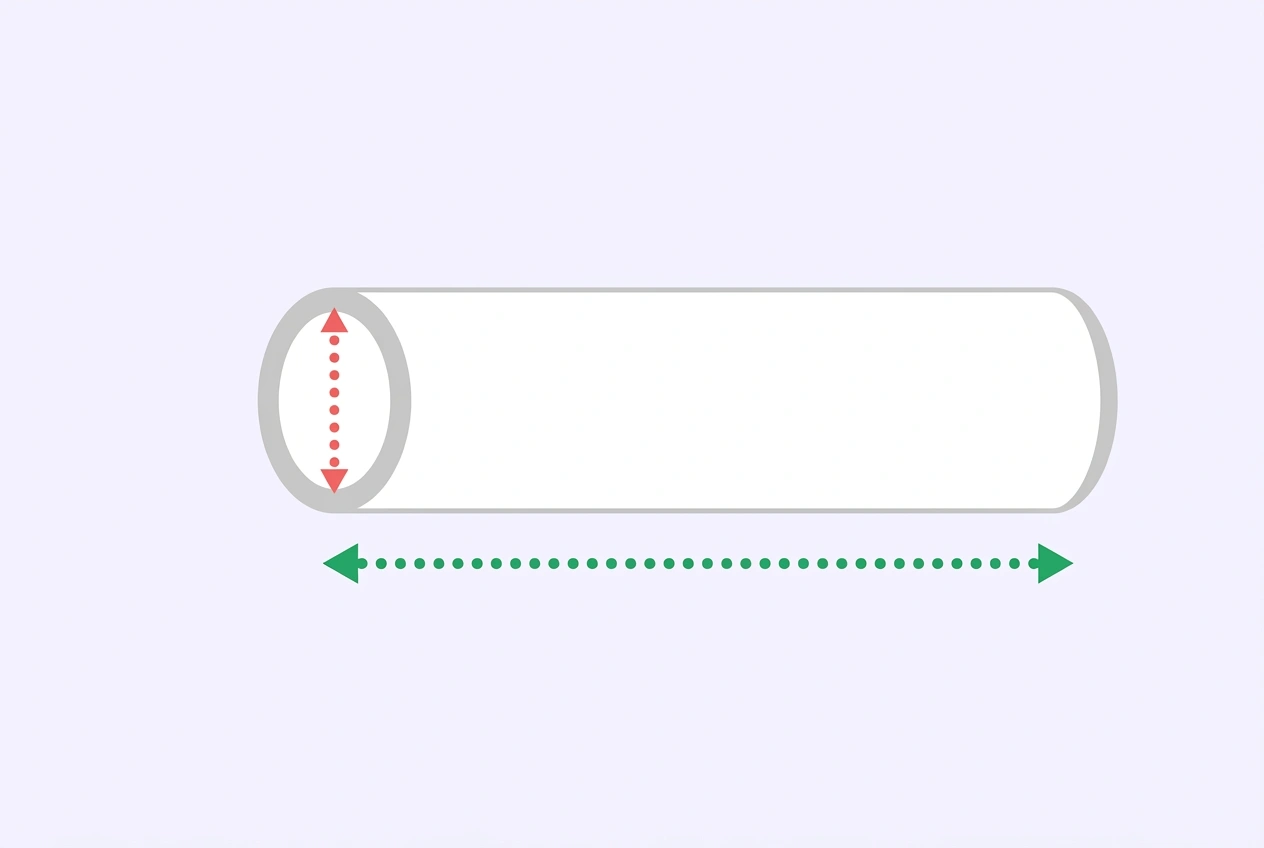
The trap that catches people is the label. Pipe is sold by nominal size — "2-inch pipe" — but the label is a category name, not a measurement of anything. The space the liquid actually occupies is set by the inner diameter, and that number is smaller than you expect once the wall thickness comes out of it. Volume grows with the square of the diameter, so a sizing error does not stay proportional: double the diameter and the volume quadruples.
Everything on this page works from the inner diameter. Pick a Schedule 40 size from the dropdown and the actual bore is filled in for you, or enter your own measurement. The results include the water weight because that number matters as much as the volume — a 4-inch run 100 feet long carries over 540 pounds of water before you add the pipe itself.
The Pipe Volume Formula
A pipe is a cylinder, so its volume is the circle's area times the length. Worked in inches the formula reads:
Volume = π × (inner diameter ÷ 2)² × length
Halve the inner diameter to get the radius, square it, multiply by π for the cross-sectional area in square inches, then multiply by the length in inches for cubic inches. From there the results card converts with fixed identities:
| Conversion | Value | Used For |
|---|---|---|
| Cubic inches per US gallon | 231 | Gallons output |
| Cubic inches per cubic foot | 1,728 | Cubic feet output |
| Milliliters per cubic inch | 16.387064 | Liters output (1,000 mL = 1 L) |
| Gallons per cubic foot | 7.48052 | Liquid weight from density |
| Water density | 62.4 lb/cu ft ≈ 8.34 lb/gal | Weight of the liquid inside |
One shortcut worth memorizing: gallons per foot = (inner diameter in inches)² × 0.0408. The constant folds π, the area formula, and the 231-cubic-inch gallon into one number, so a 2-inch bore holds about 0.174 gallons per foot and a 4-inch bore holds about 0.66 — mental math that survives on a job site without a calculator.
Worked Example: The Page Defaults
The calculator opens on a 4-inch inner diameter and a 100-foot run filled with water — a typical supply or irrigation main. Walking the math by hand:
Radius = 4 ÷ 2 = 2 inches. Cross-sectional area = π × 2² = 12.57 square inches. Length = 100 × 12 = 1,200 inches. Volume = 12.57 × 1,200 = 15,080 cubic inches.
Gallons = 15,080 ÷ 231 = 65.3 gallons. Liters = 15,080 × 16.387 ÷ 1,000 = 247.1 liters. Cubic feet = 15,080 ÷ 1,728 = 8.73 cubic feet. Gallons per foot = 65.3 ÷ 100 = 0.653 — which the shortcut reproduces as 4² × 0.0408.
Water weight = 65.3 × 8.34 = 544.6 pounds, about 247 kilograms. That is the number a hanger layout has to carry before the steel or copper itself is counted. Add a flow rate of 10 GPM and the same run charges in 65.3 ÷ 10 ≈ 6.5 minutes — useful to know when you are flushing a new line and want to know when the water running out is the water that went in.
Nominal vs Actual Inner Diameter
A "2-inch pipe" has no 2-inch measurement anywhere on it. The nominal size is a standardized label that stuck around from when pipe wall thicknesses were specified differently; the actual bore depends on the standard the pipe was made to. Schedule 40 steel and PVC share inner diameters — a nominal 2-inch is bored to 2.067 inches, and the outer diameter is 2.375 inches. Calculating the volume from the label size instead of the real bore understates a 2-inch line by about 6 percent and a 4-inch line by about 1.5 percent; using the outer diameter overstates it by more than 30 percent.
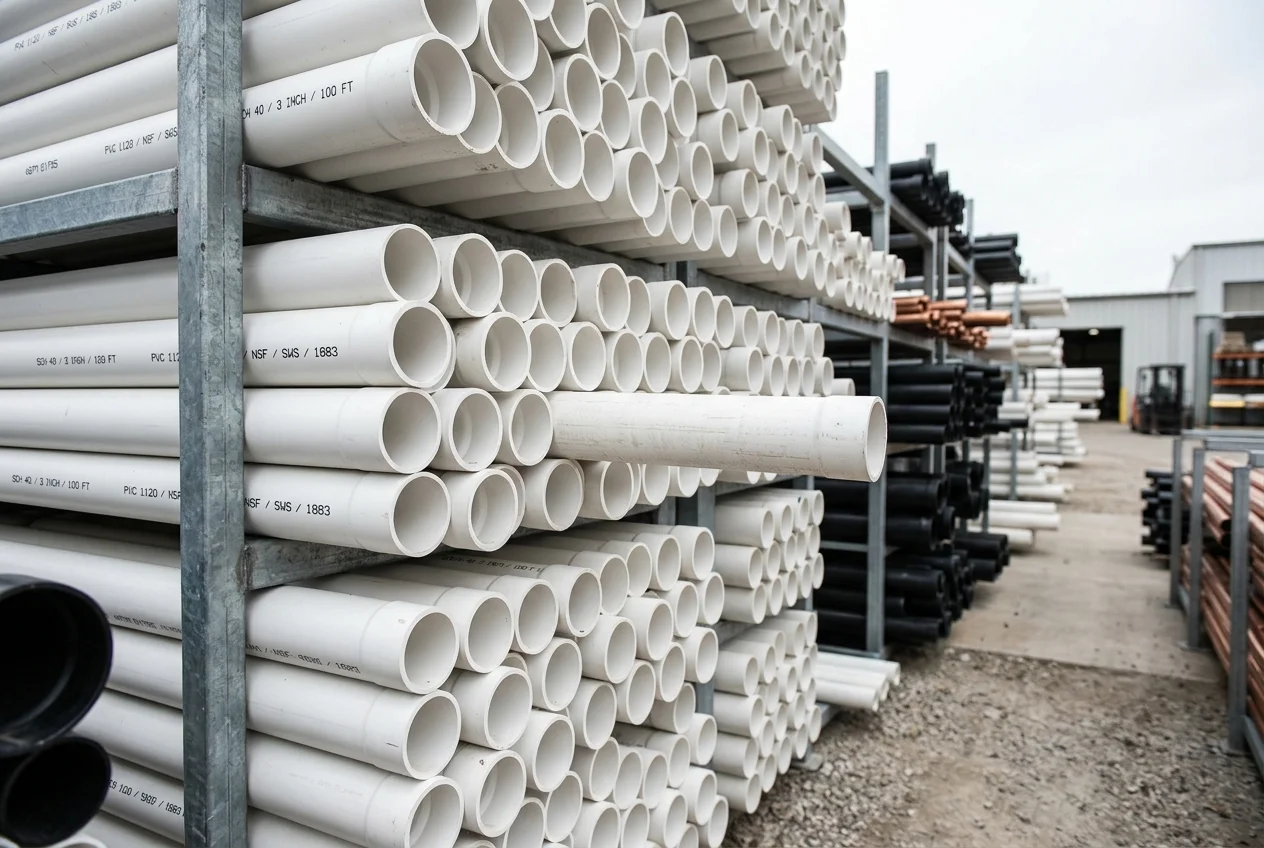
The schedules matter because the outer diameter stays fixed while the wall thickens. Schedule 80 pipe has the same outer diameter as Schedule 40 but a smaller bore: the nominal 2-inch drops from a 2.067-inch to a 1.939-inch inner diameter, and volume per foot falls about 12 percent with it. Material families move the number even further — 1-inch PEX is bored near 0.862 inches, roughly a third less volume per foot than 1-inch Schedule 40, and Type L copper sits in between at 1.025 inches.
The table below lists actual Schedule 40 inner diameters for common nominal sizes with the water each holds per foot. These are the numbers the size dropdown uses, so a select-and-go estimate matches what the pipe will really hold.
| Nominal Size | Actual ID (in) | Cubic Inches / ft | Gallons / ft | Water Weight (lb/ft) |
|---|---|---|---|---|
| 1/8" | 0.269 | 0.68 | 0.0030 | 0.025 |
| 1/4" | 0.364 | 1.25 | 0.0054 | 0.045 |
| 3/8" | 0.493 | 2.29 | 0.0099 | 0.083 |
| 1/2" | 0.622 | 3.65 | 0.0158 | 0.132 |
| 3/4" | 0.824 | 6.40 | 0.0277 | 0.231 |
| 1" | 1.049 | 10.37 | 0.0449 | 0.374 |
| 1-1/4" | 1.380 | 17.95 | 0.0777 | 0.648 |
| 1-1/2" | 1.610 | 24.43 | 0.1058 | 0.882 |
| 2" | 2.067 | 40.27 | 0.1743 | 1.454 |
| 2-1/2" | 2.469 | 57.45 | 0.2487 | 2.075 |
| 3" | 3.068 | 88.71 | 0.3840 | 3.203 |
| 3-1/2" | 3.548 | 118.64 | 0.5136 | 4.284 |
| 4" | 4.026 | 152.76 | 0.6613 | 5.516 |
| 5" | 5.047 | 240.07 | 1.0393 | 8.669 |
| 6" | 6.065 | 346.73 | 1.5010 | 12.52 |
| 8" | 7.981 | 600.31 | 2.5987 | 21.68 |
| 10" | 10.020 | 946.25 | 4.0963 | 34.17 |
| 12" | 11.938 | 1,343.16 | 5.8145 | 48.50 |
Water weight rows assume fresh water at about 62.4 lb per cubic foot. Warmer water weighs slightly less and colder water slightly more; glycol solutions and wastewater run different densities, which is what the custom density field is for.
Pipe Volume Reference Tables
Metric sizing works the same way with the diameter stated directly — a "50 mm pipe" label refers to the outer diameter family, but the tables below are computed from the inner diameter in millimeters, so treat the first column as the bore. Liters per meter and kilograms per meter of water are numerically near-identical because a liter of water weighs almost exactly a kilogram.
| Inner Diameter (mm) | Liters / m | Water Weight (kg/m) |
|---|---|---|
| 15 | 0.177 | 0.177 |
| 20 | 0.314 | 0.314 |
| 25 | 0.491 | 0.491 |
| 32 | 0.804 | 0.804 |
| 40 | 1.257 | 1.257 |
| 50 | 1.963 | 1.963 |
| 65 | 3.318 | 3.318 |
| 80 | 5.027 | 5.027 |
| 100 | 7.854 | 7.854 |
| 125 | 12.272 | 12.272 |
| 150 | 17.671 | 17.671 |
For the sizes people look up most, here is a full Schedule 40 100-foot run of each, computed from the actual inner diameters:
| Nominal Size | 100-Foot Run | Gallons | Water Weight |
|---|---|---|---|
| 1/2" | ID 0.622" | 1.58 gal | 13.2 lb |
| 3/4" | ID 0.824" | 2.77 gal | 23.1 lb |
| 1" | ID 1.049" | 4.49 gal | 37.4 lb |
| 2" | ID 2.067" | 17.43 gal | 145.4 lb |
| 4" | ID 4.026" | 66.13 gal | 551.6 lb |
| 6" | ID 6.065" | 150.10 gal | 1,252.1 lb |
| 8" | ID 7.981" | 259.87 gal | 2,167.8 lb |
Reading the last two columns together is a quick sanity check on structural work: an 8-inch main 100 feet long puts more than a ton of water on its hangers, before the weight of the pipe itself.
Frequently Asked Questions
It depends on the inner diameter. A 100-foot run of 2-inch Schedule 40 pipe (2.067-inch ID) holds about 17.4 gallons; the same run of 4-inch Schedule 40 (4.026-inch ID) holds about 66.1 gallons. The quick identity: gallons per foot equals the inner diameter in inches squared times 0.0408, so multiply that figure by the run length in feet.
Always the inner diameter — the wall thickness takes up space the liquid cannot. A nominal 2-inch Schedule 40 pipe has a 2.067-inch inner diameter and a 2.375-inch outer diameter; calculating from the outer diameter would overstate the volume by about 32 percent on that size. If you only know the outer diameter, subtract twice the wall thickness.
On an open end, measure straight across the opening from inside wall to inside wall with calipers or a ruler. If the end is capped or the line is buried, measure the outer circumference, divide by pi to get the outer diameter, then subtract twice the wall thickness from the pipe's specification sheet.
About 8.34 pounds per gallon, which is roughly 62.4 pounds per cubic foot. The page default — a 4-inch inner diameter pipe 100 feet long — holds about 65.3 gallons, so the water alone weighs about 545 pounds (247 kilograms). Hangars, stands, and structural supports must carry the water weight plus the pipe's own weight, which is a separate figure.
Divide the pipe volume in gallons by the flow rate in gallons per minute. A 2-inch Schedule 100-foot run holds about 17.4 gallons, so at 10 GPM it fills in roughly 1.7 minutes. For flushing, plan to move at least one to two full pipe volumes through the line before the fluid running out matches what is going in.
In metric units, multiply the cross-sectional area in square meters by the length in meters, then multiply by 1,000 to get liters. A 50 mm inner diameter pipe has an area of 0.001963 square meters, so a 10-meter run holds about 19.6 liters. The calculator accepts centimeters and meters directly and reports liters alongside gallons.
The formula is pure geometry, so only the inner diameter matters — but material determines wall thickness. One-inch PEX has an inner diameter near 0.862 inches, about a third less volume per foot than 1-inch Schedule 40 steel at 1.049 inches, and 1-inch Type L copper sits between them at 1.025 inches. Take the inner diameter from the actual product, not the nominal label.
Schedule numbers are standardized wall thicknesses from the pipe dimension standards. Schedule 40 and Schedule 80 pipe share the same outer diameter, but Schedule 80's thicker wall shrinks the bore: a nominal 2-inch pipe drops from a 2.067-inch inner diameter in Schedule 40 to 1.939 inches in Schedule 80, about 12 percent less volume per foot. Use the actual inner diameter for whatever schedule you are buying.
References
- ASME B36.10M, Welded and Seamless Wrought Steel Pipe — standard pipe dimensions including Schedule 40 inner diameters, asme.org
- ASTM D1785, Standard Specification for Poly(Vinyl Chloride) (PVC) Plastic Pipe, Schedules 40, 80, and 120, astm.org
- Copper Development Association, Copper Tube Handbook — Types K, L, and M tube dimensions, copper.org
- U.S. Geological Survey, Water Science School — Water Density, usgs.gov
This calculator provides estimates for planning purposes only. Verify actual inner diameters, wall thicknesses, and liquid densities against the manufacturer's specification sheets before ordering fluid, dosing chemicals, or designing supports. MyBuilderBase is not responsible for filling errors, chemical dosing errors, or structural decisions resulting from use of this tool.
Sizing a supply run, charging a hydronic loop, or pressure-testing a line? Compare quotes from local plumbers and pipefitters before you buy the pipe and the fluid to fill it.
Get Free Estimates