
Water Flow Rate Calculator
Calculate the flow moving through a pipe — from diameter and velocity, a simple bucket test, or available pressure — with a live check against code velocity limits.
Results
Flow Rate
Velocity Check
Calculation Assumptions
What You Get
- ✓Free — no sign-up, nothing to install
- ✓Three input modes: diameter + velocity, bucket test, or pressure-driven
- ✓GPM, GPH, L/min, L/s, and cubic feet per minute from one entry
- ✓Live velocity verdict against cold and hot water code limits
- ✓Actual Schedule 40 inner diameters — not rounded label sizes
- ✓Hazen-Williams pressure mode with material C-factors
- ✓Optional density for mass flow in lb/min and kg/min
- ✓Flow-by-size reference table from actual pipe bores
- ✓PDF takeoff export and shareable input-saving link
- ✓Works on phone, tablet & desktop
ON THIS PAGE:
What Water Flow Rate Tells You
Flow rate is how much water moves through a pipe per unit of time — gallons per minute on US job sites, liters per second in metric work. It is the sizing number behind half the decisions in a plumbing system: whether a tankless water heater can keep up with two showers at once, how big a filter or softener needs to be, whether a pump can deliver what the irrigation design demands, and how quickly a fixture at the end of a long run will actually fill.
It helps to keep two questions apart. Pipe volume answers how much water a run holds — a static capacity that matters for fill times, chemical dosing, and the weight on the hangers. Flow rate answers how much water moves through it — a dynamic figure that matters for delivery and sizing. The two connect directly: divide a pipe's volume by the flow rate and you get how long it takes to fill, which is exactly the fill-time figure the pipe volume page reports.

When you cannot measure velocity directly, the field's answer is the bucket test: open an outlet fully, catch the water in a container of known size, and time it. Volume divided by time is flow rate, no instruments required — and done at the farthest fixture from the meter, it tells you the worst case the system delivers, which is the number that matters when sizing equipment.
The Water Flow Rate Formulas
All three calculation modes on this page resolve to the same outputs. Each starts from the inputs you actually have:
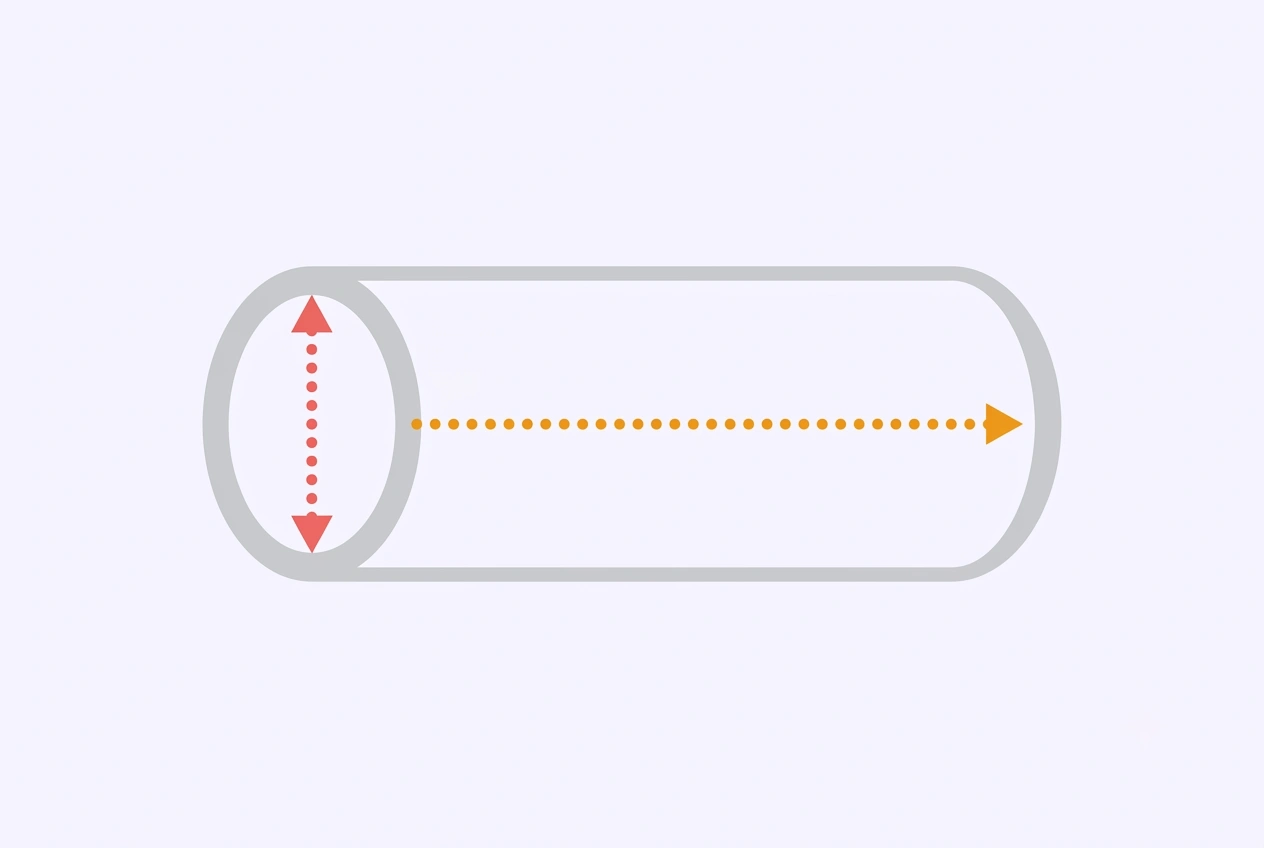
Mode 1 — Diameter + velocity: Q = A × v, where A = π × (inner diameter ÷ 2)². The area times the speed of the water gives volume per unit time. Worked in inches and feet per second, the combined shortcut is GPM = 2.448 × d² × v — the constant folds π, the area formula, the 231-cubic-inch gallon, and the seconds-per-minute conversion into one number worth memorizing.
Mode 2 — Bucket test: Q = V ÷ t. The container's volume divided by the fill time, converted to whatever unit you need. Five gallons in 30 seconds is 10 GPM.
Mode 3 — Pressure-driven (Hazen-Williams): for water at ordinary temperatures, friction loss in a pipe relates to velocity through the C-factor of the material. The standard head-loss form is h = 4.52 × L × Q1.85 ÷ (C1.85 × d4.87) — head in feet, Q in GPM, d the inner diameter in inches. Solving it for flow with the available pressure converted to head (1 psi = 2.31 feet of water) gives the mode the calculator uses:
GPM = 4.52 × C × (d/12)2.63 × (P/L)0.54
where d is the inner diameter in inches, P the available pressure drop in psi across the run, L the length in feet, and C the roughness factor — 150 for smooth new copper or PVC, sliding down toward 80 for badly corroded steel. The Hazen-Williams method is an empirical water-only model: it does not apply to compressible fluids or exotic temperatures, and it ignores fittings, valves, and elevation change, which is why the result is an estimate a real design would refine.
| Conversion | Value | Used For |
|---|---|---|
| Cubic inches per US gallon | 231 | GPM output |
| Liters per cubic inch | 0.016387064 | L/min and L/s output |
| Cubic inches per cubic foot | 1,728 | Cubic feet per minute output |
| GPM per cubic foot per second | 448.8 | Bigger-flow sanity checks |
| Water density | 62.4 lb/cu ft | Mass flow output |
Worked Example: The Page Defaults
The calculator opens on a 1-inch Schedule 40 line — actual inner diameter 1.049 inches — carrying water at 6 feet per second. Walking the math by hand:
Area = π × (1.049 ÷ 2)² = π × 0.5502 = 0.8647 square inches. Velocity = 6 ft/s = 72 inches per second. Flow = 0.8647 × 72 = 62.26 cubic inches per second.
GPM = 62.26 × 60 ÷ 231 = 16.16 GPM. That is 969.8 gallons per hour, 61.18 liters per minute, and about 2.16 cubic feet per minute. The GPM shortcut reproduces it in one step: 2.448 × 1.049² × 6 ≈ 16.16 — the shortcut and the long path agree to rounding.
Velocity check: 6 ft/s sits under the 8-foot-per-second cold-water ceiling, so the verdict is safe. Push the same 16.16 GPM through a 3/4-inch line instead — bore 0.824 inches — and velocity jumps to roughly 9.8 feet per second: above the limit, with the erosion, noise, and pressure-loss problems that follow.
Bucket-test cross-check: an outdoor spigot fills a 5-gallon bucket in 30 seconds — 5 ÷ 30 × 60 = 10 GPM. If that spigot is fed by a 3/4-inch line, velocity works out to about 6 feet per second, right in the healthy band.
Water Velocity Limits
Velocity is the quiet variable in pipe sizing. The flow number says whether the system delivers enough; the velocity number says whether it will survive delivering it. Water moving too fast scrapes the protective film off the inside of the pipe — erosion-corrosion — and generates noise that travels through the whole building. Plumbing codes and the copper industry's guidance converge on the same bands:
| Application | Velocity Limit | Why |
|---|---|---|
| Cold water, copper tube | ≈ 8 ft/s | Erosion-corrosion ceiling per code guidance |
| Hot water, copper up to 140°F | ≈ 5 ft/s | Hot water attacks copper faster |
| Hot water above 140°F | 2–3 ft/s | Water becomes more aggressive as temperature climbs |
| HVAC heating & chilled water | ≈ 3 ft/s | Noise, wear, and pump pressure balance |
| Pump suction lines | ≈ 6 ft/s | Protects the pump from cavitation and strain |
| Residential general ceiling | 8 ft/s | Erosion, noise, and pressure-drop control |
The calculator's verdict column uses the 8-foot-per-second cold-water ceiling as the primary gate. Between 8 and 10 feet per second the reading is high — survivable in short runs but worth fixing; above 10 it is excessive. Either way the fix is the same pair of levers: move less water, or make the bore bigger. Because area grows with the square of the diameter, one nominal size up cuts velocity nearly in half — the geometry the upsize advice counts on.
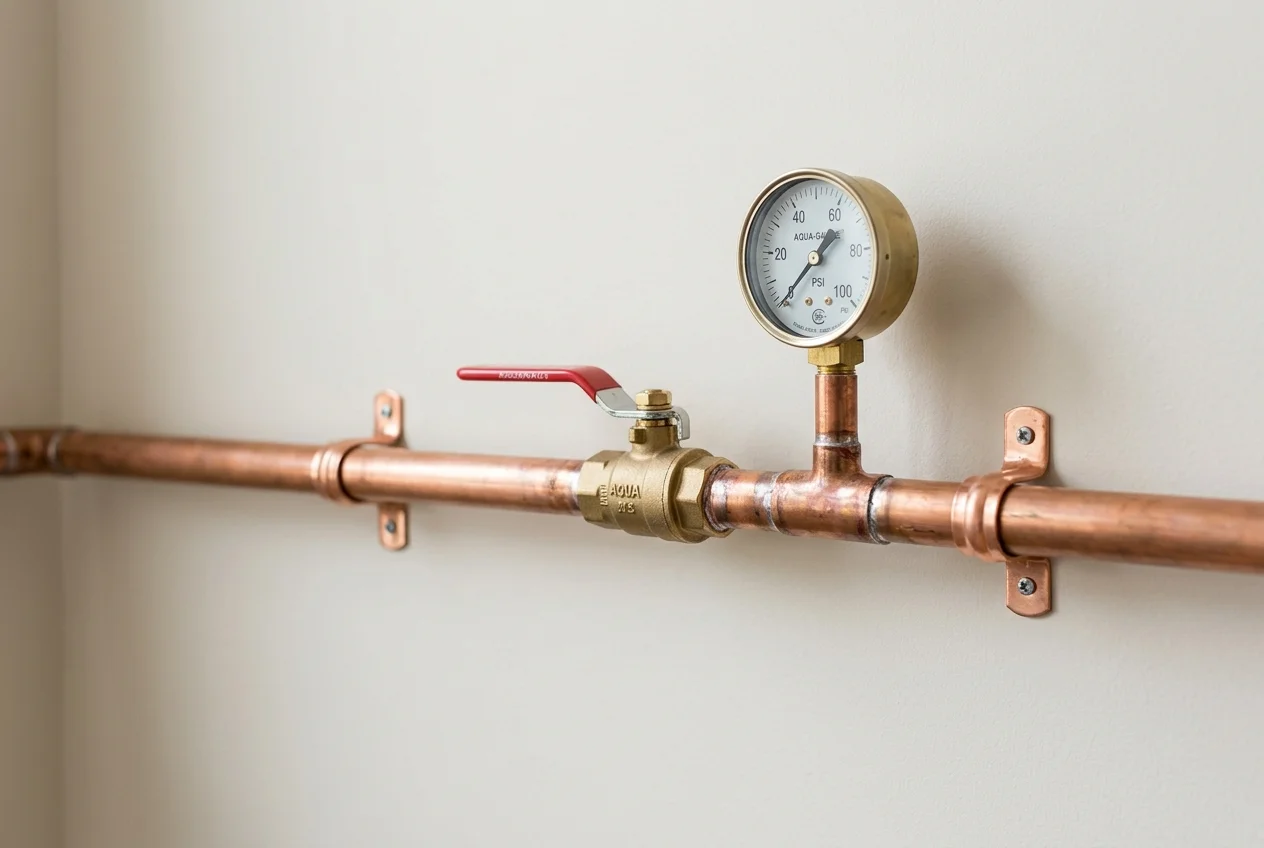
One caution: the table rows are limits, not targets. Sizing a whole house at a flat 8 feet per second produces aggressive, noisy plumbing. Comfortable residential design usually lands supply branches between 3 and 6 feet per second and lets the ceiling exist for peak moments — the hose bib on laundry day — rather than for everyday operation.
Water Flow by Pipe Size
Computed from actual Schedule 40 inner diameters — the same figures the size dropdown uses — at three reference velocities. The 6 ft/s column is the everyday supply band; the 8 ft/s column is the code ceiling for cold water.
| Nominal Size | Actual ID (in) | GPM @ 3 ft/s | GPM @ 6 ft/s | GPM @ 8 ft/s |
|---|---|---|---|---|
| 1/2" | 0.622 | 2.84 | 5.68 | 7.58 |
| 3/4" | 0.824 | 4.99 | 9.97 | 13.30 |
| 1" | 1.049 | 8.08 | 16.16 | 21.55 |
| 1-1/4" | 1.380 | 13.99 | 27.97 | 37.30 |
| 1-1/2" | 1.610 | 19.04 | 38.07 | 50.76 |
| 2" | 2.067 | 31.38 | 62.75 | 83.67 |
| 2-1/2" | 2.469 | 44.77 | 89.54 | 119.38 |
| 3" | 3.068 | 69.13 | 138.25 | 184.34 |
| 4" | 4.026 | 119.04 | 238.07 | 317.43 |
| 6" | 6.065 | 270.14 | 540.29 | 720.38 |
| 8" | 7.981 | 467.78 | 935.57 | 1,247.43 |
| 12" | 11.938 | 1,046.63 | 2,093.27 | 2,791.02 |
Reading the table against the fixture counts is the quick sanity check: a 3/4-inch branch at everyday velocity carries just under 10 GPM — enough for a shower plus a dishwasher, not enough to run two showers and the washing machine at once. Stepping a main up one nominal size roughly doubles the flow available at a given velocity, which is why trunk lines grow fast as fixture counts climb.
Frequently Asked Questions
Multiply the pipe's cross-sectional area by the water's velocity: Q = A × v. For a round pipe, A = π × (inner diameter ÷ 2)². A 1-inch Schedule 40 pipe (1.049-inch ID) at 6 feet per second has an area of 0.865 square inches and carries about 16.2 gallons per minute. If you cannot measure velocity, use the bucket test instead: time how long the outlet takes to fill a container of known size and divide volume by time.
A 3/4-inch Schedule 40 pipe with its 0.824-inch inner diameter carries roughly 10 gallons per minute at 6 feet per second, and about 13.3 GPM at the 8-foot-per-second residential ceiling. Real-world flow also depends on available pressure and the length of the run, which is why pressure-driven mode is included on this page.
Open the outlet fully, place a container of known volume under it — a 5-gallon bucket is the standard — and time how long it takes to fill. Flow rate equals volume divided by time. A 5-gallon bucket filled in 30 seconds is 10 gallons per minute. Measure at the fixture farthest from the meter to see the worst case, and run the water for a few seconds first so the line is charged.
Plumbing codes and the Copper Tube Handbook point to about 8 feet per second as the ceiling for cold water in copper, 5 feet per second for hot water up to 140°F, and 2 to 3 feet per second when hot water runs hotter than that, because hot water is more aggressive on the tube. Mechanical systems target around 3 feet per second, and pump suction lines near 6. The calculator's velocity check flags anything above the cold-water limit.
Pressure is the force pushing water through the pipe, measured in PSI; flow rate is how much water actually moves, measured in GPM. Pressure drives flow, but friction along the pipe eats into it — longer runs and smaller bores mean more friction loss, so the same street pressure delivers far less flow at the tap. The pressure-driven mode here estimates flow when you know pressure, pipe size, length, and material.
Volumetric flow rate counts volume per unit time — gallons per minute, liters per second. Mass flow rate counts weight per unit time — pounds or kilograms per minute — and equals the volumetric rate times the fluid's density. Water is the convenient case: one liter weighs almost exactly one kilogram. Choose custom density on this page to get mass flow for glycol, wastewater, or any other fluid.
Around 3 feet per second — roughly 1 meter per second — is the common design target for both heating and chilled water circuits. Slower flow settles air out of the loop and transports dirt poorly; faster flow adds noise, erosion, and pressure drop that the pump has to overcome. Always confirm against the project's design standards.
Two levers exist: reduce the flow rate or increase the pipe diameter. Because area grows with the square of the bore, upsizing a line from 1 inch to 1-1/4 inch Schedule 40 cuts velocity by more than 40 percent at the same flow — the 1.049-inch bore becomes 1.380 inches. Reducing flow is only an option where fixtures or equipment can live with less delivery, which is why upsizing is the usual fix.
References
- IAPMO, Uniform Plumbing Code — water supply system sizing and velocity provisions, iapmo.org
- International Code Council, International Plumbing Code — water distribution design provisions, iccsafe.org
- Copper Development Association, Copper Tube Handbook — velocity guidance for copper tube by temperature, copper.org
- American Water Works Association, Water Supply Sizing Resources, awwa.org
This calculator provides estimates for planning purposes only. The pressure-driven mode uses the Hazen-Williams empirical method, which applies to water at ordinary temperatures and ignores fittings, elevation change, and fixture demands. Verify actual pipe specifications, pressures, and code requirements with the manufacturer's data and your local authority before finalizing designs. MyBuilderBase is not responsible for system sizing errors or job outcomes resulting from use of this tool.
Sizing supply lines, a pump, or a whole-house repipe? Compare quotes from local plumbers before you commit to a pipe size.
Get Free Estimates