
Feet & Inches Math
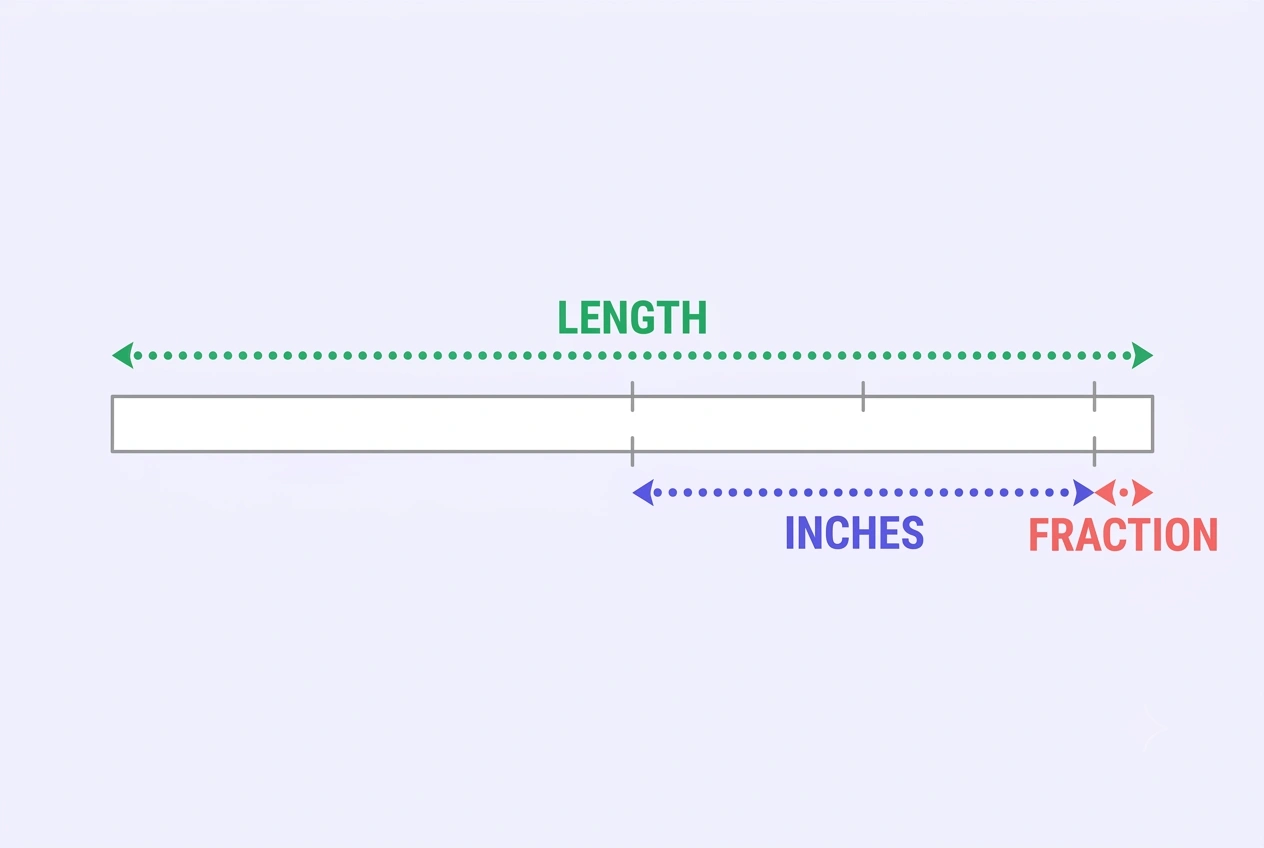
Enter dimensions the way the tape reads them — feet, whole inches, and a fraction — pick an operation, and the calculator runs the arithmetic in exact sixteenths of an inch.
Results
All Formats
Precision
Calculation Assumptions
What You Get
- ✓Free — no sign-up, nothing to install
- ✓Five operations — convert, add, subtract, multiply, divide
- ✓All 16 tape graduations, down to 1/16 inch
- ✓Every answer in feet-inches, decimal feet, inches, cm, and mm
- ✓Carry and borrow handled automatically
- ✓Rounding residual shows the exact gap from the true value
- ✓Precision selector — nearest 1/8, 1/16, 1/32, or 1/64
- ✓Integer-sixteenths engine — no floating-point drift on long sums
- ✓Export a PDF of the calculation in one click
- ✓Shareable link that saves your inputs
ON THIS PAGE:
Feet, Inches, and Fractions on a Job Site
American construction runs on three number formats at once. The tape reads feet, whole inches, and fractions of an inch — 3 ft 11¼ in, marked in sixteenths. The blueprint writes the same dimension with prime marks — 3′ 11¼″. And the CAD file behind the blueprint stores it as decimal feet — 3.9375 ft — because software adds and scales decimals cleanly. A carpenter who moves between tape, plan, and screen is translating constantly, and that translation is where mistakes live.
The fraction is the part that trips people up. Halves, quarters, eighths, and sixteenths do not add the way decimals do: ⅝ + ⅝ is 1¼, not 10/8 of anything you can read off a tape. Inches carry into feet at twelve, feet borrow back at twelve when you subtract, and a sum that lands between graduations has to be rounded to the nearest mark before it can be set with a pencil. This calculator does that arithmetic the way a tape does — in exact sixteenths of an inch — and shows every format of the answer side by side, so the number you read on the screen is the number you mark on the board.
The definitions underneath are exact, not measured: 1 foot is exactly 12 inches, and 1 inch is exactly 2.54 centimeters under the international yard and pound agreement that the U.S. customary system hangs on. Converting between feet, inches, and fractions introduces no rounding at all. The only place rounding ever appears is when a result is snapped to the nearest tape graduation — and this calculator shows you precisely how big that snap was.

How the Operations Work
All five operations run on the same engine: each dimension becomes a count of sixteenths of an inch, the arithmetic happens on whole numbers, and the total is converted back. Working in integer sixteenths is what lets a long chain of additions stay exact — decimal approximations drift, sixteenths never do.
- Convert
One measurement in, every format out. Total inches = (feet × 12) + inches + fraction. Decimal feet = total inches ÷ 12. Centimeters = total inches × 2.54 exactly. The primary readout is the tape-style feet-and-inches answer, with the fraction reduced to lowest terms.
- Add
Both dimensions go to sixteenths and the counts simply add. If the inches total 12 or more, the calculator carries 12 of them into a foot automatically — the same carry you do on paper when 11 in + 8 in becomes 1 ft 7 in.
- Subtract
The same counts subtract, and when the inches being taken away exceed the inches on hand, the calculator borrows 1 foot as 12 inches. A negative result displays as a negative length rather than wrapping around — useful for checking how far a rough opening overshoots a wall section.
- Multiply
Dimension A is multiplied by a plain number — three window openings at 4 ft 2 in each, five equal shelves. The product is rounded to your selected precision and the residual shows the snap. Note that multiplying a length by a length gives an area, not a length: for that, use the Square Footage Calculator.
- Divide
Dimension A divided by a plain number splits a run into equal parts: an 8-foot plate into 3 spacings, a 2-inch offcut into 3 shims. The quotient is rounded to the nearest tape graduation so every mark can actually be set with a pencil, and the residual tells you the cost of that rounding.
Worked Examples
Each example uses the calculator's own defaults and shows the whole chain — tape readings in, tape-readable answer out:
| Example | Operation | Inputs | Result |
|---|---|---|---|
| Two wall segments | Add | 3 ft 11¼ in + 2 ft 8½ in | 6 ft 7¾ in · 79.75 in · 6.6458 ft · 202.57 cm |
| Trimming a stud | Subtract | 8 ft 3 in − 4 ft 9 in | 3 ft 6 in · residual 0 — clean sixteenth result |
| Three shelf blanks | Multiply | 2 ft 6 in × 3 | 7 ft 6 in · exact — no rounding needed |
| Equal shim spacing | Divide | 8 ft 0 in ÷ 3 | 2 ft 8 in · 32 in exactly — three marks, no remainder |
| Metric spec on an imperial tape | Convert | 5 ft 10 in | 5 ft 10 in · 5.8333 ft · 70 in · 177.80 cm · 1,778.0 mm |
The subtract example is the borrow in action: 8 ft 3 in becomes 7 ft 15 in the moment 9 in needs to come off 3 in, and the rest is whole-number arithmetic. The divide example is the happy case — 96 in divides by 3 with nothing left over — but divide 8 ft by 7 and the calculator hands you 1 ft 4½ in with a residual of about 4.8 thousandths of an inch, the honest price of a tape that only speaks in sixteenths.
Inch Fractions to Decimal Feet
Surveying, CAD, and area math all speak decimal feet, while the tape speaks sixteenths. This table bridges the two — the left column is what you measure, the right column is what the software wants:
| Inches | Decimal of a Foot | Inches | Decimal of a Foot |
|---|---|---|---|
| 1 in | 0.0833 | 7 in | 0.5833 |
| 2 in | 0.1667 | 8 in | 0.6667 |
| 3 in | 0.2500 | 9 in | 0.7500 |
| 4 in | 0.3333 | 10 in | 0.8333 |
| 5 in | 0.4167 | 11 in | 0.9167 |
| 6 in | 0.5000 | 12 in | 1.0000 |
A useful field shortcut hides in the third row: 3 inches is exactly 0.25 ft, so every quarter-foot of layout is a clean 3-inch step. The eighth-inch marks fill the gaps between rows — 1½ in is 0.125 ft, 4½ in is 0.375 ft — and anything finer than an eighth is where the calculator's decimal-feet output earns its keep, because reading 0.0208 ft off a tape is nobody's idea of a good time.
What the Rounding Residual Means
When a result lands exactly on a tape graduation — which is always true for add and subtract of clean sixteenth-inch readings — the rounding residual is zero and you can ignore the row entirely. It earns its place the moment the math leaves the grid: metric conversions, multiply, and divide usually land between graduations, and the fraction you see is the nearest mark, not the truth.
The residual shows that distance in thousandths of an inch. A residual under 5 thousandths is invisible in the field — it is thinner than a pencil line. Past about 15 thousandths (roughly a quarter of a sixteenth), the rounding starts to matter across repeated marks: three shims each cut 5 thousandths short of true are 15 thousandths short in the stack. That is the moment to bump the precision selector to 1/32, re-round, and watch the residual shrink.
Nothing is lost by displaying it: the residual is the honest accounting of what "nearest 1/16 inch" actually cost, and it is the reason two calculators can show the same fraction while only one tells you how far off it is.
Where This Math Shows Up
Pre-cut studs and plate height. A nominal 8-foot wall is not built from 96-inch studs. Pre-cut studs arrive at 92⅝ in — three plates of 1½ in each stack to 4½ in, and 92⅝ + 4½ = 97 in, which finishes at 8 ft 1 in of wall with a ceiling material below. That arithmetic — three sixteenth-graduated numbers summing to a wall height — is exactly the add operation on this page, and it is cited framing practice under the IRC's prescriptive stud provisions (2021 IRC R602.3).
Rough openings. Standard door framing practice adds about 2 in of width to the slab — 1 inch of shim per jamb — and 2½ to 3 in of height for the head jamb and flooring, so a 3 ft 0 in door wants a roughly 3 ft 2 in by 6 ft 10½ in opening. Every one of those figures is a feet-plus-inches addition, and getting the fraction wrong on the height is how doors end up floated on thick underlay.
Layout spacing. Sixteen-inch on-center layout across a 12-foot wall is 144 ÷ 16 = 9 bays — divide mode's cleanest case. But lay out a 10-foot wall and the tenth bay lands at 9 ft 8 in, an eighth-of-an-inch trim that the divide operation rounds and reports honestly.
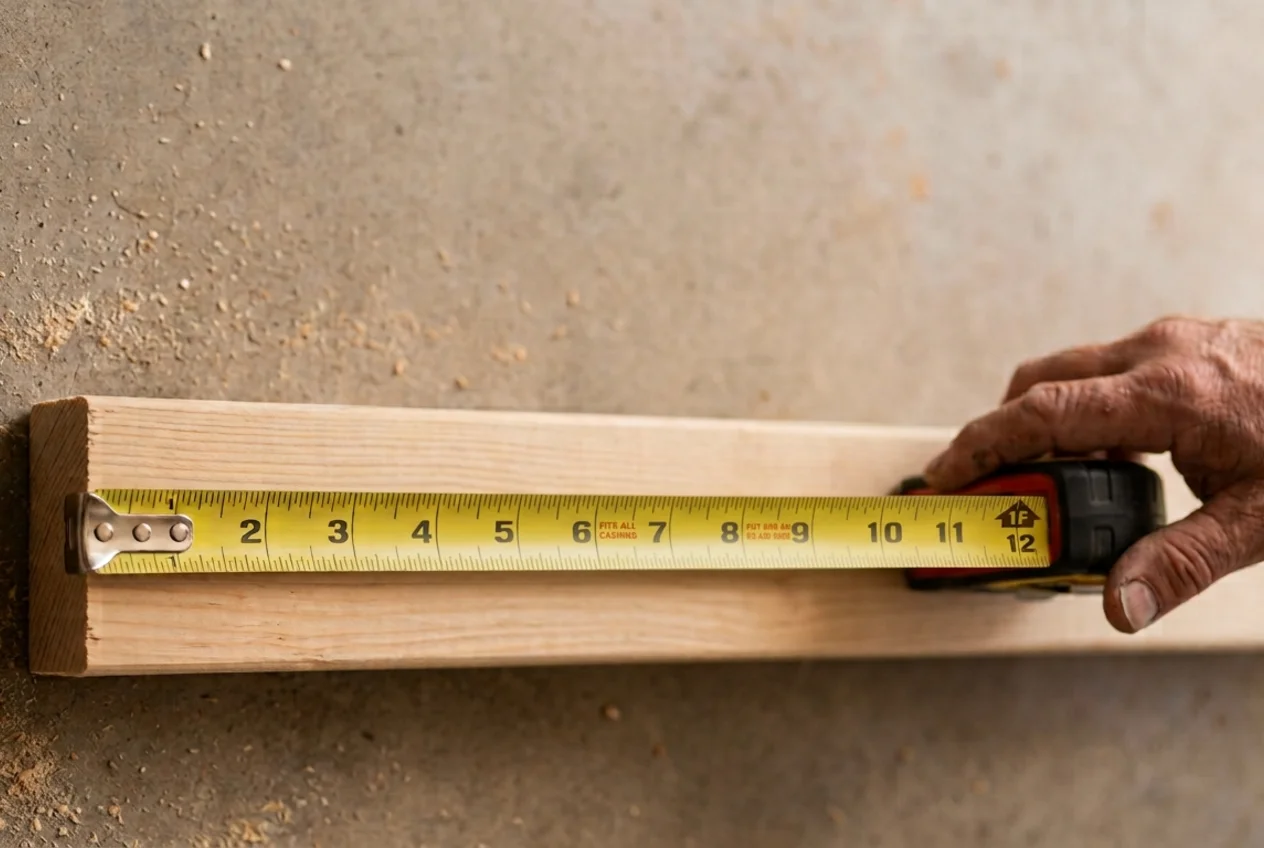
Nominal versus actual lumber. A 2×4 is 1½ × 3½ in actual, per the American Wood Council's NDS dimension-lumber standards, and a "6-inch" deck board shows 5½ in of face. Any sum that mixes nominal names with tape readings is wrong before the math even starts — measure the actual, enter the actual.
Frequently Asked Questions
References
- National Institute of Standards and Technology, NIST Special Publication 330 — The International System of Units (SI), nist.gov
- National Institute of Standards and Technology, International Yard and Pound Agreement (1959) — exact definitions of the inch and foot, nist.gov
- International Code Council, 2021 International Residential Code, Section R602.3 — Wall Stud Size and Spacing, codes.iccsafe.org
- American Wood Council, National Design Specification (NDS) for Wood Construction — Dimension Lumber Standards, awc.org
Disclaimer: The feet and inches calculator results on this page are for measurement planning and arithmetic verification only. Framing dimensions, rough openings, and lumber sizing must follow project specifications, manufacturer requirements, and local building code — verify critical measurements directly on site before cutting.
Need framing, trim, or layout work measured and built to the sixteenth? Get free quotes from local contractors near you.
Get Free Estimates