
Electrical Load Calculator
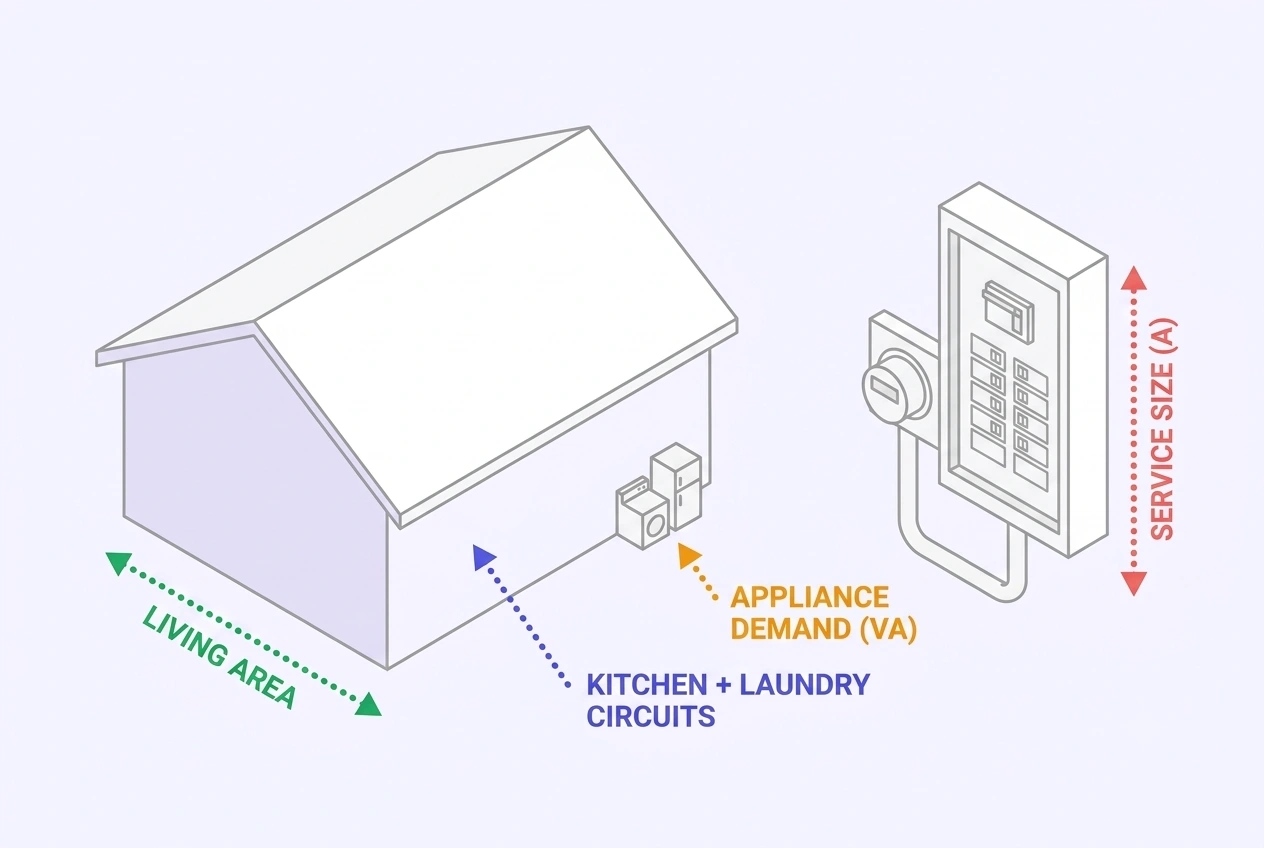
Run the NEC 220 standard dwelling calculation on your home's area and nameplates — get the calculated demand in amps, a line-by-line breakdown with the code section behind each number, and a verdict on whether your service can take the next vehicle charger.
Results
Load Demand Breakdown (NEC 220)
Service Sizing
Calculation Assumptions
What You Get
- ✓Free — no sign-up, nothing to install
- ✓Live results as you type — change an appliance, watch the amps move
- ✓NEC 2023 Article 220 standard dwelling method, step by step
- ✓Range, dryer, and fixed-appliance demand values from Tables 220.55 and 220.54 and the 220.53 factor
- ✓Heating-or-cooling non-coincidence built in, so a heat pump swap shows its real effect
- ✓Largest-motor adder with a check that keeps the compressor from being counted twice
- ✓Level 2 EV charger planner using the NEC 2023 7,200 VA floor, so tomorrow's load sits next to today's
- ✓A verdict against your current service at the 80 percent planning line — fits, crowding, or upgrade
- ✓Line-by-line demand breakdown naming the code section behind every number
- ✓Recommended next standard service size, with the 100 A dwelling floor applied
- ✓Four NEC 2023 paths in one select — Part III standard, 220.82 optional, 220.83 existing-dwelling, and 220.87 measured-demand
- ✓PDF export and shareable link that saves your inputs
- ✓Works on phone, tablet & desktop
ON THIS PAGE:
What the Load Calculation Actually Decides
A residential electrical load calculation answers one question with code-grade honesty: how many amps does this house demand, worst-case-normal, so the service and panel can be sized to it — and so a permit inspector can see the number behind a 200 amp upgrade request. It is not a bill estimate and it is not a guess from raw nameplates. The whole point of NEC Article 220 is to convert the pile of appliance ratings a house has into the demand it will actually place on the service, using decades of measured usage patterns about what doesn't run at once.
That is why the calculation deliberately discards some connected load. A 12 kW range becomes 8 kW of demand because no household uses every burner and the oven together at full tilt. Heating and cooling never overlap. Four or more permanently installed appliances share a 75 percent factor because a dishwasher, a disposal, a microwave, and an attic fan rarely draw together. Skip those adjustments and every all-electric home would appear to need a 400 amp service — which would be expensive, physically awkward to produce, and not asked for by a single code book.
The result has three real uses. It sets the minimum service size on new construction and on service upgrade permits — commonly 100, 150, or 200 amps. It answers the fastest-growing question in modern electrical work: does the panel have room for an EV charger, heat pump, or hot tub — or does a load-management device get them onto the service you already own. And it is the proper starting point for whole-house generator sizing, before motor-starting inrush complicates it. This calculator runs the standard dwelling method of NEC 2023 Article 220 and states every adjustment on the line, so you can see exactly which rule set the number.
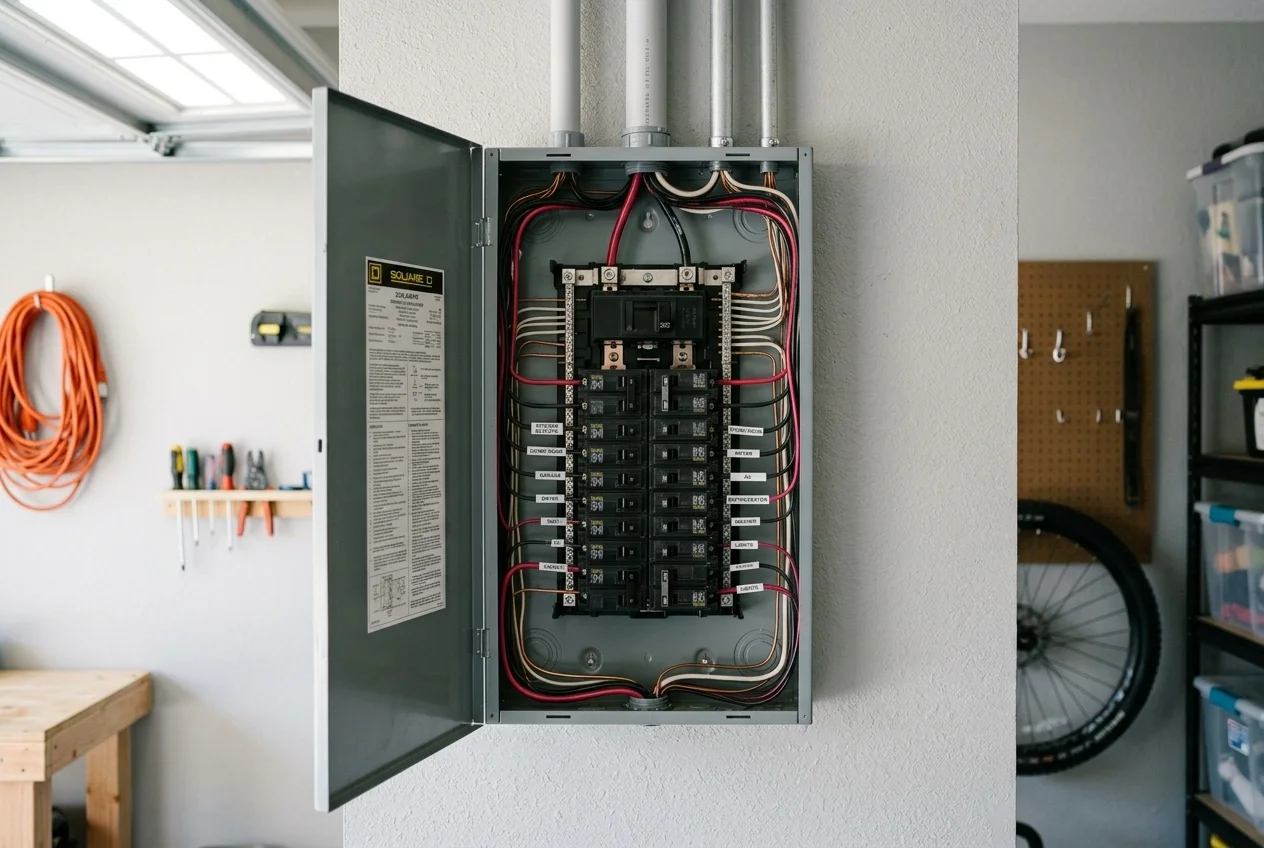
Confirm It with a Clamp Meter
The calculation gives you worst-case-normal demand — the number the service is built around. A clamp meter answers the other question: what is this house actually moving through the service on an ordinary evening. Clip a true-RMS clamp meter around one ungrounded service conductor just below the main disconnect — a single leg, never both at once, because two clamped legs cancel the magnetic field and the display squares to zero — set it to record the peak, and let the house run its usual routine with the range on, the dryer tumbling, and the charger plugged in. A meter peaking at 41 amps on one leg is telling you the service is delivering roughly 9,840 volt-amperes at that instant — about 41 percent of a 100 amp panel's 24,000 VA capacity, and a long way from the 30,000-odd VA the code method projects when every nameplate overlaps on paper.
The two numbers answer different questions, so keep them separate in the conversation with your electrician. The calculated demand is what the panel must survive on the worst synchronized night of the year; the measured load is what the service has actually seen. If the measurement runs close to the calculation, the panel is living at its planning limit and a load-management device is worth pricing before any service upgrade. If the measurement is far below the calculation, the house has not yet grown into its nameplates — the panel has more real headroom than the arithmetic admits. Reading inside a live panel is not a do-it-yourself task; the example above is the electrician's work. This calculator gives you the first number; the meter confirms the second.

The NEC 220 Standard Method, Step by Step
The standard dwelling calculation runs in this order. Each step lists the code section it comes from, and the results panel reproduces the same lines so nothing hides under a sum.
Step 1 — general lighting pool (220.12, 220.52). Floor area × 3 VA, plus 1,500 VA per kitchen small-appliance circuit (minimum two) and 1,500 VA per laundry circuit. For a 2,000 sq ft home with the required two plus one circuits, the pool is 6,000 + 3,000 + 1,500 = 10,500 VA.
Step 2 — lighting demand tiers (220.42, Table 220.42). Take the first 3,000 VA at 100 percent and the remainder at 35 percent. The 10,500 VA pool above becomes 3,000 + (0.35 × 7,500) = 5,625 VA. Small, minor homes can land below the first tier, meaning the pool takes no derate at all.
Step 3 — range demand (Table 220.55). One range up to and including 12 kW counts as 8,000 VA, no matter what the plate says. Above 12 kW the demand grows by 5 percent of 8 kW for each whole kW over: a 14.5 kW range is 8,000 + (3 × 5% × 8,000) = 9,200 VA.
Step 4 — dryer demand (220.54). The nameplate counts, but not below 5,000 VA. A 5.4 kW dryer stays 5,400 VA; a 4 kW dryer is raised to 5,000.
Step 5 — other fastened-in-place appliances (220.53). Water heater counts at 100 percent. The remaining fixed appliances — dishwasher, microwave, disposal, compactor, attic fan, spa, well pump — count at their nameplate sum multiplied by 75 percent when four or more are fastened in place, 100 percent when under four. The range, dryer, and water heater are excluded from this count because Steps 3, 4, and the water-heater line carry them.
Step 6 — heating or cooling, the larger one (220.60). These are non-coincident: max(heating VA, cooling VA) at full nameplate, never their sum. This is why replacing a gas furnace with a heat pump moves the number less for heating-through-electrical-bills reasons and more for the pure nameplate reason.
Step 7 — EV supply equipment (2023 220.57). The larger of 7,200 VA or nameplate — so a 16 A charger books 7,200 VA today even though it draws less, and a 48 A charger books 11,520 VA. Treat it separately as a full continuous load walked in at 100% for the service figure; sizing the branch circuit itself is a 125 percent matter of NEC 625.42, which the Wire Size Calculator handles.
Step 8 — largest motor (220.50). The house's single largest motor earns a 25 percent budget fraction on top of its load, budgeting start-up surge. If that motor is already the A/C or heat pump counted at Step 6, do not double-count: the adder applies to a separate motor such as a well pump or shop tool.
Step 9 — convert to amps. Add every demand line and divide by 240 volts: Service amps = Total demand VA ÷ 240 V. Round up to the next standard service size, and remember the floor for a one-family dwelling is 100 A (230.79(C)).
Worked Examples
Example 1 — a 2,000 sq ft all-electric home. Living area 2,000 sq ft; two kitchen circuits and one laundry circuit; range 12 kW; dryer 5.4 kW; water heater 4.5 kW; dishwasher 1,200 W, disposal 800 W, attic fan 400 W (three fixed appliances); no electric heat; a 5,000 W air conditioner; the biggest motor is the A/C itself; no EV charger yet.
The lighting pool is 6,000 + 3,000 + 1,500 = 10,500 VA, which derates to 3,000 + 0.35 × 7,500 = 5,625 VA. The range books 8,000 VA, the dryer 5,400 VA (its nameplate sits above the 5,000 floor), and the water heater 4,500 VA. Three fixed appliances stay at 100 percent: 1,200 + 800 + 400 = 2,400 VA. Cooling wins over zero heating: 5,000 VA. The compressor is not a separate motor, so its adder is zero. Total demand: 5,625 + 8,000 + 5,400 + 4,500 + 2,400 + 5,000 = 30,925 VA, which is 128.9 amps at 240 volts — above the 100 A floor, so the recommended service is the next standard size: 150 A. Against an existing 200 A main, that is 64 percent utilization and fits with room to spare.
Example 2 — the same home adds a 32 A charger and a hot tub. The charger books 7,680 VA (nameplate 32 × 240, above the 7,200 floor). A 6,000 W spa joins the fixed list, bringing it to four appliances — 1,200 + 800 + 400 + 6,000 = 8,400 VA × 75% = 6,300 VA. The new total: 5,625 + 8,000 + 5,400 + 4,500 + 6,300 + 5,000 + 7,680 = 42,505 VA = 177.1 A. A 200 A service sits at 89 percent — code-compliant, but crowded past the 80 percent planning line, which is exactly when a load-management conversation is worth more than a service upgrade quote. The next standard size up is 200 A; the calculator's recommended size stays there.
Standard Service Sizes
These are the ratings main breakers and meter equipment are built in. A calculation never lands exactly on one — round up, and note that a one-family dwelling cannot be served below 100 A regardless of what the arithmetic suggests.
| Service | Capacity at 240 V | 80% Continuous Line | Typical Home |
|---|---|---|---|
| 100 A | 24,000 VA | 80 A | Small homes and apartments; gas appliances, no EV headroom |
| 125 A | 30,000 VA | 100 A | Older homes with partial electrification |
| 150 A | 36,000 VA | 120 A | 1,500–2,500 sq ft with central AC and electric appliances |
| 175 A | 42,000 VA | 140 A | Less common; often found in mid-century panels |
| 200 A | 48,000 VA | 160 A | The modern default — EV charger, heat pump, and hot tub friendly |
| 225 A | 54,000 VA | 180 A | Larger homes, electric heat with low-insulation envelopes |
| 400 A | 96,000 VA | 320 A | Estates, second services, or two 200 A metered panels |
Reading the table the way an electrician does: the capacity column is what the service delivers at a full 100 percent draw, while the 80 percent column is the number a demand calculation is usually held under for continuous operation. A 200 A service comfortably carries a house that calculates at 120 to 150 A because the calculation is itself a worst-normal blend of simultaneous and staggered use — the diversities built into Article 220 do the rest.
Standard vs Optional Method
Both paths below are code-legal for a dwelling, and an inspector accepts either. They nearly always disagree, and the pull each has on the answer is worth understanding before choosing between two quotes.
| Aspect | Standard Method (NEC 220 Part III) | Optional Method (NEC 220.82) |
|---|---|---|
| Shape | Each category at its own demand factor and table: lighting tiers, Table 220.55 ranges, Table 220.54 dryers, the 75 percent four-appliance rule, the largest-motor adder | One flat structure: the whole lighting-plus-appliance pool gets 100% of its first 10 kVA and 40% of everything above, plus heating or cooling at full nameplate, plus the motor adder |
| Eligibility | Listed in the code; works for any service size, including small legacy panels | Only for a dwelling unit on a single 120/240 V (or 208Y/120 V) service rated 100 A or larger |
| Tends to produce | A more conservative figure — the numbers are audit-friendly line-by-line on this page | A smaller calculated load for heavily electrified homes, because the whole pile above 10 kVA shares one aggressive 40 percent factor |
| Typical use | Small-existing-service verification and the line-by-line worksheet style an inspector hands over | Whole-house worksheet economy: fast to run, common on permit forms labeled "220.82 calculation" |
If the two methods disagree by a wide margin on the same home, the difference is the diversity answer: the optional method only assumes departures from simultaneity when there is a lot of load above 10 kVA to prove them. When a home lands near the crossover, whichever method the AHJ has been running will usually set the number — and when both pass, the standard method's line-by-line trail is easier to defend on paper, which is the one this calculator produces.
Adding Loads to an Existing Service: NEC 220.83 and 220.87
Generations of houses were wired on paperwork that made sense when the biggest question was a second window unit. Electrification has inverted that: today the dominant question is not "what should this new house be served by?" but "what can the old service absorb?" — and the 2023 NEC answers it on two dedicated paths. Both run from the Calculation Method select at the top of the calculator, and both ignore the worst-case-normal framing of the standard method.
NEC 220.83 — the existing-dwelling calculation. This is the method for a building that exists and a load that is about to join it. Where no air-conditioning or electric space heat is being added, 220.83(A) pools the whole dwelling's load — general lighting at 3 VA per square foot, 1,500 VA per small-appliance and laundry circuit, and the nameplate rating of ranges, wall-mounted ovens, counter-mounted cooking units, dryers not on the laundry circuit, water heaters, and everything fastened in place — and takes the first 8 kVA at 100 percent, the remainder at 40 percent. Where A/C or electric space heat is being added, 220.83(B) counts the new cooling and central electric space heating at 100 percent, never the 40 percent factor — the 2023 rewrite's headline change — with only the larger of cooling and heating counted, and everything else through the same 8 kVA / 40 percent split. Note what is deliberately absent here: no Table 220.55 range derate and no 5 kW dryer floor. The existing-dwelling method takes plain nameplates, because its subject is a house that already runs them.
NEC 220.87 — measured demand. Where actual data exists, the code lets you substitute measurement for calculation entirely. Three conditions (220.87(1)–(3)) must all hold: maximum demand data for a 1-year period is available — or, failing that, the highest average kilowatts held for a 15-minute interval, continuously recorded over a minimum 30-day period on the highest loaded phase, with the larger of the heating or cooling load reflected in the recording; the measured maximum at 125 percent plus the new load does not exceed the feeder or service rating; and overcurrent/overload protection meets 240.4 and 230.90. The exception disqualifies premises with renewable production (solar PV, wind) or any peak-load shaving, because those systems bury the true peak. Work the example: a 100 A service (24,000 VA), a 30-day recording peaking at 9.8 kW, and a planned 40 A EVSE booking 9,600 VA at the 220.57 floor. The 220.87 check: 9,800 × 1.25 = 12,250 VA, plus 9,600 = 21,850 VA against 24,000 — fits, with roughly 2,150 VA (about 9 A) of headroom. The same house through the standard method would have looked far tighter, because nameplates are fiction and a clamp-on meter reads facts.
Where each path belongs: new construction or a service upgrade permit → the standard method's line-by-line trail (or 220.82 when the AHJ accepts it). Adding appliances or a heat pump to an existing house → 220.83, with any new HVAC at 100 percent. Fitting an EV charger or similar addition when real data exists → 220.87 on a recorded peak — and it is also the method behind most load-management approvals, which retire the nameplate fiction entirely.
Common Load Calculation Mistakes
Adding nameplates with no demand factors. Summing every rating produces connected load, not calculated load — a modest all-electric home will appear to need a 400 amp service. The Article 220 diversities exist because the real world uses them; use the tables rather than raw arithmetic.
Counting heating and cooling together. The nameplates both exist, but they cannot run side by side. NEC 220.60 takes the single larger of the two, never their sum, and the biggest real-world movement in modern load math — a heat pump replacing a gas furnace — is the result of this rule, not of raw wattage.
Forgetting the required circuits while counting only appliances. Two kitchen circuits and one laundry circuit are code minimum, not optional — 4,500 VA of pool that first sits in the lighting tier, not alongside appliances. Dropping them undersizes the demand by 1,500–3,000 VA straight away.
Getting the fixed-appliance count wrong. The 75 percent factor at NEC 220.53 turns on four or more fastened-in-place appliances, and the range, dryer, and water heater do not join that count. One spa briefly added can flip the whole bucket from 100 percent to 75 percent — if you add a fifth appliance, remember the bucket prune applies to all four.
Double-counting the largest motor. If the biggest motor in the house is the compressor already sitting in the cooling line, do not also add its 25 percent on the motor line. NEC 220.50 budgets the adder for the largest motor that is load elsewhere untouched.
Assuming a 200 amp label covers everything. A panel bus can be 200 A while the main breaker is 150 A — and the binding rating is the smaller of the two. Read the main breaker before running the verdict, not the sheet metal.
Treating an EV charger as a small load. A "32 amp charger" feels like a dishwasher; it books 7,680 VA at NEC 2023 220.57 — over half of what a 12 kW range demands. When a quote says an upgrade is required before installation, running this calculation first is often how you learn that it wasn't.
Ignoring local amendments. States and cities amend NEC editions on their own schedule and may demand worksheets of their own form for permit submission. The number here is the standard-method figure; your local jurisdiction decides whether that document or its own worksheet is what travels on the job.
Frequently Asked Questions
The NEC Article 220 standard method starts with the living area: 3 volt-amperes per square foot for general lighting and receptacles, plus 1,500 VA for each required kitchen small-appliance circuit (minimum two) and 1,500 VA for the laundry circuit. The first 3,000 VA of that pool counts at 100 percent and the rest at 35 percent. Then demand-factored appliance values are added: a 12 kW range counts as 8 kW, a dryer never falls below 5 kW, the larger of heating and cooling counts at its full nameplate (they never run together), four or more fastened-in-place appliances share a 75 percent factor, and the largest motor contributes an extra 25 percent. Divide the total volt-amperes by 240 volts and you have the service amperage the code cares about.
Run the calculation with and without the charger and compare. The 2023 NEC counts EV supply equipment at the larger of 7,200 VA or its nameplate rating, so a 40 amp, 240 volt charger adds 9,600 VA — 40 amps of demand at 240 volts. Homes that calculate around 100 to 125 amps before the charger often go over 80 percent of service capacity with it, which is when a load-management device or smart panel lets the charger pace itself without a service upgrade. On a 200 amp service with headroom to spare, most Level 2 chargers fit without touching the panel.
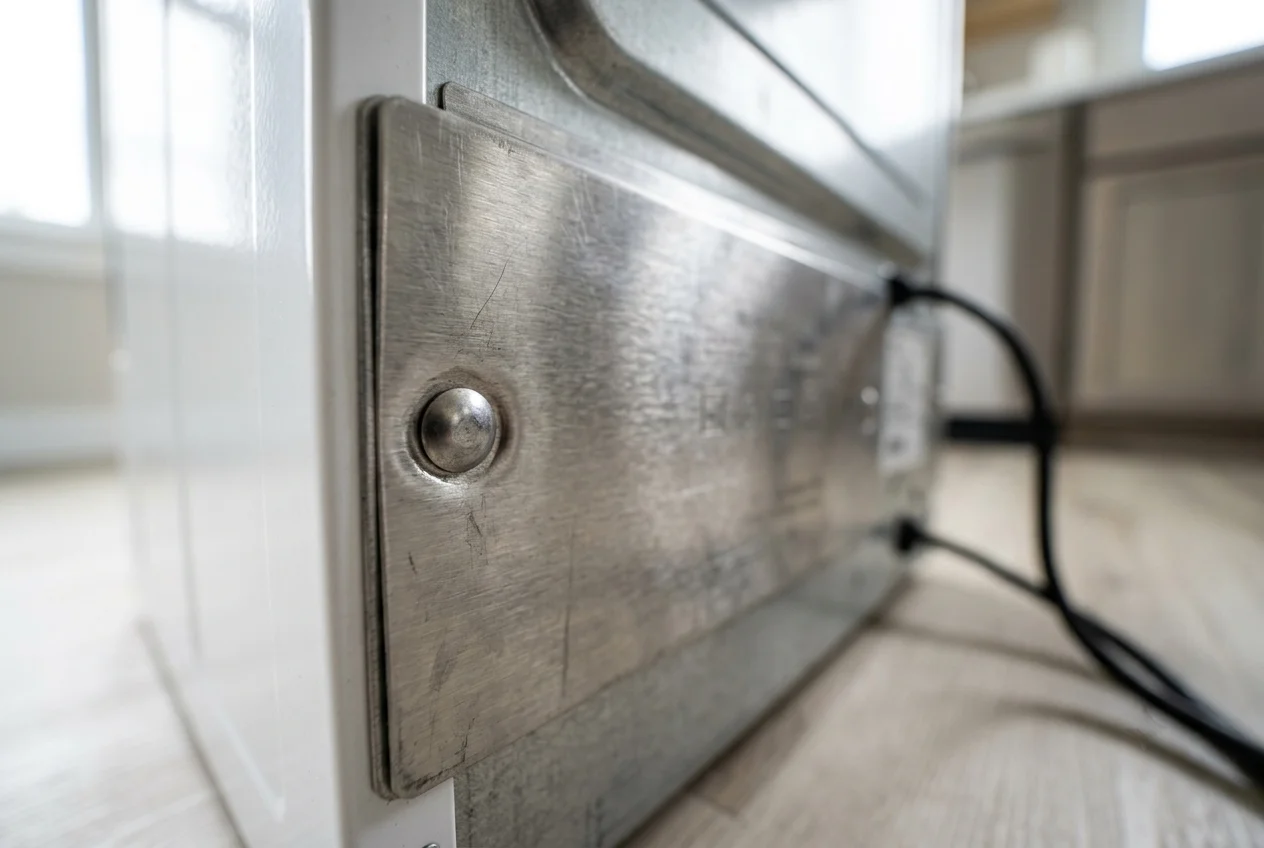
Every appliance has a nameplate — a metal or foil sticker near the cord mount, back panel, door frame, or inside base — listing watts or kilowatts, or sometimes just amps. If the label shows amps, multiply amps by volts: a 240 volt dryer drawing 22 amps is 5,280 VA. Use the nameplate on the unit that is actually installed; a 1990s range may still be rated 12 kW even if new ranges run lower. Enter 0 for any appliance that is absent or runs on gas.
Gas fuel itself draws no electrical load, but its controls do. A gas water heater with a standing pilot needs nothing, a gas furnace still runs a blower motor of a few hundred watts, and gas cooking with an electric ignition clocks a small control load. For a load calculation, a purely gas appliance is entered as zero, a gas furnace with an electric blower is entered as its blower motor wattage, and leaving the field blank does the same as entering zero. Only the electrical portion belongs in the numbers.
NEC sizing keeps continuous loads — anything running three hours or more — at or under 80 percent of a breaker or panel rating, and the same 80 percent line is the practical planning threshold for a whole service. If the calculated load is below 80 percent of your existing service, there is room to add circuits safely. Between 80 and 100 percent the service is code-compliant for what it has but is crowded, and adding a heat pump or EV charger deserves a load-management conversation. Above 100 percent the calculated demand exceeds the rating and a service upgrade or load reduction is the honest path. The calculator marks this on the verdict line using the service size you select.
Connected load is every nameplate summed as if everything ran full-tilt at once — a big all-electric house can easily total 60,000 VA. Demand load is the code-adjusted figure that recognizes real usage diversity: lighting is derated past the first 3,000 VA, four or more fixed appliances share at 75 percent, a 12 kW range is counted as 8 kW, and heating and cooling are not added together because they cannot run simultaneously. The service is sized on the demand figure; the connected figure is only the starting pile.
The standard method (NEC 220 Part III) is the category-by-category one this calculator runs by default: lighting tiers, Table 220.55 ranges, Table 220.54 dryers, the 75 percent fixed-appliance factor, and the motor adder, each at its own pace. The optional method (220.82) is a shortcut for a dwelling on a single 120/240 V service rated 100 amps or more: first 10 kVA of the general pool at 100 percent, everything above at 40 percent, then the larger of heating or cooling added whole. This calculator now runs both from the Calculation Method select — plus the 220.83 existing-dwelling method for loads being added to an old service, and the 220.87 measured-demand check that substitutes recorded peak data for nameplates. The optional method usually lands lower for bigger homes and is what whole-house worksheets lean on; the standard method works everywhere, including small older services where 220.82 is not permitted. Inspectors accept either.
NEC 220.87 replaces appliance guesswork with recorded data. It needs maximum demand information for a one-year period, or the highest average kilowatts held for a 15-minute interval continuously recorded over at least 30 days on the highest loaded phase, with the larger of heating or cooling reflected — and it is not available where solar, wind, or peak shaving hides the real peak. The code then multiplies that measured peak by 125 percent and adds the new load: on a 100 amp service with a recorded 9.8 kW peak, that is 12,250 VA, and a 40 amp EV charger adding 9,600 VA lands at 21,850 VA against the service's 24,000 — it fits, with about 9 A of headroom. An electrician runs this check before any panel-upgrade quote, because a provable peak often beats the nameplate arithmetic by 30 to 50 percent.
A practical starting point is about 80 percent of the calculated load — a 28,000 VA demand points toward a 24 kW standby unit. Treat it as a floor conversation, not a verdict: real generator sizing also has to absorb motor-starting inrush from well pumps, compressors, and blowers, which can surge three or more times their running rating, and any load-management feature that lets a smaller unit stagger heavy loads can bring the requirement back down. Size essentials-only backup from the actual circuits you want to ride through an outage, which is usually far less than the whole-house figure.
References
- NFPA 70, National Electrical Code (2023) — Article 220: Table 220.12 general lighting loads; 220.42 and Table 220.42 demand factors; 220.50 largest motor; 220.52 small-appliance and laundry circuits; 220.53 four-or-more fixed appliances; 220.54 dryers; Table 220.55 ranges; 220.56 additional loads; 220.57 EV supply equipment; 220.60 non-coincident heating and cooling, nfpa.org
- NFPA 70 — Article 230: 230.79(C) minimum 100 A service for a one-family dwelling; Article 210: 210.11(C) required small-appliance and laundry circuits, nfpa.org
- U.S. Department of Energy, Building Science Education — residential electrical load calculation resources for the main service, bsesc.energy.gov
- Pacific Northwest National Laboratory, Electrical Panel Calculator — NEC 220.83-based panel capacity screening for heat pump water heater retrofits, basc.pnnl.gov
- International Association of Electrical Inspectors, Calculating General Lighting Loads for Residential Dwellings, iaei.org
This calculator provides planning estimates under the NEC 2023 Article 220 standard dwelling method and does not replace a licensed electrician, an engineered design, or the adopted code edition and local amendments in force where you are working. Real load calculations for permitted work use equipment nameplate data, AHJ worksheets, and service conditions this tool cannot see. Verify all service and panel decisions against NFPA 70 and your local authority having jurisdiction before installing. MyBuilderBase is not responsible for electrical work, inspection outcomes, or damage resulting from use of this tool.
Planning a service upgrade, panel swap, or EV charger circuit? Compare quotes from local licensed electricians before the work starts.
Get Free Estimates