
ON THIS PAGE:
Electrical Permit Requirements at a Glance
Bookmark this table. It covers every common residential electrical task and whether it requires a permit.
| Work Type | Permit Required? | Notes |
|---|---|---|
| New outlet or receptacle | Yes | Includes garage-door opener receptacles |
| New light fixture | Yes | Hard-wired fixtures only; plug-in lamps exempt |
| Running new wiring | Yes | Any new circuit or extended circuit |
| Panel upgrade or replacement | Yes | Includes changing service size |
| Service entrance work | Yes | May require utility coordination |
| Subpanel installation | Yes | Includes feeder wiring from main panel |
| EV charger installation | Yes | Often requires both electrical and building permits |
| Solar panel system | Yes | Requires interconnection agreement with utility |
| Generator installation | Yes | Includes transfer switch wiring |
| Hot tub or spa wiring | Yes | Dedicated circuit, GFCI required |
| Whole-house rewire | Yes | May require plan review |
| Low-voltage systems (security, data) | Yes | Security alarms typically require permit |
| Fuse box to breaker conversion | Yes | Panel replacement trigger |
| Air conditioner installation | Yes | Also requires mechanical permit |
| Like-for-like outlet/switch swap | No | Same type, same location, no wiring changes |
| Replace fuse or breaker | No | Same rating, existing panel |
| Replace light bulb | No | Plug-in or screw-in only |
| Replace garbage disposal | No | 30 amps or less, existing wiring |
| Replace dishwasher | No | 30 amps or less, existing wiring |
| Replace doorbell | No | Like-for-like replacement |
| Fix appliance cord | No | Portable appliance only |
| Install phone/coax cable | No | Proper insulated wire required |
| Low-voltage under 25V/50W | No | Below NEC threshold |
Requirements vary by jurisdiction. This table reflects general rules from the NEC, IRC, and common state practices. Always confirm with your local building department.
When You Need an Electrical Permit
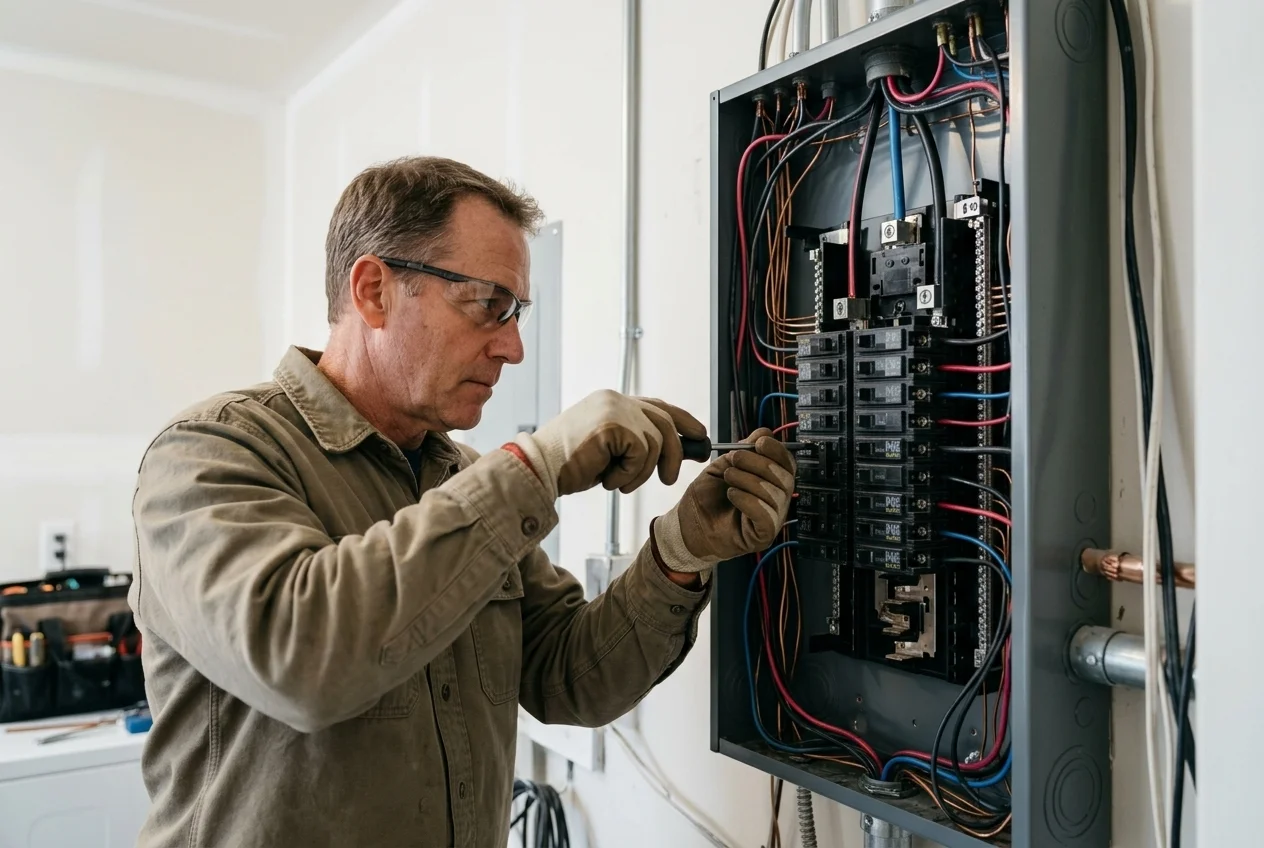
An electrical permit is required any time electrical wiring is installed, altered, extended, or connected to electrical equipment. The permit triggers a mandatory inspection process that ensures the work meets the National Electrical Code (NEC) and local safety standards.
Projects That Always Require a Permit
- New circuits — adding a circuit to a panel for any purpose (outlets, lights, appliances, dedicated equipment)
- Panel upgrades — replacing a panel, increasing service amperage, or moving a panel location
- Subpanel installation — running a feeder from the main panel to a new subpanel
- Service entrance work — new service drop, meter base replacement, service conductor installation
- EV charger installation — Level 2 (240V) charging stations require a dedicated circuit and permit
- Solar panel systems — photovoltaic installations require electrical permits plus interconnection agreements
- Generator installation — standby generators with automatic transfer switches
- Hot tub or spa — dedicated 240V circuit with GFCI protection
- Whole-house rewire — replacing all or most branch circuit wiring
- Low-voltage systems — security alarms, structured wiring, and network cabling in many jurisdictions
- Hard-wired appliances — ceiling fans, built-in microwaves, range hoods, hard-wired smoke/CO detectors
- Outdoor wiring — landscape lighting, outbuilding power, detached garage circuits
Work That Does NOT Require a Permit
- Like-for-like replacement — swapping an outlet, switch, or light fixture for the same type in the same location without changing wiring
- Replacing fuses or breakers — same rating, existing panel
- Replacing light bulbs — plug-in or screw-in lamps
- Replacing appliances — garbage disposal, dishwasher, or similar appliance of 30 amps or less on existing wiring
- Replacing a doorbell — like-for-like, same wiring
- Fixing appliance cords — portable appliance repair
- Phone or coaxial cable — installing phone outlets or CATV cable with proper insulated wire
- Low-voltage under thresholds — wiring operating at less than 25 volts between conductors and less than 50 watts
Do I Need a Permit? Decision Guide
Use this decision tree to determine whether your project requires an electrical permit.
Are you installing, altering, or extending any permanent wiring?
Running new cable, adding circuits, extending existing circuits, or modifying wiring paths = Yes, you need a permit. If the answer is No, go to step 2.
Are you installing a new electrical device or appliance that is hard-wired?
Ceiling fans, built-in microwaves, range hoods, smoke detectors, EV chargers, generators, hot tubs = Yes, you need a permit. Plug-in appliances do not count.
Are you replacing an existing device with the same type in the same location?
Swapping an outlet for an outlet, a switch for a switch, a light for a light — without changing wiring, box location, or wire gauge = No permit needed. Any deviation triggers a permit.
Are you working on low-voltage systems?
Security alarms typically require a permit. Data/phone/coax wiring usually does not. Other low-voltage work (landscape lighting, speakers) varies by jurisdiction — call your building department.
When in doubt, call your local building department.
A 5-minute phone call is faster than a stop-work order. Document the call (date, name, answer) — it serves as your defense if the question comes up later.
The 7-Step Electrical Permit Process
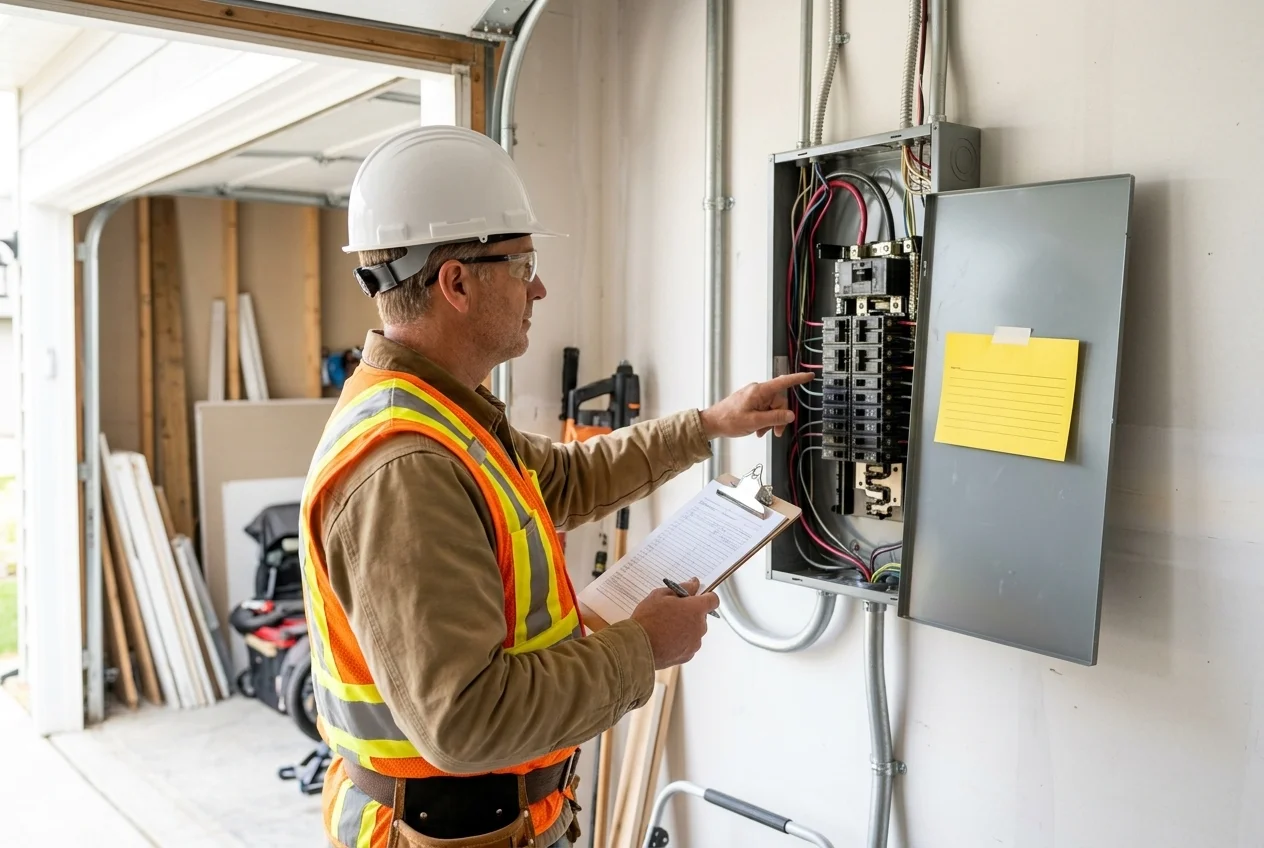
Confirm You Need a Permit
Review the "When You Need a Permit" section above. When in doubt, call your local building department. Document the call.
Hire a Licensed Electrician or Verify Homeowner Qualification
A licensed electrical contractor is the default path. Most states allow homeowners to pull their own permit for owner-occupied primary-residence work — request the homeowner affidavit form from your building department. Rental property, commercial, and second-home work always requires a licensed electrician.
Gather the Paperwork
Standard packet includes: signed application form, contractor license and certificate of insurance (or homeowner affidavit), scope of work narrative, panel schedule showing existing and new circuits, load calculation for any new high-amperage load, and a single-line diagram for panel or service work. EV charger and solar permits include their own supplemental forms.
Submit Application and Pay Fees
Most cities with 50,000+ population use an online permit portal. Smaller jurisdictions may require counter submission. At submission, expect to pay either the full fee (flat-fee cities) or a plan review deposit of 25 to 40 percent (valuation-based cities). Keep your receipt — you need the confirmation number for inspections.
Wait for Permit Issuance
Simple projects: same day to 5 business days. Complex projects with plan review: 2 to 4 weeks. Do not start work before the permit is issued.
Schedule the Rough-In Inspection
After wires are run and devices are in boxes but before drywall goes up. The inspector checks wire gauge, cable protection through studs, box fill per NEC 314.16, grounding, staple spacing, and cable support. Do not close up walls until this passes.
Schedule and Pass the Final Inspection
After devices, cover plates, and the panel are complete and everything is energized. The inspector verifies GFCI and AFCI protection per current NEC, tests receptacles, checks panel labeling per NEC 408.4, confirms service grounding, and inspects working space clearances per NEC 110.26. Passing closes the permit. Save the signed card.
What Inspectors Check: Inspection Checklists by NEC Section
Each inspection stage covers specific NEC requirements. Here is what the inspector looks for at each phase.
Rough-In Inspection
| Check Item | NEC Reference | What They Look For |
|---|---|---|
| Wire gauge and type | NEC 310, 334 | Correct wire size for circuit amperage; NM-B for dry locations, UF-B for wet |
| Cable protection at studs | NEC 300.4 | Nail plates where wires pass within 1.25 inches of stud edge |
| Box fill | NEC 314.16 | Box volume sufficient for number and size of conductors |
| Cable support | NEC 334.30 | Stapled within 12 inches of boxes, every 4.5 feet for NM cable |
| Grounding conductor | NEC 250 | Continuous ground wire from panel to each device box |
| High/low voltage separation | NEC 725 | Proper separation between power and low-voltage wiring |
| AFCI/GFCI circuit identification | NEC 210.12, 210.8 | Circuits requiring AFCI or GFCI protection are identified |
Final Inspection
| Check Item | NEC Reference | What They Look For |
|---|---|---|
| Devices installed and functional | NEC 406 | All outlets, switches, and fixtures installed with cover plates |
| GFCI protection | NEC 210.8 | GFCI outlets tested with test button; kitchen, bath, garage, outdoor, basement |
| AFCI protection | NEC 210.12 | AFCI breakers tested; bedrooms, living areas, hallways |
| Panel labeling | NEC 408.4 | Every circuit identified on panel directory |
| Working space clearances | NEC 110.26 | 36 inches deep, 30 inches wide, 78 inches high in front of panel |
| Tamper-resistant receptacles | NEC 406.12 | TR receptacles in all habitable rooms (new installations) |
| Outdoor receptacles | NEC 406.9 | Weather-resistant in-use covers on exterior outlets |
| Polarity and grounding | NEC 200 | Correct polarity on all outlets; equipment grounded and energized |
| Smoke/CO detectors | NEC 314, local fire code | Operational and properly interconnected where required |
Service Inspection (Panel Upgrade / Service Change)
| Check Item | NEC Reference | What They Look For |
|---|---|---|
| Service mast and meter base | NEC 230 | Properly installed, weatherproof, utility-approved |
| Grounding electrode conductors | NEC 250 | Two ground rods or rod-and-water-pipe, properly bonded |
| Main breaker sizing | NEC 240 | Correct amperage for service size and load |
| Panel working clearance | NEC 110.26 | 36" deep × 30" wide × 78" high minimum |
| Bus bar torque | NEC 110.14 | All connections torqued to manufacturer specifications |
| Bonding | NEC 250 | Neutral-ground bond at main panel only; no parallel paths |
Homeowner vs Licensed Contractor: Who Can Pull the Permit?
Homeowner Permit
- Owner-occupied primary residence only
- Requires signed homeowner affidavit
- Work must be done by the homeowner personally
- Cannot be used for rental property or second homes
- Some cities (e.g., Boston) prohibit homeowner permits entirely
- Same inspection requirements as contractor permits
- May limit scope to single-family dwellings
Licensed Contractor
- Required for commercial, rental, and second-home work
- Must hold valid state electrical contractor license
- Must carry certificate of liability insurance
- May need Worker's Compensation Affidavit (state-dependent)
- Contractor pulls and holds the permit
- Contractor is responsible for scheduling inspections
- Permit is tied to the contractor's license
Permit Costs and Timelines by State
Electrical permit fees and processing times vary widely. Here is a comparison of major jurisdictions.
| State / City | Typical Cost | Processing Time | Notes |
|---|---|---|---|
| California (Los Angeles) | $100–$400 | OTC: 1–2 days; Plan review: 4–8 weeks | EV charger/solar streamlined by state law |
| California (San Francisco) | $150–$500 | OTC: 1–2 days; Plan review: 3–6 weeks | High-volume; plan review can be slow |
| California (San Jose) | $100–$350 | OTC: Same day; Plan review: 2–4 weeks | Efficient for residential work |
| Oregon (Portland) | $50–$250 | Issued within 24 hours of payment | Online via DevHub portal |
| Washington (Seattle) | $75–$300 | OTC: Same day; Plan review: up to few weeks | Solar PV under 7.7KW: no plan review |
| Massachusetts (Boston) | $100–$350 | Variable; 48-hour inspector response | Homeowners cannot apply |
| Pennsylvania (Philadelphia) | $75–$400 | No plans: same day; With plans: 20 business days | Accelerated review: 5 business days (extra fee) |
| New Jersey | $100–$300 | 7–21 business days | F120 subcode form; AB 573 requires 3-day inspection |
| Missouri (Kansas City) | $50–$640 | 3 business days | Schedule 24–48 hours in advance |
| Oklahoma (OKC Metro) | $25–$150 | Same day to 1 day | Most permits now online |
| Texas (Houston) | $50–$200 | 1–3 business days | Over-the-counter available |
| Virginia (Arlington) | $75–$300 | Variable; plan review may be required | Solar now requires both electrical + building permit |
Worked Examples
Example 1: Adding Two Outlets to a Home Office
You want to add two new 20-amp outlets in a home office for a computer setup. The nearest panel has available capacity and the circuit run is about 40 feet through the basement and up through the floor.
Yes. Running new wire to a new location requires an electrical permit. This is a straightforward single-circuit addition.
Signed application, scope of work narrative ("install one 20A circuit with two duplex receptacles in home office"), contractor license (or homeowner affidavit), and permit fee ($50–$200 depending on jurisdiction).
Rough-in: after running wire through joists and up through the floor, before installing drywall or closing the basement ceiling. Final: after installing outlets, cover plates, and energizing the circuit. Total timeline: 1 to 2 weeks.
Example 2: 200-Amp Panel Upgrade
Your 100-amp panel is full and you need to upgrade to 200 amps to support a new HVAC system, EV charger, and kitchen remodel.
Yes. This is a service upgrade requiring both an electrical permit and utility coordination. Plan review is likely.
Signed application, contractor license and insurance, load calculation, single-line diagram showing existing and new circuits, panel schedule, scope of work. Utility coordination (service disconnect/reconnect) runs in parallel with the permit process.
Rough-in: after running new feeders and grounding electrodes. Service inspection: after installing new meter base, service panel, grounding electrode conductors. Final: after all branch circuits are reconnected, panel is labeled per NEC 408.4, and working clearances per NEC 110.26 are met. Total timeline: 2 to 4 weeks.
Example 3: Level 2 EV Charger Installation
You want to install a 240V, 40-amp Level 2 EV charger in your garage. Your panel has available capacity and the run is about 25 feet.
Yes. EV charger installation requires an electrical permit in every jurisdiction. In California, Colorado, and several other states, this permit is streamlined to 1 to 5 business days by state law.
Signed application, scope of work, load calculation (or panel schedule showing available capacity), EV charger supplemental form (if your jurisdiction has one), contractor license. Some cities offer over-the-counter (OTC) permits for this work.
Rough-in: after running the dedicated 50-amp circuit (wire, box, conduit) but before closing walls. Final: after installing the charger, verifying GFCI protection, testing the charger, and labeling the breaker. Total timeline: 1 to 2 weeks (streamlined states) or 2 to 4 weeks (standard process).
Glossary of Electrical Permit Terms
- AFCI (Arc-Fault Circuit Interrupter)
- A circuit breaker or outlet that detects dangerous electrical arcs and shuts off power to prevent fires. Required in bedrooms, living rooms, and most habitable rooms per NEC 210.12.
- GFCI (Ground-Fault Circuit Interrupter)
- A device that detects current leakage to ground and cuts power to prevent electric shock. Required in kitchens, bathrooms, garages, outdoors, basements, and near water sources per NEC 210.8.
- NEC (National Electrical Code)
- Published by the National Fire Protection Association (NFPA 70), the NEC is the standard for safe electrical installation in the United States. Updated on a three-year cycle; the 2023 edition is the most current.
- Rough-In Inspection
- An inspection performed after wiring is run and boxes are installed but before walls are closed up. The inspector checks wire routing, box fill, grounding, and cable support.
- Final Inspection
- An inspection performed after all devices, cover plates, and panels are installed and circuits are energized. The inspector verifies GFCI/AFCI protection, panel labeling, polarity, and working clearances.
- Over-the-Counter (OTC) Permit
- A permit that can be issued immediately or within 1 to 2 business days without plan review. Typically available for simple residential work like single-circuit additions and basic panel upgrades.
- Plan Review
- A formal review of electrical plans, load calculations, and specifications by a city plan checker before a permit is issued. Required for complex commercial work, major service upgrades, and solar installations.
- Service Inspection
- A specific inspection for panel upgrades or service entrance changes. Checks the service mast, meter base, grounding electrode conductors, main breaker, and bonding.
State-by-State Homeowner Permit Rules
Homeowner electrical permit rules vary significantly across the United States. Here is a summary of key states.
| State | Homeowner Permit Allowed? | Requirements | Restrictions |
|---|---|---|---|
| California | Yes | Owner-occupant; primary residence | Cannot be used for rental or commercial |
| Oregon | Yes | Owner-occupant; primary residence | Licensed contractor for non-owner work |
| Washington | Yes | Owner-occupant; primary residence | Utility work excluded |
| Texas | Yes | Owner-occupant; primary residence | Varies by municipality |
| Florida | Yes | Owner-occupant; primary residence | Limited to single-family dwellings |
| Colorado | Yes | Owner-occupant; primary residence | EV charger streamlined by state law |
| Pennsylvania | Yes | Owner-occupant; primary residence | Philadelphia: homeowners can apply |
| New Jersey | Yes | Owner-occupant; primary residence | F120 form still required |
| Massachusetts | No | N/A | Must hire licensed contractor |
| New York City | No | N/A | Licensed master electrician required |
| Illinois (Chicago) | No | N/A | Licensed contractor required |
| Virginia | Yes | Owner-occupant; primary residence | Solar requires both electrical + building permit |
After-the-Fact Permits: What to Do If You Already Did the Work
If you completed electrical work without a permit, you can often obtain an after-the-fact permit to bring the work into compliance. The process varies by jurisdiction but generally follows these steps:
Contact Your Local Building Department
Explain that you completed work that should have been permitted. Be honest — departments are generally more cooperative when you come forward voluntarily.
Pay the Application Fee
After-the-fact permit fees may be higher than standard permit fees. Some jurisdictions charge double; others charge the same rate.
Schedule an Inspection
The inspector will examine the existing work for code compliance. They may require you to open walls to inspect concealed wiring.
Make Corrections If Required
If the inspector finds code violations, you must correct them before the permit can be closed. This may involve rewiring, replacing devices, or adding GFCI/AFCI protection.
Receive Final Approval
Once the work passes inspection, the permit is closed and you have documentation that the work is code-compliant. This is valuable for home sales and insurance purposes.
Frequently Asked Questions
References
- National Fire Protection Association, National Electrical Code (NEC / NFPA 70), 2023 Edition, nfpa.org
- International Code Council, International Residential Code (IRC), Sections R311, E3801–E3804, iccsafe.org
- City of Portland, "Residential Electrical Permits," portland.gov
- City of Seattle, "Electrical Permit — SDCI," seattle.gov
- City of Philadelphia, "Get an Electrical Permit," phila.gov
- City of Boston, "Electrical Permits," boston.gov
- PermitDeck, "How to Apply for an Electrical Permit: 2026 Step-by-Step Guide," permitdeck.com
- ClearPath Permits, "NJ Electrical Permit Guide (2026)," clearpath-nj.com
- Oregon Building Codes Division, "About Oregon Residential Building Permits," oregon.gov
- Washington State Legislature, WAC 296-46B-901 Electrical Work Permits and Fees, leg.wa.gov
Disclaimer: This guide covers general electrical permit requirements based on the 2023 NEC, 2021 IRC, and common state and municipal practices. Local jurisdictions adopt and amend these codes, so the permit requirements, fees, timelines, and inspection procedures in your area may differ significantly. Always confirm requirements with your local building department before starting any electrical work. This guide is for informational purposes and does not constitute professional electrical engineering or legal advice.