
Wallpaper Calculator
Enter each wall once, set the pattern repeat and match type, and get the roll count the strip-by-strip method produces — the number that survives install day, not the square-foot guess.
Results
Strips & Rolls
Strips by Wall
Wall Area
Cost Estimate
Calculation Assumptions
What You Get
- ✓Free — no sign-up, nothing to install
- ✓Strip-by-strip method, not a square-foot guess
- ✓Room length × width — the four walls handled for you
- ✓Single wall or whole-room presets
- ✓Pattern repeat with straight and half-drop rounding
- ✓Single roll and double roll (bolt) output labels
- ✓Any roll size — US, European, commercial, peel-and-stick
- ✓Optional strip-level door and window deduction
- ✓Optional price per roll with total cost
- ✓PDF takeoff export and shareable input-saving link
- ✓Works on phone, tablet & desktop
ON THIS PAGE:
Why Wallpaper Orders Run Short
Wallpaper is the one wall finish where the ordering unit and the installing unit are different things. You order rolls but you hang strips — vertical drops cut to a specific length, pattern-matched to the strip beside them. A roll that "covers 56 square feet" almost never delivers 56 square feet of full-length strips, because every strip must be cut long enough to reach floor to ceiling and land on a full cycle of the pattern. The offcut between two pattern cycles cannot be spliced into the next wall, so it becomes waste no matter how much area it adds up to.
This is why the common shortcut — room square footage divided by roll coverage — runs short on patterned paper. A 12 by 12 room with 8-foot ceilings has 384 square feet of wall; at 56 square feet per double roll the shortcut says 7 rolls. But each strip needs a 100-inch cut, a 33-foot bolt only yields 3 of them, and the room needs 32 strips: 11 bolts. The shortcut wasn't wrong about area — it was answering a question the installer isn't asking.
The second short-order trap is the dye lot. Wallcovering is batch-printed, and even the same pattern from the same manufacturer can shift color visibly between production runs. Two rolls short is not a small top-up order; it's a re-order that may not match the wall it's joining. That's why every figure on this page rounds conservatively and why the pro move is one spare bolt, not a percentage.
The Strip Method, Step by Step
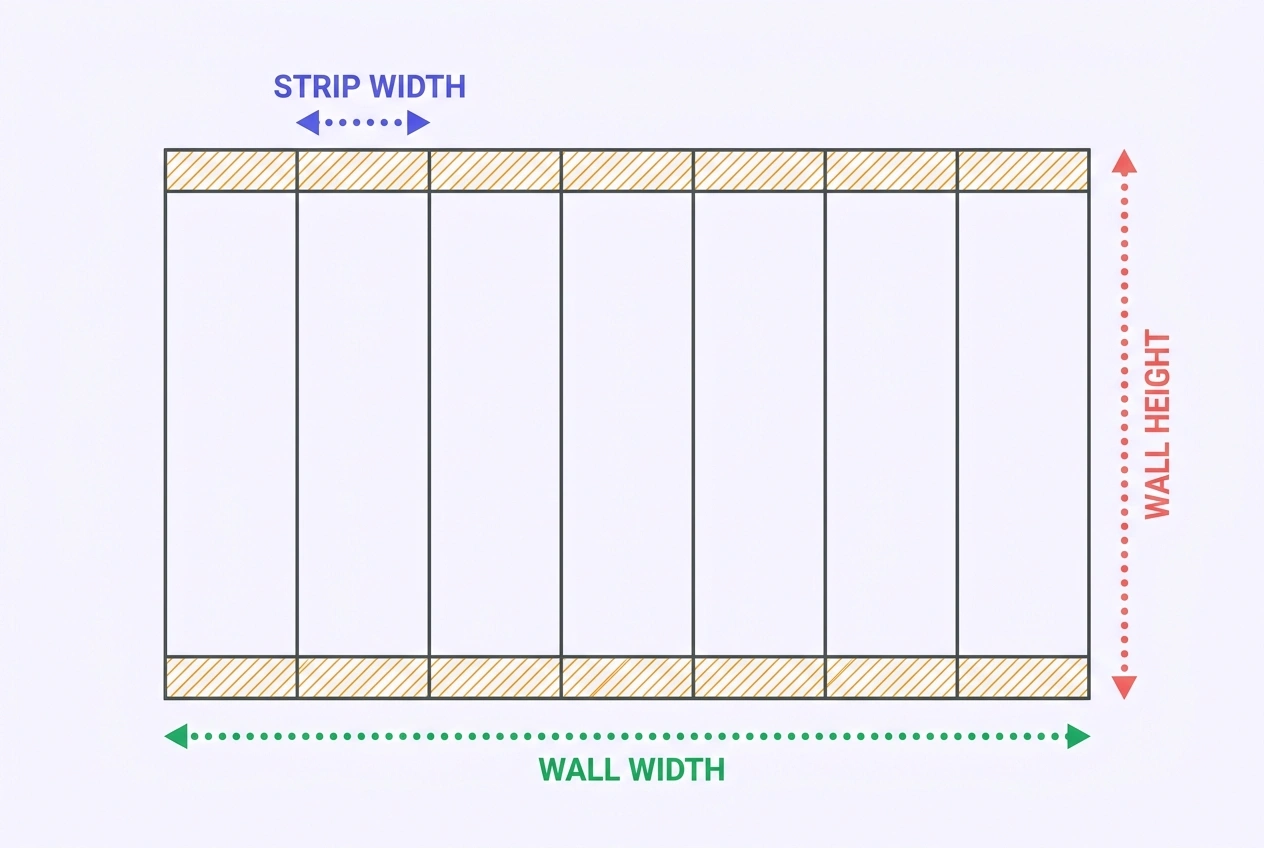
Professional paperhangers estimate in strips, and every number in the results card maps to one step of that method. Worked in any unit — the calculator converts everything to feet internally.

- Cut length per strip
Wall height plus the trim allowance (4 inches is standard breathing room at top and bottom). For straight-match paper, round that working height up to the next full pattern repeat — every strip must start and end on the same point of the design. For half-drop, add one more full repeat on top, because alternate strips hang half a cycle lower.
- Strips per wall
Wall width divided by roll width, rounded up. A 12-foot (144-inch) wall with 20.5-inch paper takes 8 strips — seven don't quite cover it. Strips never carry around a corner: the pattern sequence breaks at every corner, so each wall starts its own count.
- Opening deduction
A window or a standard door does not eliminate the strips beside and over it — full-height drops still hang there, and the offcuts fill around the frame. Only opening width that spans enough full strips actually reduces the count, which is why this calculator deducts whole strips (opening width ÷ roll width) instead of raw area.
- Strips per roll
Roll length divided by cut length, rounded down — a partial strip can't hang. A 33-foot (396-inch) bolt with a 100-inch cut yields 3 strips; with a 120-inch straight-match cut it still yields 3; at a 144-inch half-drop cut only 2. That step-down is where patterned rooms quietly double their order.
- Rolls needed
Total strips divided by strips per roll, rounded up, then converted to the packaging you actually buy: bolts (double rolls) in most US retail, or single rolls where goods are sold that way. The trim allowance and repeat waste are already inside these numbers — adding a percentage on top double-counts. One spare bolt covers dye-lot risk and future repairs instead.
Worked Example: The Page Defaults
The calculator opens on four 12-foot walls, 8-foot ceilings, 20.5-inch by 33-foot double rolls, random match, 4-inch trim — a plain 12 by 12 bedroom. Walking the math by hand:
Cut length = 8 feet + 4 inches = 100 inches, no repeat rounding for random match. Strips per wall = 144 ÷ 20.5 = 7.02 → 8 strips, so 4 walls = 32 strips. Strips per bolt = 396 ÷ 100 = 3.96 → 3. Rolls = 32 ÷ 3 = 10.67 → 11 double rolls.
Same room with a 24-inch-repeat straight-match paper: cut length rounds 100 up to 120 inches, still 3 strips per bolt, still 11 bolts. Switch that paper to half-drop: cut length climbs to 144 inches, the bolt yields 2 strips, and the order jumps to 16 bolts — 5 extra rolls purely from the match type. Add one 30-inch door and two 36-inch windows in random match: 102 inches of opening width is 4 whole strips at 20.5 inches, netting 28 strips and 10 bolts.
Budget check: at $45.00 per bolt, 11 bolts is $495.00. The area shortcut's "7 rolls" would have bid the job $315 — and run out on wall three.
Pattern Match Types
The match type printed on the product label decides the cut-length rule, and the cut length decides everything else. The three labels cover nearly all wallcovering:
| Match Type | How Strips Align | Cut-Length Rule | Waste Level |
|---|---|---|---|
| Random (free match) | No alignment needed — stripes, textures, solid-ish designs | Working height + trim, no rounding | Lowest |
| Straight match | Pattern level across seams — every strip identical | Round up to the next full repeat | Moderate — grows with repeat size |
| Half-drop match | Every other strip drops half a repeat for a diagonal flow | Round up, plus one extra repeat | Highest of the three |
A drop match (quarter- or third-drop) behaves like half-drop with even more waste, and panel/mural sets are cut to printed panels rather than strips — those need a panel count from the manufacturer, not a strip calculator. On this page's defaults (100-inch working height), a 24-inch repeat produces a 120-inch straight cut or a 144-inch half-drop cut: the difference between 3 strips per bolt and 2, which is 11 bolts versus 16 on the same room.
Single vs Double Rolls
US wallcovering has a quirk no other trade shares: the pricing unit and the selling unit are different sizes. Rolls are priced per single roll but packaged, shipped, and sold as double rolls — bolts. Most makers will not cut a bolt in half, so the number you take to the store is bolts.
| Packaging | Typical US Size | Coverage | Role |
|---|---|---|---|
| Single roll | 20.5 in × 16.5 ft | ≈ 28 sq ft | Pricing unit only — rarely sold |
| Double roll (bolt) | 20.5 in × 33 ft | ≈ 56 sq ft | The standard retail package |
| European roll | 21 in × 33 ft | ≈ 57 sq ft | Common imported goods |
| Triple roll | 20.5 in × 49.5 ft | ≈ 84 sq ft | Murals and long runs |
Peel-and-stick panels don't follow this table — they ship as 24-inch-wide panels of fixed length. Enter the panel's actual width and length as the "roll" and the same strip math holds. Always check the label: roll width, roll length, and the pattern repeat are printed on every bolt, and entering the real numbers beats any standard assumption.
Frequently Asked Questions
With 8-foot ceilings, four 12-foot walls, and no pattern repeat: 32 strips at an 8-foot-4-inch cut length, and a 33-foot double roll yields 3 strips — 11 double rolls. A square-foot shortcut (384 ÷ 56) suggests 7, but strips cannot be spliced mid-wall, so the strip count is the number to order. One door and two windows bring it to about 10.
The vertical distance between one point in the printed design and the next identical point down the roll, typically 0 to 27 inches. Every strip must be cut at a full multiple of the repeat so adjacent strips align at the seams — a 24-inch repeat on an 8-foot wall forces a 10-foot cut and about 20 inches of waste per strip.
Straight match means every strip is cut to the same length: round the working height up to the next full repeat and all strips align horizontally. Half-drop shifts every other strip down by half the repeat, so strips need one extra full repeat of length. On this page's defaults, the straight-match cut is 10 feet and the half-drop cut is 12 feet, which drops a 33-foot roll from 3 strips to 2 and raises the order from 11 to 16 bolts.
In US retail, wallpaper is priced per single roll (about 28 square feet) but packaged and sold as double rolls (about 56 square feet, a 33-foot bolt). Most manufacturers will not break a bolt. Order by bolts — the packaging select matches the results and cost to what the store actually sells.
Professional practice is usually no — you still hang full-height strips beside and over openings, and the offcuts become trimming stock around frames. That's why most wallcovering retailers refuse to deduct at all. The optional openings fields here take the middle path: they remove only whole strips that full opening widths actually displace, never raw area, so a standard window in the middle of a strip saves nothing while a floor-to-ceiling opening a strip wide saves a full strip.
The US standard is a 20.5-inch-wide roll, 16.5 feet long per single roll and 33 feet per double roll (bolt). European goods commonly run 21 inches wide and 33 feet long; commercial vinyl is wider at 27 inches; peel-and-stick panels run about 24 inches wide. Treat these as defaults only — the roll label lists the real width, length, and repeat, and the calculator accepts any size you enter.
None beyond the calculation is required for trimming or matching — the 4-inch trim allowance is already in every cut length, and pattern waste is already inside the repeat rounding. Adding a percentage on top double-counts. What the strip math can't price in is the dye lot: order one spare bolt so future repairs match, because wallpaper is batch-printed and a later order can shift color visibly on the wall.
Measure each wall's full width at floor level and take the height at the tallest point of each wall — plaster walls in older homes vary by an inch or more from end to end. Do not subtract doors or windows from the width, and leave baseboards and crown in the height; strips run over them and get trimmed. Enter each wall as its own row: strips never carry around a corner because the pattern sequence breaks there.
References
- The Wallcoverings Association, Wallcovering Installation and Specification Resources, wallcoverings.org
- The Wallcoverings Association, How to Estimate, wallcoverings.org
- The Wallcoverings Association, Pattern Matches, wallcoverings.org
- Wallcovering Installers Association, Wallcovering Tips and Information, wallcoveringinstallers.org
This calculator provides estimates for planning purposes only. Verify roll dimensions, pattern repeat, packaging, and pricing with your supplier before ordering. MyBuilderBase is not responsible for ordering errors, material shortfalls, dye-lot variations, or job costs resulting from use of this tool.
Papering a feature wall or a whole floor? Compare quotes from local paperhangers and painters before you place the roll order.
Get Free Estimates