
Enter Project Dimensions
Fill in the area and paint details. Results update live as you type.

Results
Project Summary
Primer Estimate
Cost Estimate
Calculation Assumptions
What You Get
- ✓Free — no sign-up, nothing to install
- ✓Live results as you type
- ✓Feet, inches, cm, meters & yards — mix any units
- ✓Export a PDF takeoff in one click
- ✓Shareable link that saves your inputs
- ✓Works on phone, tablet & desktop
- ✓Walls, ceilings & whole rooms
- ✓Coat count & primer options
- ✓Paint and primer gallons split separately
ON THIS PAGE:
What Is a Paint Calculator
A paint calculator estimates how many gallons of paint (and primer) you need to cover walls and ceilings, along with the total material cost. Choose what you are painting — all four walls of a room, walls plus ceiling, a single wall, or the ceiling only — enter the dimensions, doors and windows, number of coats, and the calculator converts the paintable area into whole gallons.
Whether you are refreshing a single bedroom or repainting an entire house, this tool eliminates guesswork so you buy the right amount on the first trip — because returned tinted paint is rarely refunded, and a gallon short means a color-matching risk on the second purchase.
How to Calculate Paint
Calculating paint follows a straightforward process. Here is the step-by-step method for each project type:
- Step 1: Choose what you are painting — All four walls of a room, walls plus ceiling, a single wall, or the ceiling only.
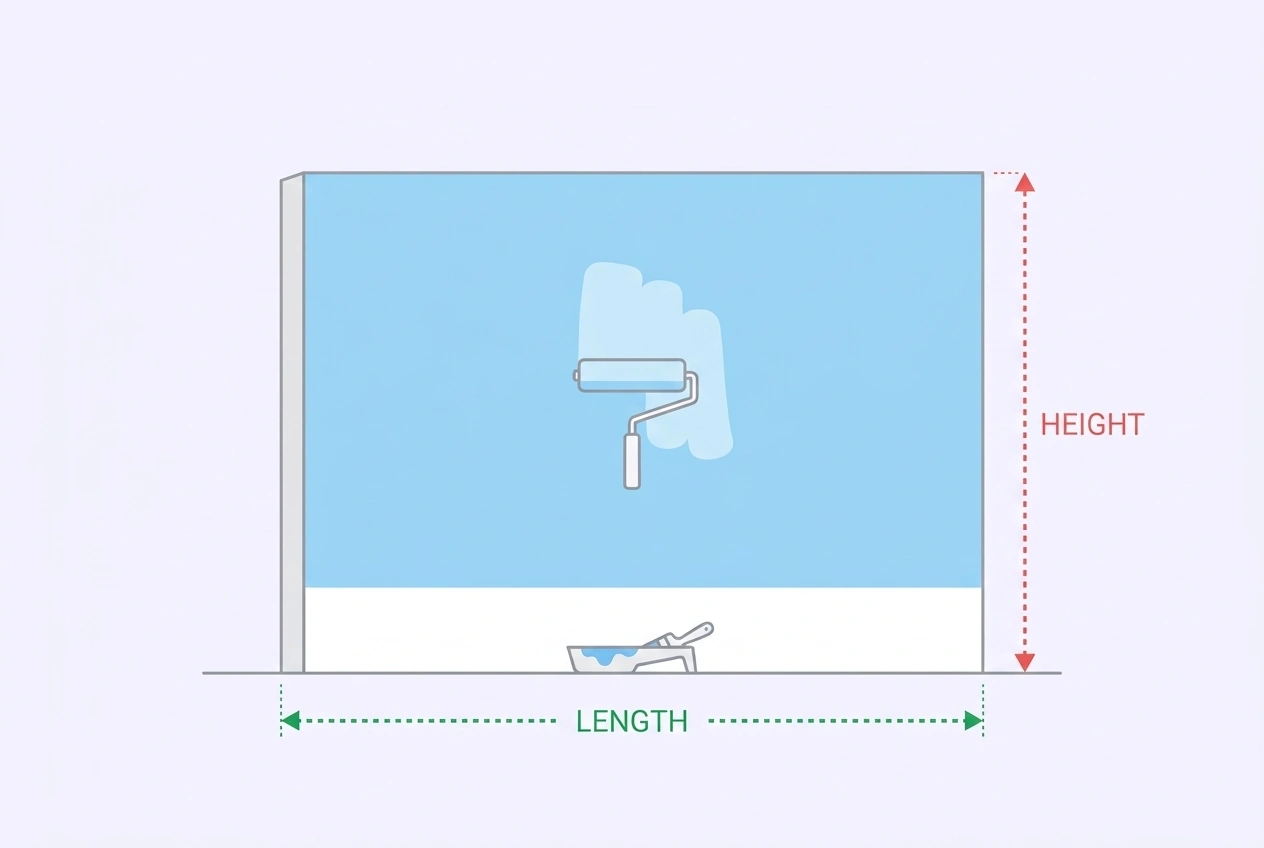
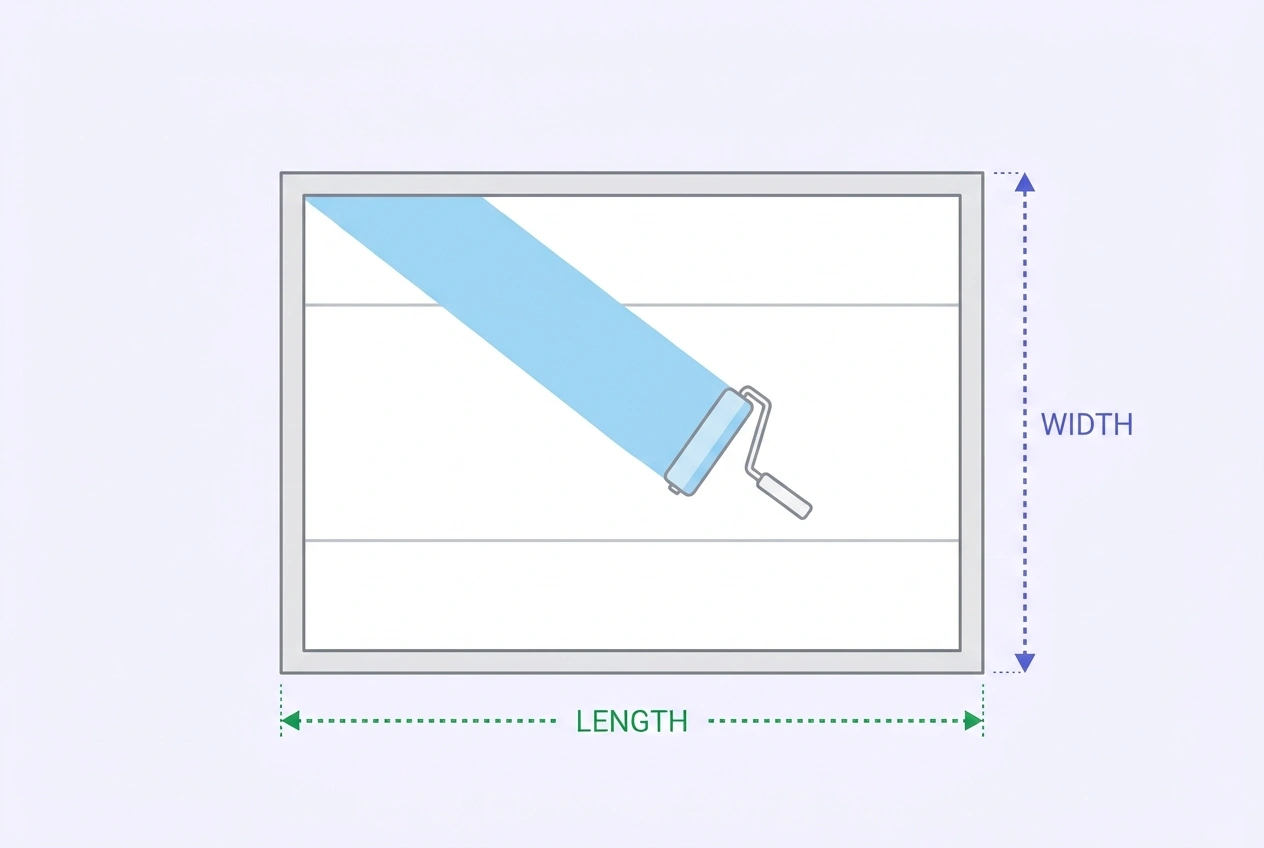
- Step 2: Measure the dimensions — For a room, measure the length, width, and wall height. For a single wall, measure its length and height. Note the count of doors and windows.
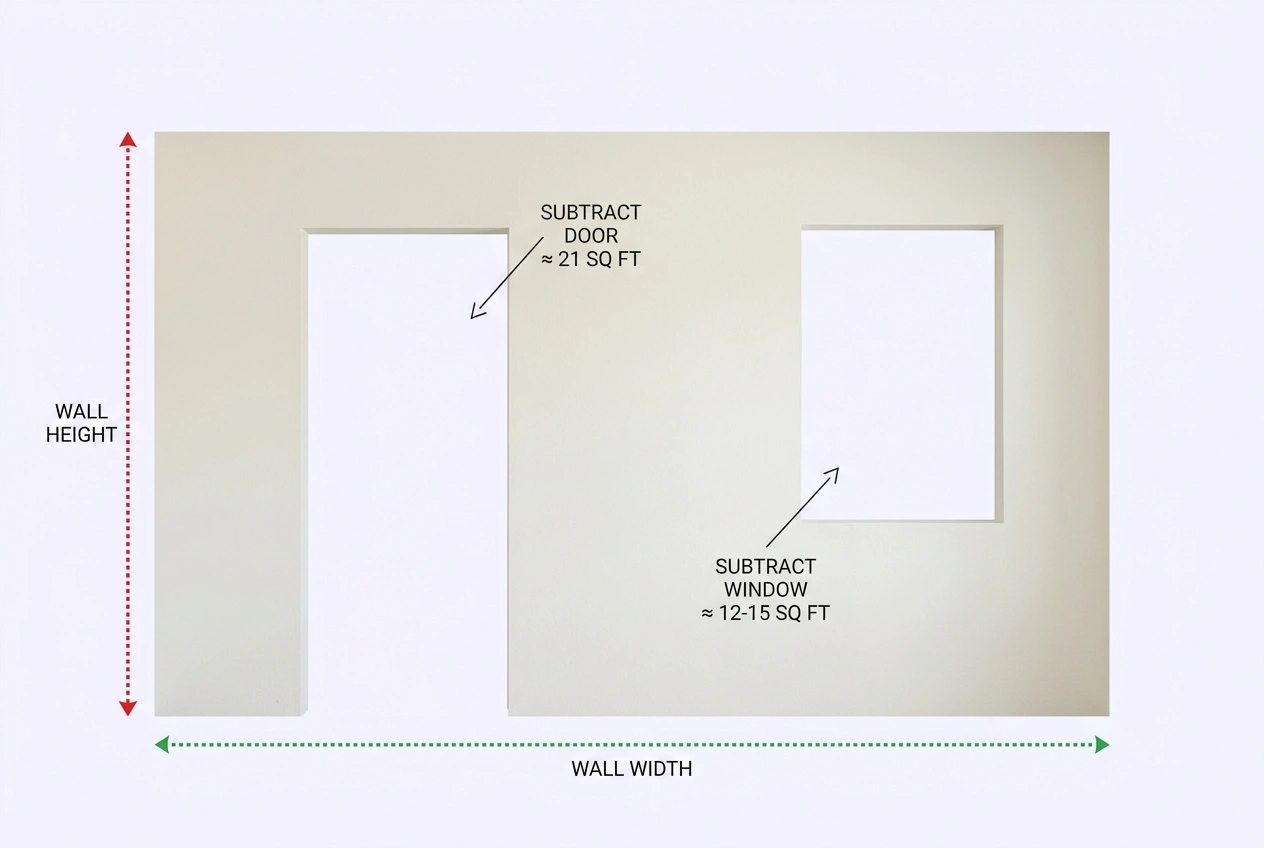
- Step 3: Calculate the paintable area — For a room, add all four walls: 2 × (length + width) × height. For a single wall, multiply length × height. Subtract roughly 20 sq ft per door and 15 sq ft per window, and add the ceiling area (length × width) if you are painting it.
- Step 4: Divide by coverage and multiply by coats — Divide the paintable area by the coverage per gallon (typically 350 sq ft), multiply by the number of coats, add 10% waste, and round up to whole gallons.
Formula: Gallons = (Paintable Area × Coats × 1.10) ÷ Coverage per Gallon, rounded up
Paint Coverage Guide
One gallon of paint covers about 350-400 sq ft per coat on smooth, primed walls. Real-world coverage varies with surface texture, porosity, and color contrast:
| Surface | Coverage per Gallon | Notes |
|---|---|---|
| Smooth, primed drywall | 350 – 400 sq ft | Best-case coverage; typical for most rooms |
| Previously painted walls | 350 – 400 sq ft | Similar color usually needs 2 coats for depth |
| Bare new drywall | 250 – 300 sq ft | Porous; prime first for even coverage |
| Textured walls (orange peel, knockdown) | 250 – 300 sq ft | Texture adds surface area |
| Rough stucco or masonry | 200 – 250 sq ft | Very absorbent; use masonry primer |
| Dark over light (or vice versa) | 200 – 300 sq ft | Plan 3 coats or tinted gray primer |
| Primer | 200 – 300 sq ft | Soaks in more than finish paint |
Room Size Paint Chart
Exact paint needed for common room sizes, assuming two coats on all four walls with 8-foot ceilings, 10 percent waste allowance, and standard 350 sq ft per gallon coverage. Doors and windows are not deducted. The calculator rounds up to whole gallons — the exact figures below are also handy if you combine a large can with quarts:
| Room (ft) | Walls Only | Walls + Ceiling |
|---|---|---|
| 8 × 8 | 1.6 gal | 2.0 gal |
| 10 × 10 | 2.0 gal | 2.6 gal |
| 12 × 12 | 2.4 gal | 3.3 gal |
| 12 × 14 | 2.6 gal | 3.7 gal |
| 14 × 14 | 2.8 gal | 4.0 gal |
| 16 × 16 | 3.2 gal | 4.8 gal |
| 18 × 18 | 3.6 gal | 5.7 gal |
| 20 × 20 | 4.0 gal | 6.5 gal |
Chart figures follow the same formula as the calculator: wall area = 2 × (length + width) × 8 ft, multiplied by 2 coats and 1.10 waste, divided by 350 sq ft per gallon. The walls-plus-ceiling column adds the floor-area ceiling at the same coverage and coats.
When to Use Primer
Primer is not always required, but in these situations it saves paint and prevents problems down the road:
- New drywall — Bare joint compound and paper absorb finish paint unevenly. A PVA primer seals it and gives a uniform sheen.
- Stains and water marks — Use a stain-blocking primer (shellac or oil-based) or tannins and marks will bleed through the topcoat.
- Drastic color changes — Going from dark navy to white takes 3-4 unprimed coats. A tinted gray primer does it in 2.
- Glossy surfaces — Paint will not adhere to gloss without deglossing or a bonding primer.
- Bare wood and masonry — Porous surfaces drink paint; primer evens out absorption and prevents blotches.
Repainting a wall in a similar color with quality paint usually needs no primer — just clean the wall and paint two coats.
Doors & Windows Deductions
Openings reduce the paintable area, and the calculator subtracts standard sizes automatically. If your openings are unusually large or small, adjust the counts to approximate the area:
| Opening | Standard Size | Area Deducted |
|---|---|---|
| Interior door | 3 ft × 6 ft 8 in | 20 sq ft |
| Window (average) | 3 ft × 4 ft | 15 sq ft (incl. trim) |
| Picture window | 6 ft × 5 ft | ~30 sq ft — count as 2 |
| Closet / bifold opening | 6 ft × 6 ft 8 in | ~40 sq ft — count as 2 doors |
Many painters skip the deduction for small windows and simply let it offset trim and touch-up waste — the two roughly cancel out.
Paint Sheen Guide

Sheen affects durability, washability, and how much the paint hides. Choose by room rather than by color:
| Sheen | Best For | Trade-off |
|---|---|---|
| Flat / Matte | Ceilings, adult bedrooms, low-traffic walls | Hides imperfections; hardest to clean |
| Eggshell | Living rooms, hallways, dining rooms | Balanced washability and low glare |
| Satin | Kitchens, bathrooms, kids' rooms, trim | Moisture-resistant; shows flaws more |
| Semi-gloss | Doors, trim, cabinets, baseboards | Very durable and scrubbable |
| High-gloss | Accent furniture, banisters | Shiniest and toughest; shows every flaw |
Tips Before You Paint
- Buy all the paint at once — Tint batches can drift between shipments. One purchase from the same store keeps the color consistent; note the formula for touch-ups later.
- Box your paint — Pour multiple gallons into a 5-gallon bucket and stir. Even the same formula varies slightly between cans, and boxing eliminates the seam between batches.
- Cut in first, roll second — Brush a 2-3 inch border around edges while the rolled area is still wet to avoid lap marks.
- Keep a wet edge — Always roll toward the last painted area, not away from it, to blend the sections invisibly.
- Wait full recoat time — Latex needs 2-4 hours; recoating too soon can pull the first coat right off.
- Save ¼ gallon for touch-ups — Label it with the room and date. Dried leftovers in the original can rust and spoil.
Paint Costs
Paint prices vary widely by quality tier. Higher grades contain more titanium dioxide and solids, which is why they cover better in fewer coats — often making them cheaper per project:
| Product | Typical Cost |
|---|---|
| Budget interior paint (per gallon) | $15 – $30 |
| Quality interior paint (per gallon) | $35 – $60 |
| Premium / designer paint (per gallon) | $70 – $120 |
| Ceiling paint (per gallon) | $20 – $40 |
| Primer (per gallon) | $20 – $35 |
| Painter's tape, rollers, brushes, trays | $20 – $50 per project |
| Drop cloths / plastic sheeting | $10 – $30 |
| Pro installed (walls, per sq ft of floor area) | $2 – $6 |
Worked Example
Let us calculate paint for a 14-foot by 12-foot room with 8-foot ceilings (all four walls), one door, two windows, 2 coats, and 350 sq ft per gallon coverage.
Step 1: Calculate the walls area
Step 2: Subtract the openings
Step 3: Multiply by coats and add waste
Step 4: Divide by the coverage
Step 5: Cost
Priming first (new drywall) adds 366 ÷ 300 = 1.22, so 2 gallons of primer. Painting the ceiling too adds 14 × 12 = 168 sq ft: (366 + 168) × 2 × 1.10 ÷ 350 = 3.36, so 4 gallons.
Frequently Asked Questions
References
- ASTM International, "Standard Test Method for Hiding Power of Architectural Paints," ASTM D344, astm.org
- U.S. Environmental Protection Agency, "Paint and Surface Preparation Best Practices," epa.gov
- American Coatings Association, "Calculating Paint Coverage," paint.org
- Painting and Decorating Contractors of America (PDCA), "Estimating Guide for Painting Contractors," pdca.org
- U.S. Consumer Product Safety Commission, "Lead-Based Paint Safety," cpsc.gov
Disclaimer: The paint calculator results on this page are planning estimates only. Actual gallon coverage varies with surface texture, porosity, color change, and application method, and primer needs vary with surface condition. Confirm coverage ratings on the product label with your supplier, and spot-test adhesion and color before committing to the full order.
Need a precise estimate for your painting project?
Get Free Estimates