
ON THIS PAGE:
Paint Coverage at a Glance
One gallon of standard interior wall paint covers about 350 to 400 square feet in one coat on a smooth, sealed surface. A quart covers about 100 square feet, and a five-gallon pail covers about 1,750 to 2,000 square feet. Primer is the exception that catches people out: it spreads at only 200 to 300 square feet per gallon because it is formulated to penetrate and seal. Exterior paint falls between the two on rough surfaces, at roughly 250 to 350 square feet per gallon on smooth siding and 150 to 250 on stucco or masonry. Texture is the largest single modifier — light orange peel cuts coverage by about 15 percent, heavy texture by about 30 percent, and bare brick or popcorn can cut it by half.
| Product | Coverage per gallon (one coat) | Coverage per quart |
|---|---|---|
| Interior wall paint, smooth | 350–400 ft² | About 100 ft² |
| Interior wall paint, textured | 250–300 ft² | About 65–75 ft² |
| Primer | 200–300 ft² | About 50–75 ft² |
| Ceiling paint, smooth | 350–400 ft² | — |
| Exterior paint, smooth siding | 250–350 ft² | — |
| Masonry and stucco paint | 150–250 ft² | — |
| Five-gallon pail of wall paint | 1,750–2,000 ft² | — |
What a Gallon of Paint Actually Covers
Paint coverage is quoted as a spreading rate: the area one gallon covers in one coat at the manufacturer's recommended film thickness. The number is measured in a lab on a smooth, sealed, non-porous panel, and it is printed on the can as a range such as 350 to 400 square feet. That range is not a promise about your wall. It is the best-case result on an ideal surface, and every real surface departs from the ideal in the same direction — toward using more paint.
Three things eat into the published rate. Texture increases the actual surface area the paint must wet. Porosity pulls binder and pigment into the substrate instead of leaving them on the face. Application method changes how much material lands on the wall versus the tray, the drop cloth, or the air. A smooth, previously painted drywall wall in good condition will land at the top of the label range. A bare, porous, heavily textured wall can land 30 to 50 percent below it. The honest planning number for an average interior repaint is 350 square feet per gallon, not 400.
Label Coverage vs Real Coverage
Manufacturers publish ranges rather than single numbers because the same product behaves differently on different substrates. Sherwin-Williams quotes 350 to 400 square feet per gallon for typical wall paint, Behr quotes 250 to 400 for its interior paint-and-primer products, and most exterior data sheets quote 350 to 400 square feet on smooth, non-porous surfaces while acknowledging that rough siding and masonry reduce it. When two products quote the same headline number, the one with the higher solids content often delivers more usable film on a porous surface even though the printed spreading rate looks identical.
Why More Expensive Paint Can Cost Less
Premium paints carry more pigment and binder, so they hide in fewer coats and sometimes cover more area per gallon than a thin budget product. A cheap paint that needs three coats at 300 square feet per gallon uses more material than a premium paint that covers in two at 375. Compare the cost per square foot of finished wall across all required coats, not the price per can. The same logic applies to primer: a high-hiding primer that covers in one coat at 250 square feet can beat a cheap primer that needs two coats at 300.

Paint Coverage Chart by Coating and Surface
This chart collects the planning coverage rates for common paints, primers, and coatings. All figures are for one coat on the stated surface. Ranges reflect the difference between a smooth, sealed substrate at the top and a rougher or more absorbent substrate at the bottom. When a project sits between two rows, use the lower figure.
| Coating | Surface | Coverage per gallon | Notes |
|---|---|---|---|
| Interior wall paint | Smooth, primed or previously painted drywall | 350–400 ft² | Flat, eggshell, satin, and semi-gloss similar |
| Interior wall paint | Light orange-peel or knockdown texture | 250–300 ft² | About 15% loss from texture |
| Interior wall paint | Heavy texture or rough plaster | 200–250 ft² | About 30% loss or more |
| Ceiling paint | Smooth ceiling | 350–400 ft² | Flat finish limits flashing |
| Ceiling paint | Popcorn or heavy texture | 150–240 ft² | Texture absorbs heavily |
| Trim and door enamel | Smooth, primed wood or metal | 350–400 ft² | Brushing uses more than spraying |
| Cabinet enamel | Smooth, primed cabinet fronts | 350 ft² | Two to three thin coats typical |
| Exterior latex | Smooth siding | 250–350 ft² | Up to 400 on premium smooth products |
| Exterior latex | Rough-sawn or weathered wood | 150–250 ft² | Primer helps reduce absorption |
| Masonry paint | Smooth stucco or concrete | 250 ft² | Acrylic masonry coatings |
| Masonry paint | Medium texture stucco | 200 ft² | Roller or spray, back-rolled |
| Masonry paint | Heavy texture stucco | 150 ft² | May need two priming coats |
| Brick paint | Bare brick | 100–150 ft² | Very porous; prime first |
| Elastomeric coating | Stucco or masonry | 65–100 ft² | Applied thick to bridge cracks |
| Deck stain | Smooth or new wood | 300 ft² | Weathered wood drops to 150–175 |
| Concrete sealer | Dense concrete | 200–300 ft² | Porous concrete drops to 100–175 |
| Standard primer | Previously painted or patched wall | 200–300 ft² | Soaks in more than topcoat |
| PVA drywall primer | New, unfinished drywall | 300–400 ft² | Cheapest option for new board |
| High-build primer | Textured or uneven surface | 200–300 ft² | Builds film to level minor texture |
| Bonding primer | Glossy tile, laminate, or metal | 250–350 ft² | Improves adhesion on slick surfaces |
| Shellac or stain-blocking primer | Stained or smoke-damaged surface | 300–350 ft² | Seals tannin, water marks, and odor |
These rates are planning defaults drawn from manufacturer data sheets and common trade practice. The can in your hand overrides every row: if it says 300 square feet per gallon, use 300. Paint calculators built around a 350 to 400 square foot default are useful for budgeting, but they cannot see the texture, porosity, or color change that your wall actually has.
Quarts, Gallons, and Five-Gallon Pails
Paint is sold in four practical sizes: the quart (one-quarter gallon), the gallon, the five-gallon pail, and occasionally a one-gallon or two-gallon kit for specialty coatings. Coverage scales linearly with volume, so the only arithmetic needed is multiplying the per-gallon rate by the container size. The complication is that partial containers cannot be bought, so a job that needs 1.2 gallons becomes a gallon plus a quart, and a job that needs 4.4 gallons becomes five gallons.
| Container | Volume | Wall paint coverage (one coat) | Primer coverage (one coat) |
|---|---|---|---|
| Quart | 0.25 gal (0.95 L) | 87.5–100 ft² | 50–75 ft² |
| Gallon | 1 gal (3.785 L) | 350–400 ft² | 200–300 ft² |
| Five-gallon pail | 5 gal (18.93 L) | 1,750–2,000 ft² | 1,000–1,500 ft² |
A quart is the right size for an accent wall, a door and its casing, a small piece of furniture, or a touch-up kit. A gallon suits a single bedroom or a small bathroom. A five-gallon pail suits a whole-house repaint, a large open-plan space, or an exterior job where the same color runs continuously around the building. Buy all containers for one continuous color at the same time and from the same batch when possible; color can shift slightly between manufacturing lots, and a five-gallon pail is the manufacturer's way of guaranteeing one lot across a large job.
Mixing and Storage
If a job needs more than one gallon, box the paint — pour all containers into one large bucket and mix thoroughly before starting. This blends any slight batch variation and ensures a consistent color across walls that meet at a corner. Keep a small labeled jar of the mixed color for touch-ups, and store it upside down in a climate-controlled space; freezing and extreme heat both ruin latex paint. Leftover paint from a five-gallon pail should be decanted into smaller, full containers because a half-empty pail has a large air volume that speeds skinning and drying.
Primer Coverage per Gallon
Primer covers less than topcoat, and that surprises people who assume a gallon is a gallon. Standard primer spreads at about 200 to 300 square feet per gallon because it is designed to penetrate, seal, and bond rather than to build a decorative film. On new drywall the paper and joint compound pull binder out of the primer, so the first coat disappears faster still. On a previously painted wall, a primer may reach 350 to 400 square feet if the surface is smooth and non-porous, but planning at 250 is safer.
| Primer type | Coverage per gallon | Best use |
|---|---|---|
| PVA drywall primer | 300–400 ft² | New, unfinished drywall before paint |
| Standard latex primer | 300–400 ft² | Previously painted walls, light repairs |
| High-build primer | 200–300 ft² | Textured, patched, or uneven surfaces |
| Bonding primer | 250–350 ft² | Glossy tile, laminate, metal, and hard-to-stick surfaces |
| Shellac-based primer | 300–350 ft² | Water stains, smoke, tannin, and odor blocking |
| Oil-based primer | 300–400 ft² | Bare wood and adhesion on slick surfaces |
| Masonry primer | 200 ft² | Stucco, concrete, and brick before coating |
When Primer Is Required
Primer is not optional on bare drywall, bare wood, bare masonry, or metal; the topcoat will not bond or hide properly without it. It is also the right call for a dramatic color change, for covering stains, for sealing knots and tannin, and for any surface that has been patched with filler. A paint-and-primer-in-one product can skip a separate primer on a clean, previously painted wall in good condition, but it does not replace primer on new or bare substrates. Budget primer as a separate line with its own lower coverage rate rather than assuming it behaves like paint.
Tinted Primer for Color Changes
A tinted primer pitched toward the new color reduces the number of topcoats needed when moving from dark to light or light to dark. It does not change the primer's coverage rate, but it can save a whole coat of finish paint. On a deep red or navy wall going to off-white, a tinted high-hiding primer plus two topcoats is usually faster and cheaper than three or four coats of paint alone. Ask the paint desk to tint the primer to roughly 50 percent of the topcoat color.
Exterior Paint Coverage per Gallon
Exterior paint faces sun, moisture, and a much rougher set of substrates than interior walls, and its coverage reflects that. On smooth, previously painted siding, a quality exterior latex covers about 250 to 350 square feet per gallon; some premium products claim 350 to 400 on smooth, non-porous surfaces. On rough-sawn wood, weathered siding, stucco, and masonry, expect 150 to 250 square feet per gallon, and on bare brick as little as 100 to 150. The label range is the smooth-surface figure; the bottom of the range is the realistic exterior number.
Siding and Surface Factors
Profiled siding has more surface than the flat wall measurement suggests. A lap or clapboard wall has roughly 10 percent more area than its flat dimensions, rough-sawn siding about 30 percent more, stucco about 40 percent, and brick about 50 percent. These are planning multipliers applied to the measured wall area before dividing by coverage. They are not the same as texture loss — they represent real additional surface that the paint must wrap around, and they stack with the lower coverage of rough products.
| Exterior surface | Area factor | Planning coverage |
|---|---|---|
| Smooth siding or trim | 1.0 | 350 ft²/gal |
| Lap or clapboard siding | 1.1 | 300–350 ft²/gal |
| Rough-sawn wood | 1.3 | 250–300 ft²/gal |
| Stucco | 1.4 | 200–250 ft²/gal |
| Brick | 1.5 | 150–200 ft²/gal |
| Bare masonry or concrete | — | 150–250 ft²/gal |
Measuring an Exterior
Measure each wall from corner to corner and from the foundation line to the eave, then add gable triangles separately as half the base times the height. Subtract doors, windows, and any areas that will not be painted. Garages, porches, and additions often share a color but have separate wall planes, so treat each as its own rectangle and add them at the end. On a two-story house, measure both stories rather than doubling the first-floor area; trim bands, roof lines, and window placement often make the upper wall area different. Add 5 to 10 percent for touch-ups and for the paint lost to spraying if you plan to spray.
Primer for Exterior Work
Bare wood, bare masonry, and chalky or peeling surfaces need an exterior primer before topcoat. Exterior primer covers about 200 to 300 square feet per gallon on smooth surfaces and less on rough ones. On a house with weathered siding, primer is not a cost-saving step to skip; it stabilizes the surface and can reduce the number of finish coats from three to two. Spot-prime bare patches and knots even when the rest of the house is only being cleaned and repainted.
Ceiling Paint Coverage per Gallon
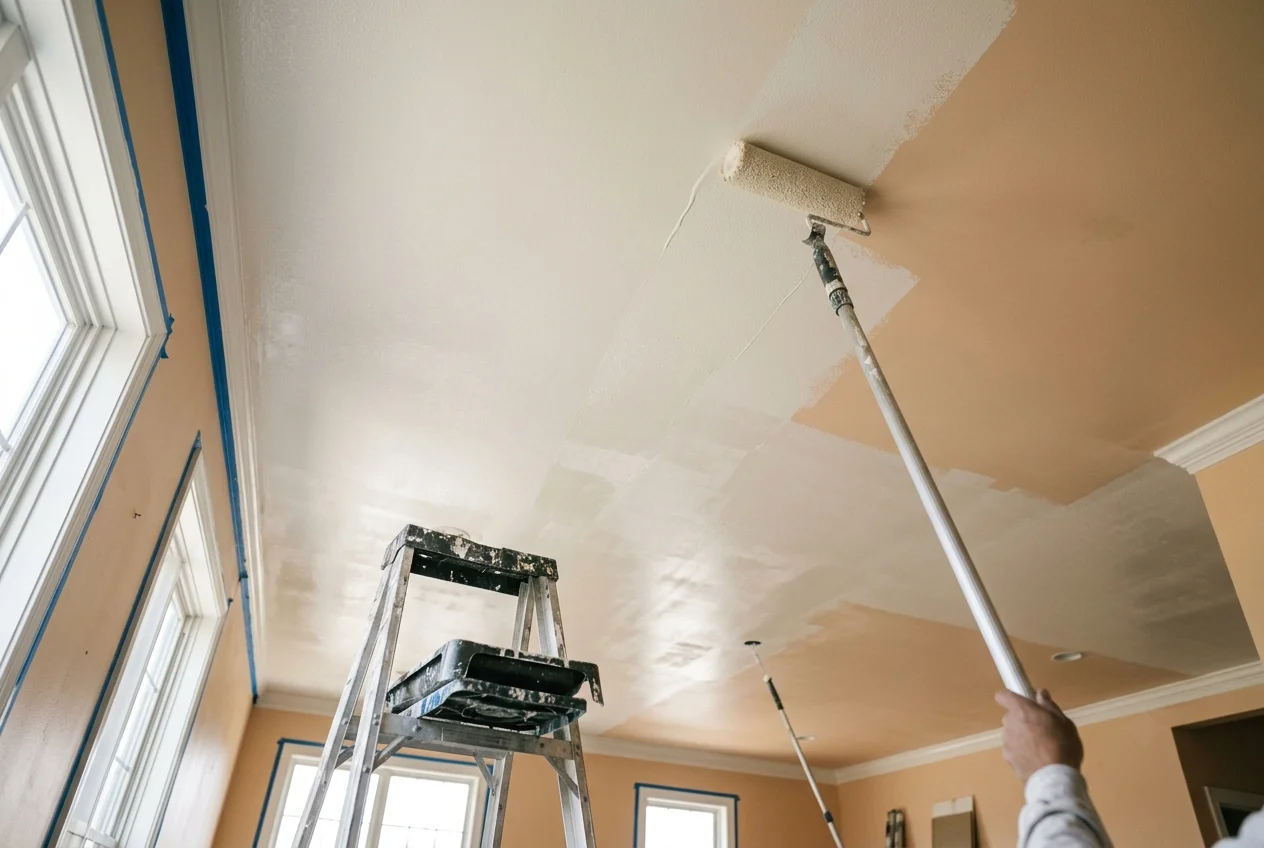
Ceiling paint covers about 350 to 400 square feet per gallon on a smooth ceiling, close to wall paint. Flat ceiling paint is formulated to hide roller marks and limit flashing, and it usually goes on in one or two coats over a clean, previously painted surface. Texture changes the number quickly: light orange peel or knockdown drops coverage to roughly 300 to 340 square feet per gallon, and a popcorn ceiling can fall to 150 to 240 square feet per gallon because the acoustic texture has far more surface area and absorbs more material.
Measuring a Ceiling
Multiply the room length by the width. For an L-shaped room, split it into rectangles and add them. Do not subtract light fixtures or vents unless they are large; the saving is negligible and the counting error is not. A standard 12-foot by 12-foot bedroom ceiling is 144 square feet, which is well under half a gallon per coat. A 20-foot by 30-foot open-plan ceiling is 600 square feet, or about 1.5 to 1.7 gallons per coat.
Ceiling Painting Practicalities
Ceiling paint is thicker than wall paint to reduce spatter, and that consistency can reduce coverage slightly compared with a wall product. Two thin coats cover better and look more even than one heavy coat, which can sag or show lap marks. On a stained ceiling, apply a stain-blocking primer first; painting directly over a water stain will let it bleed through the new finish. For a popcorn ceiling, use a thick-nap roller and expect to use roughly twice the paint that the smooth-ceiling calculation suggests.
Paint Coverage on Textured and Porous Walls
Texture and porosity are the two biggest reasons a gallon falls short of its label. A textured wall has more actual surface than its flat dimensions, and a porous wall pulls paint into the substrate instead of keeping it on the face. Both effects reduce the area a gallon covers, and both are invisible in a simple length-times-width measurement. The practical fix is a surface factor: multiply the smooth-surface coverage by a number below 1.0 to estimate real coverage.
| Surface | Factor | Real coverage of a 350 ft²/gal paint | Real coverage of a 400 ft²/gal paint |
|---|---|---|---|
| Smooth, sealed drywall or trim | 1.00 | 350 ft² | 400 ft² |
| Light orange peel or knockdown | 0.85 | 298 ft² | 340 ft² |
| Heavy texture or rough plaster | 0.70 | 245 ft² | 280 ft² |
| Popcorn ceiling | 0.60 | 210 ft² | 240 ft² |
| Bare wood | 0.75 | 263 ft² | 300 ft² |
| Bare concrete or masonry | 0.60–0.70 | 210–245 ft² | 240–280 ft² |
| Bare brick | 0.40–0.50 | 140–175 ft² | 160–200 ft² |
The factor is a planning tool, not a physical law. A light knockdown wall painted with a thick, high-solids product may do better than 0.85; a deeply textured plaster wall may do worse than 0.70. The direction of the adjustment is always the same, though: texture and porosity increase paint consumption. If the surface is bare and absorbent, add a primer coat and count its coverage separately rather than trying to solve the problem by buying more topcoat.
Priming Porous Surfaces
Bare drywall, bare wood, concrete, masonry, and brick should be primed before topcoat. Primer seals the surface and reduces the amount of finish paint that disappears into it, which usually saves money even though it adds a step. On new drywall, a PVA primer at 300 to 400 square feet per gallon is the standard first coat. On bare brick or concrete, a masonry primer at about 200 square feet per gallon is more appropriate, and heavily porous block may need two primer coats before the finish coat behaves.
Color Change and Texture Together
A textured wall plus a dramatic color change is the worst-case combination for coverage. The texture consumes more paint, and the color change requires more coats to hide the old color. Plan on the low end of the coverage range and two to three finish coats, or use a tinted primer to reduce the number of topcoats. On a dark textured wall going to white, three coats at 250 square feet per gallon is a realistic budget; two coats at 350 is not.
How Many Square Feet Does a Can of Spray Paint Cover?
Aerosol spray paint coverage is small and highly dependent on can size. The commonly quoted figures are about 7 square feet for a 4.5-ounce can, about 20 square feet for an 11- or 12-ounce can, and about 30 square feet for a 16-ounce can. These assume a thin, even coat on a smooth, non-porous surface with little overspray loss. On a porous surface, in wind, or with a heavy coat, expect to use two or three times as much.
| Can size | Approximate coverage | Typical use |
|---|---|---|
| 4.5 oz | About 7 ft² | Small touch-ups, hardware, craft projects |
| 11–12 oz | About 20 ft² | Furniture, trim, small repairs |
| 16 oz | About 30 ft² | Larger touch-ups, several small pieces |
Spray Guns and Transfer Efficiency
A spray gun or airless sprayer is rated in gallons per minute and transfer efficiency rather than can size. Transfer efficiency is the share of material that lands on the target; conventional air spray might deliver 50 to 65 percent, HVLP guns 65 to 85 percent, and airless units 55 to 75 percent depending on tip and pressure. The rest becomes overspray. For estimating, add 10 to 30 percent to the rolled coverage when spraying, and mask or shield more area than you think you need. Spraying is fast on large, flat, uncluttered surfaces and wasteful on small, cut-up ones.
Spray Paint on Exterior Projects
Wind carries aerosol and gun overspray away from the target, so exterior spray coverage is always lower than the label figure. Spray on a calm day, keep the can or gun at the recommended distance, and use overlapping passes rather than a single heavy coat. Runs and sags are more likely with spray than with a roller, and they are harder to fix on a textured surface. For fences, shutters, and outdoor furniture, a brush or roller often uses less material and produces a more durable film.
The Paint Coverage Formula
Every paint estimate reduces to one relationship: the area to be covered, multiplied by the number of coats, divided by the coverage rate of the product, rounded up to a purchasable container. The work is in measuring the area honestly and choosing a coverage rate that reflects the surface rather than the label's best case.
Walls
Net wall area = Perimeter × Ceiling height − Door and window area
Gallons = Net wall area × Number of coats ÷ Coverage per gallon
Measure the perimeter of the room and multiply by the floor-to-ceiling height. Subtract about 20 square feet for a standard door and 12 to 15 square feet for a standard window when the openings are large or numerous; on a room with one door and one window, subtracting both is reasonable. If the room has several walls of different heights, measure each wall separately and add the results. Then multiply by the number of coats and divide by the coverage rate. The result is gallons per project, not per coat.
Ceilings and Trim
Ceiling area = Length × Width
Trim area = Linear feet × Trim height in feet
Ceilings are a simple rectangle unless the room is L-shaped. Trim is measured in linear feet around the room, multiplied by the height of the trim in feet; a 4-inch baseboard is 0.33 feet tall, so 60 linear feet of baseboard is about 20 square feet. Doors are often counted as 20 square feet each per side, and window casings are counted from their linear footage. Trim paint coverage is similar to wall paint, but brushing uses more material than rolling, so plan at the low end of the range.
Exterior Walls
Wall area = Σ (Length × Height) + Gable triangles − Openings
Measure each exterior wall separately, add gable ends as half base times height, and subtract doors and windows. Apply the surface factor for the siding type before dividing by coverage. Add 5 to 10 percent for touch-ups, and 10 to 30 percent more if spraying. Exterior jobs often need two coats even when the color is similar, because sun and weather degrade the old film and a single coat wears unevenly.
Rounding to Containers
Round up to a full gallon or to the nearest combination of gallons and quarts. A calculated need of 2.1 gallons is two gallons plus a quart, not two gallons. A need of 4.4 gallons is five gallons, because the next purchasable step above four gallons plus a quart is five. Keep a small surplus for touch-ups rather than trying to buy exactly the calculated amount; paint matching becomes harder after the original batch is gone.
Coats and Color Changes
Coverage per gallon is always quoted per coat, and the number of coats is the multiplier people forget. A room that needs two gallons for one coat needs four gallons for two, before any waste allowance. The right coat count depends on what is under the new paint and how different the new color is.
| Situation | Typical coats | Notes |
|---|---|---|
| Same color refresh, clean surface | 1 | Two coats improve durability and sheen uniformity |
| Similar color over similar color | 1–2 | Two coats is the professional default |
| Light over light or dark over dark | 2 | Coverage is mostly about film build |
| Dark over light | 2 | One coat may look blotchy |
| Light over dark | 2–3 | Tinted primer can replace one coat |
| New drywall | 1 primer + 2 paint | PVA primer first |
| Bare wood | 1 primer + 2 paint | Spot-prime knots and tannin |
| Bare masonry | 1–2 primer + 2 paint | Primer consumption is separate |
Two coats are the standard for a reason: the first coat seals and builds, the second levels the film and delivers the intended color and sheen. One coat can work over a matching color in good condition, but it leaves less film for scrubbing and touch-ups. Three coats are usually reserved for dramatic color changes, deep saturated colors, or surfaces that are still showing through after two. Each additional coat adds its full coverage requirement to the gallon count.
Paint-and-Primer Products
Paint-and-primer-in-one products combine a primer's sealing function with a topcoat, and they can reduce the total number of coats on a clean, previously painted wall. They do not eliminate the need for a separate primer on bare drywall, bare wood, bare masonry, or metal, and they do not guarantee one-coat coverage over a dramatic color change. Read the product's stated coat recommendation rather than assuming the word "primer" on the label means a separate primer step is unnecessary.
Room-by-Room Paint Coverage Chart
This chart gives a planning estimate for common room sizes with 8-foot ceilings, one door, one window, and two coats of wall paint at 350 square feet per gallon. Deductions are approximate. Ceiling paint is shown separately because many projects paint the walls only, and adding the ceiling changes the total by roughly 0.3 to 1.5 gallons.
| Room size | Wall area (net) | Wall paint, 2 coats | Ceiling area | Ceiling paint, 1 coat |
|---|---|---|---|---|
| 8 × 8 ft | About 206 ft² | 1.2 gal → 2 gal | 64 ft² | 0.2 gal → 1 qt |
| 10 × 10 ft | About 270 ft² | 1.5 gal → 2 gal | 100 ft² | 0.3 gal → 1 qt |
| 10 × 12 ft | About 302 ft² | 1.7 gal → 2 gal | 120 ft² | 0.3 gal → 1 qt |
| 12 × 12 ft | About 334 ft² | 1.9 gal → 2 gal | 144 ft² | 0.4 gal → 1 qt |
| 12 × 16 ft | About 398 ft² | 2.3 gal → 3 gal | 192 ft² | 0.5 gal → 1 qt |
| 14 × 20 ft | About 494 ft² | 2.8 gal → 3 gal | 280 ft² | 0.8 gal → 1 gal |
| 18 × 18 ft | About 526 ft² | 3.0 gal → 3 gal | 324 ft² | 0.9 gal → 1 gal |
| 20 × 30 ft open plan | About 750 ft² | 4.3 gal → 5 gal | 600 ft² | 1.7 gal → 2 gal |
The conversions assume standard 350 square feet per gallon and a single door and window. A room with more openings or a wall of windows will need slightly less; a room with texture, a dark-to-light color change, or more than two coats will need more. The chart is a sanity check, not a replacement for measuring the actual room.
Common Paint Coverage Mistakes
Using Floor Area as Wall Area
A 12-foot by 12-foot room has 144 square feet of floor but about 384 square feet of wall before deductions. Floor area and wall area are different quantities, and substituting one for the other undershoots the paint by a factor of two or more.
Forgetting the Ceiling
Wall paint calculations usually exclude the ceiling. If the ceiling is being painted, add its area and its own coat count to the total. A 12-foot by 12-foot ceiling is 144 square feet, or roughly half a gallon per coat.
Buying One Coat
Coverage is quoted per coat. A room that needs two gallons for one coat needs four for two coats, before waste. Buying the one-coat quantity is the most common reason a project runs short on the second coat.
Trusting the Label on a Textured Wall
The 350 to 400 square foot figure assumes a smooth, sealed surface. Orange peel, knockdown, plaster, popcorn, brick, and concrete all reduce real coverage by 15 to 50 percent. Use a surface factor rather than the headline number.
Deducting Every Small Opening
Subtracting a door and a window is reasonable. Subtracting every outlet, switch plate, and small vent is not; the area saved is trivial and the counting error is larger than the saving. Deduct large openings only.
Skipping Primer to Save a Step
Primer covers only 200 to 300 square feet per gallon, so it looks like an extra expense. It is also what lets the topcoat bond and hide in the intended number of coats. Skipping it on bare drywall or masonry usually costs more in extra topcoat than the primer would have cost.
Mixing Batches or Sheens Mid-Job
Two gallons from different lots can dry to slightly different colors, and two products with the same color name but different sheens will look different on the wall. Buy all the paint for one continuous color at once, box it in a single container, and keep the sheen consistent from room to room.
Rounding Down
Paint is sold in fixed containers, and a calculated 2.1 gallons is not two gallons. Round up, and keep a small surplus for touch-ups. The cost of an extra quart is small compared with a second trip to the paint store after the walls are half done.
Frequently Asked Questions
A gallon of standard interior wall paint covers about 350 to 400 square feet in one coat on a smooth, sealed, previously painted surface. Most labels print a range in that band, and manufacturers such as Sherwin-Williams and Behr quote similar figures. Real coverage drops to roughly 250 to 300 square feet on light texture and 200 to 250 square feet on heavy texture, bare masonry, or rough wood. Use the spreading rate printed on the can whenever it is available, and use 350 square feet per gallon as a conservative planning default.
A quart is one quarter of a gallon, so it covers about 87.5 to 100 square feet of smooth surface in one coat at a 350 to 400 square foot per gallon rate. Manufacturers commonly round that to about 100 square feet. A quart is enough for one accent wall, a door and its trim, a small piece of furniture, or touch-ups, but not enough for a full room unless the walls are very small and only one coat is needed.
A five-gallon pail covers about 1,750 to 2,000 square feet of smooth surface in one coat at 350 to 400 square feet per gallon. That is roughly five times a single gallon, or enough for two coats on 875 to 1,000 square feet of wall area. A five-gallon pail of primer covers less, typically 1,000 to 1,500 square feet, because primer spreads at about 200 to 300 square feet per gallon. Five-gallon containers are intended for large, single-color projects where the whole quantity will be used within one job.
A gallon of standard primer covers about 200 to 300 square feet, noticeably less than a topcoat because primer is designed to soak into and seal the surface. PVA drywall primer can cover 300 to 400 square feet on new drywall, while high-build primer is closer to 200 to 300 square feet and bonding primer about 250 to 350. Shellac and stain-blocking primers usually land around 300 to 350 square feet. Check the label, because primer coverage varies more between products than wall paint coverage does.
Exterior latex paint typically covers 250 to 350 square feet per gallon on smooth siding, and some premium exterior products claim 350 to 400 square feet on smooth, sealed surfaces. Coverage falls on rough-sawn wood, weathered siding, stucco, and masonry: plan on 150 to 250 square feet per gallon for stucco and masonry and 100 to 150 square feet for bare brick. Textured exterior surfaces can absorb far more paint than the label suggests, so order at the low end of the published range.
A smooth interior ceiling needs about 350 to 400 square feet per gallon, the same as wall paint. Light texture such as orange peel or knockdown reduces that to roughly 300 to 340 square feet, and a popcorn or heavily textured ceiling can drop to 150 to 240 square feet per gallon. Ceiling paint is usually applied in one or two coats; a stained or previously unpainted ceiling may need a stain-blocking primer first, which covers only 200 to 300 square feet per gallon.
Textured walls need more paint, not less, because the surface area is larger and the texture absorbs material. As a planning rule, multiply the smooth-surface coverage by about 0.85 for light orange-peel or knockdown texture and by about 0.70 for heavy texture or rough-sawn wood. That turns a 350 square foot per gallon paint into roughly 298 square feet on light texture and 245 square feet on heavy texture. Popcorn ceilings can cut coverage by 40 percent or more. Bare brick, concrete, and stucco absorb even more and should be primed first.
Coverage depends on can size. A 4.5-ounce aerosol can covers about 7 square feet, an 11- or 12-ounce can covers about 20 square feet, and a 16-ounce can covers about 30 square feet. These figures assume a thin, even coat on a smooth surface. Spray application loses material to overspray and wind, so outdoor projects and porous surfaces often need two or three times the nominal coverage. For larger projects, a sprayer is measured in gallons per minute and transfer efficiency rather than aerosol can size.
References
- Sherwin-Williams, Paint Calculator and coverage FAQs, sherwin-williams.com — 350 to 400 square feet per gallon for wall paint, about 100 square feet per quart, 200 to 300 square feet per gallon for primer, and aerosol can coverage by size.
- Behr Paint, How Much Interior Paint to Buy, behr.com — 250 to 400 square feet per gallon for interior paint-and-primer products and guidance on quarts and five-gallon pails.
- Lowe's, Paint Calculator and paint buying guide, lowes.com — 350 to 400 square feet per gallon for paint and 200 to 300 square feet per gallon for primer, plus door and window deduction practice and the room-by-room measurement walkthrough.
- PaintCare, Buy the Right Amount of Paint to Reduce Waste, paintcare.org — typical coverage of 300 to 400 square feet per gallon and 350 as a rough planning default.
- Hirshfield's, Select 1000 Exterior Housepaint product data sheet, hirshfields.com — 350 to 400 square feet per gallon for exterior flat, eggshell, and satin finishes on smooth non-porous surfaces.
- Farrow & Ball, Calculating Paint Quantities, farrow-ball.com — finish-by-finish maximum coverage rates, two-coat recommendations, and primer-plus-two-topcoat systems.
- U.S. Environmental Protection Agency and PaintCare, Paint stewardship and leftover paint guidance, epa.gov — storage, consolidation, and disposal practice for leftover latex and oil-based paint.
Disclaimer: This guide compiles paint and coating coverage figures for general educational planning — spreading rates by product and surface, container sizes, primer and exterior coverage, texture factors, spray-can coverage, and the area-to-gallons formula. It is not a manufacturer specification, a professional estimate, or a substitute for reading the label on the product you are actually using. Published coverage varies by brand, product line, sheen, color, substrate, application method, and film thickness, and manufacturers revise formulations without notice. Verify quantities against the spreading rate and coat recommendations printed on the container, test on a small area when the surface is unfamiliar, and consult a painting professional for large, exterior, or specialty coating projects.