
ON THIS PAGE:
Concrete Bag Coverage at a Glance
Concrete is sold by weight, but it is placed by volume, and the two do not carry the same number. Every bag of standard concrete mix yields a fixed volume of finished concrete once it is mixed with water: an 80 lb bag yields about 0.60 cubic feet, a 60 lb bag about 0.45 cubic feet, a 40 lb bag about 0.30 cubic feet, with 50 lb and 90 lb bags filling the gaps at about 0.375 and 0.675 cubic feet. That volume is the bag yield, and it is printed on the bag because it is the number that actually determines how far the bag will go.
Coverage is what happens when that yield meets a thickness. Spread the 0.60 cubic feet from an 80 lb bag at 4 inches thick and it covers about 1.8 square feet; spread the same bag at 2 inches and it covers twice as much, about 3.6 square feet. The formula is simple: coverage in square feet equals 12 times the bag yield in cubic feet divided by the thickness in inches. Because a cubic yard is 27 cubic feet, a full yard of concrete covers about 81 square feet at 4 inches thick and about 27 square feet at a foot thick, and one yard takes about 45 eighty-pound bags — or 60 of the 60 lb, 72 of the 50 lb, 90 of the 40 lb, and 40 of the 90 lb bags. Read the yield chart, the coverage chart, and the formula in that order and any bag-to-area question resolves the same way.
Cubic Feet per Bag of Concrete: The Bag Yield Chart
The number that governs everything else is the yield — the volume of mixed, placed concrete one bag produces. For standard bagged concrete mix, yield runs at roughly 0.0075 cubic feet per pound of dry material, which is why the yield scales cleanly with weight: 40 lb gives 0.30 cubic feet, 60 lb gives 0.45, 80 lb gives 0.60, and 90 lb gives about 0.675. A 50 lb bag, common in some regions and in fast-setting post mixes, yields about 0.375 cubic feet. Because a cubic yard holds 27 cubic feet, dividing 27 by any yield gives the number of that bag needed to make a yard.
| Bag Size | Yield (cubic feet) | Yield (cubic yards) | Bags per Cubic Yard | Bags per Cubic Foot |
|---|---|---|---|---|
| 40 lb | 0.30 | 0.011 | 90 | 3.33 |
| 50 lb | 0.375 | 0.014 | 72 | 2.67 |
| 60 lb | 0.45 | 0.017 | 60 | 2.22 |
| 80 lb | 0.60 | 0.022 | 45 | 1.67 |
| 90 lb | 0.675 | 0.025 | 40 | 1.48 |
Yields are approximate planning values for standard general-purpose concrete mix. The 90 lb bag is not stocked in every region, and high-yield, fast-setting, and specialty mixes publish their own yields that can differ at the same bag weight.
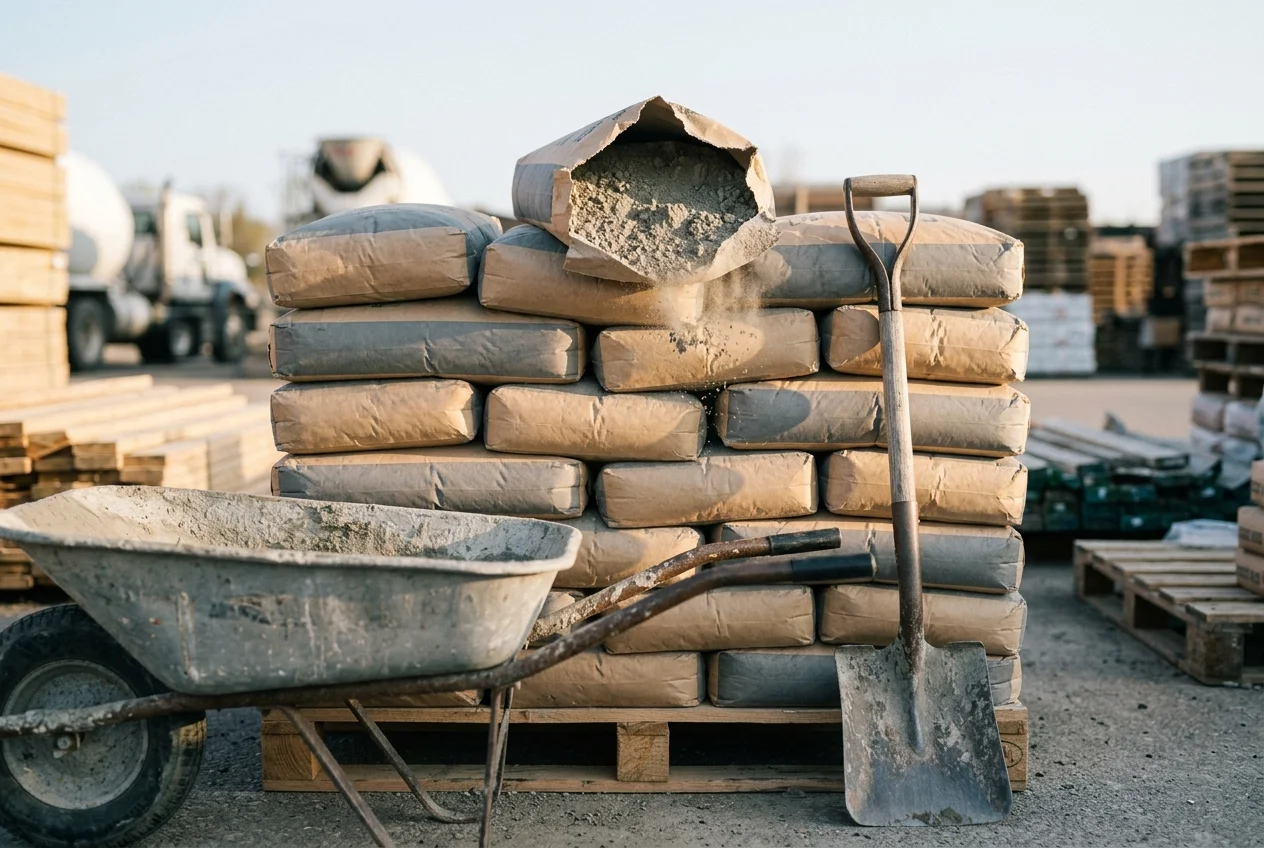
Concrete Bag Coverage Chart
This is the table to keep open while you plan. Each cell is the square feet one bag covers at that thickness, calculated from the standard yields above with the formula coverage = 12 × yield ÷ thickness. Read down a column to see how one bag size gives up area as the pour gets thicker; read across a row to compare bag sizes at the same depth. Every figure is per single bag and excludes any waste allowance.
| Thickness | 40 lb | 50 lb | 60 lb | 80 lb | 90 lb |
|---|---|---|---|---|---|
| 2 in | 1.80 sq ft | 2.25 sq ft | 2.70 sq ft | 3.60 sq ft | 4.05 sq ft |
| 3 in | 1.20 sq ft | 1.50 sq ft | 1.80 sq ft | 2.40 sq ft | 2.70 sq ft |
| 4 in | 0.90 sq ft | 1.13 sq ft | 1.35 sq ft | 1.80 sq ft | 2.03 sq ft |
| 5 in | 0.72 sq ft | 0.90 sq ft | 1.08 sq ft | 1.44 sq ft | 1.62 sq ft |
| 6 in | 0.60 sq ft | 0.75 sq ft | 0.90 sq ft | 1.20 sq ft | 1.35 sq ft |
| 8 in | 0.45 sq ft | 0.56 sq ft | 0.68 sq ft | 0.90 sq ft | 1.01 sq ft |
| 12 in | 0.30 sq ft | 0.38 sq ft | 0.45 sq ft | 0.60 sq ft | 0.68 sq ft |
Square feet covered per single standard-mix bag, rounded to two decimals. Coverage depends on thickness and on the product's own yield; confirm against the bag you are using before a large pour. Minimum placement thickness is product-specific — standard concrete mix is generally intended for pours 2 inches thick and up.
Coverage by Bag Size: 40, 60, and 80 lb Bags
The three bag sizes sold in most stores are the ones people ask about by name, so here they are pulled out on their own. Each table repeats the same relationship in a single column: as the pour thickens, the bag covers less.
80 lb Bag of Concrete Coverage
The 80 lb bag is the standard residential size, and it is also the most efficient on a per-yard basis — 45 of them make a cubic yard. At the very common 4 inch slab it covers about 1.8 square feet, and at 6 inches it covers 1.2.
| Thickness | Coverage per 80 lb Bag |
|---|---|
| 2 in | 3.60 square feet |
| 3 in | 2.40 square feet |
| 4 in | 1.80 square feet |
| 5 in | 1.44 square feet |
| 6 in | 1.20 square feet |
| 8 in | 0.90 square feet |
60 lb Bag of Concrete Coverage
The 60 lb bag yields about 0.45 cubic feet — three-quarters of an 80 lb bag — and covers about 1.35 square feet at 4 inches. It is a common choice when lifting a heavier bag is difficult, at the cost of buying more bags for the same volume.
| Thickness | Coverage per 60 lb Bag |
|---|---|
| 2 in | 2.70 square feet |
| 3 in | 1.80 square feet |
| 4 in | 1.35 square feet |
| 5 in | 1.08 square feet |
| 6 in | 0.90 square feet |
| 8 in | 0.68 square feet |
40 lb Bag of Concrete Coverage
The 40 lb bag yields about 0.30 cubic feet and covers about 0.9 square feet at 4 inches — enough for a small repair, a single footing, or setting a post, but not a practical way to build a walkway or a slab. Ninety of them make a cubic yard.
| Thickness | Coverage per 40 lb Bag |
|---|---|
| 2 in | 1.80 square feet |
| 3 in | 1.20 square feet |
| 4 in | 0.90 square feet |
| 5 in | 0.72 square feet |
| 6 in | 0.60 square feet |
| 8 in | 0.45 square feet |
The 50 lb and 90 lb bags are not broken out here because they follow the same curve off their own yields of 0.375 and 0.675 cubic feet — read them directly from the master coverage chart above.
Concrete Coverage by Thickness
Thickness is the variable people leave out, and it is the one that moves coverage the most. The table below puts the common slab depths side by side and shows how much area a full cubic yard of concrete covers at each — a useful reference because a yard is the unit ready-mix is sold in. A thinner pour always stretches further; a thicker pour always consumes more.
| Thickness | Area Covered by 1 Cubic Yard | Bags of 80 lb per This Depth for 100 sq ft |
|---|---|---|
| 2 in | 162 sq ft | 28 bags |
| 3 in | 108 sq ft | 42 bags |
| 4 in | 81 sq ft | 56 bags |
| 5 in | 65 sq ft | 70 bags |
| 6 in | 54 sq ft | 84 bags |
| 8 in | 41 sq ft | 112 bags |
| 12 in | 27 sq ft | 167 bags |
Yard coverage is 324 square feet divided by the thickness in inches (a cubic yard covers 324 sq ft one inch deep). The 80 lb bag column uses a 0.60 cubic foot yield and rounds up to whole bags, with no waste allowance added.
The depths group into recognizable jobs. Two and three inch pours suit light-duty toppings and garden borders where the mix permits that thinness. Four inches is the residential default for patios, sidewalks, and shed pads. Five and six inch slabs carry residential driveways and heavier pads, and six inches is typical for garage floors. Eight inches and beyond belongs to footings and foundation elements, where concrete is best measured directly in cubic feet or cubic yards rather than by square-foot coverage.
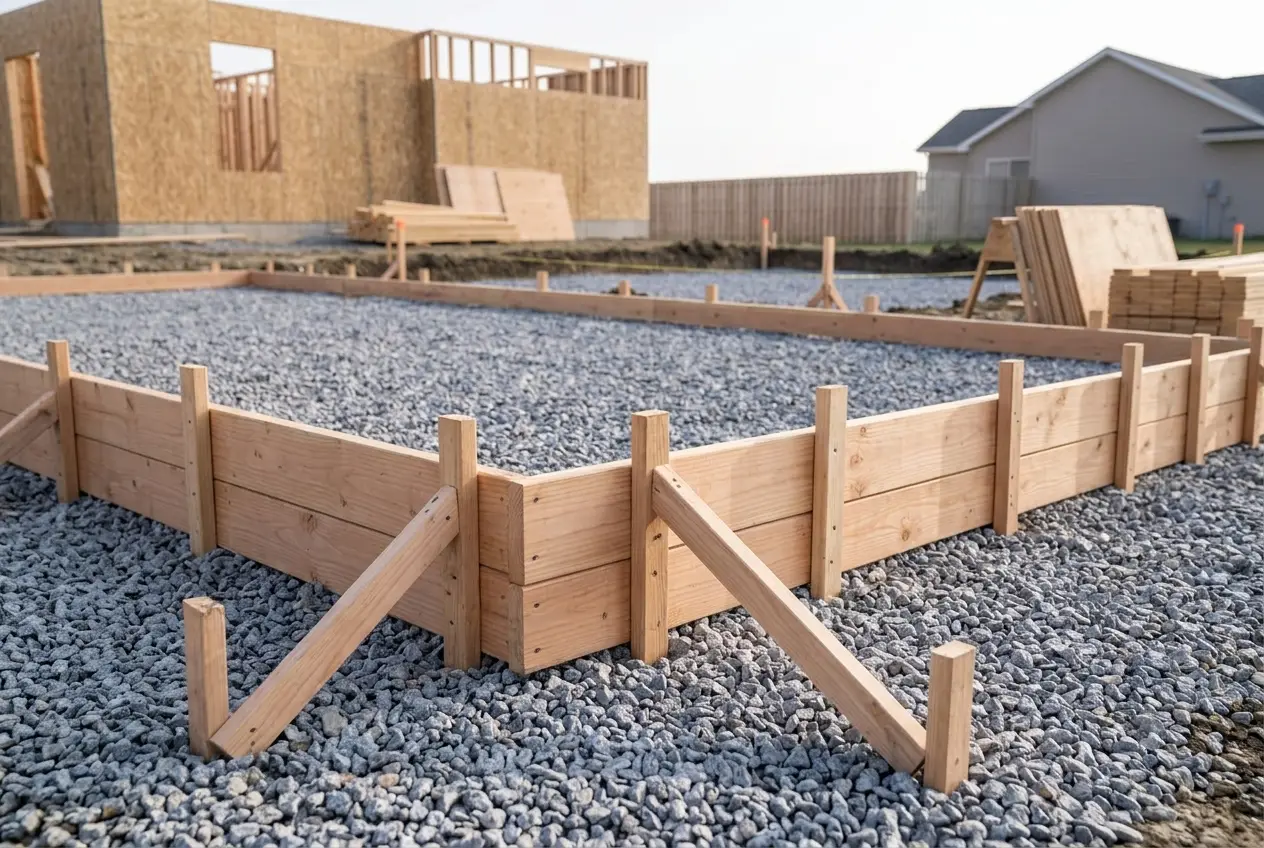
Bags per Cubic Yard and Bags per Cubic Foot
When a job grows past a couple of yards, thinking in bags fades and thinking in cubic yards takes over — but the two are directly linked. One cubic yard is 27 cubic feet, so the bags needed to make a yard are simply 27 divided by the yield of one bag. The counts land on whole numbers for the standard mixes, which is a handy coincidence worth remembering: 45 eighty-pound bags, 60 sixty-pound bags, 72 fifty-pound bags, 90 forty-pound bags, or 40 ninety-pound bags each equal one cubic yard.
Those counts are theoretical. They produce exactly one yard of concrete with nothing left over for the shovel, the wheelbarrow, or the low corner of an uneven subgrade, so the bags you actually have on hand should include a waste allowance. Add 5 to 10 percent and a yard of 80 lb bags becomes roughly 48 to 50 bags. For scale, one cubic yard of concrete weighs about 4,000 pounds in place, and the dry mix that makes it weighs about 3,600 pounds no matter which bag size you use — smaller bags do not reduce the material, they only split it into more lifts.
How to Calculate Concrete Coverage
Converting a bag yield into square feet takes one line of arithmetic. Because thickness is measured in inches and yield in cubic feet, the 12 in the formula converts the inches to feet:
Coverage (sq ft) = 12 × Yield (cu ft) ÷ Thickness (in)
The same relationship can be written as coverage equals yield divided by thickness in feet. Both forms say the same thing: a fixed volume spread over a chosen depth covers that much surface.
Worked Calculation
An 80 lb bag yields about 0.60 cubic feet. Placed at 4 inches thick: 12 × 0.60 ÷ 4 = 7.2 ÷ 4 = 1.8 square feet. That is the figure in the chart for an 80 lb bag at 4 inches, and it is the number most often needed, because 4 inches is the standard residential slab depth. Change only the thickness and the answer changes with it — at 6 inches the same bag covers 12 × 0.60 ÷ 6 = 1.2 square feet.
How Many Bags of Concrete Do You Need?
The coverage formula runs in reverse just as easily, and this is the direction most projects actually use: start from the slab and arrive at bags. First find the volume, then divide by the bag yield, then round up.
Volume (cu ft) = Length (ft) × Width (ft) × Thickness (in) ÷ 12 → Bags = Volume ÷ Yield per bag (round up)
A 10 foot by 10 foot slab at 4 inches thick is 100 square feet. Its volume is 100 × 4 ÷ 12 = 33.3 cubic feet. Using 80 lb bags at 0.60 cubic feet each, that is 33.3 ÷ 0.60 = 55.6, rounded up to 56 bags before any waste allowance. The same slab in 60 lb bags at 0.45 cubic feet takes 33.3 ÷ 0.45 = 74, rounded to 74 bags. Always round up, because a partial bag cannot be applied.
| Slab Area | 3 in Thick | 4 in Thick | 5 in Thick | 6 in Thick |
|---|---|---|---|---|
| 10 sq ft | 5 bags | 6 bags | 7 bags | 9 bags |
| 25 sq ft | 11 bags | 14 bags | 18 bags | 21 bags |
| 50 sq ft | 21 bags | 28 bags | 35 bags | 42 bags |
| 100 sq ft | 42 bags | 56 bags | 70 bags | 84 bags |
| 200 sq ft | 84 bags | 112 bags | 139 bags | 167 bags |
Bags of 80 lb concrete (0.60 cubic foot yield), rounded up to whole bags, without a waste allowance. For other bag sizes, divide the same volume by the yield of the bag you are using.
Standard, High-Yield, and Fast-Setting Mixes
Bag weight tells you how much the sack weighs, not how much concrete it makes, and that distinction is where coverage surprises come from. Standard general-purpose mixes run at about 0.0075 cubic feet per pound of dry material. High-yield, lightweight formulations use low-density aggregate so the same weight of bag makes noticeably more finished concrete. Fast-setting mixes, often sold as post-setting concrete in 50 lb bags, follow their own published yields. The only reliable figure is the amount printed on the specific bag you are holding.
The practical effect is that two bags of the same weight can cover very different areas. An 80 lb standard mix covers about 1.8 square feet at 4 inches, while an 80 lb high-yield mix yielding close to 0.92 cubic feet covers closer to 2.75 square feet at the same depth — nearly 40 percent more area from a sack that weighs the same. When a job is large, that difference is worth a few minutes of reading the label.
| Mix Type | Typical 80 lb Yield | Effect on Coverage |
|---|---|---|
| Standard concrete mix | About 0.60 cu ft | Baseline coverage in the charts on this page |
| High-yield / lightweight | About 0.92 to 1.0 cu ft | Substantially more area per bag; fewer bags per yard |
| Fast-setting post mix | Product-specific (often 50 lb bags) | Check the label; volume is set for post setting |
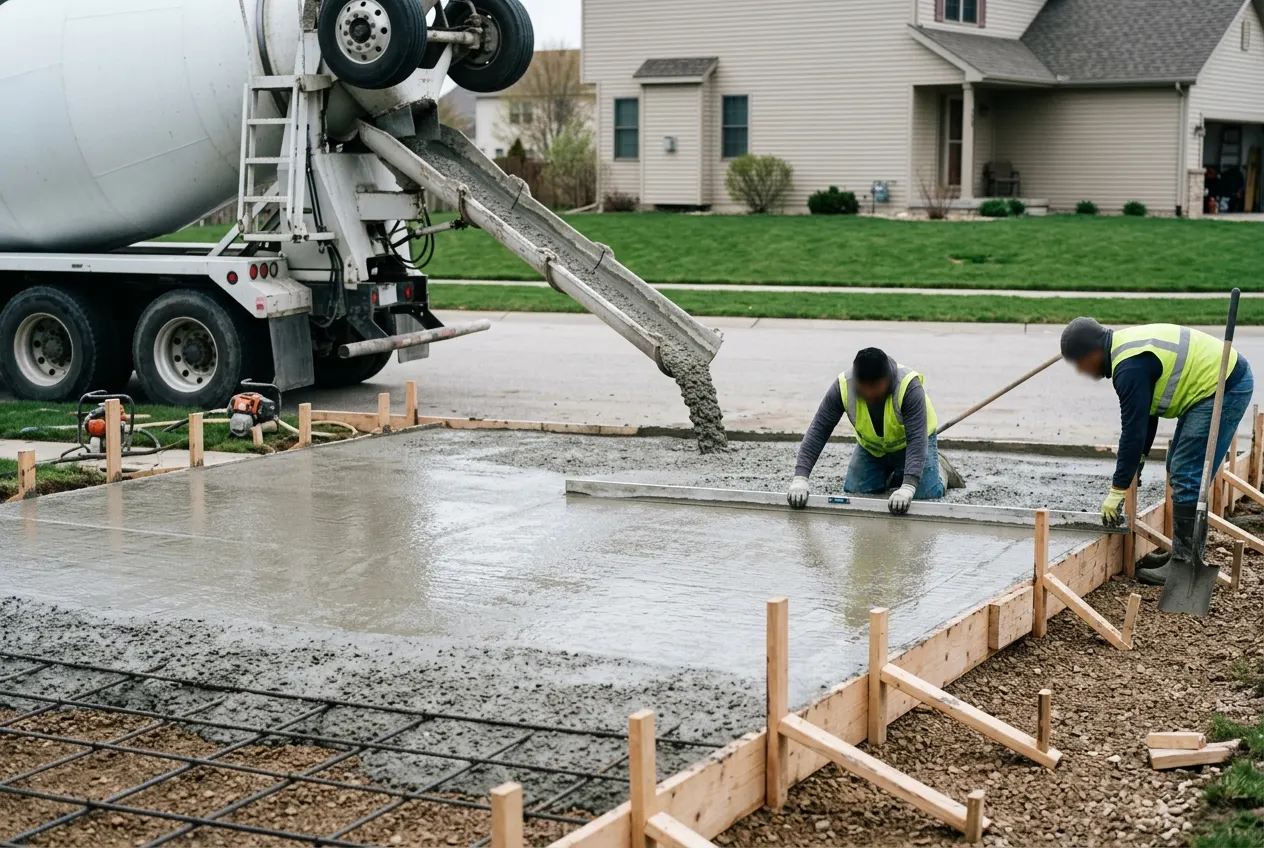
Coverage by Project Type
Different jobs default to different thicknesses, and that is really what changes the bag count. Slabs, patios, and shed pads are poured at 4 inches; walkways and sidewalks usually 4 inches as well; driveways 4 to 6 inches depending on the vehicles; garage floors 6 inches; footings and pads deepen from there. Post holes are the odd one out — they are calculated by volume, because the post itself displaces part of the hole.
- Patios and sheds: 4 inch slab. A 12 by 12 foot patio is 144 square feet, which at 4 inches needs about 48 cubic feet — roughly 80 bags of 80 lb before waste.
- Walkways and sidewalks: 3 to 4 inch slab. A 10 by 3 foot walk at 4 inches is 30 square feet and about 17 bags of 80 lb.
- Driveways: 4 to 6 inches. A single-car driveway quickly passes the point where ready-mix beats bags on both time and cost.
- Post holes: volume-based. Setting a 3 inch post in a 9 inch diameter hole 30 inches deep typically takes about two 50 lb bags of fast-setting mix; the post displaces part of the hole, so square-foot coverage does not apply.
Where the bag count climbs into the dozens, compare it against a ready-mix delivery before committing. Ready-mix is generally cheaper per cubic yard than any bagged product, but it carries a minimum load and a short-load fee that only make sense once the pour is large enough — often around a half yard to a yard and up.
Waste Allowance and Why Coverage Varies
Every coverage and bag-count figure on this page is theoretical, and real jobs consume a little more. The standard remedy is a waste allowance of 5 to 10 percent added on top of the calculated count, and many crews simply use 10 percent for bag work. The allowance absorbs the ordinary losses that a clean calculation cannot see: a subgrade that is not perfectly flat and consumes extra volume, small gaps in the forms, slight variation in poured thickness across the slab, material spilled while mixing and carrying, and the rounding that comes with measuring by hand.
The allowance is an estimating practice, not a manufacturer specification or a code requirement, so it can be tuned to the job. A well-prepared, flat subgrade and level forms justify the low end; a rough excavated footing or an irregular patch justifies the high end. Running a bag or two long is almost always cheaper than running short — a pour that stops partway sets a cold joint, and the second batch rarely matches the first.
Common Coverage Mistakes
- Quoting coverage without a thickness. A bag has no fixed square footage. "An 80 lb bag covers 1.8 square feet" is only true at 4 inches.
- Confusing square feet with cubic feet. Area is not volume. Thickness has to enter the calculation before the two can be compared.
- Forgetting to convert inches to feet. The 12 in the coverage formula does that; skip it and the answer is out by a factor of twelve.
- Assuming every 80 lb bag yields 0.60 cubic feet. High-yield, fast-setting, and specialty mixes differ, sometimes by a lot.
- Treating bag weight as volume. Pounds of dry mix and cubic feet of finished concrete are different measurements.
- Not rounding bags up. Partial bags cannot be applied, and a 55.6-bag answer means buying 56.
- Skipping the waste allowance. Real conditions consume more than the clean calculation, and a short pour leaves a cold joint.
- Mixing up bag coverage with rebar cover. "Concrete cover" in the structural sense is the clearance over reinforcing steel — a different subject entirely.
Worked Examples
Three short jobs show the whole method start to finish.
Example 1 — A 10 by 10 Foot Slab at 4 Inches
Area is 10 × 10 = 100 square feet. Volume is 100 × 4 ÷ 12 = 33.3 cubic feet. In 80 lb bags at 0.60 cubic feet each, that is 33.3 ÷ 0.60 = 55.6, rounded up to 56 bags. Adding a 10 percent waste allowance brings the practical count to about 62 bags. This is the size of pour where a crew starts weighing bags against a ready-mix truck.
Example 2 — 60 lb Versus 80 lb Bags for the Same Slab
A 50 square foot pad at 4 inches has a volume of 50 × 4 ÷ 12 = 16.7 cubic feet. In 80 lb bags that is 16.7 ÷ 0.60 = 27.8, rounded to 28 bags. In 60 lb bags it is 16.7 ÷ 0.45 = 37.1, rounded to 38 bags. The 60 lb bags are easier to lift, but they mean ten more bags to carry, open, and mix for exactly the same slab.
Example 3 — Standard Versus High-Yield Mix
An 80 square foot slab at 4 inches has a volume of 80 × 4 ÷ 12 = 26.7 cubic feet. In standard 80 lb mix at 0.60 cubic feet, that is 26.7 ÷ 0.60 = 44.5, rounded to 45 bags. In a high-yield 80 lb mix yielding about 0.92 cubic feet, it is 26.7 ÷ 0.92 = 29, rounded to 29 bags. Same slab, same number of pounds lifted per bag, sixteen fewer bags — which is why reading the yield on the label is worth the minute it takes.
Frequently Asked Questions
A bag of concrete has no single coverage number on its own, because coverage depends on how thick the pour is. Every bag yields a fixed volume of mixed concrete, and that volume spreads over less area as the slab gets thicker. A standard 80 lb bag yields about 0.60 cubic feet and covers roughly 1.8 square feet at 4 inches thick, 2.4 square feet at 3 inches, or 1.2 square feet at 6 inches. A 60 lb bag yields about 0.45 cubic feet and covers about 1.35 square feet at 4 inches, and a 40 lb bag yields about 0.30 cubic feet and covers about 0.9 square feet at the same 4 inch depth. Coverage is always quoted together with a thickness.
A standard 80 lb bag of concrete mix yields about 0.60 cubic feet of finished concrete and covers approximately 3.6 square feet at 2 inches thick, 2.4 square feet at 3 inches, 1.8 square feet at 4 inches, 1.44 square feet at 5 inches, and 1.2 square feet at 6 inches. The formula is coverage in square feet equals 12 times the bag yield in cubic feet divided by the thickness in inches, so for an 80 lb bag at 4 inches: 12 times 0.60 divided by 4 equals 1.8 square feet. The same bag covers more area the thinner you pour it and less area the thicker you pour it.
A standard 60 lb bag of concrete mix yields about 0.45 cubic feet of finished concrete. At 4 inches thick it covers about 1.35 square feet, at 2 inches about 2.7 square feet, at 3 inches about 1.8 square feet, and at 6 inches about 0.9 square feet. Roughly 60 of these bags make one cubic yard of concrete. A 50 lb bag, which many suppliers also stock, yields about 0.375 cubic feet and covers about 1.13 square feet at 4 inches, while a 40 lb bag yields about 0.30 cubic feet and covers about 0.9 square feet at the same depth.
There are about 45 eighty-pound bags of concrete in one cubic yard. A cubic yard is 27 cubic feet, and one 80 lb bag yields about 0.60 cubic feet, so 27 divided by 0.60 equals 45 bags. The other common sizes divide out the same way: about 40 bags of 90 lb, 60 bags of 60 lb, 72 bags of 50 lb, and 90 bags of 40 lb all make one cubic yard. Because those counts are theoretical, add a waste allowance of about 5 to 10 percent before buying, which turns a cubic yard of 80 lb bags into roughly 48 to 50 bags to actually have on hand.
A standard 80 lb bag of concrete mix yields about 0.60 cubic feet of mixed, finished concrete, which is roughly 0.022 cubic yards. Standard bagged concrete yields about 0.0075 cubic feet per pound of dry mix, so multiplying the bag weight by 0.0075 gives the yield: 40 lb gives 0.30 cubic feet, 50 lb gives 0.375, 60 lb gives 0.45, 80 lb gives 0.60, and 90 lb gives about 0.675. High-yield or lightweight formulations can differ substantially at the same bag weight, so the yield printed on the bag you are holding always takes priority.
A bag covers twice as much area at 2 inches as it does at 4 inches, because the same fixed volume is spread half as deep. An 80 lb bag covers about 3.6 square feet at 2 inches but only about 1.8 square feet at 4 inches. Coverage and thickness move in opposite directions: for a fixed bag yield, halving the thickness doubles the square footage, and doubling the thickness halves it. That is why a coverage figure is meaningless unless the thickness travels with it.
No. Bag weight tells you what the sack weighs, not what volume of concrete it makes. Standard concrete mix yields about 0.60 cubic feet from an 80 lb bag, but high-yield lightweight formulations can yield close to 0.9 or even 1 cubic foot from the same 80 lb bag, because their lightweight aggregate produces more finished volume per pound. Fast-setting and specialty repair mixes carry their own published yields as well. Two 80 lb bags from different product lines can therefore cover noticeably different areas at the same thickness, so always read the yield printed on the specific bag rather than assuming every 80 lb sack behaves the same.
A common estimating practice is to add a waste allowance of 5 to 10 percent on top of the calculated bag count, and many crews simply use 10 percent for small bag-based work. The allowance covers uneven or over-excavated subgrade, gaps in the forms, thickness variation across a pour, mixing and placement spillage, and the small quantity errors that come with measuring by hand. The allowance is an estimating habit rather than a manufacturer specification or a code requirement, so you can adjust it to the conditions of the job. It is generally better to finish with a spare bag or two than to run short partway through a pour, because stopping mid-slab leaves a cold joint.
References
- ASTM International, ASTM C387/C387M: Standard Specification for Packaged, Dry, Combined Materials for Concrete and High Strength Mortar, astm.org — the standard governing packaged, dry concrete mixes sold in bags, including the basis for the published yields of 40, 50, 60, 80, and 90 lb products.
- ASTM International, ASTM C94/C94M: Standard Specification for Ready-Mixed Concrete, astm.org — the cubic-yard basis on which ready-mix concrete is batched, ordered, and delivered, and the tolerance conventions that accompany it.
- American Concrete Institute, ACI 302.1R: Guide to Concrete Floor and Slab Construction, concrete.org — recommended slab thicknesses for residential and commercial flatwork and the placement and finishing practices that accompany them.
- National Ready Mixed Concrete Association, CIP 3: Estimating Concrete, nrmca.org — guidance on estimating concrete quantities and the overage or waste allowance commonly added to the calculated volume.
- Portland Cement Association, Cement and Concrete Basics and Concrete Slab Thickness, cement.org — how concrete volume, density, and slab thickness relate, and typical unit weight of normalweight concrete.
- ASTM International, ASTM C138/C138M: Standard Test Method for Density (Unit Weight), Yield, and Air Content of Concrete, astm.org — the definition of concrete yield and the method used to measure the volume a given mass of concrete actually produces.
- American Concrete Institute, ACI 211.1: Standard Practice for Selecting Proportions for Normal, Heavyweight, and Mass Concrete, concrete.org — how the cement, sand, aggregate, and water proportions affect the density and yield of a concrete mixture.
Disclaimer: This guide compiles concrete bag coverage and yield reference figures for general educational planning — the cubic feet per bag of concrete for 40, 60, 80, and 90 lb bags, concrete bag coverage by thickness, how many 80 lb bags are in a cubic yard, and the coverage formula behind each table. It is an estimating reference, not an engineering or structural design, and it does not account for the specific mix proportion, aggregate, moisture, or field conditions of your project. Published yields are approximate and vary by product, so always read the bag you actually buy, add a waste allowance, and confirm thickness and slab design against your local building code and, where structural work is involved, a licensed engineer.