
ON THIS PAGE:
Roofing Coverage at a Glance
One roofing square equals 100 square feet of finished roof area. The standard package count is three bundles per square for 3-tab and architectural asphalt shingles, which works out to roughly 33.3 square feet per bundle. Heavyweight designer lines drop to four bundles per square at 25 square feet each, premium designer lines take five bundles at 20 square feet, and a handful of extra-heavy products take six. Because roofs are measured on the slope, the pitch multiplier turns a building footprint into roof area before the square count is calculated — a 2,000 square foot footprint at 6:12 is 2,236 square feet of roof, not 2,000. Add 10 to 20 percent for waste depending on hips, valleys, and dormers, then round up to whole bundles. Starter strip, ridge cap, underlayment, drip edge, and nails are separate items and are not inside the field-shingle count.
| Question | Short answer |
|---|---|
| Bundles per square (most shingles) | 3 |
| Square feet in one square | 100 |
| Square feet per standard bundle | About 33.3 |
| Bundles in 20 squares | 60 before waste, 66 with 10 percent |
| Squares in a 2,000 ft² roof surface | 20 |
| Shingles per square (architectural) | About 64 |
| Metric equivalent of one square | 9.2903 m² |
What a Roofing Square Is — and Why It Is Not a Bundle
A roofing square is a unit of area equal to 100 square feet. Picture a 10-foot by 10-foot square laid flat on the roof: that is one square. In metric terms one square is 9.2903 square meters. The unit exists because roof coverings are sold by the square rather than by the individual piece, and because a roofer can look at a plane and estimate squares far faster than they can count bundles. A square is always 100 square feet regardless of the product on top of it, the slope of the roof, or the region of the country.
A bundle is packaging. It is the wrapped unit the manufacturer ships, and the number of bundles required to cover one square depends on how much product the manufacturer puts in the bundle and how much exposure the shingle yields after overlapping. For most standard products the two numbers happen to line up at three bundles per square, which is why the phrase “three bundles to a square” is repeated so often that it sounds like a definition. It is a coincidence of packaging, not a rule of geometry.
Squares and Square Feet, Side by Side
| Squares | Square feet | Bundles at 3 per square | Approximate roof footprint at 6:12 |
|---|---|---|---|
| 1 | 100 | 3 | 89 ft² |
| 5 | 500 | 15 | 447 ft² |
| 10 | 1,000 | 30 | 894 ft² |
| 20 | 2,000 | 60 | 1,789 ft² |
| 30 | 3,000 | 90 | 2,683 ft² |
| 50 | 5,000 | 150 | 4,472 ft² |
The last column is the reverse of the pitch conversion: divide roof area by the 6:12 multiplier of 1.118 to see how large a footprint would produce that many squares. It is there to catch the most common estimating error in residential roofing — treating the footprint, or worse the finished living area, as if it were the roof surface.
Why 100 Square Feet of Shingles Is Not 100 Square Feet of Roof
Shingles lap over one another. The exposed face of a shingle is shorter than the piece itself, and each course covers the top portion of the course below. That overlap is what sheds water, and it also means the flat area of material in a bundle is always larger than the finished area it covers. Three bundles described as one square do not contain exactly 100 square feet of shingle; they contain enough overlapping pieces to cover about 100 square feet of roof. Manufacturers publish the covered area, not the flat material area, and that published figure is the only number worth using.
How Many Bundles of Shingles in a Square?
For standard 3-tab and architectural shingles the answer is three bundles per square. The packaging convention is old and nearly universal: a bundle covering about one-third of a square, three bundles to the square, and a pallet holding enough bundles to cover a conveniently round number of squares. The exceptions follow weight and thickness. As shingles get heavier and the exposure gets shorter, each bundle covers less area, so more bundles are needed to finish a square.
| Shingle class | Bundles per square | Coverage per bundle | Shingles per bundle | Bundle weight |
|---|---|---|---|---|
| Standard 3-tab | 3 | About 33.3 ft² | 26–29 | 50–70 lb |
| Architectural / laminated | 3 | About 33.3 ft² | 20–22 | 65–80 lb |
| Heavyweight designer | 4 | 25 ft² | 16–20 | 75–90 lb |
| Premium designer | 5 | 20 ft² | 10–18 | 80–100 lb |
| Extra-heavy specialty | 6 | About 16.7 ft² | About 15 | 90–110 lb |
The ranges matter less than the wrapper. Two architectural shingles that both call themselves “architectural” can differ by half a square across a 30-square roof, and the difference is printed in the coverage statement on every bundle. The class table is a planning shortcut; the product table below is what a real takeoff should use.
Published Coverage by Product
| Product | Type | Bundles per square | Coverage per bundle | Shingles per square |
|---|---|---|---|---|
| GAF Timberline HDZ | Architectural | 3 | 32.8 ft² (98.4 per 3) | 64 |
| Owens Corning TruDefinition Duration | Architectural | 3 | 32.8 ft² (98.4 per 3) | 64 |
| CertainTeed Landmark | Architectural | 3 | 33.3 ft² (99.9 per 3) | 66 |
| IKO Cambridge | Architectural | 3 | 33.3 ft² (100 per 3) | 60 |
| IKO Marathon Plus AR | Architectural | 3 plus 2 shingles | 32.3 ft² (96.9 per 3) | — |
| GAF Royal Sovereign | 3-tab | 3 | 32.9 ft² (98.75 per 3) | 79 |
| CertainTeed Slateline | Designer | 3 | 33.3 ft² (100 per 3) | 48 |
| GAF Camelot II | Heavyweight designer | 4 | 25 ft² | 56 |
| IKO Crowne Slate | Heavyweight designer | 4 | 25 ft² | — |
| GAF Grand Sequoia | Premium designer | 5 | 20 ft² | — |
| IKO Armourshake | Premium designer | 5 | 20 ft² | — |
| Owens Corning Woodcrest | Extra-heavy specialty | 6 | About 16.7 ft² | 90 |
How Many Square Feet Does a Bundle of Shingles Cover?
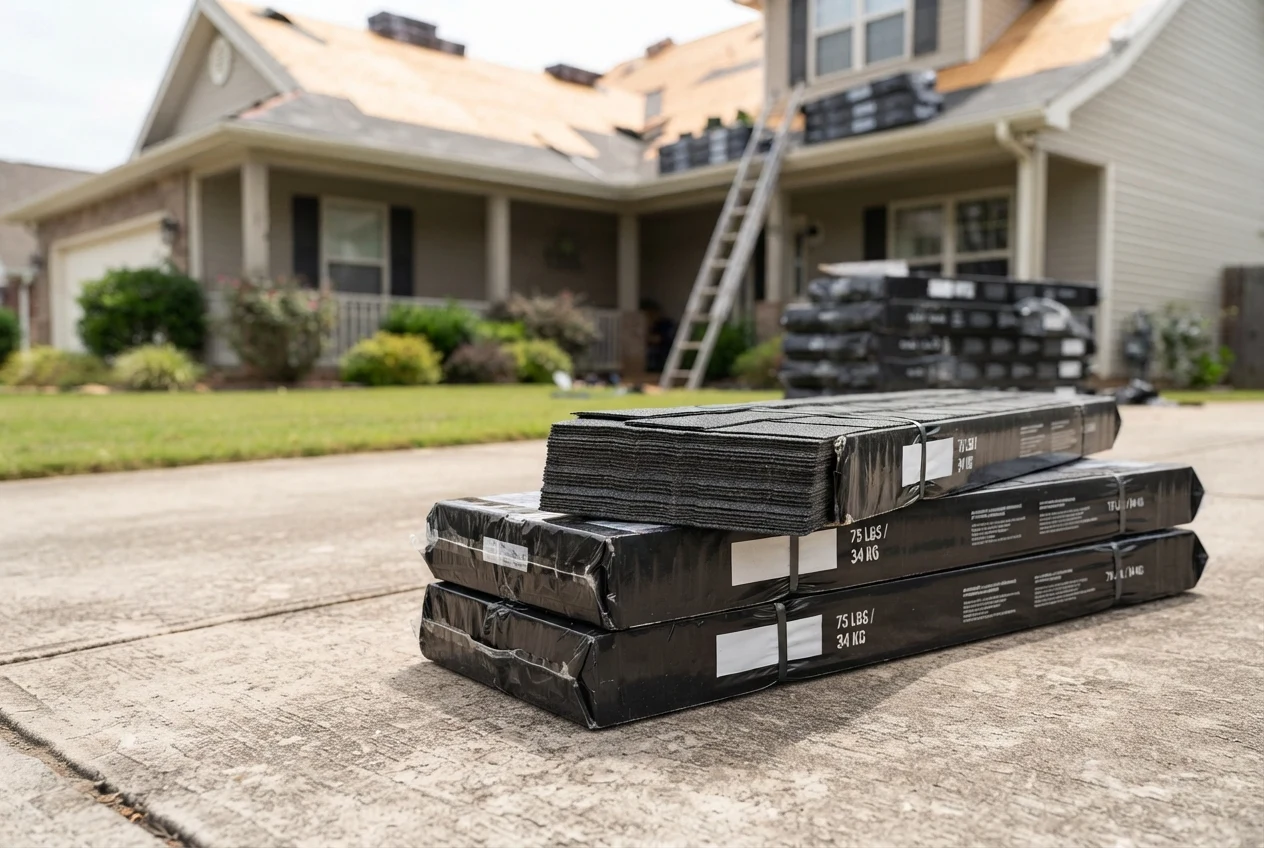
A standard bundle covers about 33.3 square feet of finished roof. That is the number behind the three-bundles-per-square convention, and it is accurate enough for a planning estimate. For an actual takeoff, use the coverage statement on the wrapper: published figures for mainstream architectural lines run from 32.3 to 33.3 square feet per bundle, and the difference is worth roughly one bundle on a 30-square roof. Designer lines cover 25 square feet per bundle at four bundles per square, or 20 square feet at five bundles per square.
The Three-Bundle Shortfall
Three bundles at 32.8 square feet each contain 98.4 square feet of covered area, not 100. On a single square that shortfall disappears into waste and rounding. On a large roof it compounds. Thirty squares at three bundles each is 90 bundles; at 98.4 square feet per three bundles that is 2,952 square feet, which is 48 square feet — nearly half a square — short of 3,000. Add the normal 10 percent waste and the same 30-square roof needs about 3,300 square feet of coverage, which is 101 bundles at 32.8 square feet per bundle rather than the 99 that the nominal three-per-square math predicts. The extra two bundles are not padding; they are the difference between the published coverage and the shorthand.
Coverage Conversions Worth Memorizing
| If you know… | Multiply or divide by | To get… |
|---|---|---|
| Roof area in square feet | Divide by 100 | Squares |
| Squares | Multiply by 100 | Roof area in square feet |
| Squares | Multiply by 3 | Bundles (standard shingles) |
| Bundles | Divide by 3 | Squares (standard shingles) |
| Roof area in square feet | Divide by 33.3 | Bundles (standard shingles) |
| Roof area in square meters | Divide by 9.2903 | Squares |
These conversions assume standard three-bundle shingles. For a four-bundle product divide squares by four, for a five-bundle product divide by five, and for a six-bundle product divide by six. Using the standard conversion on a designer roof under-buys badly: a 30-square roof that needs 150 bundles of a five-bundle product would be estimated at 90 bundles by the three-per-square shortcut, a shortfall of 60 bundles.
From Roof Area to Squares to Bundles: The Formula
Every accurate shingle takeoff follows the same chain, and the order of operations matters as much as the numbers. Measure area first, convert footprint to sloped area second, add waste third, convert to squares fourth, and round to whole bundles last. Skipping a step or applying one twice is how a roof ends up short by a pallet or over by several hundred dollars.
The Chain
Roof area = Building footprint × Pitch multiplier
Squares = Roof area ÷ 100
Bundles = ⌈ Squares × (1 + waste) × Bundles per square ⌉
The pitch multiplier is the only step that converts a horizontal measurement into a sloped one. If you measured the roof planes directly along the slope, skip it — the area is already sloped. The ceiling brackets mean round up to the next whole bundle, applied once at the end. Waste is expressed as a decimal: 10 percent is 0.10, 15 percent is 0.15.
A Footprint Example
A house with a 50-foot by 40-foot rectangular footprint has 2,000 square feet under roof. At 6:12 pitch the multiplier is 1.118, so the sloped area is 2,000 × 1.118 = 2,236 square feet. Divided by 100, that is 22.36 squares. With 10 percent waste the quantity becomes 24.6 squares, which rounds up to 25 squares. At three bundles per square the roof needs 75 bundles. Notice that the rounding happened once, at the end: rounding 22.36 to 23 first and then adding waste would have produced 76 bundles, and rounding bundles before applying waste would have produced a different error again.
Why Pitch and Waste Are Not Interchangeable
Pitch adds real surface that must be covered. Waste covers cutting loss on that surface. They are separate multipliers and they compound: a 6:12 roof with 15 percent waste needs 2,000 × 1.118 × 1.15 = 2,571 square feet of shingles, not 2,300. Applying pitch as though it were waste, or adding waste to a footprint and then forgetting pitch, is the most common arithmetic error in DIY roofing estimates. Keep them as two distinct lines in the calculation and the result stays honest.
Measuring the Roof Before You Convert to Bundles
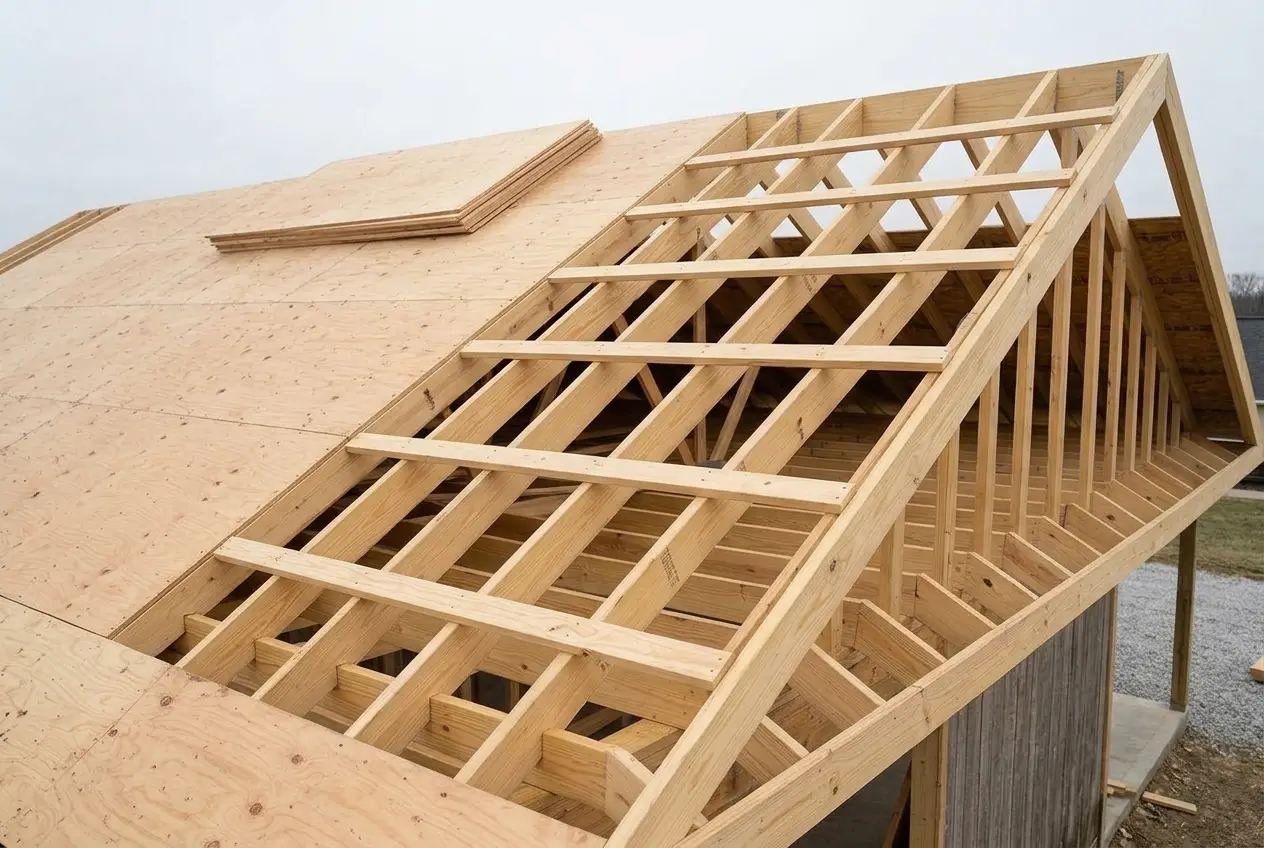
The square count is only as good as the area measurement behind it. Measure each roof plane as a rectangle — length along the eave times width along the rake — and add the planes together. A simple gable has two planes; a hip roof has four; a cross-gable has six or more; dormers and porches add their own planes. Measure to the outer edge of the fascia, because the shingles run past the wall line to the drip edge, and that overhang is part of the roof area even though it is not part of the house.
Footprint Is Not Surface Area
The footprint is the horizontal projection of the roof — what you would see looking straight down. The surface area is larger because the roof rises as it runs. On a low-slope 2:12 roof the difference is only 1.4 percent, small enough to ignore on a shed. On a 12:12 roof the surface is 41 percent larger than the footprint, and ignoring that difference under-buys by nearly a third of the roof. Finished living area is a third number entirely: it excludes garage, porch, and attic space and includes only conditioned floor area, so it is never a valid stand-in for either footprint or roof surface.
Finding the Pitch
Pitch is rise over run expressed in inches per foot: a 6:12 roof rises 6 inches for every 12 inches of horizontal run. To measure it, hold a level horizontally against a gable end or rake with one end at the roof surface, mark 12 inches along the level, and measure vertically from that mark down to the roof. The vertical distance in inches is the first number of the ratio. Do this on the gable end or from the attic rather than walking a steep roof; a pitch measurement is not worth a fall.
Working From Plans or From the Ground
If you have plans, use the roof plan for the footprint and the elevation for the pitch, then apply the multiplier once. If you are measuring an existing house, measure the footprint at the foundation or the eave line and add the overhang on all sides, then apply the multiplier. Aerial measurement services do the same geometry from imagery and are usually accurate enough for ordering, but they can miss porch roofs, bay windows, and additions; compare their area against a hand measurement on at least the main rectangle before trusting the bundle count.
Roof Pitch Multiplier Table
The multiplier converts a horizontal footprint to sloped roof area. It comes from the Pythagorean relationship between run and rise: for a pitch of r inches per 12 inches of run, the multiplier is the square root of (r² + 144) divided by 12. A 6:12 roof, for example, has a multiplier of √(36 + 144) ÷ 12 = 1.118. The table rounds to three decimals, which is more precision than a shingle takeoff needs.
| Pitch (rise : 12) | Angle (degrees) | Multiplier | Footprint of 1,000 ft² becomes |
|---|---|---|---|
| 0:12 (flat) | 0.0° | 1.000 | 1,000 ft² |
| 1:12 | 4.8° | 1.003 | 1,003 ft² |
| 2:12 | 9.5° | 1.014 | 1,014 ft² |
| 3:12 | 14.0° | 1.031 | 1,031 ft² |
| 4:12 | 18.4° | 1.054 | 1,054 ft² |
| 5:12 | 22.6° | 1.083 | 1,083 ft² |
| 6:12 | 26.6° | 1.118 | 1,118 ft² |
| 7:12 | 30.3° | 1.158 | 1,158 ft² |
| 8:12 | 33.7° | 1.202 | 1,202 ft² |
| 9:12 | 36.9° | 1.250 | 1,250 ft² |
| 10:12 | 39.8° | 1.302 | 1,302 ft² |
| 11:12 | 42.5° | 1.357 | 1,357 ft² |
| 12:12 | 45.0° | 1.414 | 1,414 ft² |
| 14:12 | 49.4° | 1.537 | 1,537 ft² |
| 16:12 | 53.1° | 1.667 | 1,667 ft² |
| 18:12 | 56.3° | 1.803 | 1,803 ft² |
| 20:12 | 59.0° | 1.944 | 1,944 ft² |
| 24:12 | 63.4° | 2.236 | 2,236 ft² |
Pitch changes the number of squares, never the number of bundles per square. A steep roof is not packed more densely; it simply has more surface to cover. That is why the multiplier is applied before the square count and before waste, and why it never appears again later in the calculation.
Bundles by Roof Size: Quick Reference Chart
This chart converts sloped roof area directly to bundles for standard three-bundle shingles, with waste already included in the second and third columns. Read the row for your measured roof surface. If your product is a four- or five-bundle line, use the multiplier note below the table instead of the bundle columns.
| Roof surface area | Squares | Bundles, no waste | Bundles, 10% waste | Bundles, 15% waste |
|---|---|---|---|---|
| 1,000 ft² | 10 | 30 | 33 | 35 |
| 1,500 ft² | 15 | 45 | 50 | 52 |
| 2,000 ft² | 20 | 60 | 66 | 69 |
| 2,500 ft² | 25 | 75 | 83 | 87 |
| 3,000 ft² | 30 | 90 | 99 | 104 |
| 3,500 ft² | 35 | 105 | 116 | 121 |
| 4,000 ft² | 40 | 120 | 132 | 138 |
| 5,000 ft² | 50 | 150 | 165 | 173 |
For other bundle classes: multiply the squares in the second column by four for heavyweight designer shingles, by five for premium designer shingles, or by six for extra-heavy specialty products, then apply the waste column of your choice. The chart rounds each bundle count up to the next whole bundle, so a row may be one bundle higher than the raw multiplication suggests.
Waste Allowance for Shingles
Waste covers the shingles that are cut and cannot be reused: the half-shingle at a rake, the diagonal cut in a valley, the pieces trimmed around a chimney, and the starter courses that get cut at the hip. The percentage depends on how many cuts the roof geometry forces, not on the size of the roof. A large simple gable wastes proportionally less than a small complex roof because most of its courses run full length.
| Roof geometry | Waste allowance | Typical features |
|---|---|---|
| Simple gable or shed | 10% | Two planes, straight eaves and rakes, no valleys |
| Hip roof | 12–15% | Four planes, four hips, diagonal cuts at every hip |
| Gable with one or two valleys | 12–15% | Cross-gable, L-shaped plan, valley cuts on both sides |
| Complex roof | 15–20% | Multiple dormers, valleys, hips, skylights, and direction changes |
| Tear-off with sheathing repairs | 12%+ | Simple geometry but damaged decking forces extra cuts and patches |
Apply the waste percentage to the field-shingle quantity only. Starter strip, ridge cap, and underlayment are linear-foot or roll items with their own overlap and trim; adding the field waste percentage to them double-counts material. A small trim allowance of 5 to 10 percent on those accessory lengths is reasonable, but it is calculated separately. If a roofing calculator already includes waste, do not add it again at the supplier counter — check the calculator's assumption first.
Keep a Spare Bundle
Roofing is manufactured in color lots, and a bundle bought two years later may not match the original roof exactly. Keeping one unopened bundle from the same lot is cheap insurance for a future repair after a storm or a satellite installation. It is not part of the waste calculation, but it is a common line on a contractor's material list for that reason. Store it flat and dry, and write the lot number on the wrapper.
What the Shingle Bundle Count Does Not Include
A bundle count covers the field shingles and nothing else. Starter strip, hip-and-ridge cap, underlayment, ice-and-water membrane, drip edge, and nails are separate products with separate coverage rates, and a takeoff that stops at bundles will be short at the most inconvenient moment. Count each one by its own unit: linear feet for starter, ridge cap, and drip edge; square feet or rolls for underlayment; pieces for flashing and boots.
| Accessory | Typical coverage | How to count it |
|---|---|---|
| Starter strip | 100–123 linear feet per bundle | Eave length plus rake length |
| Hip-and-ridge cap | 20–36.5 linear feet per bundle | Hip length plus ridge length |
| Synthetic underlayment | 1,000 ft² per roll (10 squares) | Roof area plus 5–10% for overlap |
| No. 15 asphalt felt | About 400 ft² per roll | Roof area plus overlap |
| No. 30 asphalt felt | About 200 ft² per roll | Roof area plus overlap; required on low slopes |
| Ice-and-water membrane | 36-inch by 65-foot roll (about 195 ft²) | Eaves plus valleys plus penetrations |
| Drip edge | 10-foot lengths | Eave length plus rake length |
| Roofing nails | About 2–3 lb per square | Four nails per shingle minimum, six in high wind |
Nails per Square
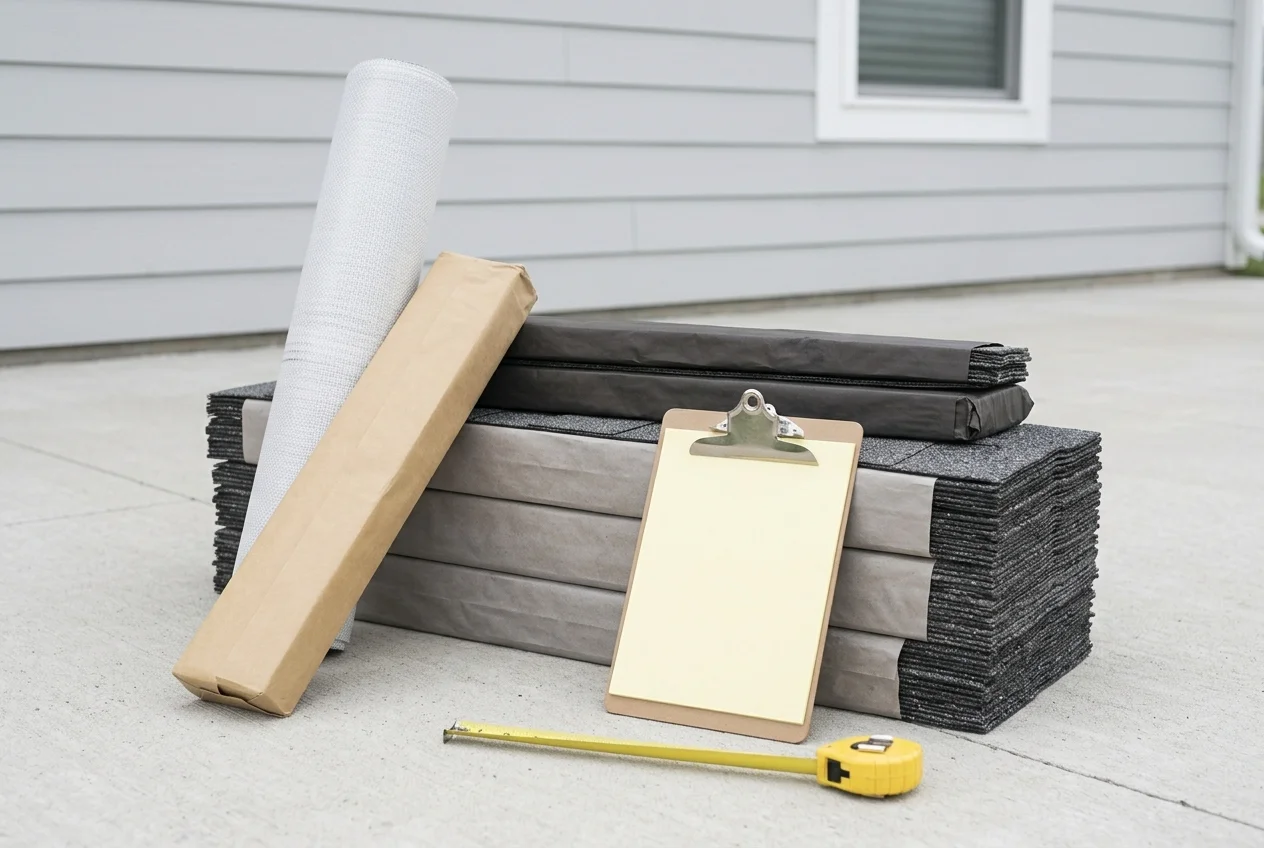
The code minimum for asphalt shingles is four nails per shingle, and many manufacturers require six in high-wind zones or on steeper slopes. A square of architectural shingles at about 64 shingles needs roughly 256 nails with a four-nail pattern and 384 with six; a square of 3-tab at about 79 shingles needs roughly 316 and 474. At about 140 nails per pound, that is roughly 2 pounds per square for architectural shingles with four nails and 3 pounds or a little more with six. Buy nails by the box with a small surplus rather than by the exact count; running out mid-course stops the roof.
Underlayment and Low Slopes
Underlayment coverage depends on the product and the overlap. Synthetic rolls usually cover 10 squares, No. 15 felt about 4 squares, and No. 30 felt about 2 squares. Roofs between 2:12 and 4:12 generally need a double layer of underlayment, which doubles the roll count. Below 2:12, asphalt shingles are outside their intended application and a different roof system is required. Check the code and the shingle manufacturer's installation instructions for the slope on your project rather than assuming a single layer.
3-Tab vs Architectural Shingle Coverage
Both 3-tab and architectural shingles normally sell three bundles to the square, so the bundle count for a given roof is often identical. The differences show up in weight, piece count, and appearance rather than in square footage per bundle. A bundle of 3-tab shingles holds more pieces because each piece is smaller and lighter; a bundle of architectural shingles holds fewer, heavier, laminated pieces with a shorter exposure. Both cover about 33.3 square feet.
| Characteristic | 3-tab | Architectural | Designer / luxury |
|---|---|---|---|
| Bundles per square | 3 | 3 | 4–5 |
| Coverage per bundle | About 33.3 ft² | About 32.8–33.3 ft² | 20–25 ft² |
| Shingles per bundle | 26–29 | 20–22 | 10–20 |
| Shingles per square | About 79 | About 60–66 | Varies by profile |
| Bundle weight | 50–70 lb | 65–80 lb | 75–100+ lb |
| Typical material cost per square | $90–$130 | $120–$200 | $200–$350 |
| Typical service life | 20–25 years | 25–30 years | 30–40 years |

Cost ranges are material-only planning figures for 2026 and vary widely by region, brand, and profile. The estimating point is simpler: switching from 3-tab to architectural usually does not change the bundle count, while switching to a designer line can raise it by 33 to 67 percent. Confirm the bundles-per-square figure before converting a square count into a purchase quantity, and remember that heavier bundles mean more weight on the roof and on the delivery truck.
Pallets, Bundle Weight, and Delivery
Bundles arrive on pallets, and the pallet count matters for delivery, staging, and how much weight the roof structure sees at once. Pallet quantities vary by manufacturer and profile, typically between 36 and 60 bundles. A standard architectural pallet of 56 bundles covers about 18.7 squares at three bundles per square; a designer pallet of 36 bundles at five per square covers only about 7.2 squares. Never assume that two pallets equal the same number of squares across product lines.
| Product line | Bundles per pallet | Approximate squares per pallet |
|---|---|---|
| IKO Cambridge | 56 | 18.7 |
| IKO Dynasty | 56 | 18.7 |
| IKO Nordic | 56 | 18.7 |
| IKO Marathon Plus AR | 56 | 18.7 |
| IKO Crowne Slate | 60 | 15.0 |
| IKO Royal Estate | 52 | 17.3 |
| IKO Armourshake | 36 | 7.2 |
A bundle of 3-tab shingles weighs about 50 to 70 pounds, an architectural bundle 65 to 80, and a designer bundle 75 to 100 or more. A 56-bundle architectural pallet therefore weighs roughly 3,600 to 4,500 pounds. That is fine on a driveway but not fine on a roof in one spot: stage bundles in small piles over bearing walls and spread them out as the crew works. Confirm the pallet quantity and the delivery equipment with the supplier before the truck arrives, especially on a narrow street or a steep driveway where a forklift cannot operate.
Common Mistakes in Shingle Coverage Math
Using the Footprint as the Roof Area
The footprint is horizontal; the roof is sloped. On a 6:12 roof the surface is 11.8 percent larger, and on a 12:12 roof it is 41.4 percent larger. Skipping the pitch multiplier is the single most common reason a DIY order comes up short.
Applying the Pitch Multiplier Twice
If you measured along the slope, the area is already sloped. Multiplying by the pitch factor again inflates the roof by 12 to 41 percent and wastes several bundles. Decide which measurement you have before touching the calculator.
Adding Waste Before Pitch
Waste applies to the sloped area, so pitch comes first. Adding 10 percent to a footprint and then applying the pitch multiplier gives the same arithmetic result as doing it in the other order, but adding waste to the footprint and skipping pitch does not. Keep the chain in the published order to avoid forgetting a step.
Assuming Every Product Takes Three Bundles
Designer shingles take four or five bundles per square, and a few specialty products take six. The three-bundle assumption under-buys those roofs by 25 to 50 percent. Read the wrapper.
Rounding Each Plane Separately
Round once, at the bundle level, after all planes and waste are combined. Rounding each plane up to a whole square before adding them together can add several bundles on a cut-up roof.
Forgetting the Accessories
A bundle count is not a roofing material list. Starter strip, ridge cap, underlayment, drip edge, nails, and flashing are separate purchases. Running out of ridge cap on the last hip is a trip to the supplier that a five-minute count would have prevented.
Mixing Product Lines or Color Lots
Coverage figures and color lots belong to a specific product. Mixing a 32.8 square foot bundle with a 33.3 square foot bundle, or mixing two manufacturing lots, creates both a quantity mismatch and a visible color mismatch. Keep one product and one lot for the field.
Worked Shingle Coverage Examples
Example 1: Simple Gable From a Footprint
A 50-foot by 40-foot footprint, 2,000 square feet, with a 6:12 gable roof and 10 percent waste. Roof area = 2,000 × 1.118 = 2,236 square feet. Squares = 22.36. With waste = 24.6 squares, rounded to 25. Bundles at three per square = 75. Add starter and ridge cap in linear feet rather than bundles: the eaves total 100 feet, the rakes total about 63 feet, and the ridge is 50 feet.
Example 2: Hip Roof With Accessories
A measured hip roof with 2,400 square feet of sloped surface needs 24 squares. With 15 percent waste that becomes 27.6 squares, rounded to 28, which is 84 bundles of standard architectural shingles. Starter strip for 220 linear feet of eaves and rakes needs 2 bundles at about 120 feet per bundle. Ridge cap for 90 linear feet of hips and ridge needs 4 bundles at 25 feet per bundle. Synthetic underlayment for 2,400 square feet plus overlap needs 3 rolls at 1,000 square feet each. Nails at about 64 shingles per square and four per shingle come to roughly 51 pounds, or about 2 to 3 pounds per square.
Example 3: Five-Bundle Designer Shingles
A 3,300 square foot roof surface is 33 squares. With 12 percent waste it becomes 36.96 squares, rounded to 37. At five bundles per square the roof needs 185 bundles. The same roof in standard architectural shingles would need 111 bundles, so the product choice changes the bundle count by 74 — a reminder that bundles per square belongs in the calculation before the purchase quantity is set.
Example 4: The 98.4 Square Foot Shortfall
A 3,000 square foot roof surface at 10 percent waste requires 3,300 square feet of shingle coverage. At a nominal three bundles per square, the shorthand gives 99 bundles. At the published 32.8 square feet per bundle, 99 bundles cover 3,247 square feet, which is 53 square feet short. Dividing 3,300 by 32.8 gives 100.6, which rounds to 101 bundles. The two-bundle difference is exactly the gap between “three bundles to a square” and the coverage statement on the wrapper — small per square, meaningful per roof.
Frequently Asked Questions
Three bundles make one square for the great majority of 3-tab and architectural asphalt shingles sold in North America, because each bundle covers about 33.3 square feet and three bundles cover about 100 square feet. Heavyweight designer lines usually need four bundles per square at 25 square feet each, premium designer lines need five bundles at 20 square feet each, and a few extra-heavy products need six. Always check the coverage printed on the wrapper instead of assuming three, because the same nominal class can vary by half a square over a whole roof.
Yes. A roofing square is a unit of finished roof area equal to 100 square feet, a 10-foot by 10-foot patch, or 9.2903 square meters. It measures the surface being covered, not the flat area of material in the packages. Because shingles overlap, three bundles that contain roughly 98 to 100 square feet of product cover roughly one square of roof. The square never changes with pitch, product type, or region; only the number of squares on a given roof changes.
Most standard 3-tab and architectural bundles cover about 33.3 square feet. Real published figures cluster tightly around that number: 32.8 square feet for Owens Corning Duration, 33.3 for CertainTeed Landmark and most IKO architectural lines, and 32.3 for IKO Marathon Plus AR. Heavyweight designer shingles cover 25 square feet per bundle and premium designer products cover 20. Six-bundle specialty products cover about 16.7. The wrapper coverage is the authority for the product you are holding.
A bundle of 3-tab shingles typically holds 26 to 29 pieces, a bundle of architectural shingles holds 20 to 22, and a bundle of luxury or designer shingles holds 10 to 18. Piece count alone tells you very little about coverage because exposure differs: 3-tab shingles run about 79 pieces per square, while architectural shingles run about 64 per square. Two products with the same bundle count can need different piece counts to cover one square, which is why coverage and bundles per square matter more than shingles per bundle.
Measure each roof plane separately as length times width along the slope, add the plane areas together, and divide the total by 100. If you are working from the building footprint instead of the sloped surface, multiply the footprint by the pitch multiplier for your slope before dividing by 100. A 2,000 square foot footprint at 6:12 becomes 2,236 square feet of roof, or 22.4 squares. Never use finished living area as the footprint, and never apply the pitch multiplier twice.
Add 10 percent for a simple gable or shed roof, 12 to 15 percent for a hip roof or a roof with one or two valleys, and 15 to 20 percent for a complex roof with multiple dormers, valleys, hips, and skylights. Apply the percentage to the measured sloped area or to the square count before converting to bundles, then round up to whole bundles once. Starter strip, ridge cap, and underlayment are separate linear-foot and roll items and carry their own small trim allowance rather than the field-shingle percentage.
If 2,000 square feet is the sloped roof surface, that is 20 squares, which takes 60 bundles of standard 3-bundle shingles before waste and 66 bundles with 10 percent waste. If 2,000 square feet is the building footprint, the roof area is larger: at 6:12 pitch the multiplier is 1.118, giving 2,236 square feet, 22.4 squares, 68 bundles before waste, and 75 bundles with 10 percent waste. Always confirm which area you measured before converting to bundles.
No. Starter strip and hip-and-ridge cap are separate products counted in linear feet, not included in the field-shingle bundle count. Starter strip covers roughly 100 to 123 linear feet per bundle and runs along the eaves and rake edges. Hip-and-ridge cap covers roughly 20 to 36.5 linear feet per bundle depending on the profile and runs along every hip and ridge. Underlayment, drip edge, ice-and-water membrane, and nails are also separate line items with their own coverage rates.
References
- Asphalt Roofing Manufacturers Association, Asphalt Roofing Residential Manual: Design and Application Methods, asphaltroofing.org — definitions of the roofing square, bundle coverage conventions, and residential application guidance for asphalt shingles.
- National Roofing Contractors Association, NRCA Roofing Manual — Steep-slope Roof Systems, nrca.net — steep-slope takeoff practice, waste guidance for hips and valleys, and accessory coverage conventions.
- GAF, Timberline HDZ and Royal Sovereign product data and coverage statements, gaf.com — published bundle coverage, shingles per square, and starter and ridge-cap coverage rates.
- IKO, Roofing shingle product and bundle coverage data, iko.com — coverage per bundle and bundles per pallet for Cambridge, Dynasty, Nordic, Crowne Slate, Royal Estate, Armourshake, and Marathon Plus AR.
- Owens Corning, TruDefinition Duration and Woodcrest product specifications, owenscorning.com — 32.8 square feet per bundle for Duration and six-bundle packing for Woodcrest.
- CertainTeed, Landmark and designer shingle product data, certainteed.com — 33.3 square feet per bundle, shingles per square, and four-bundle designer packing.
- International Code Council, International Residential Code (IRC), Chapter 9 — Roof Assemblies, iccsafe.org — asphalt shingle application requirements, including the four-nail minimum and underlayment provisions by roof slope.
- ASTM International, ASTM D3462 — Standard Specification for Asphalt Shingles Made from Glass Felt and Surfaced with Mineral Granules, astm.org — product specification underlying shingle coverage and labeling.
Disclaimer: This guide compiles roofing coverage reference figures for general educational planning — the 100-square-foot roofing square, bundles per square by shingle class, published bundle coverage, pitch multipliers, waste allowances, accessory takeoffs, and worked examples. It is not a supplier quote, an engineering design, or a substitute for a project-specific takeoff. Published coverage and packaging figures vary by manufacturer, product line, and region, and manufacturers revise them without notice. Verify quantities against the coverage statement on the product you are actually buying, follow the manufacturer's installation instructions and the building code adopted in your jurisdiction, and consult a licensed roofing contractor for structural questions, steep or unusual roofs, and commercial quantities.