
ON THIS PAGE:
What Are Roof Shingle Types?
Roof shingle types are the categories a buyer actually chooses between when a roof is being replaced: within asphalt — the dominant steep-slope covering in North America — the three tiers are 3-tab shingles, architectural shingles, and luxury asphalt shingles, and beyond asphalt sit metal, slate, tile, wood, and composite coverings. Knowing which of these roof shingle types is on the quote matters because the tiers differ in construction, weight, wind rating, impact rating, lifespan, warranty, and price. The same house, same tear-off, and same crew can produce a roof that lasts 15 years or 40 years depending on which bundle was carried up the ladder.
Asphalt shingles account for roughly 80 percent of the steep-slope roofing market, according to industry association figures, so for most re-roof projects the practical decision is a comparison inside the asphalt family rather than a comparison against slate or tile — which is why this guide treats the roof shingle types as first and foremost a comparison among the three asphalt shingle types. The three asphalt tiers share the same basic chemistry — a fiberglass mat saturated with asphalt and surfaced with ceramic granules — but they differ in how much material is laminated onto that mat, how much the finished shingle weighs, how many nails the design expects, and how long the manufacturer will stand behind it.
The roofing shingle types described below run from the simplest and least expensive to the heaviest and most durable. Each tier section covers how the shingle is built, what it weighs, what wind and impact ratings it carries, how long it lasts, and what it costs per square. After the tiers, this guide pulls the numbers into a single comparison table, then works through cost bands, standards (ASTM D3161, ASTM D7158, ASTM D3462, UL 2218), insurance credits, warranties, structural load, bundle and waste math, and a decision framework for picking the right product for a specific house.
One quick vocabulary point before comparing the roof shingle types: a square covers 100 square feet of roof surface, a bundle is the unit that comes off the pallet (standard shingles ship three bundles to a square, about 33.3 square feet per bundle), and exposure is the portion of each shingle left visible after the next course laps over it. Costs in this guide are stated per square, because that is how roofers size a job — and because it keeps the types of roof shingles directly comparable.

How Asphalt Shingles Are Built
Every asphalt shingle starts as a mat, and that shared anatomy is why the main asphalt shingle types can be compared directly against each other: the mat, the asphalt, and the granules are common to all three tiers, while the amount of laminated material on top is what separates them. Modern shingles use a woven or non-woven fiberglass mat (older generations used organic felt), and the mat is what gives the shingle tensile strength and the ability to hold a nail without tearing. The mat is saturated and coated with asphalt — the waterproofing ingredient — then topped with ceramic-coated mineral granules. The granules are not decoration: they block ultraviolet light from degrading the asphalt, provide the color, and add fire resistance. A strip of thermally activated sealant runs along the butt edge of each shingle and bonds the courses together after the sun warms the roof, which is what turns a field of individual pieces into a monolithic water-shedding surface.
The difference between the tiers is mostly a difference in how much of that stack is added after the base sheet. A 3-tab shingle is one flat layer, cut into three tabs. An architectural shingle laminates a second, irregularly cut layer of shingle onto the base mat, which creates the staggered shadow lines that read as depth from the ground. A luxury shingle uses a heavier mat, more asphalt, deeper die-cut contours, and in some products a granule-blended color blend designed to mimic wood shake or slate. Thickness runs from about 3/16 inch for a basic 3-tab up to 1/4 inch or 3/8 inch for architectural products and around 1/2 inch for the heaviest luxury profiles.
Fastening across the roof shingle types is designed around the same layers. Standard nailing is four nails per shingle for 3-tab in most regions (six for high-wind zones), driven just above the cutouts on the nail line; architectural shingles usually carry a four-to-six nail pattern depending on the wind rating being claimed. Nail placement is not cosmetic — a nail driven above the nail line misses both shingle layers, while one driven too low through the exposure line can telegraph and leak. The manufacturer's nailing diagram is part of the warranty, and the wind ratings quoted later in this guide assume the specified pattern on a solid deck.
Underneath the shingles sits the rest of the system: underlayment (felt or synthetic) over the roof sheathing, ice-and-water membrane in the eave zone and at valleys in cold climates, starter strip along the eaves and rakes, drip edge at the perimeter, and ridge cap over the hips and ridges. The shingle type you choose affects only the visible layer — but ridge cap, starter, underlayment quantity, and nail count all scale with the roof, so they belong in any honest cost comparison of roof shingle costs.
3-Tab Shingles
3-tab shingles are the original modern asphalt shingle: a single flat sheet, about 36 inches long, with three cutouts across the butt edge that produce the familiar uniform tab pattern once the courses are offset. They are one layer thick, light, inexpensive, and simple to install. Every course looks identical, which gives a 3-tab roof its clean, horizontal-striped appearance — and also its flatness. From the street a 3-tab roof reads as a single plane with no shadow variation.
On performance, 3-tab shingles carry the lowest ratings in the family. Typical weight is 200 to 250 pounds per square. Wind ratings usually top out at 60 to 70 mph with the standard four-nail pattern, though some premium 3-tab products are tested to 90 or 110 mph with six nails. Lifespan is about 15 to 20 years in a moderate climate — the shortest of the three tiers. Warranties are typically 25 to 30 years, prorated after the first decade, and many builder-grade lines carry shorter non-prorated windows. Material cost runs roughly $90 to $160 per square, which puts an installed 3-tab roof around $300 to $450 per square once tear-off, underlayment, starter, ridge cap, and labor are included — the cheapest of the three roof shingle types at every stage of the takeoff.
Where 3-tab makes sense: tight budgets, simple gable roofs with few penetrations, rental or short-hold properties, shed and outbuilding roofs, and regions without strong wind or hail exposure. It also makes sense as a like-for-like replacement when a budget-conscious owner wants to keep the roof looking exactly as it did. The trade-offs are the short life, the lower wind resistance, and the flat appearance — 3-tab is also the entry point of every roof shingle types comparison on a contractor's quote sheet. One practical note for re-roofs: 3-tab cannot be installed over a second layer of existing shingles in most jurisdictions beyond the limits the code already sets for weight and fastening, and the thinner profile telegraphs deck imperfections more than a laminated shingle does.
Architectural Shingles
Architectural shingles — also sold as dimensional or laminate shingles — are the most common of the roof shingle types, and they take the same base sheet and glue a second, irregularly cut layer onto it. That lamination is the whole trick: the staggered upper layer creates shadow lines, a varied tab silhouette, and a roof that has visible texture from the driveway. Architectural shingles are the most-installed roof shingle type in the United States today, occupying the middle band of the 3-tab vs architectural shingles debate and winning it on most houses.
The second layer adds real performance along with the looks. Weight climbs to 250 to 400 pounds per square — a structural consideration covered later in this guide. Wind ratings jump to 110 to 130 mph for common product lines, with a few reaching higher under enhanced nailing. Lifespan is about 20 to 30 years, roughly a decade past 3-tab in the same climate. Thickness sits around 1/4 to 3/8 inch, which also helps the shingle bridge minor deck irregularities instead of showing them. Material cost runs about $150 to $350 per square; installed, an architectural roof lands around $450 to $700 per square nationally, depending on tear-off layers, pitch, region, and access.
The cost of architectural shingles relative to 3-tab is usually a few hundred to perhaps $1,500 more on a typical residential roof — a difference worth sizing against the roof's total area before deciding — a delta that most appraisers, insurers, and buyers treat as recovered in curb appeal and resale positioning. Most architectural lines carry 30-year to limited-lifetime warranties (prorated), and many are available in the impact-resistant Class 4 versions discussed under insurance. For a homeowner asking which roof shingle type to choose, architectural is the default recommendation unless the budget genuinely forces the lower tier or the design specifically calls for the deeper profile of a luxury product.
Luxury Asphalt Shingles
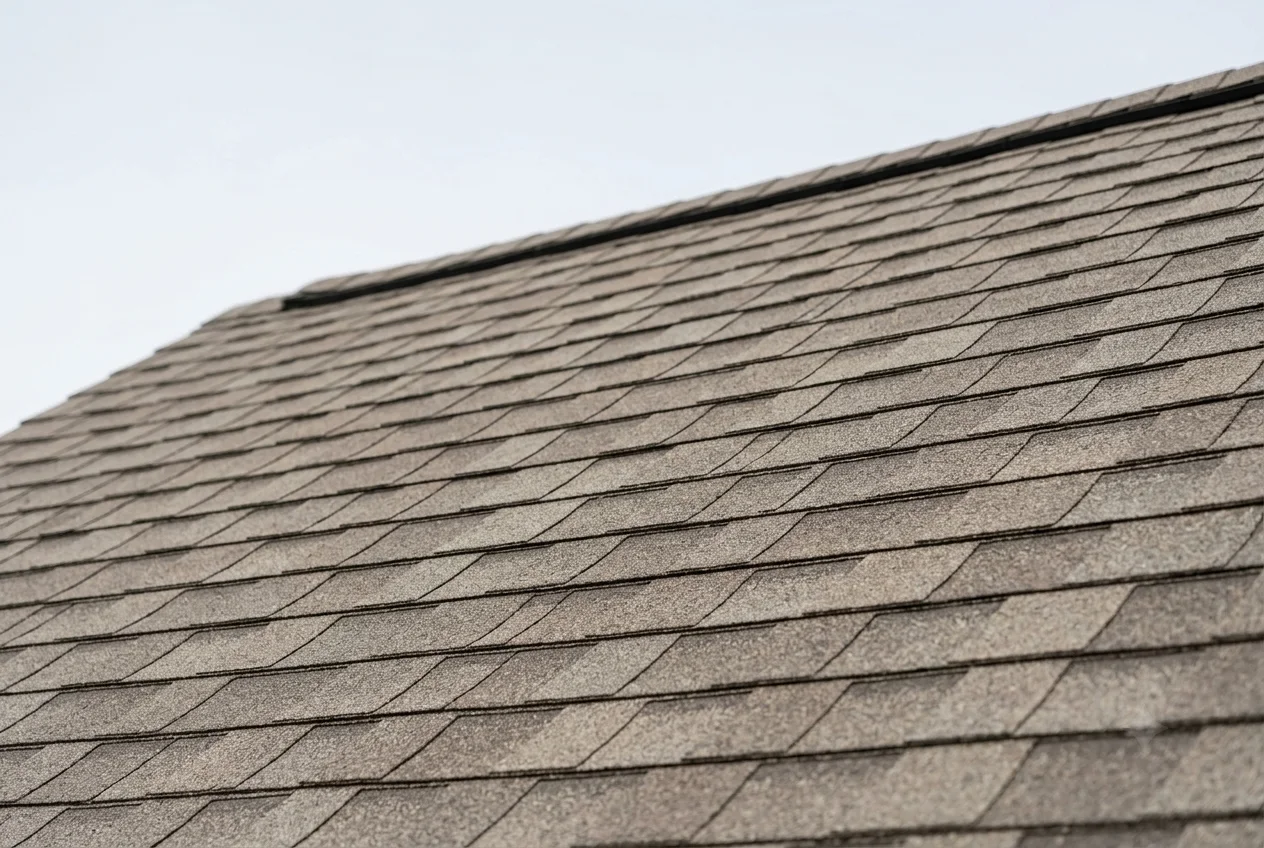
Luxury asphalt shingles are the heavy end of the asphalt family and the third of the three main roof shingle types: thicker mats, more asphalt, deeper die-cut profiles, and color blends engineered to imitate hand-split cedar shake, natural slate, or quarried stone. Where architectural shingles add a second layer for dimension, luxury products often add heavier mats and precision-cut tabs that create large, deep shadow gaps — the roof equivalent of a premium finish package. They are the third of the three main roofing shingle types and the only asphalt tier where appearance, not price, drives the decision.
Performance figures track the added material. Weight runs 400 to 550 pounds per square — sometimes more — which matters structurally on older framing (covered in the weight section). Wind ratings typically hold 110 to 150 mph with the specified nailing, and many luxury lines are available with UL 2218 Class 4 impact ratings. Lifespan is about 30 to 50 years in a moderate climate, the longest of the asphalt tiers, and warranties are usually limited-lifetime (prorated) with non-prorated windows of 10 to 15 years. Material cost runs about $300 to $800 per square; installed, luxury roofs land around $700 to $1,400 per square once tear-off, system components, and labor are counted.
Luxury asphalt shingles make sense when the architecture warrants them — a large front-facing gable, a historic house, a steep pitch visible from the street — when the owner plans to stay long enough to collect the extra decades of life, or when a Class 4 luxury product unlocks an insurance credit that narrows the price gap. They make less sense on a modest house with a simple roof, where the premium buys profile that the street will not read and where the extra weight adds structural cost for no functional gain.
Three-Tier Comparison: 3-Tab vs Architectural vs Luxury Roof Shingle Types
The table below pulls the numbers from each tier section of the asphalt shingle types into one side-by-side view. Every figure is a typical national band — individual products vary, and the exact specifications always come from the product data sheet for the line being installed. Use the table to shortlist, then verify the specific shingle's test results and warranty text before signing.
| Attribute | 3-Tab Shingles | Architectural Shingles | Luxury Asphalt Shingles |
|---|---|---|---|
| Construction | Single flat layer with three cutouts | Base sheet laminated with irregular second layer | Heavy mat, deep die-cut profiles, color-blended granules |
| Typical thickness | ~3/16 inch | 1/4 to 3/8 inch | Up to ~1/2 inch |
| Weight per square | 200 to 250 lb | 250 to 400 lb | 400 to 550 lb |
| Wind rating (typical) | 60 to 70 mph (some to 110 mph, 6 nails) | 110 to 130 mph | 110 to 150 mph |
| Lifespan (moderate climate) | 15 to 20 years | 20 to 30 years | 30 to 50 years |
| Warranty (typical) | 25 to 30 years, prorated | 30-year to limited lifetime, prorated | Limited lifetime, prorated; 10–15 yr non-prorated window |
| Material cost per square | $90 to $160 | $150 to $350 | $300 to $800 |
| Installed cost per square | $300 to $450 | $450 to $700 | $700 to $1,400 |
| Impact (UL 2218) options | Rarely offered | Common (Class 3 and Class 4) | Common (Class 3 and Class 4) |
| Best for | Tight budgets, simple roofs, rentals | Most homes; the default upgrade | Premium architecture, long hold, impact zones |
The single most useful line in the roof shingle types comparison table is installed cost per square. Moving from 3-tab to architectural on a typical 2,000-square-foot roof (about 20 squares of surface, before waste) changes the installed band from roughly $6,000–$9,000 to roughly $9,000–$14,000 — a difference that buys a decade of extra life, 40-plus mph of extra wind rating, and a visibly dimensional roof. That is the heart of the 3-tab vs architectural shingles comparison for most homeowners.
Roof Shingle Costs and the Cost of Architectural Shingles
Roof shingle costs split into two numbers: material per square and installed per square. Material is the bundle price — what the pallet costs — while the installed figure includes tear-off and disposal of the old roof, underlayment, ice-and-water membrane where required, starter strip, drip edge, ridge and hip cap, nails, and labor. Material is typically 30 to 40 percent of the installed total; labor and tear-off are the rest. Any comparison of roof shingle costs that quotes only bundle prices understates the real job by more than half.
| Tier | Material per square | Installed per square | Installed, 20-square roof* |
|---|---|---|---|
| 3-tab | $90 to $160 | $300 to $450 | $6,000 to $9,000 |
| Architectural | $150 to $350 | $450 to $700 | $9,000 to $14,000 |
| Luxury asphalt | $300 to $800 | $700 to $1,400 | $14,000 to $28,000 |
*20 squares of surface, before waste; excludes complex tear-offs, deck repair, and regional labor premiums.
The cost of architectural shingles is where most quotes land for homeowners comparing all three tiers of roof shingle costs, and the drivers that move a quote up or down are the same regardless of tier: number of existing layers to tear off, roof pitch (steep roofs slow the crew), number of valleys and penetrations, region and labor market, deck repair discovered at tear-off, and disposal fees. A simple, low-pitch, one-layer tear-off in a competitive market sits at the bottom of each band; a steep, two-layer roof with multiple valleys and a chimney sits at the top.
Across the three tiers of roof shingle costs, two extras deserve their own line in any cost conversation. Ridge cap is not optional — hips and ridges need the cap shingle designed for them, roughly 20 linear feet per standard bundle, and ridge cap material for a typical house runs several hundred dollars. Waste is the other: add 10 percent for a simple gable, 15 percent for a typical roof with a few hips and valleys, 20 percent or more for complex roofs. On a 20-square architectural roof, moving from 10 to 15 percent waste is five extra squares — roughly $750 to $1,750 of material at architectural prices. The Roofing Calculator handles this math from footprint and pitch automatically.
Finally, cost per year is often more honest than cost at install. A 3-tab roof at $7,500 lasting 18 years runs about $417 per year. An architectural roof at $11,500 lasting 25 years runs about $460 per year. A luxury roof at $19,000 lasting 40 years runs about $475 per year. The tiers are far closer on an annual basis than on a sticker basis — and the annual figures ignore the tear-off savings that come with a longer-lived roof: every extra decade of life is one fewer full tear-off the owner pays for. Remodeling-cost surveys have repeatedly found that a new roof boosts resale value, recovering roughly 60% to 70% of project cost at resale, with architectural shingles the tier most often credited by appraisers for the visible improvement.
Wind and Impact Standards Explained
Shingle performance claims are only meaningful when tied to a named test. Four standards cover nearly everything a residential buyer will see on a data sheet: ASTM D3462 (the base manufacturing specification for asphalt shingles), ASTM D3161 (wind resistance by fan test), ASTM D7158 (wind resistance by static uplift), and UL 2218 (impact resistance by steel-ball drop). Knowing which class a shingle holds tells you what the number on the bundle actually means.
| Standard | What it tests | Classes |
|---|---|---|
| ASTM D3462 | Base manufacturing spec (material, mass, tearing strength) | Pass/fail specification shingles must meet to be sold as roofing |
| ASTM D3161 | Wind resistance, fan test (shingle held in a wind tunnel) | Class A = 60 mph · Class D = 90 mph · Class F = 110 mph |
| ASTM D7158 | Wind resistance, static uplift (constant pressure) | Class D = 110 mph · Class G = 150 mph · Class H = 190 mph |
| UL 2218 | Impact resistance (steel balls dropped on the shingle) | Class 1 = 1.25 in ball · Class 2 = 1.5 in · Class 3 = 1.75 in · Class 4 = 2 in (two drops) |
The two wind standards are not interchangeable. D3161 runs the shingle in moving air and measures when it fails in the tunnel; D7158 applies static uplift pressure. A shingle can carry a high D7158 class and a moderate D3161 class on the same data sheet — read both, and read the nailing pattern each rating assumes. Roofing codes tie into the same family of standards: the International Residential Code sets minimum fastening and underlayment requirements for asphalt shingles, and local jurisdictions may add wind-zone fastening rules on top.
For impact, UL 2218 Class 4 is the meaningful threshold — it is the class insurers recognize and the one tied to premium credits. A Class 3 product resists smaller hail but usually does not unlock the credit. It is worth stating plainly what impact resistance does and does not do: Class 4 shingles resist cracking from hail strikes far better than standard shingles, but they are not hail-proof, and a severe storm can still bruise or crack any asphalt product.
Insurance Credits and Class 4 Shingles
In hail-prone states, the impact rating of the asphalt shingle types can change the insurance premium. Carriers offer credits for roofs with a documented UL 2218 Class 4 rating, and those credits are most commonly reported in the 5 to 30 percent range in hail-belt states such as Texas, Colorado, Nebraska, and Minnesota. The size of the credit depends on the carrier, the state's insurance regulations, the age of the roof, and the roof's geometry — and in some states carriers are required to offer the credit while in others it is at the carrier's discretion.
The practical sequence for a homeowner considering an upgrade for insurance reasons: confirm with the carrier before the roof is installed that a Class 4 credit applies, get the credit terms in writing, verify the specific product carries a current UL 2218 Class 4 listing (not merely a marketing claim of "impact resistant"), and keep the certificate with the roof documents. A Class 4 architectural shingle is often the smartest combination — the credit applies, the weight stays in the normal range, and the profile looks right on a standard house. Class 4 versions are also available in luxury lines for owners who want both the credit and the deeper profile.
One caution: impact-resistant shingles cost more than the standard version of the same line — often 10 to 25 percent more for the material — and the credit should be weighed against that delta plus any deductible changes. In low-hail regions the premium credit is often small or unavailable, and the extra material cost buys little. In active hail country the math frequently works in favor of Class 4, and over a 20-year holding period the cumulative credit can approach or exceed the upgrade cost.
Lifespan and Warranties
Lifespan and warranty are related but not the same thing. Expected life is how long the product performs in a real climate; the warranty is what the manufacturer promises if it fails early. Architectural shingles commonly carry 30-year to limited-lifetime warranties, luxury lines carry limited-lifetime terms, and 3-tab lines carry 25- to 30-year terms — but nearly all residential asphalt warranties are prorated, meaning the payout shrinks each year after the initial non-prorated window. A "lifetime" warranty that pays 10 percent in year 20 is a marketing number, not a replacement check.
| Tier | Expected life (moderate climate) | Typical warranty |
|---|---|---|
| 3-tab | 15 to 20 years | 25 to 30 years, prorated |
| Architectural | 20 to 30 years | 30-year to limited lifetime, prorated |
| Luxury asphalt | 30 to 50 years | Limited lifetime, prorated; 10–15 yr non-prorated window |
Brand lines illustrate how specs land in practice. GAF Timberline HDZ, for example, is an architectural line built around a proprietary wind-grip nailing zone and published uplift classes reaching the top of the ASTM D7158 scale when installed as specified. Owens Corning Duration pairs its architectural laminate with a reinforced nail line strip aimed at consistent high-wind fastening. CertainTeed Landmark is another architectural standard-bearer with published wind and fire classifications typical of the tier. These are representative of the category rather than endorsements — the pattern to notice is that major architectural lines publish their ASTM D3161 and D7158 classes up front, while entry-level 3-tab lines and luxury profiles (GAF Camelot, Owens Corning Berkshire, CertainTeed Presidential) carry their own higher-tier specs and price bands.
Three conditions turn a warranty into an actual claim path. First, manufacturer-approved installation: correct fasteners, correct pattern, correct underlayment — deviations void the coverage. Second, system warranty registration, where the manufacturer's enhanced terms (some offer non-prorated windows when the full system — underlayment, starter, ridge — is used and the job is registered) require the contractor to file paperwork after the install. Third, ventilation: many warranties reference attic ventilation requirements, and a roof cooked by poor intake/exhaust can be denied for heat-related failure. This is why the ventilation guidance in this site's roof ventilation guide is not separate from shingle selection — a balanced intake/exhaust system is worth 5 to 10 years of real service life on top of whatever the bundle claims.
Climate compresses or stretches every figure in the table. A south-facing roof in Phoenix ages asphalt faster than the same shingle in Seattle; a north roof in Minnesota is cycled through freeze-thaw; coastal salt air attacks fasteners before it attacks the mat. When comparing roof shingle types, treat the lifespan bands as moderate-climate baselines and adjust for the local weather.
Weight and Structural Load
Weight is the one attribute of the roof shingle types that reaches past the roof surface and into the structure. A 3-tab roof at 200 to 250 pounds per square, an architectural roof at 250 to 400 pounds per square, and a luxury roof at 400 to 550 pounds per square spread across the rafters as dead load — and unlike a finishes choice, the framing was sized (or not) before anyone picked a shingle. Most modern homes are framed with ample capacity for architectural shingles, but two situations deserve a look: older houses with dimension lumber spaced at wider centers, and re-roofs that would add a second layer rather than replacing the first.
Adding a second layer over existing shingles was common practice for decades, but it stacks weight (a second architectural layer over an old one can approach 600+ pounds per square total), hides deck damage, shortens the new roof's life, and is restricted by code in many jurisdictions beyond limited cases. The safer pattern — and what most roofing codes encourage — is a full tear-off so the deck can be inspected and the weight stays at a single layer's figures. If you are considering luxury asphalt shingles on an older house, having the framing checked (or a structural engineer confirm capacity) is cheap insurance against a sagging ridge.
Deck condition matters alongside framing: plywood or OSB sheathing that has been wet, fastened with undersized nails, or spaced too widely will hold nails poorly regardless of shingle tier. Nail-holding ability is what converts the wind rating on the data sheet into actual uplift resistance on the roof, so a sound deck is part of the shingle system, not a separate trade.
Bundles, Squares, and Waste
Quantities connect the choice of roof shingle type to the actual pallet delivered, whatever the roof shingle types shortlisted. Standard asphalt shingles ship three bundles per square; each bundle covers about 33.3 square feet, and three bundles reach the 100 square feet of one square. Architectural and luxury shingles keep the three-bundle convention in most product lines, though some heavy luxury profiles ship four bundles per square — always check the label, because assuming three bundles on a four-bundle product undercounts the pallet by 25 percent.
| Item | Rule of thumb |
|---|---|
| Square | 100 square feet of roof surface |
| Bundles per square | 3 (standard) — verify 4-bundle luxury products |
| Coverage per bundle | ~33.3 square feet (3-bundle products) |
| Starter strip | One bundle per ~60–65 linear feet of eave/rake |
| Ridge/hip cap | ~20 linear feet per bundle (standard profile) |
| Waste — simple gable | Add 10% |
| Waste — typical hips/valleys | Add 15% |
| Waste — complex/steep | Add 20% or more |

Waste is where takeoffs go wrong. Cut waste comes from valleys, hips, rakes, dormers, and the offsets that make the pattern run — a roof with many planes wastes more because each plane ends in cuts. Steep roofs waste more because breakage and mis-cuts rise when crews work at angle. The percentages above are the working range used in residential estimating, and the Roofing Calculator applies the right factor from the roof's pitch and geometry. The Roof Shingle Calculator converts square footage straight to bundles, ridge cap, and starter quantities for whichever roof shingle type you select.
Sequence of computation matters too: measure the roof planes, apply pitch factors to get the true surface area, divide by 100 for squares, add waste, then multiply by bundles-per-square. Skipping the pitch factor — measuring the footprint instead of the surface — undercounts on anything steeper than a very low slope, and a 6/12 roof carries about 12 percent more surface than its footprint suggests. Every one of these steps shows up in the waste factor guide and the takeoff guide on this site.
How to Choose Between Roof Shingle Types
The decision framework below narrows the field of roof shingle types in the same sequence a roofer would walk it with a homeowner. It is deliberately a sequence of filters, not a feature checklist — the first filter that eliminates a tier ends the debate for that tier, and whatever survives the last filter is the recommendation.
- 1. Set the budget ceiling for the whole job, not the bundle. Roof shingle costs are only part of the total; tear-off, disposal, underlayment, and labor apply to every tier. Decide the installed ceiling first, then see which tiers fit inside it. If the ceiling clears the architectural band, the 3-tab question is usually closed.
- 2. Match the tier to the house's holding period and curb appeal needs. A house being sold within a few years benefits most from the architectural upgrade (visible improvement, modest cost delta). A long-hold home can justify luxury on life-cycle math alone. A rental or short-hold property often makes 3-tab the rational call.
- 3. Check the climate overlays — wind, hail, and heat. Wind zone: coastal and plains wind exposure pushes toward architectural minimum with 6-nail fastening. Hail: in hail-belt states, price a Class 4 architectural (or luxury) against the insurance credit before deciding. Heat and UV: hot climates shorten every lifespan figure, which argues against the shortest-lived tier.
- 4. Confirm structure and deck. Verify the framing accepts the weight — especially for luxury asphalt shingles on older homes — and plan for a full tear-off so the deck can be inspected. This step removes luxury from consideration on some older houses and removes second-layer shortcuts everywhere.
- 5. Shortlist specific products and read their data sheets. Within the chosen tier of the asphalt shingle types, compare the actual D3161/D7158 wind classes, any UL 2218 rating, the warranty's non-prorated window, and the nailing pattern the ratings assume. Two products in the same tier can differ by 20 mph of rated wind and five years of non-prorated coverage.
- 6. Run the quantities with the right waste factor. Whatever the roof shingle types on the shortlist, convert the roof to squares, apply waste (10/15/20 percent by complexity), and convert to bundles, ridge cap, and starter. This is the step the roofing tools on this site automate — and the step that most separates an accurate quote from an optimistic one.
For most houses the framework converges on the same answer: architectural shingles, installed as a full tear-off with a balanced ventilation system, at 15 percent waste. 3-tab remains correct at the budget floor, and luxury asphalt shingles earn their place where architecture, holding period, or a Class 4 credit justifies the premium.
Beyond Asphalt: The Other Roof Covering Types
Asphalt dominates steep-slope roofing, but the full menu of roof covering types beyond the asphalt shingle types includes several materials a homeowner may encounter on quotes or on older houses. Each trades cost against life differently from the asphalt tiers, and each has constraints the asphalt family does not.
| Material | Installed cost per square | Lifespan | Notes |
|---|---|---|---|
| 3-tab asphalt | $300–$450 | 15–20 yr | Baseline; flat profile |
| Architectural asphalt | $450–$700 | 20–30 yr | Most common residential choice |
| Luxury asphalt | $700–$1,400 | 30–50 yr | Deepest profile; heaviest asphalt tier |
| Standing-seam metal | $800–$1,600 | 40–70 yr | Excellent wind; exposed-fastener panels cost less |
| Natural slate | $1,500–$4,000+ | 75–100+ yr | Requires structural capacity; repairable forever |
| Clay/concrete tile | $700–$2,000 | 40–75 yr | Heavy; common in warm climates |
| Wood shake/shingle | $600–$1,400 | 20–40 yr | Fire-code limits in many jurisdictions |
| Composite/rubber | $600–$1,500 | 30–50 yr | Mimics slate/wood without the weight |
Outside the asphalt shingle types, two constraints shape the non-asphalt choices: weight and fire code. Slate and tile are heavy enough to demand structural verification on any house not originally framed for them. Wood shakes are restricted or banned in wildland-urban interface zones and many municipalities because of fire performance. Metal, by contrast, is light, wind-resistant, and increasingly competitive on life-cycle cost — the standing seam vs shingles decision is covered in the metal roofing guide linked below.
For most re-roof projects the choice still lands inside the asphalt family, which is why the rest of this guide stays there. The table exists so the comparison of roof shingle types sits in honest context against the wider market.
Common Mistakes When Choosing and Installing Shingles
- Comparing bundle prices instead of installed costs. Roof shingle costs quoted per bundle hide tear-off, underlayment, and labor — usually the majority of the bill. Always compare installed per square, and ask which system components the quote includes.
- Choosing on color alone. Among all the roof shingle types, color is the easiest thing to change later only at full replacement cost. Tier, wind rating, and impact rating are the attributes that pay back every year; pick those first, then choose the color inside the shortlisted products.
- Ignoring the waste factor. A takeoff that uses footprint instead of pitched surface area, or skips the complexity adder, comes up short at install — and shortages mean a second delivery, a color-dye lot mismatch, or cuts so tight the pattern suffers. Add 10, 15, or 20 percent by complexity, never zero.
- Undersizing ventilation. A new shingle roof over a choked attic runs 5 to 10 years short of its rated life. Intake and exhaust must both be present and balanced; adding exhaust without intake makes things worse, not better.
- Assuming a wind rating travels with the shingle. The rating assumes the specified nail pattern, nail type, and a sound deck. Nails driven high, over-driven, or spaced wrong will not deliver the number on the bundle — verify the crew's nailing against the package during the install.
- Skipping the Class 4 check when insurance is involved. Impact resistance is a tested rating, not an adjective. Confirm UL 2218 Class 4 on the data sheet and confirm the carrier's credit terms before the tear-off starts.
- Adding a second layer to save money. It stacks weight, hides deck damage, shortens the new roof's life, and complicates the next replacement. A full tear-off with deck inspection is the standard for good work and is what code increasingly expects.
Frequently Asked Questions
The main types of roof shingles on American homes are asphalt: 3-tab shingles (flat, one-piece, 15 to 20 years), architectural shingles (layered, dimensional, 20 to 30 years), and luxury asphalt shingles (heavy, deeply contoured, 30 to 50 years). Beyond asphalt, the common roof covering types are metal panels, natural or engineered slate, clay or concrete tile, wood shakes, and composite or rubber materials. For most houses, the real choice sits inside the asphalt family, because asphalt accounts for roughly 80 percent of steep-slope roofing in North America.
3-tab shingles are a single flat layer with three cutouts that create a uniform tab pattern; they weigh about 200 to 250 pounds per square, carry wind ratings around 60 to 70 mph, and cost roughly $90 to $160 per square for material. Architectural shingles (also called dimensional or laminate shingles) glue a second, irregular layer of shingle onto the base mat, which adds shadow lines, depth, weight (250 to 400 pounds per square), wind ratings of 110 to 130 mph, and a 20 to 30 year life. In a 3-tab vs architectural shingles comparison, the architectural layer is why the dimensional shingle costs $150 to $350 per square yet usually returns more than its price difference in curb appeal and resale value.
Roof shingle costs run in three bands per square (100 square feet). 3-tab asphalt costs about $90 to $160 per square for material and $300 to $450 installed. Architectural shingles cost about $150 to $350 per square for material and $450 to $700 installed. Luxury asphalt shingles cost about $300 to $800 per square for material and $700 to $1,400 installed. Installed prices include tear-off of the old roof, underlayment, drip edge, ridge cap, starter course, nails, and labor, so material is usually only about 30 to 40 percent of the total roof shingle costs on a job.
Asphalt shingle lifespans track the product tier and the climate. 3-tab shingles run about 15 to 20 years, architectural shingles about 20 to 30 years, and luxury asphalt shingles about 30 to 50 years in moderate climates. Heat, UV exposure, poor ventilation, and steep southern roofs shorten those ranges; cool, dry climates stretch them. A roof that loses ventilation runs 5 to 10 years short of its rated life, because trapped heat bakes the asphalt from underneath and makes the mat brittle before the warranty term ends.
Often, yes — in hail-prone states. Shingles that pass the UL 2218 steel-ball impact test at Class 4 (the highest of four classes) are what carriers look for. Insurers in hail-belt states such as Texas, Colorado, Nebraska, and Minnesota have offered premium discounts commonly reported in the 5% to 30% range for Class 4 roofs, though the exact credit varies by carrier, roof age, and state insurance rules. Check with your carrier before the roof goes on: the discount must be confirmed in advance, and some states require the credit while others allow carriers to set their own terms.
Standard asphalt shingles ship three bundles to a square, one of the simplest facts to learn when comparing roof shingle types. Each bundle covers about 33.3 square feet, so three bundles reach 100 square feet of roof area — one square. Starter strips, ridge cap, and hip cap are figured separately: ridge cap typically runs about 20 linear feet per bundle for standard profiles. Waste is added on top of the square count: roughly 10 percent for a simple gable, 15 percent for a typical roof with a few hips and valleys, and 20 percent or more for complex roofs with many cuts, dormers, or steep pitch.
Wind performance is stated two ways. ASTM D3161 (the fan test) classes run A = 60 mph, D = 90 mph, and F = 110 mph. ASTM D7158 (static uplift) classes run D = 110 mph, G = 150 mph, and H = 190 mph. Coastal and hurricane-prone zones commonly call for shingles rated 110 to 130 mph with enhanced nailing (four to six nails per shingle, sealed by the factory sealant strip). Note that a wind rating only holds when the shingle is installed to the manufacturer's nailing pattern on a sound deck — under-driven nails or a cold-day sealant that never bonds will drop the actual performance well below the number on the bundle.
For most homes, architectural shingles are the sensible middle: they cost only a few hundred dollars more than 3-tab on a typical roof, last about a decade longer, handle 110 to 130 mph wind, and read as a dimensional roof from the street. Choose 3-tab when the budget is tight, the roof is simple, or the house is a rental or short-hold property. Step up to luxury asphalt shingles when you want the deepest shadow lines, the longest life, or a look that mimics slate or cedar — or when an impact-resistant Class 4 credit makes the higher first cost partly back through insurance savings.
References
- ASTM International, ASTM D3462/D3462M — Standard Specification for Asphalt Shingles Made from Glass Felt and Surfaced with Mineral Granules, astm.org — base manufacturing specification that residential asphalt shingles must satisfy.
- ASTM International, ASTM D3161 — Standard Test Method for Wind Resistance of Asphalt Shingles (Fan-Induced Method), astm.org — wind-test classes A (60 mph), D (90 mph), and F (110 mph).
- ASTM International, ASTM D7158 — Standard Test Method for Wind Resistance of Asphalt Shingles (Uplift Method), astm.org — static-uplift classes D (110 mph), G (150 mph), and H (190 mph).
- Underwriters Laboratories, UL 2218 — Standard for Impact Resistance of Roofing Products, ul.com — four-class steel-ball impact test underpinning Class 4 impact-resistant shingle ratings and insurance credits.
- Asphalt Roofing Manufacturers Association (ARMA), Residential Asphalt Roofing Manual — Design and Application Techniques, asphaltroofing.org — manufacturer guidance on shingle selection, fastening patterns, and the market share of asphalt in steep-slope roofing.
- National Roofing Contractors Association (NRCA), NRCA Roofing Manual — Architectural and Steep-Slope Roofing, nrca.net — industry guidance on system components, waste allowances, and installation practice for asphalt shingle roofs.
- International Code Council, International Residential Code (IRC) — Section R905, Roof Coverings, codes.iccsafe.org — code requirements for asphalt shingle application, fastening, underlayment, and slope.
- Insurance Institute for Business & Home Safety (IBHS), Fortified Roof and hail-resistance guidance, ibhs.org — research on impact-resistant roofing and wind/hail performance of steep-slope systems.
Disclaimer: This guide provides general educational information about roof shingle types — 3-tab shingles, architectural shingles, luxury asphalt shingles, and how these roof shingle types compare — including typical costs per square, wind and impact ratings, lifespans, and selection guidance. It is not engineering, structural, insurance, or code advice for a specific project. Cost bands are broad national estimates that vary by region, tear-off complexity, pitch, access, and labor market; wind, impact, and warranty figures must be verified on the specific product's data sheet and manufacturer documentation. Insurance credits depend on your carrier and state. Confirm fastening, underlayment, ventilation, and slope requirements with your authority having jurisdiction and the roofing manufacturer before installation, and have structural capacity evaluated when adding weight to older framing.