
Enter Grout Project Details
Results update live as you type. Mixed units welcome.
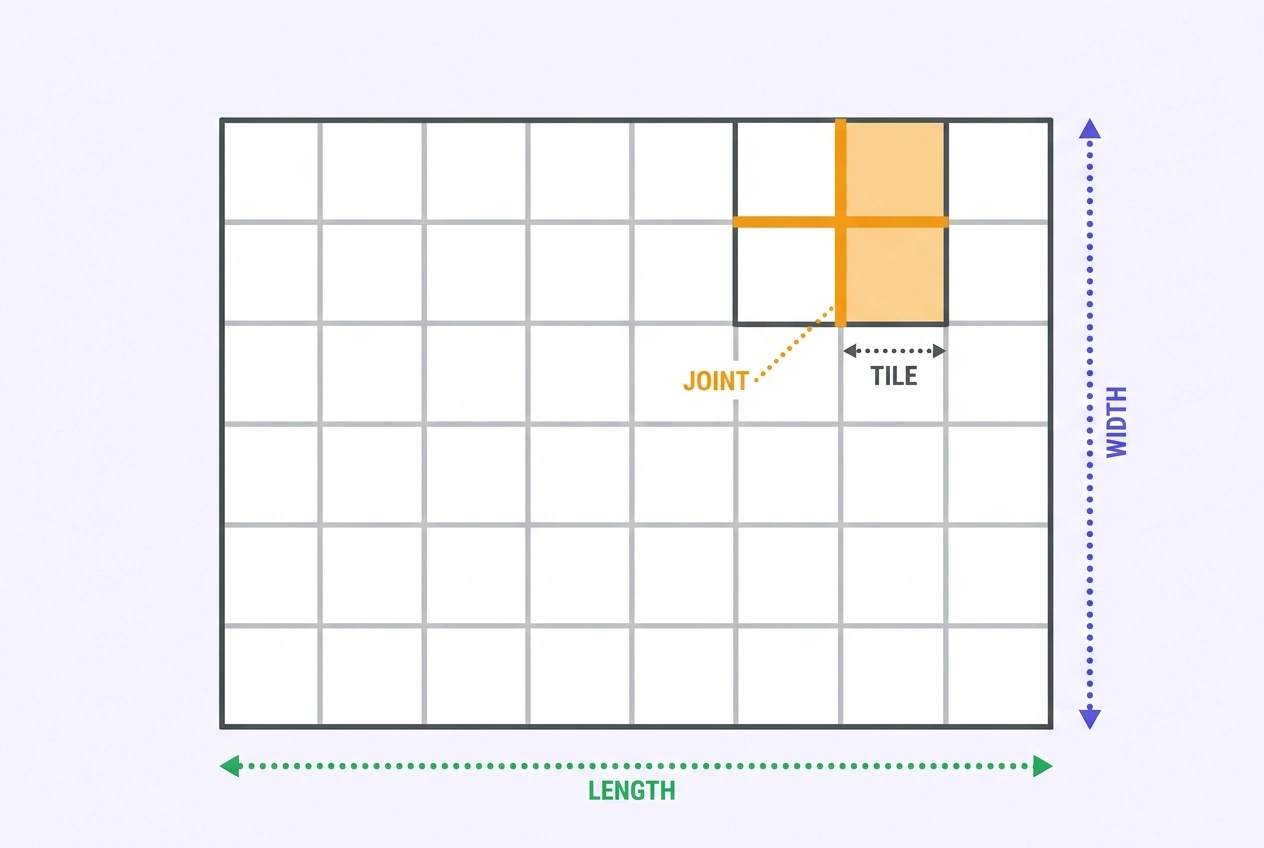 10 feet
8 feet
1/4 inch
12 x 12 inch
Results
Joint Volume
What You Need
Cost Estimate
Calculation Assumptions
What You Get
- ✓Free — no sign-up, nothing to install
- ✓Live results as you type
- ✓Feet, inches, cm, meters & yards — mix any units
- ✓Export a PDF takeoff in one click
- ✓Shareable link that saves your inputs
- ✓Works on phone, tablet & desktop
- ✓Sanded, unsanded & epoxy grout
- ✓Epoxy full & mini kit units
- ✓Obstacles deducted, multiple areas
ON THIS PAGE:
About Grout Coverage
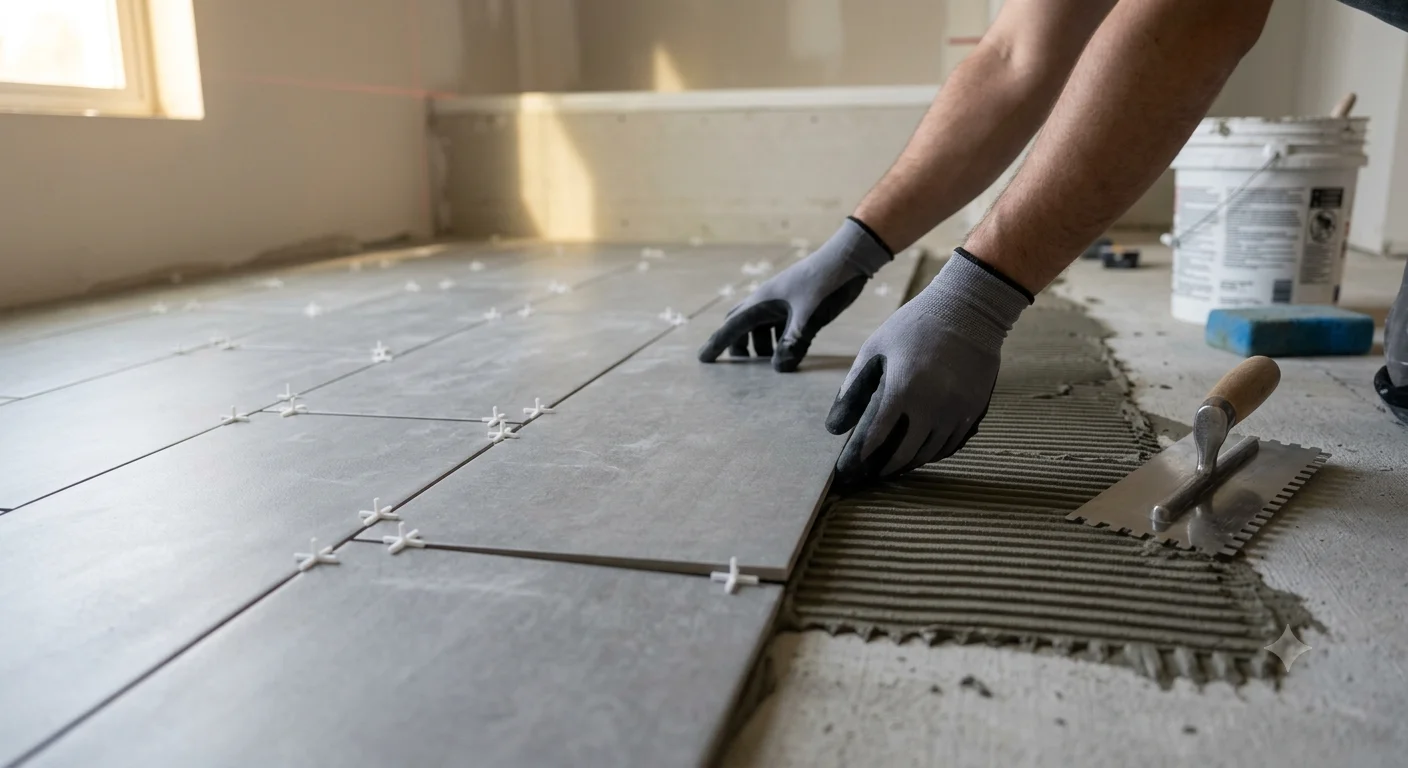
Grout fills the channels between tiles. It keeps water and debris out of the joints, locks the edges of each tile so chips are less likely, and gives a tiled surface its finished look. What makes grout awkward to estimate is that the amount you need has nothing to do with the area alone: two 100 square foot bathrooms can need a few pounds or half a sack of grout depending on the tile and the joints.
Three dimensions drive consumption. First, the tile face size — smaller tiles mean more joints per square foot. Second, the joint width — wider channels hold more material. Third, the joint depth, which is set by the tile thickness: a chunky 3/8 inch floor tile leaves a much deeper channel to fill than a slender 1/4 inch wall tile. Joint volume scales with all three at once, which is why doubling the joint width can double the grout even though the joint looks thin.
Packaging is the last wrinkle. Cement grouts come in 5, 10, 25, and 50 pound bags and cannot be bought partial, so the real question is how many whole bags to carry home. Epoxy grout skips weight entirely and is sold as resin-plus-hardener kits measured by mixed volume. This calculator handles both systems, rounds up to whole packages, and adds your waste allowance so a single trip to the supplier is enough.
How the Grout Calculation Works
The calculator uses the exact joint-volume method rather than a rough pounds-per-square-foot rule. Here is the sequence:
- Measure the area — Enter length and width (plus any additional areas for L-shapes or shower walls), then deduct obstacles such as islands, windows, or niches to get the net area.
- Find the joint fraction — One tile plus its half-joint on each side occupies (L + J) × (W + J) of the surface, where L and W are the tile face dimensions and J is the joint width. The share of surface that is joint is 1 − (L × W) / ((L + J) × (W + J)).
- Compute joint volume — Multiply the joint share by the net area and by the joint depth. At 3/8 inch depth and sanded density, every 1.0 of joint fraction costs about 3.5 pounds of grout per 100 square feet.
- Convert to weight or kits — Cement grout weight = volume × density (112 lb/ft³ sanded, 108 lb/ft³ unsanded). Epoxy stays in cubic inches and is divided by the kit volume — about 189 in³ for a full unit, 47 in³ for a mini unit.
- Add waste and round up — The waste allowance (10% floor, 15% wall, 20% shower are good defaults) is applied, then the total is rounded up to whole bags or kits. Unused dry grout keeps; running out mid-wall does not end well for color consistency.
The math runs entirely in your browser as you type — nothing is uploaded, and the shareable link in the Share panel encodes your inputs so a colleague can open the exact same calculation.
Grout Coverage Table (sq ft per 25 lb bag)
Coverage depends on all three dimensions, so the table below fixes two of them: a 3/8 inch joint depth and sanded grout at 112 lb/ft³ — the most common floor scenario. Values are computed with the same formula the calculator uses.
| Tile Size | 1/8 in Joint | 3/16 in Joint | 1/4 in Joint |
|---|---|---|---|
| 2 × 2 mosaic | 63 sq ft | 44 sq ft | 34 sq ft |
| 4 × 4 | 120 sq ft | 82 sq ft | 63 sq ft |
| 6 × 6 | 177 sq ft | 120 sq ft | 91 sq ft |
| 8 × 8 | 234 sq ft | 158 sq ft | 120 sq ft |
| 12 × 12 | 348 sq ft | 234 sq ft | 177 sq ft |
| 12 × 24 | 463 sq ft | 310 sq ft | 234 sq ft |
| 18 × 18 | 520 sq ft | 348 sq ft | 263 sq ft |
| 24 × 24 | 691 sq ft | 463 sq ft | 348 sq ft |
Reading the table: a 12 × 12 floor at 1/8 inch joints gets about 348 square feet per bag, while the same area in 2 × 2 mosaic at 1/4 inch joints burns through a bag every 34 square feet — ten times faster. If your tile is thinner than 3/8 inch, coverage improves proportionally: a 1/4 inch thick wall tile yields roughly 1.5× these numbers because the joint is that much shallower.
Sanded vs Unsanded vs Epoxy
Picking the wrong grout type causes failures no calculator can fix, so match the type to the joint width and the tile before you estimate quantities.
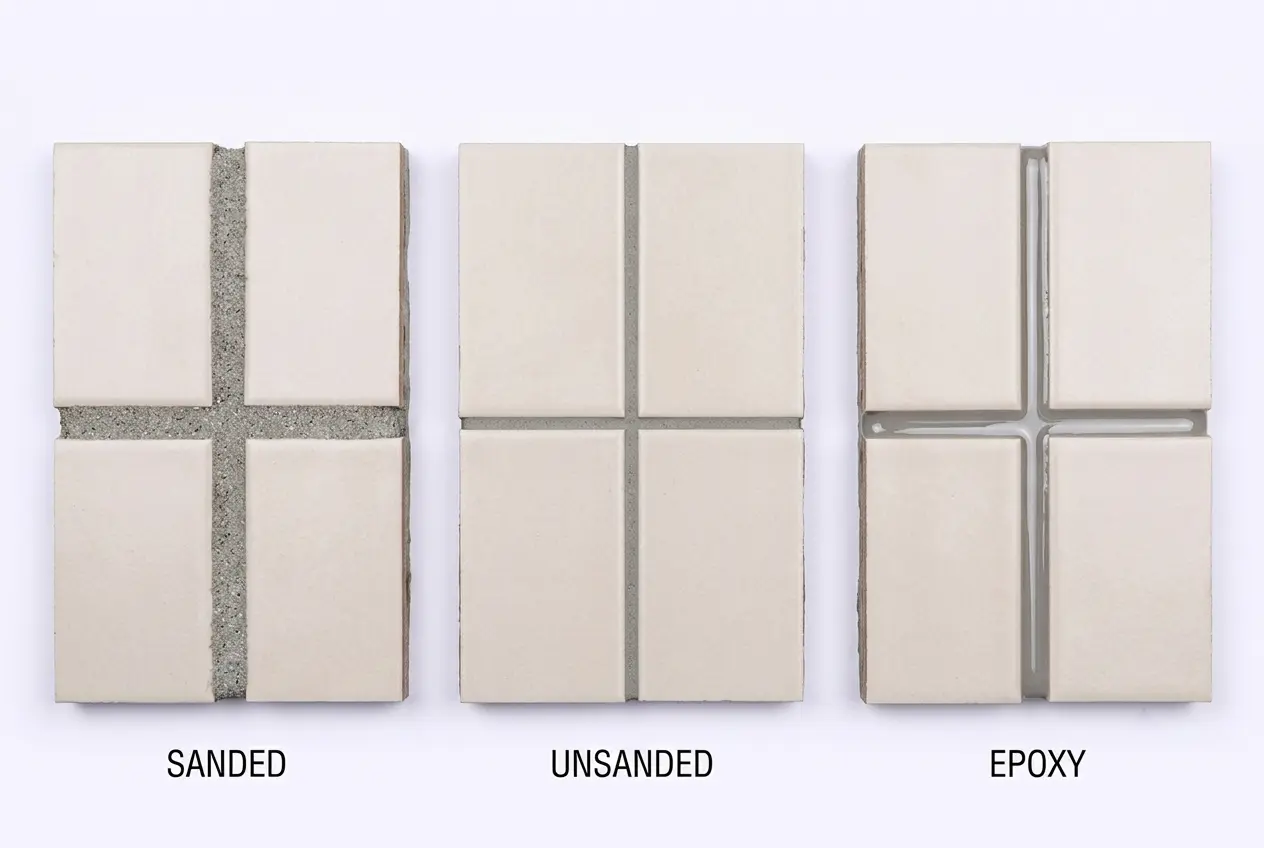
| Property | Sanded | Unsanded | Epoxy |
|---|---|---|---|
| Joint width | 1/8 – 1/2 in | up to 1/8 in | 1/16 – 1/2 in |
| Best for | Floors, most walls | Thin joints, glass & polished stone | Wet areas, grease, heavy traffic |
| Strength | High (sand aggregate) | Lower, shrinks more | Highest, no sealer needed |
| Sold as | lb bags | lb bags | Kits by mixed volume |
| Working time | Comfortable | Comfortable | Short — work in small sections |
| Cost | $ | $ | $$$ |
The rule of thumb: joints narrower than 1/8 inch take unsanded because sand particles are too coarse to pack a thin channel, and anything 1/8 inch or wider takes sanded for its extra strength. The exception is scratch-prone tile — glass, metal, or honed marble — where unsanded is used at any width to protect the face during floating. Epoxy works at nearly any width and is the standard choice for showers and kitchen counters where stains and chemicals are daily events, at several times the material cost.
Grout is not mortar. Despite the similar look, tile grout, brick mortar, and the structural grout poured into concrete block cores are three different products: mortar bonds masonry units and is laid in thick joints, structural grout is a near-liquid fill around rebar, and tile grout only sweeps into thin joints between finished tiles. This calculator estimates the tile grout only.
Sealing Grout — What It Actually Does
Cement grout is full of tiny pores, which means water, oil, and dirt sink right in if you let them. A penetrating grout sealer fixes this by soaking into those pores and creating a barrier that repels liquids. It does not make the joint waterproof and it does not stop cracks — it just gives you time to wipe up a spill before it becomes a stain. In wet areas like showers and kitchen backsplashes, plan on resealing every one to two years because the sealer wears off with cleaning and foot traffic.
Epoxy grout and single-component pre-mixed grouts skip this step entirely. They are non-porous from the start, so sealer does nothing for them. Applying sealer to epoxy is wasted money.
One thing people mix up: penetrating sealer versus colour sealer. Penetrating sealer is invisible — it soaks in and does its job without changing how the grout looks. Colour sealer is a pigmented coating that sits on top. It can restore discoloured grout without ripping it out, but it needs the joints to be completely clean and dry first, or it peels.
Drying Time, Haze, and the Sponge Technique
Grout does not dry on a single schedule. The first hour sets the tone: within 30 minutes of filling the joints, go back with a damp sponge and wipe the haze off the tile face. Wring the sponge until it stops dripping — any more water than that pulls cement out of the joint, weakens it, and leaves blotchy colour that does not come back. After that first wipe, wait another 30 minutes and do a second pass with a clean sponge, then buff the remaining haze with a dry cloth.
The joint itself is walkable after about 24 hours and fully cured at 72. That 72-hour window matters if you plan to seal the grout or get the area wet. Cold or humid rooms stretch every step, warm dry rooms shorten them. Epoxy grout sets faster but has a much shorter pot life once mixed — you are working against a clock from the moment the resin and hardener meet.
Grout haze that sits overnight is not the end of the world, but it gets harder to remove every day. After a week on porous or polished stone, it can etch the surface. On regular ceramic or porcelain, a haze remover (which is a mild acid) takes it off, but working within that 30-to-60-minute window is always easier than dealing with it later.
Where Grout Stops and Caulk Begins
Every inside corner, every change of plane, and every joint where tile meets a different material gets flexible caulk — not grout. That means the corner where two shower walls meet, the line where walls meet the floor or shower pan, the perimeter around a tub or shower base, and the transition from tile to a countertop or window frame. The TCNA handbook covers this under movement joint requirements (EJ171), and the reason is straightforward: buildings move. Walls expand and contract, floors settle, and rigid grout in a joint that flexes will crack every time.
Most grout manufacturers sell colour-matched caulk specifically for this. It looks like grout when done right, sits in the same colour as your field grout, and handles the movement that grout cannot. The most common shower repair call is cracked grout in a vertical corner, and the fix is never more grout — it is raking out the failed joint and running a bead of matching sealant.
This is also why the calculator does not try to estimate caulk. Caulk is measured in linear feet along edges and corners, not in volume like grout. Once you know your tile and joint size, measure the perimeter of each inside corner and the base of the shower or tub, and buy a tube or two of colour-matched sealant.
Common Grout Mistakes to Avoid
Using too much water during cleanup. This is the number one cause of weak, crumbly grout. Water pulls the cement paste out of the joint, leaving behind sand with nothing to bind it. The sponge should be damp, not wet. Wring it until it barely moistens your palm.
Grouting inside corners. Rigid grout in a moving joint cracks. Every inside corner, every plane change, and every perimeter edge where tile meets a fixture gets flexible sealant. If your corners are cracking, the fix is caulk, not regrouting.
Sealing too early. Sealer applied before the grout fully cures traps moisture inside the joint. That moisture causes discolouration and a hazy film that is difficult to remove. Wait the full 72 hours for cementitious grout. Epoxy grout needs no sealer at all.
Mixing bags separately on the same floor. Grout colour varies slightly between bags and between mixes with different water content. If you mix bag one, use it up, then mix bag two with a different water ratio, you may see a visible colour shift across the floor. Mix consistently, measure water rather than eyeballing it, and when possible use bags from the same lot number.
Thinking grout is waterproofing. Grout slows water absorption but does not stop it. Water passes through cementitious grout continuously, which is exactly why showers need a waterproofing membrane behind the tile. Sealer helps with staining, but if a shower is leaking, the problem is behind the tile and more sealer will not fix it.
Grouting a Shower
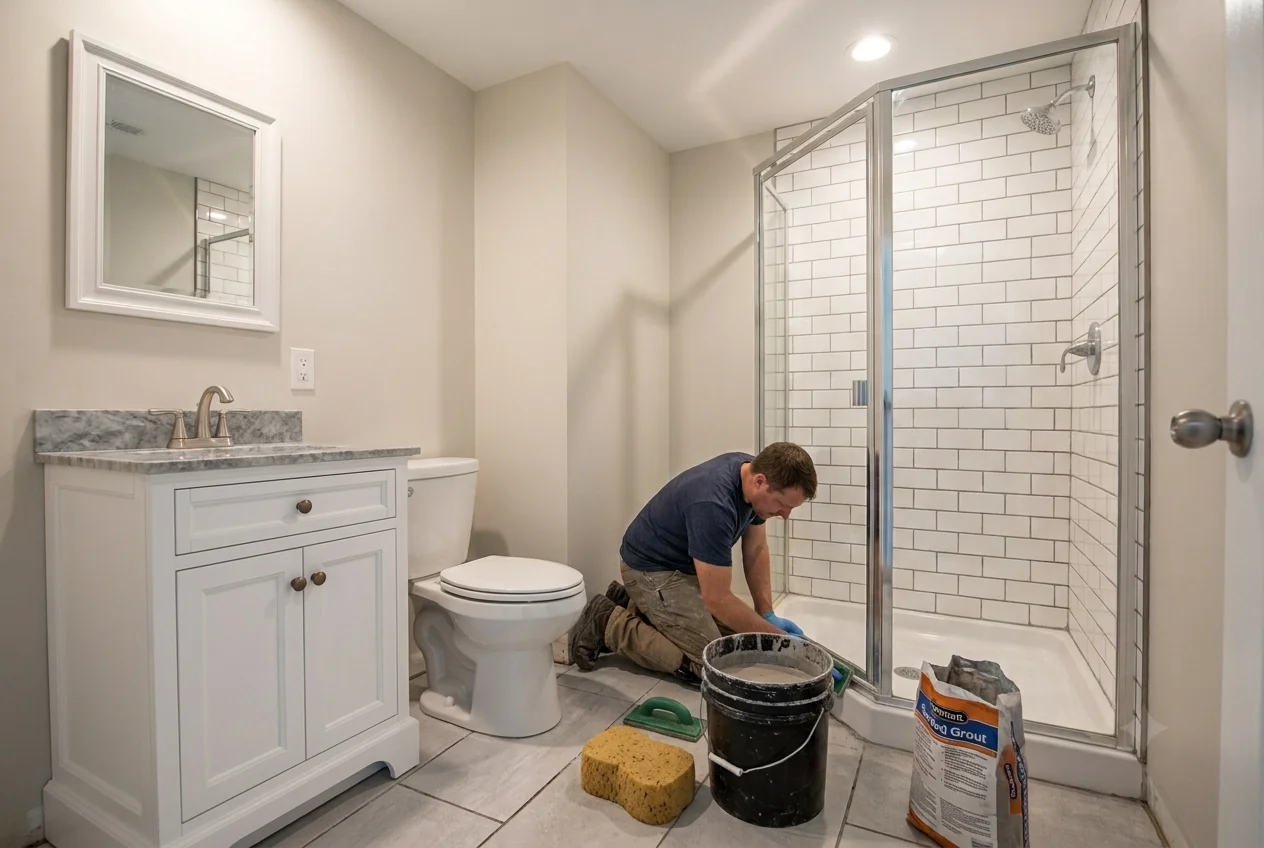
Showers deserve their own pass because the geometry fights you twice: walls and floor usually use different tile, and the fittings eat material. Run the calculator separately for each wall and for the floor — wall tile at 1/8 inch joints consumes far less per square foot than a mosaic shower pan at 1/4 inch — then add the totals.
Account for the extras a flat room does not have: a recessed niche adds the area of its back and sides (a 16 × 16 inch niche adds roughly 2.5 square feet of jointed surface), a bench seat adds its top and face, and the curb adds both faces plus the top. The obstacle deduction subtracts from your estimate, so do not use it for features that add tile — instead add their area as an "Additional Area" row.
Set waste to 15–20% for shower work. Cut-heavy layouts around niches and valves produce offcuts that cannot be reused, and color-matched touch-up grout from a different bag batch is a visible risk. If the shower gets hard daily use, epoxy at 20% waste is the low-regret choice despite the price.
Worked Example
Take the calculator's default project: a 10 × 8 foot bathroom floor (80 square feet), 12 × 12 inch tiles, 1/4 inch joints, tile 3/8 inch thick, sanded grout in 25 lb bags, 10% waste, grout at $24.50 per bag.
| Step | Calculation | Result |
|---|---|---|
| Joint fraction | 1 − (12 × 12) / (12.25 × 12.25) | 0.04041 |
| Joint area | 80 × 0.04041 | 3.233 sq ft |
| Joint volume | 3.233 × (0.375 ÷ 12) | 0.1010 ft³ |
| Weight | 0.1010 × 112 lb/ft³ | 11.32 lb |
| With 10% waste | 11.32 × 1.10 | 12.45 lb (5.65 kg) |
| Bags | 12.45 ÷ 25 | 0.50 → 1 bag |
| Cost | 1 × $24.50 | $24.50 ($0.31/sq ft) |
Notice how the packaging dominates the purchase: the project needs 12.45 pounds but the store sells 25, so the honest answer is "one bag covers this floor twice over." That is exactly the kind of insight a pounds-only estimate hides.
Frequently Asked Questions
It depends mainly on tile size and joint width. For 12×12 inch tiles with 1/8 inch joints and 3/8 inch depth, 100 square feet needs about 2.1 pounds of grout, so a single 25 lb bag is far more than enough. With 1/4 inch joints the same area needs about 4 pounds. Small mosaics use far more: 2x2 tiles at 1/4 inch joints consume roughly 0.73 lb per square foot, so 100 square feet needs about 73 pounds — three 25 lb bags.
Both work at exactly 1/8 inch. Unsanded grout is the right choice for joints narrower than 1/8 inch because sand particles cannot pack thin joints properly. At 1/8 inch and wider, sanded grout is preferred for floors and most walls because the sand makes it stronger and less prone to shrinking and cracking. Use unsanded at any width on easily scratched surfaces such as glass, metal, or polished natural stone.
Yes — thickness sets the depth of the grout joint. A joint is a narrow channel between tiles, and its volume equals the joint's cross-section times its depth. A 3/8 inch thick tile creates a joint 50 percent deeper than a 1/4 inch thick tile and needs 50 percent more grout. That is why the calculator asks for tile thickness and lets you set joint depth separately.
With a 3/8 inch joint depth, a 25 lb bag of sanded grout covers roughly 348 square feet of 12x12 tile at 1/8 inch joints, about 177 square feet at 1/4 inch joints, and only about 34 square feet of 2x2 mosaic at 1/4 inch joints. Coverage drops sharply as tiles get smaller and joints get wider. See the coverage table on this page for common combinations.
Epoxy grout is sold as kits (a resin and hardener plus filler) rather than bags, so coverage is calculated by volume instead of weight. A full-size kit contains about 189 cubic inches of mixed material and a mini kit about 47 cubic inches. The calculator converts your joint volume into cubic inches and divides by the kit size to give the number of units to buy.
Plan on 15 to 20 percent waste for shower work. Walls produce more offcuts than floors because of niches, seats, curb wraps, and plumbing penetrations, and small shower floors with mosaics waste even more. Calculate shower walls and the floor separately — wall tile usually has a different thickness and joint size — and add the results together.
No — grout is sold in fixed bag or unit sizes, so the calculator always rounds up to whole bags. Leftover dry grout stores well if sealed tightly in a dry place and used within a few months, but color can vary slightly between batches, so it is better to have the full amount on site before you start than to open a fresh bag at the end.
Two assumptions explain most differences: the density assigned to mixed grout and the joint depth used. This calculator uses 112 lb per cubic foot for sanded and 108 lb for unsanded, and defaults the joint depth to your tile thickness. If another tool assumes a shallower joint or a lighter density, its answer will be lower. Always check that the assumptions match your actual tile and joint before trusting any estimate.
Cement grout is firm enough for light foot traffic in 24 to 48 hours, but it does not fully cure for about seven days. Do not seal, scrub, or wet-clean the grout for at least 72 hours. In cold or humid conditions, extend that timeline. Epoxy grout cures faster — usually 24 hours — but is harder to work with and costs several times more. The practical rule: keep the area dry and off-limits to heavy use for three days minimum, regardless of grout type.
Not in the same joint — two colours side by side will blotch and look uneven. For different rooms or accent walls, use whatever colours you like, but mix each separately with its own measured water. For colour consistency across a large floor, always mix full bags at a time and try to buy bags from the same lot number. Grout colour can shift slightly between batches, and different water ratios between mixes make the shift worse. If you are buying multiple bags, open them all, check that the colour matches before mixing, and note the batch number for future touch-ups.
References
- Coverage figures on this page are computed from the joint-volume formula stated in the How It Works section, using the assumptions displayed with each result (joint depth, grout density, waste allowance) rather than quoted from manufacturer literature.
- Densities of 112 lb/ft³ (sanded) and 108 lb/ft³ (unsanded) reflect typical packaged dry grout; individual products vary by manufacturer, so check the coverage table printed on the bag you buy when precision matters.
- Epoxy kit volumes (about 189 in³ full unit, 47 in³ mini unit) represent common packaged sizes; kit contents differ between brands and product lines.
- Tile Council of North America (TCNA), TCNA Handbook for Ceramic, Glass, and Stone Tile Installation, tcnahandbook.com
- National Tile Contractors Association, Tile installation best practices, tileusa.com
Disclaimer: The grout calculator results on this page are estimates for planning purposes only. Actual grout quantities vary with tile bedding method, joint preparation, mixing water, substrate flatness, installer technique, and product specifications. Always verify against your grout manufacturer's coverage data and consult a qualified tile professional.
Need a tile installer for your project?
Get Free Estimates