
Enter Carpet Project Details
Results update live as you type. Mixed units welcome.
 12 feet
10 feet
12 feet
Results
Carpet Area
Roll Layout
Pad & Materials
Cost Estimate
Calculation Assumptions
What You Get
- ✓Free — no sign-up, nothing to install
- ✓Live results as you type
- ✓Feet, inches, cm, meters & yards — mix any units
- ✓Export a PDF takeoff in one click
- ✓Shareable link that saves your inputs
- ✓Works on phone, tablet & desktop
- ✓Roll-width seam planning (12 & 15 ft rolls)
- ✓Stairs with optional nosing & landing
- ✓Pad, tackless strip & full cost estimate
ON THIS PAGE:
About Carpet
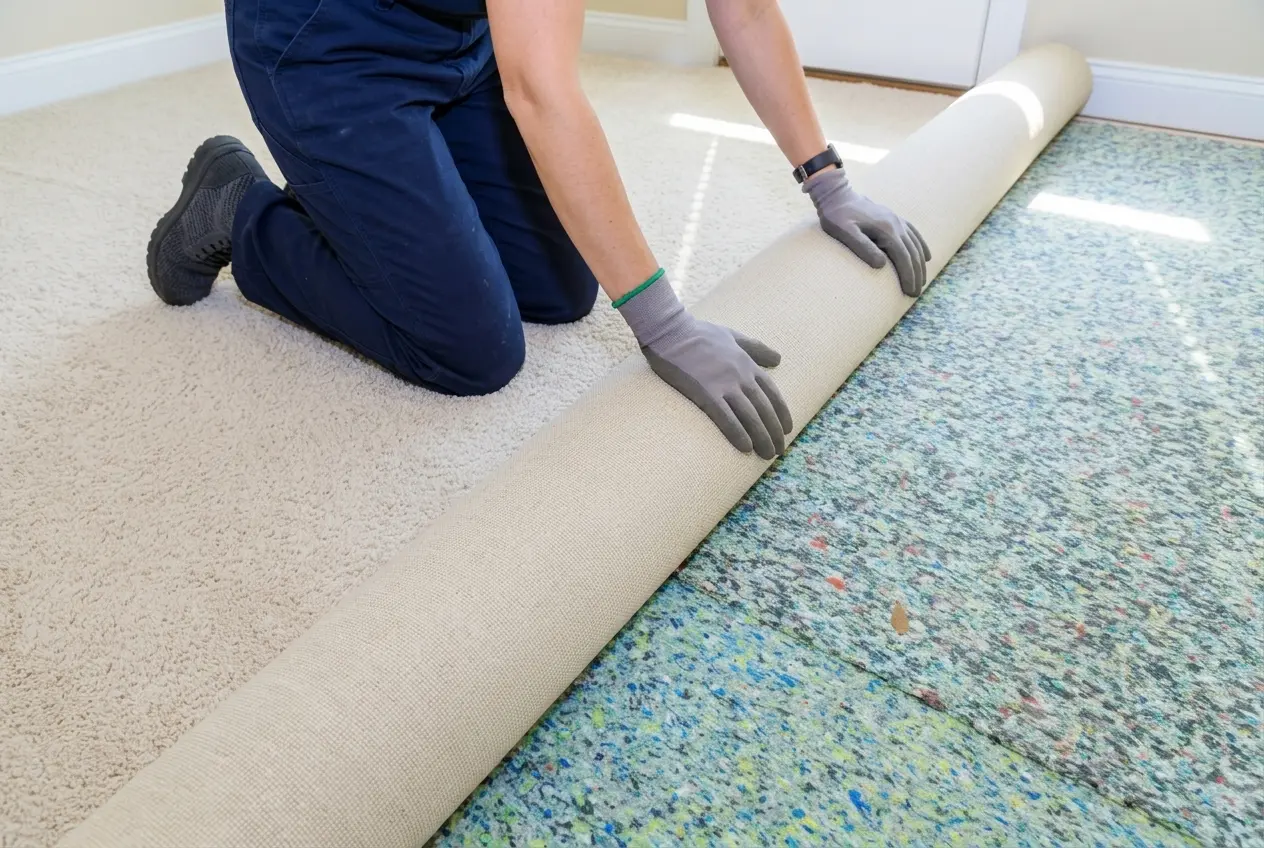
Carpet is manufactured in fixed-width rolls — most commonly 12 feet or 15 feet wide — and sold by the square yard. Unlike paint or tile, you cannot buy an exact rectangle that perfectly matches your room. You buy a length of carpet from the roll and trim the excess, which means waste is built into every installation. The roll-width constraint is the single biggest factor in how much carpet you order: a room that fits within the roll width uses one strip with no seams, while a wider room requires two or more strips and introduces seams.
Room dimensions are measured in feet, but carpet is priced and ordered in square yards — one square yard equals nine square feet. A 12 by 12 foot bedroom is 144 square feet, which converts to 16 square yards before waste. Add the standard 10 percent waste for trimming and offcuts, and the actual order is closer to 17.6 square yards. The calculator performs this conversion automatically and factors in the roll width to tell you exactly how many strips you need and where the seams will fall.
Beyond the carpet itself, a complete installation requires pad underneath, tackless strip around the perimeter, and seam tape if the room demands more than one strip. Each of these has its own unit of measure and pricing, and the calculator estimates all of them so you can budget the full material cost before calling an installer.
How the Carpet Calculation Works
The calculator converts your room dimensions into a material order that accounts for roll-width seams, waste, pad, and tackless strip. Here is the sequence:
- Measure the room — Enter length and width in any unit (feet, inches, meters, centimeters, or yards). The calculator converts everything to feet internally. If your room has an L-shape or includes a walk-in closet, add additional areas with the "+ Add Another Room" button.
- Convert to square yards — The net floor area in square feet is divided by 9 to get square yards. This is the baseline amount before waste and stair additions.
- Account for roll width and seams — The room width is compared against the selected roll width (12 or 15 feet). If the room fits within the roll, one strip covers it. If the room is wider, the calculator determines how many strips are needed and estimates the seam placement. Seams are unavoidable when the room exceeds the roll width, and the layout is planned to minimize waste.
- Add waste — The cutting allowance (default 10 percent) is added to each strip's ordered length. Patterned and textured carpets often need 15 percent because the pattern must be matched at seams. Diagonal installations or rooms with many corners push waste toward 20 percent.
- Calculate pad and materials — The pad area matches the carpet order and is cut as one or more lengths from a standard 15-foot-wide pad roll. Tackless strip is estimated from the room perimeter minus a 3-foot doorway opening per room, plus about 10 percent for cuts and joins. Stair area is calculated separately by measuring each step's tread and riser, then multiplied by the stair width — with optional extra for nosing overhang (the wrapped lip of each tread) and a mid-flight landing.
The math runs entirely in your browser as you type — nothing is uploaded, and the shareable link in the Share panel encodes your inputs so a colleague can open the exact same calculation.
Carpet Fiber Guide
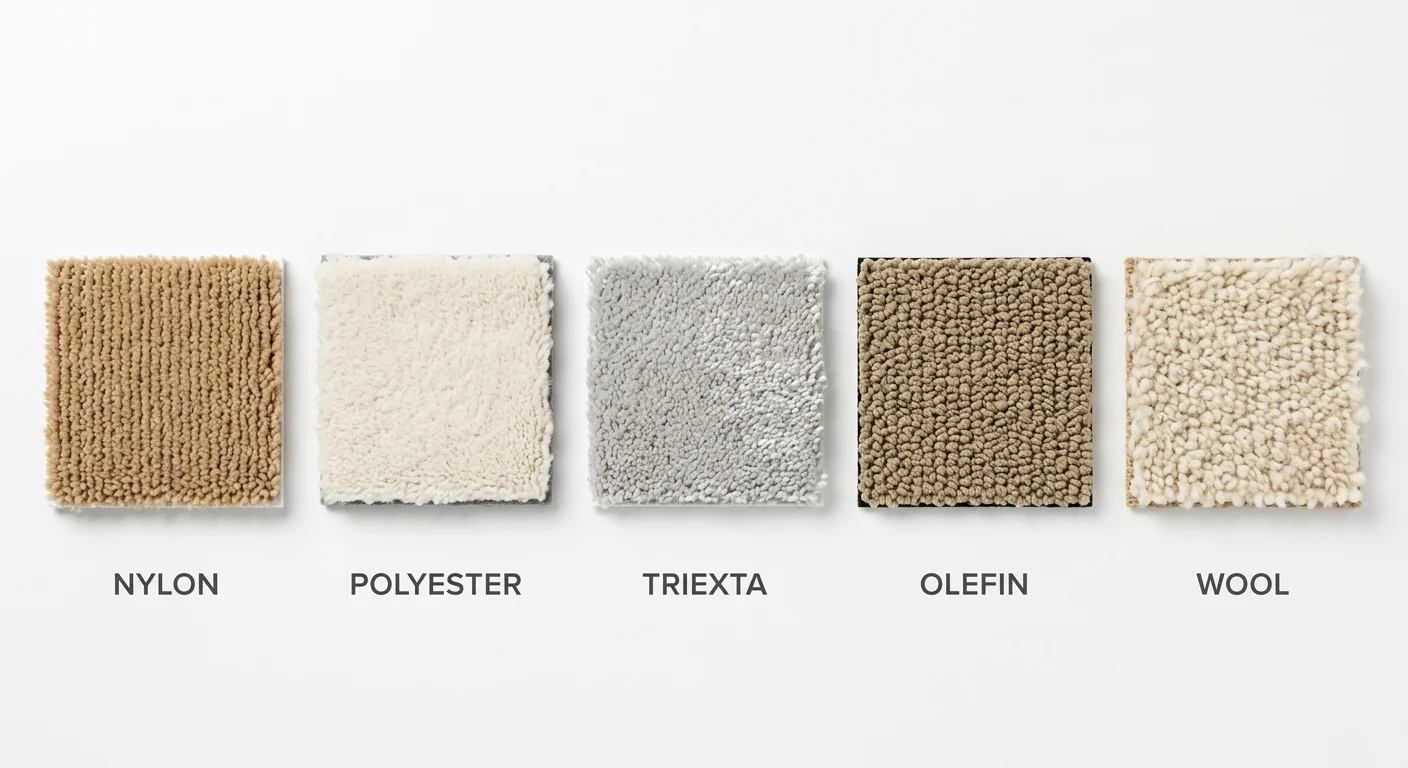
The fiber determines how carpet feels, how it wears, and how it handles stains. No single fiber is best at everything — the right choice depends on the room and the traffic it will see.
| Fiber | Resilience | Stain Resistance | Cost | Best For |
|---|---|---|---|---|
| Nylon | Excellent | Good (with treatment) | $$–$$$ | Stairs, hallways, high-traffic rooms |
| Polyester | Good | Excellent | $–$$ | Bedrooms, low-traffic living rooms |
| Triexta | Very Good | Excellent | $$ | Family rooms, kids' areas, pet households |
| Olefin | Fair | Very Good | $ | Basements, outdoor patios, moisture-prone areas |
| Wool | Excellent | Fair | $$$$ | Formal rooms, low-traffic elegance |
Nylon dominates the residential market for a reason: it has the best resilience of any synthetic fiber, meaning it bounces back after foot traffic rather than matting flat. Polyester is softer underfoot and inherently stain-resistant because it does not absorb liquids, but it crushes faster in traffic lanes. Triexta offers a middle ground with good resilience and excellent stain resistance at a moderate price point. Olefin resists moisture and mildew but crushes easily, so it is best reserved for low-pile commercial or outdoor installations. Wool is the premium natural option — beautiful and incredibly durable, but it costs several times more than synthetics and requires careful maintenance.
Carpet Pad Guide
The pad affects comfort, durability, and how long the carpet lasts. A pad that is too thin lets the carpet wear against the subfloor; too thick and the carpet stretches and wrinkles. Match the pad to the carpet type and the room's traffic level.
| Pad Type | Thickness | Density | Best For |
|---|---|---|---|
| Rebond 8lb | 7/16 in | 8 lb/ft³ | Most residential rooms, standard choice |
| Rebond 6lb | 3/8 in | 6 lb/ft³ | Low-traffic bedrooms, budget installations |
| Rebond 10lb | 1/2 in | 10 lb/ft³ | Stairs, hallways, heavy-traffic areas |
| Synthetic Fiber | 1/2 in | Varies | Moisture-prone areas, above-grade installations |
| Rubber | 1/4 in | Dense | Commercial carpet tile, flat-woven carpet |
Rebond pad — made from shredded foam bonded together — is the standard for residential broadloom carpet. The 8-pound density handles most rooms well; use 6-pound in bedrooms where comfort matters more than bounce-back, and 10-pound on stairs where the carpet takes the most abuse. Synthetic fiber pad works in basements or over concrete where moisture is a concern. Rubber pad is thin and rigid, designed for commercial carpet tile rather than residential stretched-in carpet.
Worked Example
Take a 12 by 14 foot bedroom on a 12-foot-wide roll with a 10 percent cutting allowance, Cut Pile nylon carpet at $30 per square yard, and a Rebond 8lb pad at $6 per square yard.
| Step | Calculation | Result |
|---|---|---|
| Floor area | 12 × 14 | 168 sq ft (18.67 sq yd) |
| Strip plan | ceil(14 ÷ 12) = 2 strips along the length, or ceil(12 ÷ 12) = 1 strip along the width — fewest strips wins | 1 strip × 12 ft × 14 ft |
| Ordered length | 14 ft × 1.10 allowance, rounded up to the inch | 15.42 ft |
| Carpet to order | 1 × 12 × 15.42 = 185 sq ft ÷ 9 | 20.56 sq yd |
| Seams | strips − 1 | None |
| Pad roll length | 185 sq ft ÷ 15 ft pad width | 13 linear ft |
| Carpet cost | 20.56 sq yd × $30 | $616.67 |
| Pad cost | 20.56 sq yd × $6 | $123.33 |
| Total material | $616.67 + $123.33 | $740.00 |
This is the roll-width effect in action. The same floor can be covered two ways on a 12-foot roll: two strips running the 12-foot length (2 × 12 × 12 = 288 sq ft before the allowance) or one strip running the 14-foot width (1 × 12 × 14 = 168 sq ft). Both cover the floor completely, but the single strip wins on price — with the allowance it orders 185 sq ft instead of 316.8 sq ft, and the room ends up with no seam. Note that upgrading to a 15-foot roll would not help here: you would pay for the full 15-foot width (1 × 15 × 15.42 = 231.3 sq ft, about 25.7 sq yd) even though the room is never more than 14 feet across.
Carpet Cost Benchmarks
Carpet is priced by the square yard, though some retailers quote per square foot (divide the square-yard price by 9 to compare). Material prices span a wide range by fiber and construction, and installation labor is almost always quoted separately.
| Grade | Typical Material Price | What You Get |
|---|---|---|
| Apartment grade | $9–$20 per sq yd ($1–$2.20 per sq ft) | Builder-flat polyester or olefin; cheap to replace, wears fast |
| Mid-range | $20–$40 per sq yd ($2.20–$4.45 per sq ft) | Nylon or triexta cut pile — the sweet spot for most homes |
| Premium synthetic | $40–$70 per sq yd ($4.45–$7.80 per sq ft) | Dense nylon, frieze, or branded triexta with stronger warranties |
| Wool / luxury | $70–$100+ per sq yd ($7.80+ per sq ft) | Natural wool or high-end designer broadloom |
Pad typically runs $0.90–$5.40 per square yard depending on density, and installation labor adds roughly $4.50–$18 per square yard depending on your market, stair count, and furniture moving. Patterned carpet can add pattern-match waste at seams, which the cutting allowance partially covers. For a budgeting shortcut, installed carpet in a typical bedroom lands around $25–$60 per square yard all-in — use the calculator above with your own prices for a firmer number.
Frequently Asked Questions
A 12 by 12 foot room is 144 square feet, which converts to 16 square yards. On a 12-foot-wide roll the roll spans one 12-foot side, so you order one strip 12 feet long plus a 10 percent cutting allowance — about 17.7 square yards, with no seams. If the room is 13 feet wide or more, the calculator plans a seam and adjusts the layout.
Divide the total square feet by 9. Carpet is manufactured and sold by the square yard, so a room measuring 180 square feet needs 180 divided by 9, which equals 20 square yards. The calculator does this conversion automatically and adds your waste percentage on top.
For a straightforward rectangular room with a single door, 10 percent is standard. Add 15 percent for rooms with alcoves, closets, or diagonal walls, and 20 percent for complex layouts with multiple corners or large obstructions. The waste covers offcuts from roll trimming, pattern matching on textured or patterned carpet, and trimming around door casings and vents.
Yes — carpet comes in fixed roll widths, typically 12 feet or 15 feet. If your room fits within the roll width, one length of carpet covers it with no seams. If the room is wider than the roll, the calculator plans a seam and the second strip, which may add waste. Choosing a 15-foot roll for a 13-foot-wide room covers the width in one piece, though the ordered length grows by the cutting allowance — so compare both options in the calculator before ordering.
Buy the same square yardage of pad as carpet — the pad goes under the full carpeted area. The pad quantity matches the carpet order, cut as one or more lengths off a standard 15-foot-wide pad roll. A standard 8-pound rebond pad is suitable for most residential rooms; use a denser 10-pound pad in high-traffic areas and hallways.
The Carpet and Rug Institute and most manufacturers recommend removing old carpet and pad before installing new carpet. Layering carpet on carpet traps moisture, compresses unevenly, and voids many warranties. The one exception is low-pile commercial carpet over a flat, well-adhered surface with power-stretched installation, but even then the subfloor condition must be verified.
Nylon is the most resilient fiber — it springs back underfoot and resists matting in traffic lanes, making it the best choice for busy homes and stairs. Polyester costs less and resists stains naturally, but it crushes faster in high-traffic areas. Triexta (PTT) splits the difference: good stain resistance and better resilience than polyester. For a living room with moderate traffic, polyester works well; for stairs and hallways, nylon or triexta is the better long-term investment.
Measure each step individually. A standard step has a tread (the horizontal part you step on) and a riser (the vertical face). For example, 13 steps with a 10-inch tread, a 7.5-inch riser, and a 36-inch-wide staircase work out to about 6.3 square yards before waste — add a little more for nosing overhang (the rounded lip that wraps over each tread) or a mid-flight landing, both of which the calculator can include. The calculator adds the full stair area to the room total so you order one continuous piece for both the room and the staircase.
References
- Carpet and Rug Institute (CRI), Carpet Installation Standard CRI-105, carpet-rug.org
- U.S. Department of Housing and Urban Development, Carpet Installation Guide — UM 72a, hud.gov
- Carpet and Rug Institute (CRI), Carpet Cushion Standards — CRI 104, carpet-rug.org
Disclaimer: The carpet calculator results on this page are estimates for planning purposes only. Actual carpet quantities vary with room irregularities, subfloor condition, pattern matching, seam placement, installer technique, and manufacturer specifications. Always verify against your carpet retailer's measurement and consult a qualified flooring installer.
Need a flooring installer for your project?
Get Free Estimates