
ON THIS PAGE:
Stair Anatomy for Carpet
Carpet does not see a staircase the way a carpenter does. A carpenter sees structure: stringers, treads, risers. A carpet layer sees a continuous strip of material that folds over the front of every step, drops down the face, and starts again on the next tread. That fold is the reason stair carpet is ordered in length rather than area.
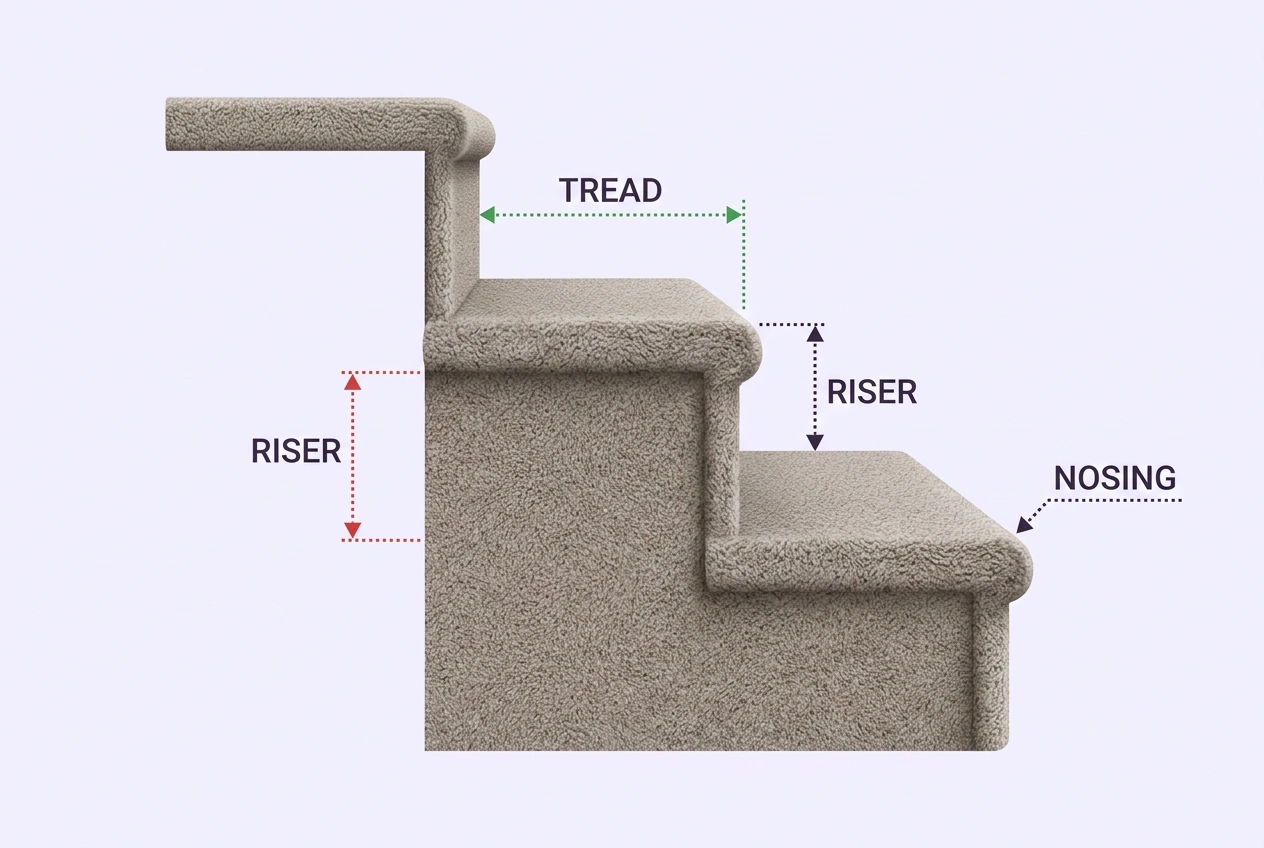
- Tread: the horizontal walking surface. For carpet, measure it from the back edge where it meets the riser above, forward to the outermost point of the nosing.
- Riser: the vertical face between two treads. Measure from the top of one tread to the top of the next, straight down the face.
- Nosing: the lip that overhangs the riser below. Carpet wraps over it, so add roughly 2 inches for the fold and the return tucked under the lip.
Add those three readings and you have the carpet length consumed by one step. A typical residential step lands between 18 and 24 inches. That number, multiplied by the count of steps, is the whole job in one line — which is why a single misread riser repeats itself a dozen times.
The measurement that does not repeat is width. It is taken once at the widest tread and applies to the entire flight, so a staircase that widens at the bottom is ordered to its widest point and trimmed everywhere else.
Width and Roll Width
Stair carpet comes off a roll of fixed width, and the staircase width decides which part of that roll you buy. Most residential carpet is woven or tufted at 12 feet wide, so a 3 foot staircase consumes a quarter of the roll and the rest is unusable for that job.
- Measure the widest tread, not the narrowest and not an average. Stairs widen at the bottom in older houses and at turns in newer ones.
- Measure wall to wall across the tread, from the finished surface on one side to the finished surface on the other, including any return or bullnose that gets covered.
- Add 2 to 4 inches for trimming. A 36 inch staircase is ordered at 38 to 40 inches of width so the edges can be squared up on site.
- Check for obstructions that narrow the clear width — a handrail bracket, a newel post, a radiator — and note them, because the cutter needs to know where the notches go.
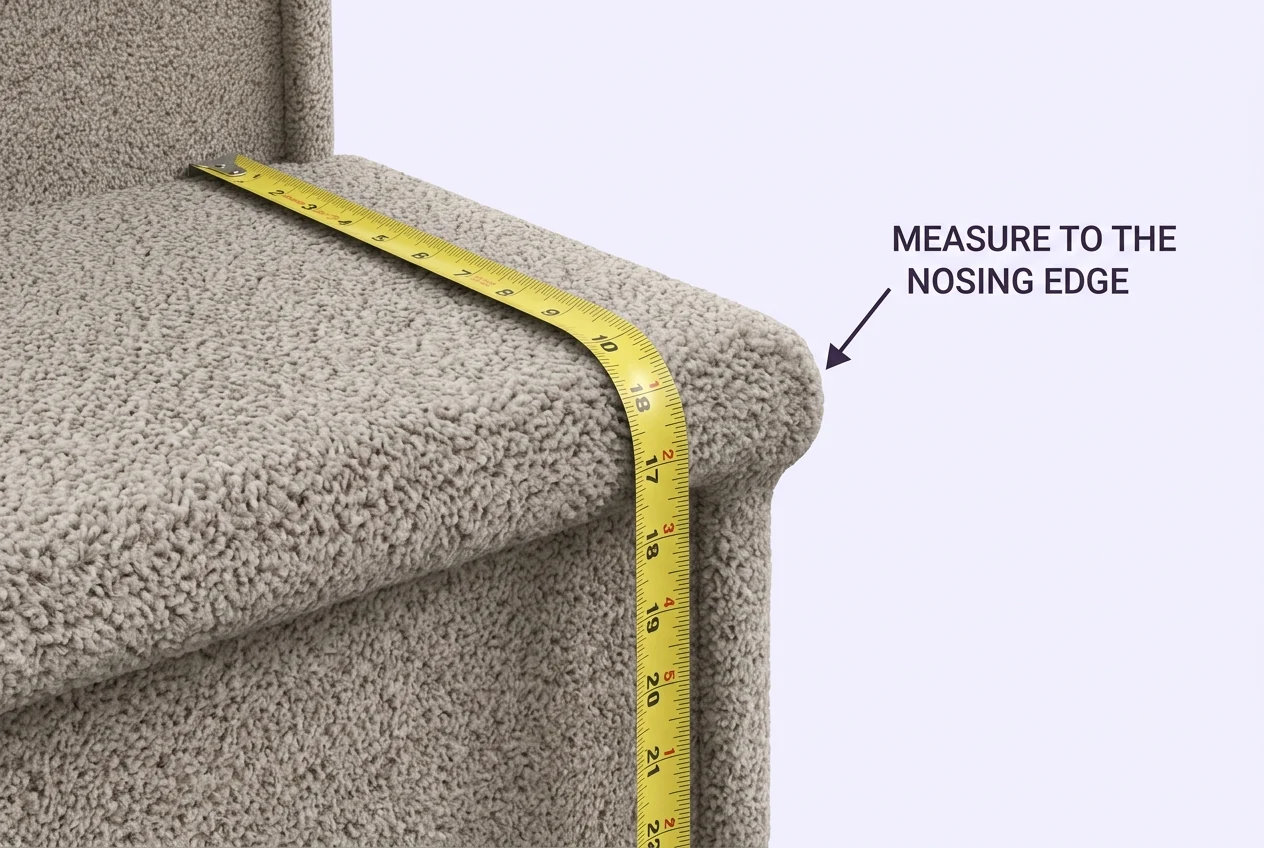
If the staircase is wider than the roll, the job needs a seam, and a seam on stairs is a decision rather than an accident. Place it away from the nosing line, where feet and vacuum cleaners work hardest, and tell the supplier so the material is cut with the seam allowance included. Commercial stairs and wide custom flights are the usual cases; a domestic flight above 11 feet clear is rare.
Pile direction matters as much as width. Carpet has a nap that reads lighter or darker depending on which way it faces, and on a staircase the direction is visible from the bottom of the flight. Decide the direction before cutting, and buy every length from the same roll and the same run.
Measuring Tread Depth
Tread depth is the single most commonly under-measured dimension on a staircase, because the part that carries the carpet is not the part you stand on.
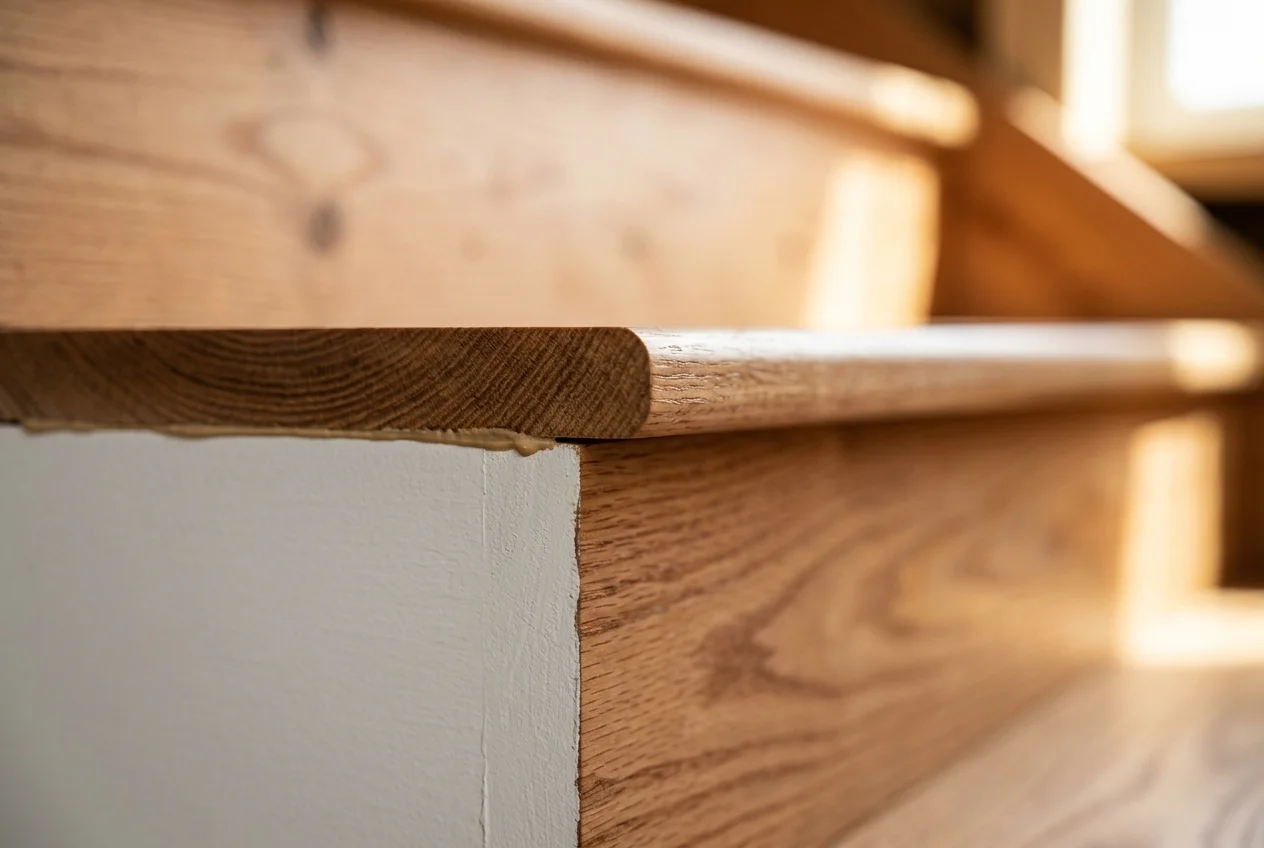
- Start at the back of the tread, where the tread surface meets the riser above it. Do not start at the wall behind — on a closed stair the tread runs under the riser above.
- Measure forward to the outer face of the nosing, the furthest point the lip projects. The round-over is included.
- Write the reading in inches and fractions, not decimal feet. Tread depths are small numbers and a conversion slip is easy.
- Measure the bottom tread separately. It is frequently deeper than the rest, sometimes by several inches, because it lands on a floor rather than on a riser.
- Check two or three treads in the middle of the run. If they disagree by more than a quarter inch, use the largest and note the variation.
A typical residential tread is 10 to 11 inches including the nosing. A deep historical tread of 12 or 13 inches adds 1 to 2 inches per step, which on a thirteen-step run is more than a foot of extra carpet — enough to matter when the roll is cut.
On a stair with a thick carpet already in place, measure with the old covering removed or subtract its thickness. Measuring over an existing carpet gives a tread depth that includes material which will not be there when the new one goes down.
Measuring Riser Height
The riser is the vertical face, and it is measured between tread surfaces rather than between structural parts. That distinction keeps the sum honest: tread plus riser then equals the total length of carpet on one step, with no overlap and no gap.
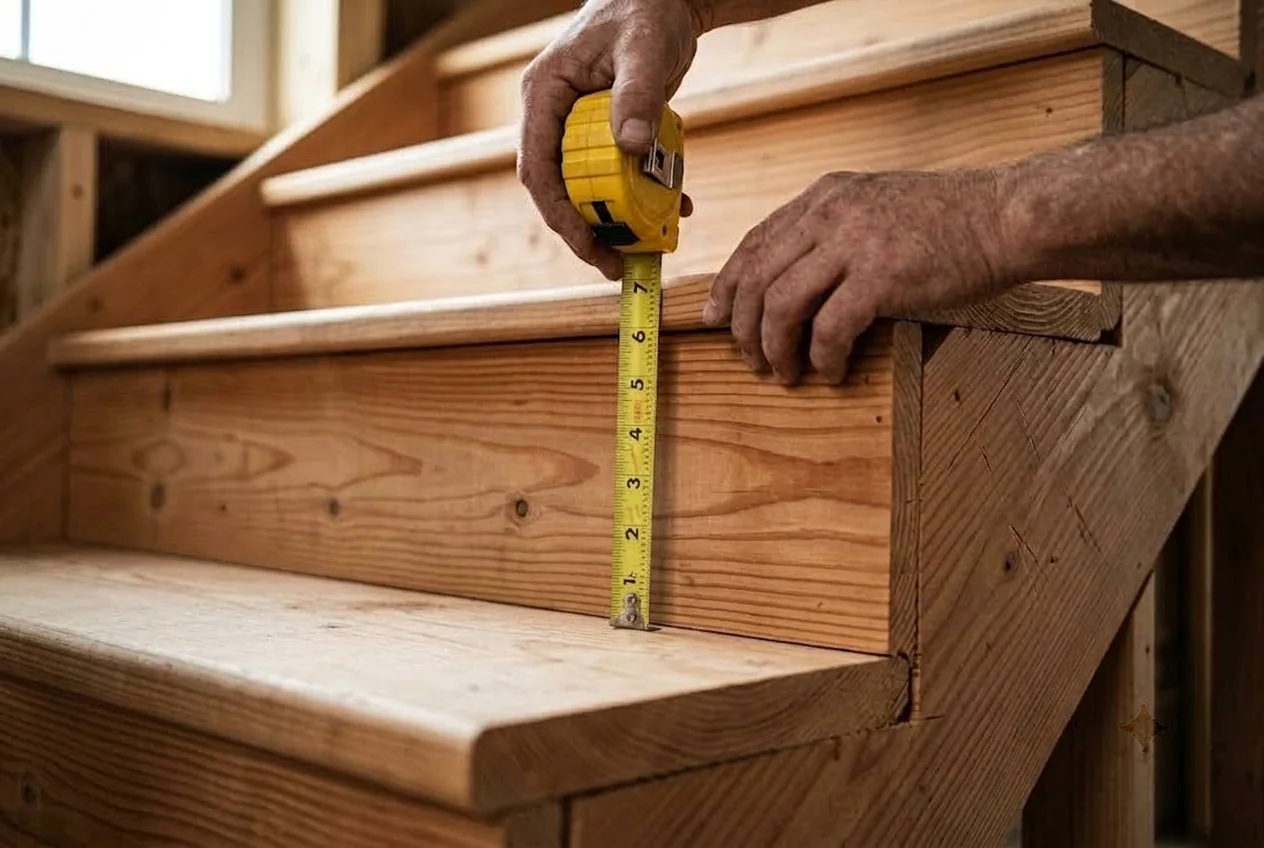
- Hook the tape on the top of one tread and read to the top of the tread above, holding the tape vertical against the riser face.
- Measure three risers in the run and use the tallest. Riser heights vary by a fraction of an inch in almost every staircase.
- Measure the bottom riser separately. It is often taller or shorter than the rest because it meets the floor rather than another tread.
- Note any riser that is not vertical, such as a raked or sloped face under a curved flight. A sloped face consumes more length than its vertical height.
Typical residential risers are 7 to 8 inches, which is also the range building codes require for safety. If your staircase has a riser above 8 inches or a tread below 10 inches, treat that as a code question rather than only a carpet question, and check the local requirement before covering it.
The finished thickness of the carpet and underlay adds to the riser height at every step. On a thick wool carpet over a dense pad that can be a quarter inch per step, which changes the geometry enough to be worth noting on the takeoff — especially when the old covering was thinner.
Runner Length Formula
Runner length is the total carpet needed to travel the flight from bottom to top, and it is the number the supplier actually cuts.
Per-step length = tread depth + riser height + nosing allowance
Runner length = per-step length × number of steps + landing lengths
| Dimension | Typical value | What it covers |
|---|---|---|
| Tread depth | 10–11 in | Walking surface plus the nosing lip |
| Riser height | 7–8 in | Vertical face between treads |
| Nosing allowance | 2 in | Fold over the lip and the return tucked beneath |
| Per-step length | 19–21 in | Total carpet consumed by one step |
| Landing | As measured | Its dimension along the direction of travel |
The old installer shorthand — plan on about 2 feet of carpet per stair — comes straight out of that table. It is a reasonable sanity check and a poor substitute for measuring, because a flight with 12 inch treads and 8 inch risers consumes 23 inches per step, and thirteen of those steps is a foot and a half more than the shorthand predicts.
Count the steps by walking up and counting treads, not risers, and confirm the two figures against each other. A flight of thirteen risers has twelve treads plus the top floor, and whether the floor counts as a step depends on where the carpet stops — which is exactly the kind of ambiguity that ruins an otherwise good takeoff.
Landings and Winders
Anything that is not a straight step needs its own line in the takeoff. Landings are rectangles, winders are wedges, and both break the tidy multiplication of the straight run.
- Landings: measure length and width as a rectangle. Carpet on a landing usually runs at 90 degrees to the flight, so it is normally cut as a separate piece and seamed at the edge of the landing rather than carried through.
- Winders: measure each one at its widest point, on the outer edge of the turn. The inner edge may be a few inches deep while the outer edge is 18 inches or more, and the difference is material.
- Curved flights: measure along the outer stringer, because that is where the carpet has to travel furthest. A curved flight consumes more length on the outside of the bend than on the inside.
- Multiple flights: treat each straight run as its own calculation, then add. Two runs that look identical often differ by a step.
Winders are the most wasteful part of any stair carpet job. A pie-shaped step forces the carpet to fan, which cannot be done without stretching and trimming, and the offcut from one winder rarely fits the next because the mirrored geometry reverses. Budget 15 to 20 percent on a winding staircase against 5 to 10 on a straight one.
Landings are the opposite: they are easy to measure and easy to forget. A 3 ft × 3 ft landing is 9 square feet of carpet that never appears in the runner total unless you add it deliberately. Walk the flight with the sketch and mark every horizontal surface, including the top landing if it is being covered in the same material.
Worked Example: 13 Steps and a Landing
A straight domestic staircase with thirteen steps, a 3 ft square landing at the top, and a carpet that comes on a 12 ft roll.
- Width: widest tread measures 37 in, so order 40 in of roll width for trimming
- Tread: 11 in from back edge to nosing lip
- Riser: 7.5 in from tread top to tread top
- Per-step length: 11 + 7.5 + 2 = 20.5 in
- Flight length: 13 × 20.5 = 266.5 in, or 22 ft 3 in
- Landing: 3 ft along the direction of travel
- Subtotal: 22 ft 3 in + 3 ft = 25 ft 3 in
- Waste at 8%: 25.25 × 1.08 = 27.3 ft, so order 28 ft of runner
The order is therefore one piece 12 ft wide by 28 ft long, cut down to 40 inches wide for the flight. That leaves a large remainder of the roll unused, which is normal: stair carpet is priced on the length you take, not on the width you use, and the leftover is why a stair job often costs more per square foot than a room.
Run the total through the Carpet Calculator if you want the price and the square-yard equivalent for comparison with a room quote, and use the Stair Calculator beforehand if you need to confirm the rise and run are within code before covering them.
Linear Feet, Square Yards, and Roll Width
Stair carpet quotes can arrive in three different units, and comparing them without converting is how a cheap quote turns out to be the expensive one.
| Unit | How it is derived | When it is used |
|---|---|---|
| Linear feet of runner | Runner length, at whatever width the roll supplies | Stairs only — the standard way a stair job is cut |
| Square feet | Runner length × roll width used | Comparing stair material with room material |
| Square yards | Square feet ÷ 9 | Room carpet pricing, broadloom quotes |
| Square yards of actual stair surface | Each tread and riser measured and summed | Working out how much of the roll is genuinely used |
The last row is the one that explains stair carpet economics. A 28 foot runner off a 12 foot roll contains 336 square feet of material, while the actual stair surface might be 70 square feet. The difference is not waste in the careless sense — it is the geometry of buying a fixed width for a narrow job. Knowing that number stops the shock at the quote and helps you decide whether a cheaper carpet at a higher waste is better value than an expensive one at the same waste.
For the conversion arithmetic itself, the Linear Feet Calculator handles the length side, and the Flooring Calculator converts area to boxes and cost if the landing is being covered in a hard floor rather than carpet.
Waste and Seam Planning
Waste on stairs is concentrated at the ends of the run and at every change of direction, not spread evenly across the flight.
| Stair configuration | Suggested waste | Why |
|---|---|---|
| Straight flight, one width, no landing | 5–8% | Square cuts at both ends only |
| Straight flight with one or two landings | 8–10% | Separate landing pieces and a seam |
| Flight with a bottom bullnose or wider first step | 10% | The bottom step is cut differently from the rest |
| L-shaped or U-shaped flight with a landing | 12–15% | Direction change and two independent runs |
| Winders or a curved flight | 15–20% | Fan-shaped pieces, mirrored offcuts, pile distortion |
| Patterned carpet with a repeat | Add the repeat | Pattern must align across every piece and the landing seam |
Seams are the other half of the allowance. A seam on a staircase should sit at the junction between the flight and the landing, or along the side of a tread where the pile direction hides it — never across the middle of a tread where feet land. On a patterned carpet, the seam also has to carry the pattern through, which can consume most of a repeat.
Two habits reduce waste without reducing the allowance. Cut the landing piece first, because it is the largest single rectangle and sets the remaining lengths. And keep the offcut from the widest tread: it is usually long enough to become the bottom step or a repair piece, and it matches by definition because it came from the same run.
Stair Types That Change the Math
Most of this guide assumes a closed straight flight, which is the common case. Four other configurations change the measurement rather than just the arithmetic.
- Open stairs: no riser boards, so the carpet wraps the tread and returns under the nosing. Per-step length drops by the riser height and rises by the return, and the underside may need a finish the carpet does not provide.
- Open-sided stairs with a bullnose: the tread projects past the stringer and is rounded at the end. The carpet has to wrap that end, so the width measured must include the projection.
- Spiral stairs: every tread is a winder, the outer edge is much deeper than the inner one, and the carpet is usually fitted as a series of separate pieces or a specially made runner. Expect the highest waste of any configuration.
- Stairs with a runner rather than full coverage: the carpet is a strip down the centre with the tread edges exposed and finished. The length calculation is identical, but the width is chosen for appearance rather than measured from the stair, and the exposed edges need binding.
The runner case catches people out because it looks like less work. A centred runner still consumes the full per-step length at every step, and the bound edges are a separate line item. The saving is in the carpet width, not in the length.
Recording the Stair Takeoff
A stair takeoff has more dimensions than a room of the same size, and fewer places to hide an error. Write it down in a fixed order so the numbers can be checked by someone else.
| Field | Example | Why it matters |
|---|---|---|
| Stair location and floors served | Main to first, front hall | Distinguishes two similar flights |
| Number of steps | 13 | The multiplier for everything else |
| Widest tread width | 37 in, order 40 in | Sets the roll width |
| Tread and riser readings | 11 in tread, 7.5 in riser | Auditable per-step length |
| Nosing allowance | 2 in | States the assumption explicitly |
| Landings and winders | 3 ft landing, two winders | The items most often lost |
| Runner length and waste | 25 ft 3 in at 8% → 28 ft | The number that gets ordered |
| Pile direction and seam plan | Pile down the flight, seam at landing | Settled before cutting, not during |
Photograph the tape in position on the tread and the riser before moving to the next step. A photograph answers the question "did that include the nosing?" faster than any note, and the question always comes up. The multi-room project guide covers keeping stair lengths alongside room areas when the whole house is being covered in one carpet.
Frequently Asked Questions
References
- Carpet and Rug Institute, Carpet Installation Standards — stair installation, power stretching, and seam placement, carpet-rug.org
- Federal Trade Commission, Buying Carpet: A Guide for Consumers — how carpet is measured and sold, including roll width and square yard pricing, consumer.ftc.gov
- International Code Council, International Residential Code R311.7 — stair tread depth, riser height, and landing requirements, iccsafe.org
- National Institute of Standards and Technology, NIST Handbook 44 — measurement units and conversion factors used in trade, nist.gov
- Occupational Safety and Health Administration, Stairways and Ladders: A Guide to OSHA Rules — stair geometry and covering practice on work sites, osha.gov
- U.S. Bureau of Labor Statistics, Occupational Employment and Wage Statistics — carpet and flooring installer wages by area, bls.gov/oes
Disclaimer: This guide explains how to measure a staircase for carpet ordering and installation planning. It is not a structural survey or a professional takeoff. Stair dimensions vary between properties and over time, and carpet is cut to the width and length the supplier supplies, so verify every tread, riser, and width on site and confirm roll width, pile direction, and return terms with your supplier before the material is cut.