
ON THIS PAGE:
What Each Number Really Means
Material cost is what a product costs at the counter, per unit: dollars per square foot of tile, per board of lumber, per sheet of drywall. It is the number you can touch, off one receipt. Installed cost is everything required for that product to be finished and in service: the same receipt, plus delivery, plus consumables, plus a crew's hours priced properly, plus the site overhead and indirect costs the job carries, plus — on professional quotes — margins.
Neither number is wrong. They answer different questions. Material cost answers what does the product cost? Installed cost answers what does the change to my building cost? Comparing quotes in the wrong base wastes hours: a $4.50 tag next to a $12 installed bid looks like an upcharge until you notice the bid includes 200 square feet of prep nobody priced at the counter.
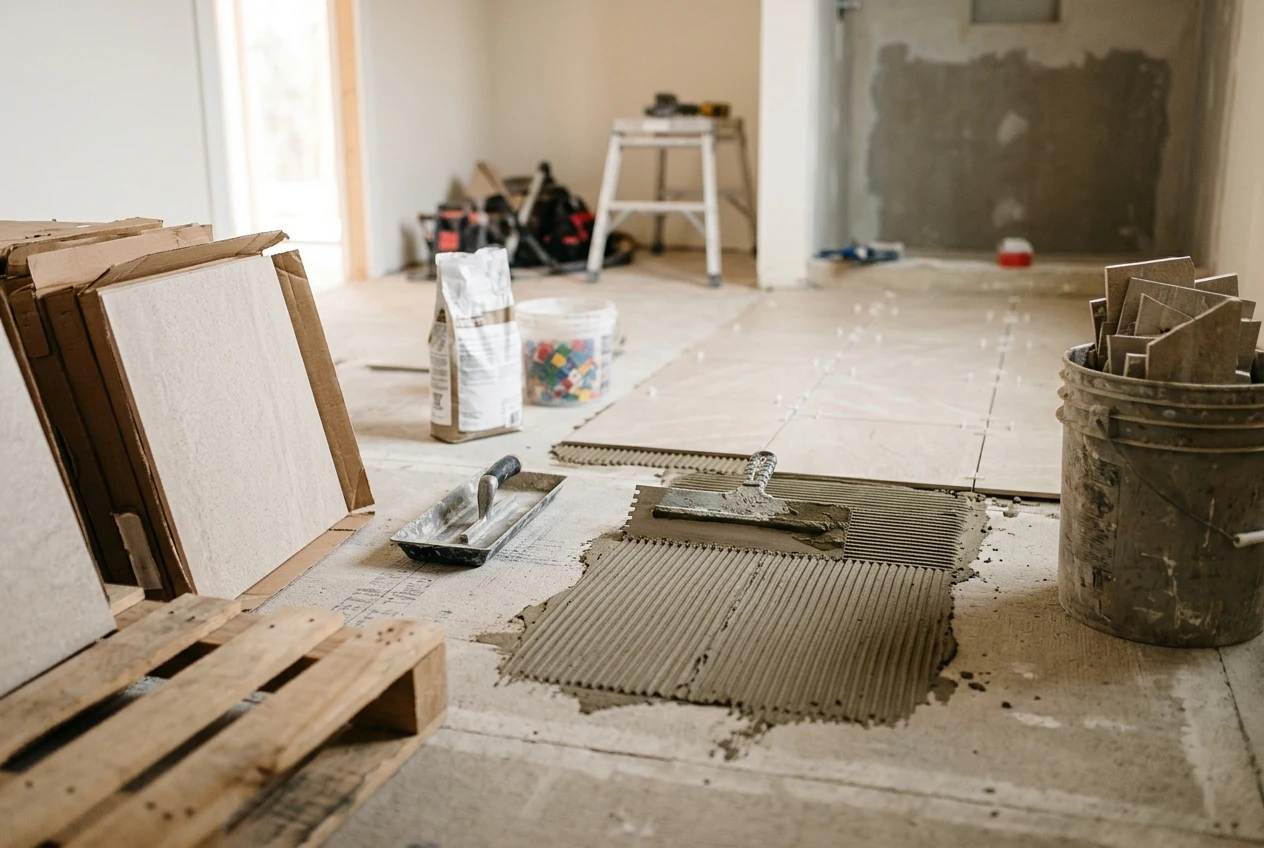
The rest of this guide walks each layer in turn — what installed cost includes, how the labor-to-material split moves by project and by trade, why an hour of labor never bills at its wage rate, and how overhead and profit turn a cost estimate into a price you can compare.
What's Included in Installed Cost
"Supplied and installed" or "installed per square foot" hides a stack of line items. Most installed quotes include all of these:
- Delivery and staging: freight charges and a fuel surcharge on palletized products; crew time to stage loads where work happens.
- Waste: nobody installs the exact measured footage. Cuts, breakage, and layout choices add 5–15% to the product quantity — a cost the tag never showed.
- Setting materials: mortar, thinset, grout, adhesive, underlayment, backer board, membrane, fasteners, tape, compound. On tile these companion materials often add 40–60% on top of the tile itself.
- Surface preparation: patching subfloor, cleaning substrate, layout chalk lines. Often 10–20% of the labor hours on finish trades.
- Labor, priced truthfully: not just wages — see the burden section below. This is typically the largest add on any labor-heavy product.
- Supervision: a foreman's share of time on a crew or the GC's site overhead.
- Site protection and cleanup: floor protection, dust barriers, end-of-day resets, haul-away of offcuts.
- Warranty: the callback margin — a real cost, quietly priced into every professional bid.
And usually not included, whatever the sales language implies:
- Permits — often paid by the owner separately; some trades price them in, most don't.
- Design and layout authority — pattern choices and engineering stay an owner/ designer cost.
- General conditions on large jobs — temp power, dumpsters, scaffolding are often broken out rather than buried in a per-unit rate.
- Owner-supplied materials — when you buy product and hire out the installation, labor-only quotes apply, and the material warranty and compatibility questions enter the picture.
The teardown side is an installed-cost exclusion people forget until day one: removal and disposal are commonly quoted per square foot or per load, and they never ride along inside an "installed" unit rate. Budget them separately on renovation work.
How the Split Runs by Project and Trade
A construction cost breakdown usually separates material, labor, and indirects before any markup. There is no single labor vs material cost rule — the labor to material cost ratio is a spectrum, set by how much of the job is hours versus product. Full residential new construction runs material-heavy; every finish touch-up runs labor-heavy. These bands are sanity-check benchmarks, not bid targets:
| Scope | Labor share | Material share | Why |
|---|---|---|---|
| New build, structural phase (foundation, framing, shell) | 25–40% | 50–65% | Concrete, lumber, trusses are purchased product; repetitive tasks build crew speed |
| Kitchen remodel | 50–65% | 30–45% | Cabinet sets are big ticket items, but plumbing, electrical, and demo trim the labor share up |
| Bathroom remodel | 60–75% | 25–40% | Small room, fussy waterproofing, tile hours, fixture resets |
| Basement finish | 70–80% | 20–30% | Framing walls and running systems in bulk to a raw box; nothing scattered carries much price |
| Whole-house interior paint | 75–85% | 15–25% | A gallon covers plenty; prep and climbing dominate |
The same spectrum holds within a single new build, line by line. Trades that sell hours price one way; trades that resell factory work price another:
| Trade / line item | Labor share of that line | Installed multiplier (installed ≈ × material tag) |
|---|---|---|
| Interior painting | 65–80% | ×8–×15 — paint is one of the cheapest tags per square foot |
| Tile work (field tile, wet areas) | 50–70% | ×2.2–×3 including backer and membrane |
| Drywall, hung and finished | 60–75% | ×2–×2.5 |
| Electrical rough-in + fixture set | 45–60% | varies with fixture grade |
| Plumbing rough-in + fixture set | 45–55% | varies with fixture grade |
| Wood framing | 35–50% | ×1.5–×2, lumber-price sensitive |
| Asphalt shingle roofing | 30–45% | ×1.5–×2 including underlayment |
| Factory-built unit sets (cabinet install, appliance set, pre-hung doors) | 10–20% | ×1.1–×1.3 — labor just plumbs in what a factory built |
Why $40/hr Labor Isn't $40/hr
The single most common error in DIY-installed-cost math is multiplying a wage by hours and calling it labor cost. Wages are only about 70–75% of what an hour of employment costs. Payroll taxes, workers' comp, and benefits ride on top of every base dollar:
- Payroll taxes: Social Security and Medicare alone total 7.65% of gross wages from the employer side, plus federal and state unemployment taxes.
- Workers' compensation: the swing factor — ceiling for low-risk clerical rates near 2%, but 15%+ for roofing and structural ironwork trades, and each company's actual rate moves with its claims history.
- Benefits: health insurance, retirement, paid leave — commonly another 7–15% of wages.
- Small tools, PPE, and travel: the unglamorous per-hour costs of having people on site at all.
Federal wage data bears this out: across private industry, benefits alone run about 30% of total compensation, and construction runs higher than the typical private employer. Applied to base wages, expect a burden of 25–40% — 30% is a fair planning figure per trade until you can verify a company's numbers.
This is also why two bids built from the same hour count can print different hours: a contractor who bills with burden included shows a higher wage line but a more honest total. When a homeowner multiplies a bare wage by hours to price labor, they understate true labor cost by a quarter to two-fifths — and own the tax and comp exposure themselves if they self-perform.
Direct vs Indirect Costs
One more split surprises people on fast bids: even labor and materials on their own do not cover everything on site. The industry divides costs by whether they end up in the finished building or support the work:
| Direct costs | Indirect costs | |
|---|---|---|
| Definition | Ends up in the finished building | Supports the work; never becomes part of it |
| Labor example | Crew hours setting the tile | Superintendent, estimator, safety meetings |
| Material example | Tile, thinset, grout, backer board | Dumpster, floor protection, temp power, saw rental |
| Tracked against | A cost code for that scope | The whole job or the whole yard |
| Share of job cost | 75–85% | 15–25% |
Small single-trade jobs roll some indirects into the unit rate, but they never disappear — they just price invisibly. If a half-day trip minimum bills the same as the measured hours, dumpster rental, travel time, and setup are the usual answer.
How to Estimate Labor from Material Cost
Two honest ways run this estimate, and a shortcut every bid review uses:
Method 1 — hours first (the honest way)
Take the trade's installed production rate, multiply hours by a burdened wage, and keep product prep separate:
- Coverage rates are the real estimating unit: one tile setter fits roughly 100 square feet of field tile in an 8–14 hour day (call it 10; complex layouts and wet areas take longer), one painter covers about 350–400 square feet of wall in a few hours per coat, one laminate hanger covers a mid-size bedroom in half a day.
- Burdened wage: base wage × 1.3 (see the burden section). Say $32/hr base → $41.60/hr all-in.
- Prep factor: busy rooms, cuts, and moisture work routinely add hours — 10–25% on congested sites is normal.
Method 2 — ratio shortcut (the sanity check)
Use the multipliers from the trade table above, but know what each hides: installed ≈ ×1.8–2.2 material for floating floors, ×2–2.5 for nail-down hardwood, ×2.2–3 for tile, ×8–15 for paint. Ratios are excellent for catching a bad quote and terrible for pinning one down. When a plumber's fixture quote prices a $300 faucet at $580 installed, that ×1.9 is in relation to a prefabricated unit — normal. A painter quoting ×15 is equally normal. The ratio scales by trade, which is precisely why it fails as a cross-check: compare like trades to like trades, then look at hours behind the outliers.

From Cost to Price: Overhead and Profit
Everything above this line is cost — what the work takes to perform. What a contractor charges is price, and the difference is two layers that fix nothing but keep the business alive:
- Overhead (about 10–20% of revenue): vehicle fleet and fuel, insurance and license fees, tools and software, bookkeeping, permits to run a legal business. Spread across jobs, not caused by any one of them.
- Profit (10–18% margin on most bids): the return for risk, warranty work, slow months, and capital. Small service calls reputedly carry 25–35% because per-hour overhead is high; large new builds carry 10–18% because volume is bigger and competition is fiercer.
The traditional benchmark — 10% overhead plus 10% profit — still shows up in insurance repair work, but it has been under pressure for decades in most trades, and restoration contractors chase that level at their own risk. Healthy commercial contractors post gross margins near 20% and net margins near 5–12% depending on sector; single-family builders average around 9% net in good years.
Worked Example: 200 sq ft of Tile
A 200-square-foot wet-area floor job in mid-range porcelain — material tag, delivery, labor, indirects, and markup, one stack:
- Material tag: $4.50/sq ft × 200 sq ft = $900 (the number people budget for)
- Cut waste at 10%: allow 220 sq ft → $990 material
- Setting materials: backer board 330 × $1.00 = $330; waterproofing membrane 220 × $1.00 = $220; mortar, grout, spacers $180 → $730
- Material delivered, on site: $990 + $730 + delivery $60 = $1,780 — already more than 1.5× the tag before a hand touches anything
- Labor: 22 setter-hours × $32 base × 1.35 burden = $950; 6 helper-hours × $20 × 1.35 = $162 → $1,112
- Indirects: dumpster share, floor protection, saw rental: $180
- Total direct + indirect cost: $1,780 + $1,112 + $180 = $3,072
- Overhead + profit (15% margin): $3,072 ÷ 0.85 = $3,614 bid → $18.07/sq ft installed
Walk the ladder: the $4.50 tag became $8.90 per square foot on site (materials in place, no labor), then $18.07 installed. Tile's installed price landed at about ×2.0 the delivered material number and ×4 the bare tag — inside the band from our trade table. Every layer in between is legit, budgetable, and part of the bid that arrives before yours does.
A self-performing owner swapping out the last three lines skips labor and margin, but not the waste, setting materials, or the tools — which is why DIY installed cost lands closest to the "materials on site" line, and why even labor-only trades quote a trip minimum.
Where the Gap Grows or Shrinks
- Grows with design complexity. Diagonal sets, patterns, borders, and minute-of-arc layouts push hours up — multipliers of 1.3–2× on the labor line are normal for decorative work.
- Grows on small jobs. Fixed lists — travel, setup, cleanup, minimums — price the same whether the room is 60 or 600 square feet. Per-square-foot costs climb fastest on the smallest jobs.
- Grows where prep hides. Wet areas and subfloor repairs frequently price 10–30% extra once tear-out reveals the deck.
- Shrinks with prefab product. Factory-assembled units (cabinet sets, tub surrounds, pre-hung doors, LVP) arrive ready-to-set — labor shares as low as 10–20% on those lines.
- Shrinks with repetition and crew experience. A straight-lay floor in a large room is the cheapest installation any trade sells; small cut-up rooms pay a premium per square foot.
- Never fully shrinks. Even a labor-free price still carries waste, setting materials, and delivery. Only the tag itself is truly optional.
Frequently Asked Questions
References
- U.S. Bureau of Labor Statistics, "Employer Costs for Employee Compensation" — wages vs benefits shares of total compensation, bls.gov/ecec
- National Association of Home Builders (NAHB), "Cost of Constructing a Home" — construction stage cost breakdowns, nahb.org
- Construction Financial Management Association (CFMA), Financial Survey — contractor gross and net margin benchmarks, cfma.org
- Internal Revenue Service, Publication 15 (Circular E), Employer's Tax Guide — Social Security, Medicare, and federal unemployment rates, irs.gov
- U.S. Bureau of Labor Statistics, Occupational Employment and Wage Statistics — wage levels by construction trade and region, bls.gov/oes
- Gordian, Construction Cost Data — unit-cost and installation-rate reference for construction estimating, gordian.com
- American Society of Professional Estimators, Estimating Standards and Best Practices, aspenational.org
Disclaimer: This guide provides general educational information about installed cost versus material cost, labor-to-material ratios, labor burden, direct and indirect costs, and contractor overhead and profit, and is not cost accounting, tax, engineering, or contracting advice. Ratios, burden factors, and margin ranges cited here are mainstream estimating benchmarks — actual splits and prices vary by trade, region, project type, wage and workers' compensation rates, and market conditions, and they change over time. Verify wage, payroll, and insurance figures against current federal and state sources, and confirm quantities and quotes with your contractor, estimator, or supplier before finalizing a budget.