
ON THIS PAGE:
What Each One Is
Both are floating plank products with a printed wood image, and both install with a click-lock edge. The cores are different materials with different behaviours, and that difference cascades into everything else.
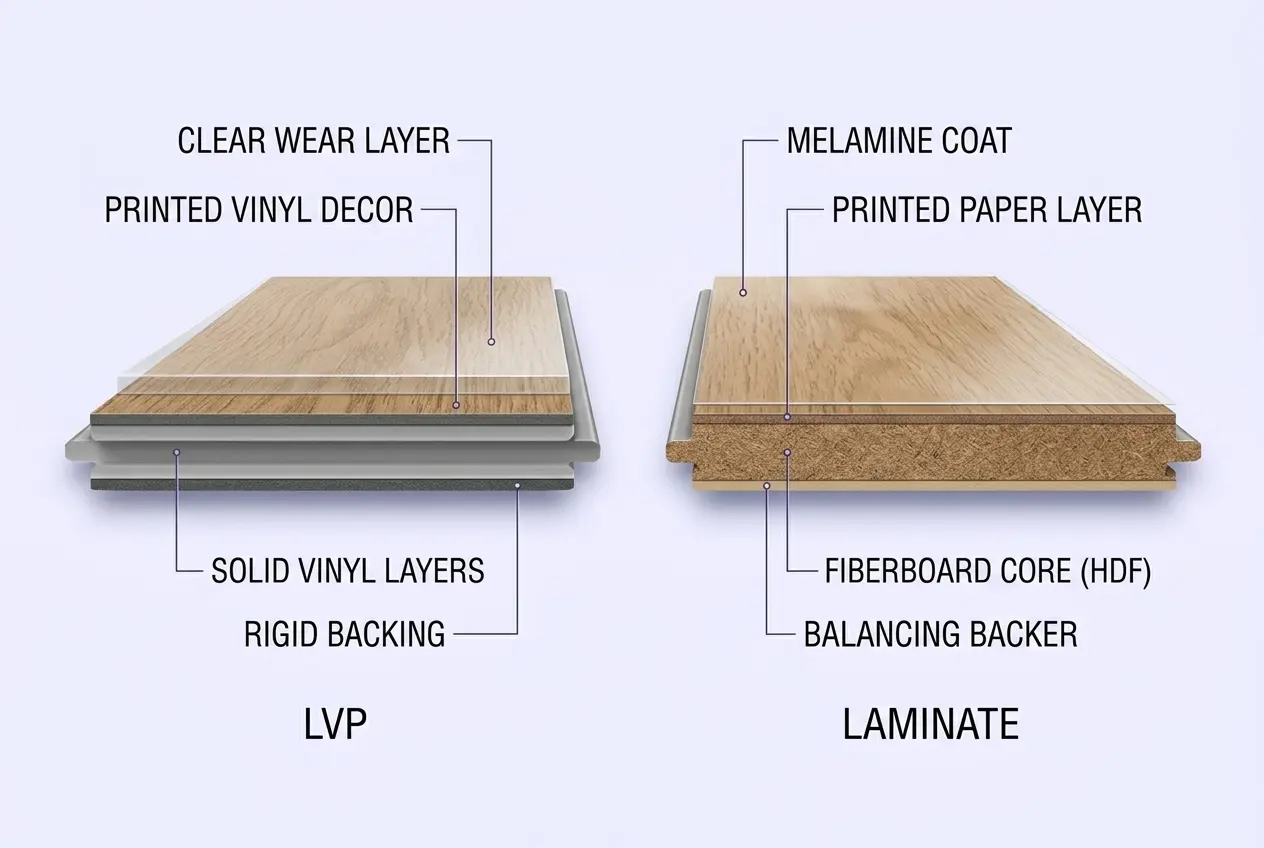
- Laminate is a high-density fiberboard core carrying a printed paper layer, sealed under a melamine wear coat. In effect, a very tough photograph bonded to engineered board.
- Vinyl plank (LVP) is PVC through and through: a vinyl core, a printed vinyl film, and a clear vinyl wear layer. Rigid-core versions use stone powder (SPC) or a foamed core (WPC).
- What that means in practice: fiberboard absorbs water and swells; plastic does not. Fiberboard is denser and feels firmer; vinyl is softer and quieter. Fiberboard takes a harder clear coat; vinyl's durability lives in its wear-layer thickness.
The Water Question
This decides most households, so it goes first.
- Laminate plus standing water equals swelling. The fiberboard core absorbs water at seams and edges, planks peak at the joints, and they never flatten again. The failure is rarely dramatic — it is one appliance leak, one week of tracked-in snow at the door, or one overflowing plant.
- Vinyl shrugs water off. Spills sit on the surface until wiped. Waterproof products are rated for bathrooms, basements, and mudrooms, and the subfloor rather than the floor becomes the moisture concern. The underlayment guide covers that side.
- "Water-resistant" laminate exists, and better edge sealants genuinely buy 24 to 72 hours of protection. That is enough for a mopped spill and not enough for a washing-machine hose.
- The subfloor still matters. Vinyl is waterproof, not a waterproofing system. Water that reaches the subfloor through a seam or around a toilet still causes damage below the floor.
If the room has any realistic chance of standing water — kitchens with dishwashers, entry doors to the outside, laundry rooms, baths, basements — vinyl is the rational choice. In bedrooms and living rooms where water never appears, the argument disappears, and the decision moves to feel, sound, and price.
Side-by-Side Comparison
| Factor | Laminate | LVP / rigid-core vinyl |
|---|---|---|
| Water resistance | Spills fine if wiped; standing water swells the core | Waterproof in most products, core included |
| Thickness | 8–12 mm; firmer underfoot | 4–8 mm; more give |
| Scratch resistance | Very good melamine coat (AC3–AC5) | Good; scales with wear layer (6–20 mil) |
| Pet claws | AC4 or better for large dogs | 12 mil or better for large dogs |
| Sound | Hollow click unless padded | Quieter; often ships with attached pad |
| Repair | Plank swap possible, but water damage spreads | Individual plank swap is straightforward |
| Sunlight | Good modern fade ratings | Good; cheap vinyls fade faster |
| Radiant heat | Usually approved; check the product | Usually approved; surface capped near 85°F |
| Material cost | $1–$4 / sq ft | $2–$5 / sq ft |
| Installed cost | $4–$9 / sq ft | $5–$11 / sq ft |
In dry rooms, durability is a tie decided by product grade rather than category. Read the specification plate: the AC rating for laminate and the wear-layer mils for vinyl. Those two numbers predict service life better than anything printed on the front of the box.
Reading the Spec Plate
Two numbers carry most of the quality signal, and both are usually printed on the end of the carton.
| Rating | Applies to | What it means |
|---|---|---|
| AC1–AC2 | Laminate | Light residential traffic; bedrooms only |
| AC3 | Laminate | General domestic traffic; the common baseline |
| AC4 | Laminate | Heavier residential and light commercial; dogs and entries |
| AC5 | Laminate | Commercial-grade; rarely needed at home |
| 6–8 mil | Vinyl | Light traffic, rentals, low-use rooms |
| 12 mil | Vinyl | Normal residential with pets; the practical minimum |
| 20 mil | Vinyl | Heavy residential and light commercial |
| 28–40 mil | Vinyl | Commercial; unnecessary in a house |
Thickness is not the same as durability. A 12 mm laminate and a 10 mm laminate with the same AC rating will wear similarly; the extra thickness buys stiffness and sound rather than scratch resistance. Likewise, a 6 mm vinyl with a 20 mil wear layer will outlast a 8 mm vinyl with a 6 mil layer, because the wear layer is the surface that takes the traffic.
Two further specifications matter on a slab: whether the product allows installation below grade, and whether the attached pad is rated as a vapor barrier. Both are printed in the installation instructions rather than the marketing copy.
Feel, Sound, and Comfort
- Underfoot firmness: laminate's thicker core flexes less and reads more like nailed hardwood. Rigid-core vinyl narrows the gap; flexible WPC feels softest of all.
- Sound: both need underlayment to sound solid. Vinyl is naturally quieter and warmer; laminate without a good pad can drum underfoot. Upstairs rooms favour vinyl, or laminate plus an acoustic pad.
- Temperature: vinyl feels cooler and slightly damp in winter; laminate feels more neutral. Over radiant heat, check the product rating — vinyl is usually capped around 85°F surface temperature.
- Dents: high heels and heavy furniture mark both. Fiberboard dents with little rebound; vinyl can sometimes recover minor marks.
If you have never walked on a rigid-core vinyl floor, do it before buying. The difference between a 4 mm and an 8 mm core is more obvious underfoot than any specification suggests, and it is the reason two products with identical ratings can feel like different categories.
Which Floor for Which Room
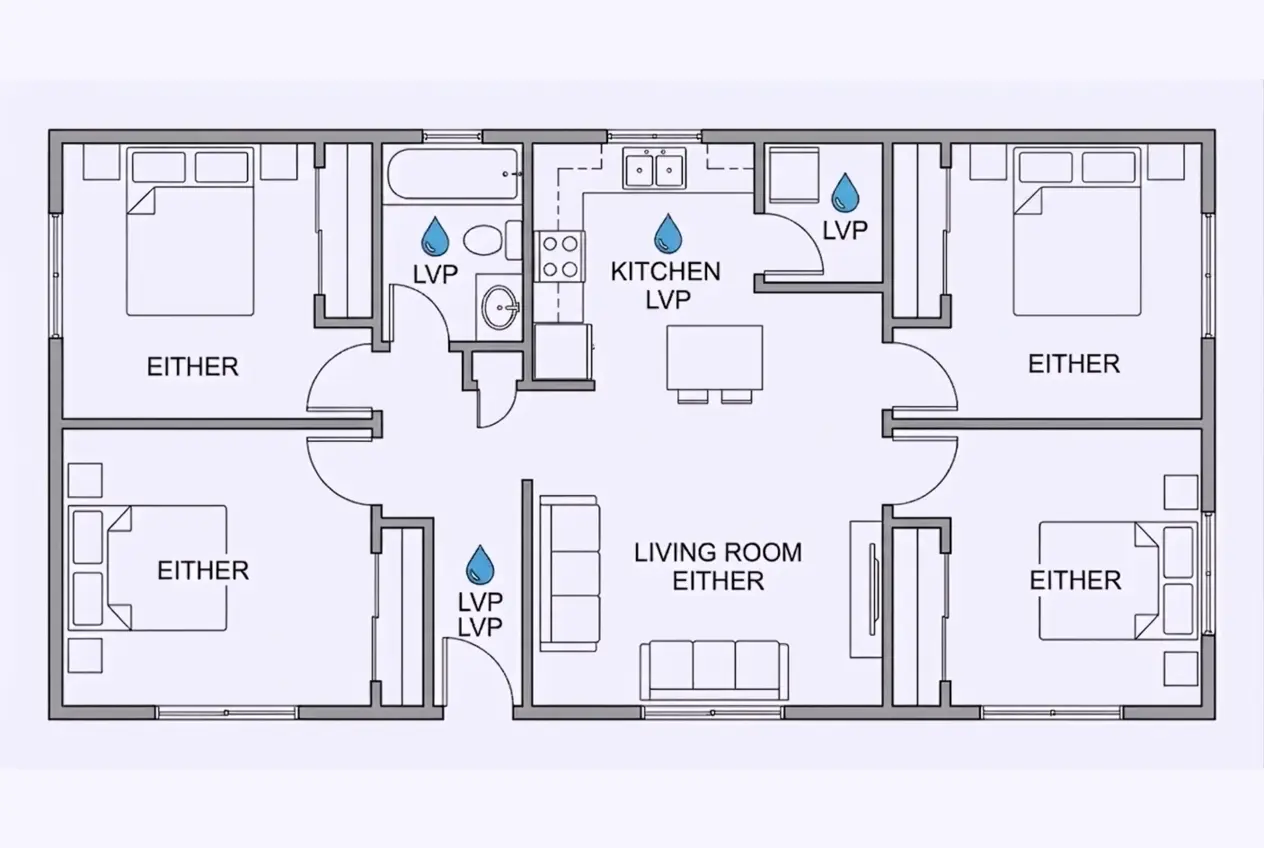
| Room | Recommendation | Why |
|---|---|---|
| Bathroom, laundry, mudroom | Vinyl, without hesitation | Water is a when, not an if |
| Basement | Vinyl over a tested slab | Slab moisture and the risk of a future leak |
| Kitchen | Vinyl for most households | Dishwasher and sink supply lines fail quietly |
| Living and dining rooms | Either | Dry room; decide on feel, sound, and budget |
| Hallways and entries | Either, favouring vinyl | Tracked-in water and grit |
| Bedrooms | Either | Laminate's firmer step; vinyl's quiet |
| Sunroom or sun-exposed room | Either with a UV warranty | Cheap vinyl fades under direct sun |
A common and sensible approach is one product through the whole main floor: vinyl in the kitchen, hall, and entry, continuing into the living room so the space reads as one surface, with laminate or carpet in the bedrooms. Continuous flooring hides transitions and makes small rooms look larger. The transitions guide covers what happens where the materials do meet.
Cost and Value
| Line item | Laminate | Rigid-core vinyl |
|---|---|---|
| Material | $1.00–$4.00 / sq ft | $2.00–$5.00 / sq ft |
| Underlayment | $0.20–$0.70 / sq ft (usually separate) | $0–$0.50 / sq ft (often attached) |
| Installation labour | $2.50–$5.00 / sq ft | $2.50–$6.00 / sq ft |
| Typical installed total | $4.00–$9.00 / sq ft | $5.00–$11.00 / sq ft |
| Expected life | 15–25 years in dry rooms | 15–25 years, longer in wet rooms than laminate |
Vinyl's price premium is largely the waterproof core and the attached pad, and it earns that premium in any room with plumbing. In a dry bedroom the premium buys comfort and quiet rather than durability, and laminate is the better value at the low end.
Watch for the grade trap in both categories: a $1.50 vinyl plank and a $4.00 vinyl plank are not the same product, and neither are two laminates at opposite ends of the shelf. The cheap end of either category wears through its printed layer, chips at the joints, and fades.
Pets, Sunlight, and Real Damage
- Dog claws: the wear layer takes the scratching, so a 12 mil vinyl or AC4 laminate is the minimum for a large dog. Grit at the door is worse than nails; a mat at every exterior door extends the life of either floor.
- Cat litter and accidents: this is where vinyl wins outright. Urine left on a laminate seam swells the core and the damage spreads along the joint. On vinyl it sits on the surface.
- Dropped objects: laminate's hard melamine surface can chip under a heavy impact, and a chipped corner is difficult to disguise. Vinyl dents instead of chipping and often recovers.
- Sunlight: both categories are far better than they were a decade ago, but thin vinyl in a sun-baked room can chalk or shift tone. Close blinds at peak hours and choose a product with an explicit fade warranty.
- Furniture legs: felt pads on every leg, and wide cups under heavy pieces. A 200-pound bookcase on four small feet will dent any floating floor.
Installation and Repair
Both are floating click-lock floors installed over a flat substrate, so the installation sequence is nearly identical: acclimate, check flatness, lay the underlayment, and work out of the room. The differences are in the details.
| Task | Laminate | Rigid-core vinyl |
|---|---|---|
| Cutting | Circular saw or jigsaw; fiberboard dust is fine and heavy | Utility knife scoring or saw; plastic chips and curls |
| Joint seating | Tap with a block; joints are stiff when new | Often press-fit; cold planks fight the joint |
| Acclimation | 2–3 days; humidity matters | 2–3 days; temperature matters more |
| Plank replacement | Possible from the nearest wall, but a damaged core usually means a field replacement | Easier; a single plank can often be lifted and replaced |
| Water damage | Spreads along seams; often a full-room replacement | Dries on the surface; a wet subfloor is the real issue |
In both cases the substrate decides the outcome. A floor that is not flat makes click joints flex, and flexing joints crack regardless of the material above them. The acclimation and subfloor prep guide covers the tolerance checks and the repair sequence.
Worked Example: 500 Square Feet
A 500-square-foot main floor — kitchen, hall, living room, and a small bath — with one continuous product. Two quotes, same installer, same 10 percent waste allowance.
- Laminate at $2.80 per sq ft plus a $0.45 pad: material 550 sq ft × $3.25 = $1,788; labour at $3.50 per sq ft on 500 sq ft = $1,750; total $3,538, or $7.08 per sq ft.
- Rigid-core vinyl at $3.60 per sq ft with an attached pad: material 550 sq ft × $3.60 = $1,980; labour at $3.75 per sq ft = $1,875; total $3,855, or $7.71 per sq ft.
- Difference: about $317, or 9 percent, for a floor that can survive the bathroom and the dishwasher.
Nine percent is the usual gap on a mid-grade job. The laminate is the better buy if the bath and kitchen were excluded; with them included, the vinyl premium is cheaper than replacing a swollen laminate floor in two years. Run your own areas through the Flooring Calculator before comparing quotes, because the labour line usually moves more than the material line does.
Frequently Asked Questions
References
- North American Laminate Flooring Association, Performance Standards and AC Ratings — abrasion classes and residential use, nalfa.com
- Resilient Floor Covering Institute, Vinyl Flooring Wear Layer and Performance Guidance — mil ratings and traffic classification, rfci.com
- National Wood Flooring Association, Installation Guidelines — acclimation and substrate tolerance for floating floors, nwfa.org
- ASTM International, F1700 Standard Specification for Solid Vinyl Floor Tile and related resilient flooring standards, astm.org
- U.S. Environmental Protection Agency, Indoor Air Quality: Flooring — emissions and ventilation during installation, epa.gov
- U.S. Bureau of Labor Statistics, Occupational Employment and Wage Statistics — flooring installer wages by state and metro area, bls.gov/oes
Disclaimer: This guide compares laminate and vinyl plank flooring for general planning. It is not a product recommendation, installation specification, or warranty statement. Performance depends on the specific product grade, wear layer, substrate condition, climate, and installation quality, and manufacturer warranties vary in what they cover and exclude. Read the installation instructions and warranty terms for the product you are considering before purchase.